


Reports: Oleshky Residents Risk Mined Roads for Food
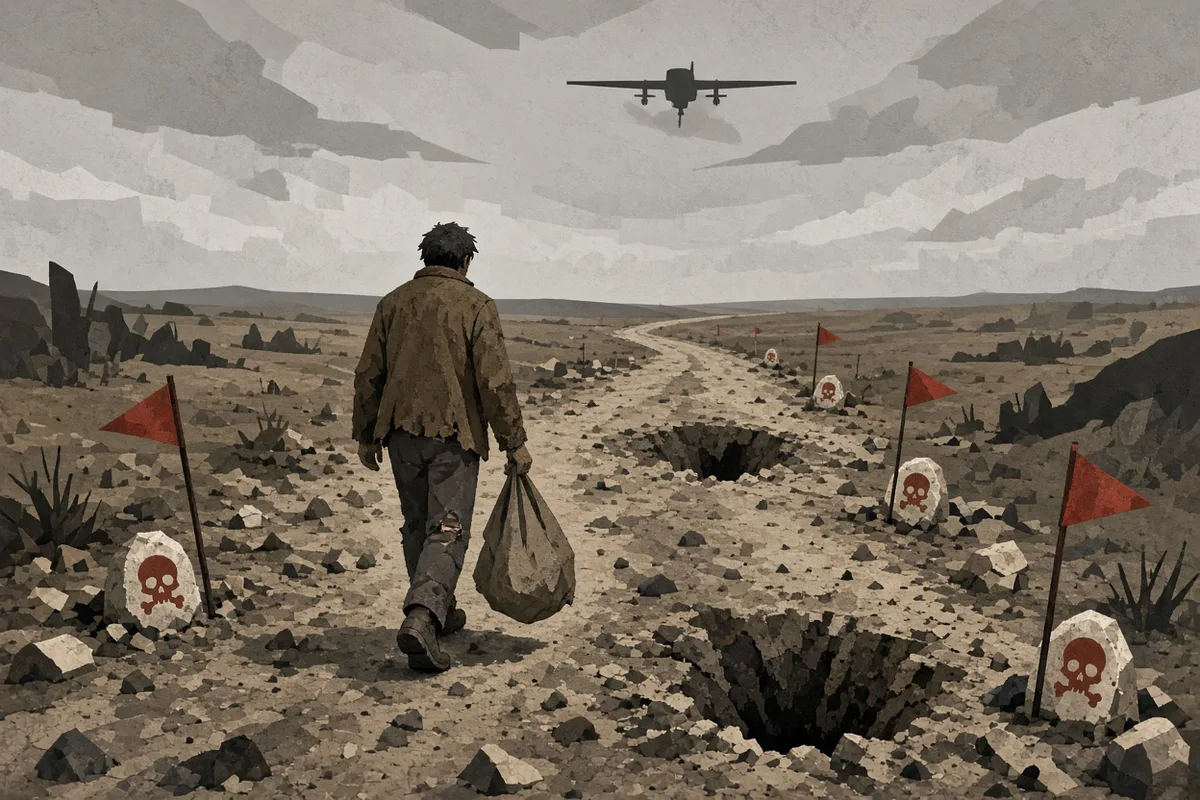
On the road back from Radensk the mine took her. She had gone the twenty kilometres southeast of Oleshky looking for food. Days earlier three people had been killed on the same stretch. Locals call it the road of death.
Burnt-out vehicles sit along the passage. Attack drones work the air above anyone who tries it. Afterward the woman, who asked not to be named, put the fact plain. “There is no safe way out.”
That is the route still open when the town itself has nothing left to give. The last food delivery to the local shop arrived in May. Half a year has passed with nothing new on the shelves. Residents still in Oleshky have been living mainly on stocks left in their homes and on local produce. One woman who remains there asked what that stretch of time does to a household. “What on earth could possibly be left in your house when you haven't been to the shop for half a year?”
Before the war the town’s population stood at around 24,000. Danielle Bell, head of the UN Human Rights Monitoring Mission in Ukraine, puts the number still living there at about 1,700. Forty-seven of them are children. There is no stable electricity, no stable water and no stable heating. The shop stays empty. The houses hold only what they already held when the last delivery came.
Dmytro Lubinets, Ukraine’s human rights commissioner, named both sides of the daily calculation. “The choice Russia forces on civilians every day: to stay — and starve to death; or to leave — and risk being blown up by a landmine.”

Lubinets said Kyiv had proposed a local ceasefire and the opening of evacuation corridors for civilians who wished to leave. Russia rejected the offer. Without them, the forced choice stayed exactly where he placed it.
Tetiana Hasanenko, head of the local military administration in the Ukrainian-controlled part of the district, keeps regular contact with people who have not gone. She hears from them how little room the options leave. “They know they are doomed. These are terrible words to say, but they know they will die either from hunger or from strikes.”
For one household the choice has already been split down the middle. Larysa fled Oleshky in February 2022, shortly after the full-scale invasion. Her husband stayed. He is seventy-two. He lives on vegetables and on homemade flatbread he bakes over an open fire. The flour comes from stocks put aside before the invasion. It spoiled long ago.
“He's been living on this for the whole summer, ever since May. There are no eggs, no dairy, no meat — there's nothing,” Larysa said.
He feeds four cats and a dog grass mixed with leftover grain. Larysa has forbidden him from taking the road to Radensk. She describes the journey as a life-and-death gamble. “It's like Russian roulette,” she said. They speak briefly by phone twice a week. She is sure he hides the full extent of his difficulties.

Before May, Ukrainian volunteers could still bring food into Oleshky and help people evacuate. Since then, those who remain have relied on gardens and on old stocks kept in their homes. Ukrainian troops have no direct access to the town. The Ukrainian military said it had dropped food by drone. Residents said they saw nothing. The claim has not been independently confirmed.
Andrii Sybiha, Ukraine’s foreign minister, placed full responsibility for the humanitarian disaster on Russia as the attacking state. Russia has acknowledged serious problems with food and medical supplies in Oleshky. It says its army is working to resolve them and accuses Ukraine of blocking transfers.
Cucumbers, courgettes and tomatoes grown through the summer are nearly gone. Cold weather is arriving and those last staples are disappearing with them. Barter has collapsed in the same stretch of months. Objects once traded for food have already been used up. The woman injured by the mine on the return from Radensk said the exchanges are finished. “There really isn't anything left to swap. We've used it all up.”
Even boiling water has become a complex task. Gas canisters cannot be obtained, so an open fire is the only method left. Medicines left in the town have expired. She eats only once a day. The meal is a thin piece of flatbread with tomato and salt, or with honey.
The road toward Radensk stays mined.