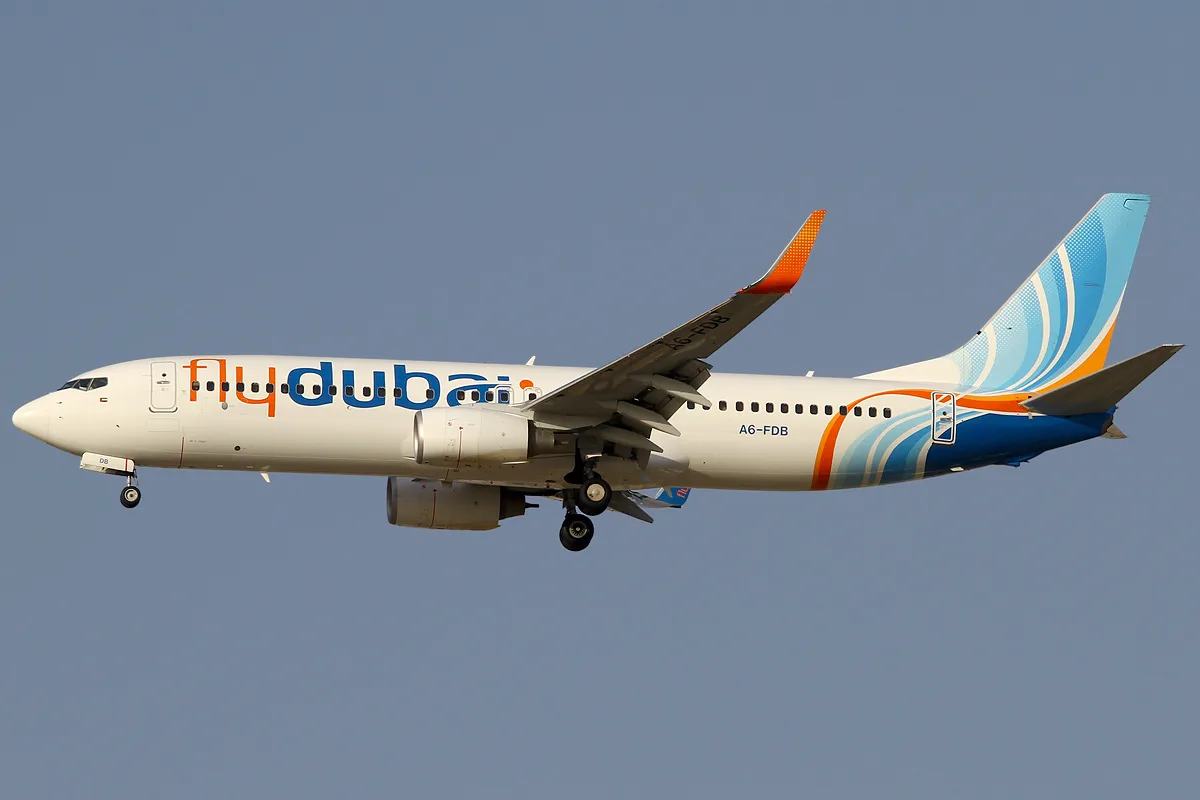



Flydubai Co-Pilot Allegedly Stabs Captain, Flight Diverts
60 sourcesUpdated Oct 1, 2026
Smit Machchhar unlocked the cockpit door from the inside. He was already wounded. Israeli Prime Minister Benjamin Netanyahu said the co-pilot had stabbed him with the aircraft’s crash axe, and the captain, despite the injuries, still freed the latch. Passengers and crew poured through the opening onto the flight deck of Flydubai Flight FZ1073.
The Boeing was bound from Dubai to Tel Aviv on 30 September with 174 people aboard. Four of them were pilots. Two extras had been added before departure in case regional rerouting stretched the original crew past duty limits. What had been a scheduled commercial leg now turned on the people flooding into the cockpit and what they could still do at the controls as the aircraft began to fall.
In 29 seconds the Boeing fell from 30,875 feet to 16,750 feet, according to Flightradar24 data reported by NBC News. From roughly 33,000 feet it had dropped to about 17,000 in a minute.
Asaf Rajuan was among those who moved on the attacker. “We felt helpless, suspended in midair, and I didn't know who to turn to. But it was all instinct to survive,” he said in a statement shared by Israel’s presidency. Yaniv Hayun helped incapacitate the co-pilot. Yasmin Abu Kasis later said her daughter Miriam, who was on the flight, heard screaming and saw a man with a knife force a pilot to the floor.
The jet had left Dubai at 03:05 UTC. The steep descent began around 05:21 UTC. At 05:28:48 UTC it squawked 7700, the code for a general emergency; at 05:35 it switched to 7500, the signal for unlawful interference; near Tabuk it returned to 7700.
Off-duty Flydubai pilots traveling as passengers took the controls of the Boeing 737 MAX 8 and put it down at Tabuk, Saudi Arabia, near the Jordanian border. Saudi Arabia and Jordan air traffic control had reportedly refused the aircraft before Tabuk accepted it. A CBS source said Saudi military jets were scrambled in the belief a hijack was under way.
Shota Musayev recorded cabin video of the co-pilot restrained and kneeling, hands tied behind his back. Philip Kean, head of the New Zealand flight school where Machchhar had trained, called the outcome miraculous in the way that the airplane was never, ever kind of designed for that sort of dive and survive that, the airplane actually didn't break up completely. The rudder was torn away during the dive.
The jet was on the ground at Tabuk. What the survival did not answer was why the co-pilot had done it, or how a man cleared to sit on the flight deck had reached that point.
UAE Attorney General Hamad Saif al-Shamsi ordered a probe into the circumstances, the motives, any terrorist link, and whether there had been prior planning or direction. The aircraft was UAE-registered, and Emirati authorities took the lead. The co-pilot still had no public name. Reports identified him as Omani. He had joined FlyDubai less than a year earlier. Saudi authorities held him.

A regional official briefed on the investigation said every line stayed open. “All possible scenarios, from terrorism to mental disorders, are being looked into. Nothing is ruled out for now,” the official said. Benjamin Netanyahu, asked about Iranian involvement, answered “it's too early to say.” On where the co-pilot would go next, he told Fox News: “I think he'll be taken to the Emirates, where he comes from, or at least where he left, where he flew off from, and we'll be following and possibly also participating in this investigation.”
After a call with Netanyahu, President Donald Trump told reporters the co-pilot was “perhaps a terrorist or perhaps a whack job.” Israeli officials were to join the interrogation. Motive remained unsettled. So did the quieter problem of how a man cleared for the flight deck had been cleared at all.
Flydubai flies under the oversight of the UAE’s General Civil Aviation Authority. A commercial pilot cleared for its decks needs a valid professional licence, the matching aircraft type rating, a current Class 1 medical certificate that covers physical and mental health, English-language proficiency, and the required flight experience. Those gates are the industry standard.
Saj Ahmad, chief analyst at the London consultancy StrategicAero Research, described the net they form. “Pilot vetting is very thorough, from security and financial checks to mental health evaluation,” he said. “But those checks are a single snapshot in time and will never uncover whether a person has issues that then manifest in the workplace or flight deck.” He added one further limit: “This is why it's so hard to know what people think and what they may do if they feel a sense of some form of injustice.”
Reinforced cockpit doors were built to keep outside threats out. They were never designed to stop someone who already held legitimate access to the flight deck.
Flydubai had opened the first commercial service between Dubai and Tel Aviv in November 2020 and kept the route flying through the Gaza war. That corridor was now the one under scrutiny.
Flydubai suspended all flights to and from Israel. A second Flydubai aircraft was sent to Tabuk to retrieve the stranded passengers and carry them onward to Israel.
Smit Machchhar was stable and under treatment in Tabuk. Doron Spielman, a spokesperson for the Israeli prime minister’s office, said crews bound for the country would face a new filter. “Every pilot that is going to be flying into Israel, we are going to know the pilots' identities, know who they are, and do some type of security check,” he said.
The relief jet stood on the Tabuk tarmac. The co-pilot remained in Saudi custody pending transfer and the multi-national probe.
How it spread
They need stricter mental health checks for cockpit crews after this incident.
It's hard to believe a co-pilot would attack the captain mid-flight like that.