Global expansion and Model Y (2019–present)
From July 2019 to June 2020, Tesla reported four consecutive profitable quarters for the first time, which made it eligible for inclusion in the S&P 500. During 2020, its share price increased 740%, and by December 14, 2020, its market capitalization was more than the next nine largest automakers combined, and it became the sixth most valuable company in the US. Tesla was added to the S&P index on December 21, 2020; it was the most valuable company ever added, and was the sixth-largest member of the index immediately after it was added. It became the sixth US company to reach $1 trillion in market capitalization in October 2021.
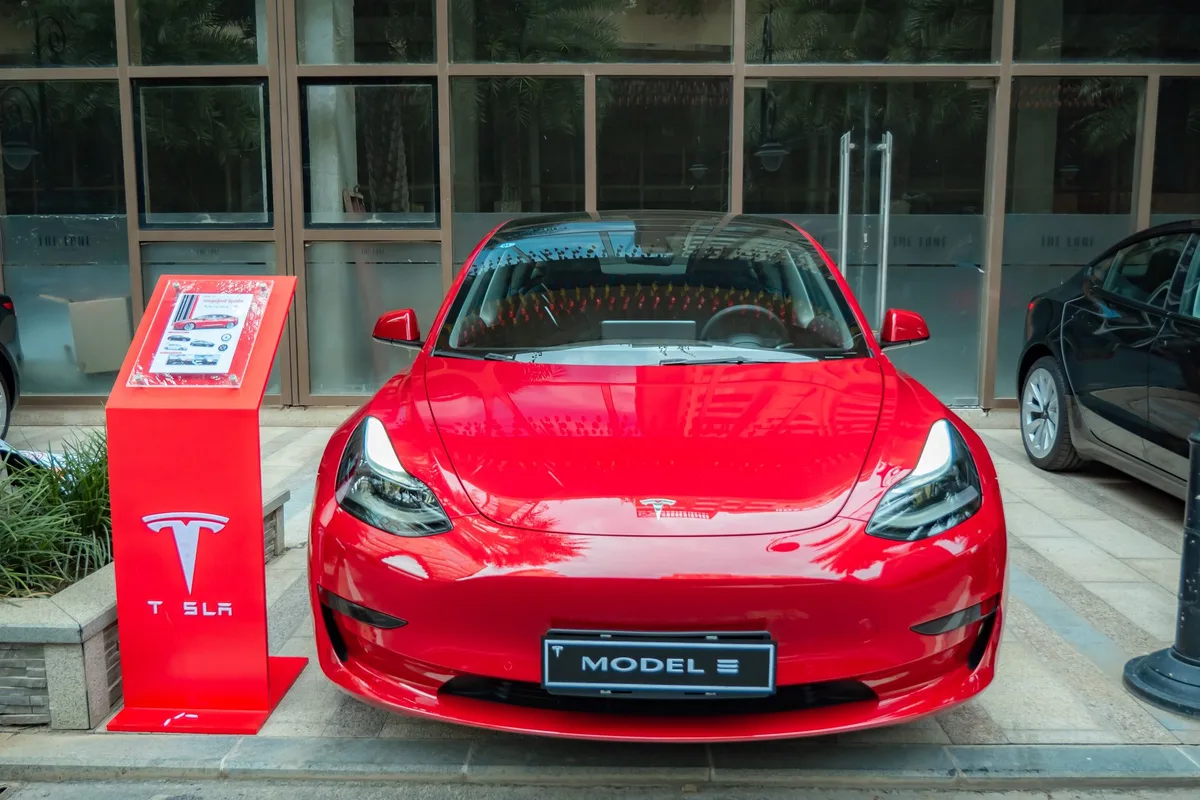
In March 2019, Tesla introduced the Model Y mid-size crossover SUV, its second mass-market vehicle, based on the Model 3. Deliveries started in March 2020.
During this period, Tesla invested heavily in expanding its production capacity, opening three new Gigafactories in quick succession. Construction of Gigafactory Shanghai started in January 2019, as the first automobile factory in China fully owned by a foreign company (not a joint venture). The factory's first production vehicle, a Model 3, rolled out in December, less than one year after groundbreaking. Gigafactory Berlin broke ground in February 2020, and its production of the Model Y began in March 2022. Gigafactory Texas broke ground in June 2020, and its production of the Model Y began in April 2022. In March 2023, Tesla announced plans for a Gigafactory Mexico to open in 2025, but its groundbreaking has been delayed.
At the beginning of the COVID-19 pandemic, Tesla closed the Fremont Factory in March 2020 due to California state and Alameda county COVID restrictions. When California lifted restrictions, but the county did not, Tesla sued the county, and restarted production on May 11, 2020. The county lifted restrictions on May 13, 2020, and Tesla dropped its lawsuit. After the dispute with county officials, on December 1, 2021, Tesla moved its legal headquarters to Gigafactory Texas. However, Tesla continued to use its former headquarters building in Palo Alto, and over the next two years significantly expanded its footprint in California. The company opened its Megafactory to build Megapack batteries in Lathrop, California in 2022, and announced in February 2023 that it would establish a large global engineering headquarters in Palo Alto, moving into a corporate campus once owned by Hewlett Packard.
In early 2021, Tesla became a major investor in bitcoin, acquiring $1.5 billion of the cryptocurrency, and on March 24, 2021, the company started accepting bitcoin as a form of payment for US vehicle purchases. However, after 49 days, the company ended bitcoin payments over concerns that the production of bitcoin was contributing to the consumption of fossil fuels, against the company's mission of encouraging the transition to sustainable energy. After the announcement, the price of bitcoin dropped around 12%. Musk later noted that Tesla would resume bitcoin payments if there was confirmation of at least 50% clean energy usage by bitcoin miners. Despite later reaching this milestone, Tesla did not return to accepting bitcoin. By July 2022 Tesla had sold about 75% of its bitcoin holdings at a loss, citing that the cryptocurrency was hurting the company's profitability.
Between May 2023 and February 2024, almost all major North America EV manufacturers announced plans to switch to Tesla's North American Charging Standard adapters on their EVs by 2025, which is expected to be a stable source of recurring revenue for Tesla. In November, Tesla started shipping the Cybertruck, produced from Gigafactory Texas.
In April 2024, the company announced it was laying off 10% of its employees. In June, the company moved its incorporation from Delaware to Texas. In October, the company unveiled a concept version of two autonomous vehicles – the Cybercab and Robovan – and detailed that both would be an integral part of a Tesla ridehailing service called the Tesla Network, a future service it had previously teased in 2019.
In December 2024, a Delaware court rejected Musk's $56 billion pay package from Tesla, ruling that it was not properly approved by the company's board. The decision arose from a lawsuit by Tesla shareholders who claimed the compensation was excessive and not aligned with performance metrics.
By February 2025, Tesla saw large decreases in its stock price and sales across Europe widely attributed to Musk's political advocacy and embrace of far-right politics. Polling found that Musk's ties to United States President Donald Trump and his Department of Government Efficiency were strongly correlated to decreasing views of Tesla, and triggered multiple protests, vandalism, gunfire, and arson at Tesla stores and charging stations. By March 7, Tesla's stock had decreased every week for seven straight weeks since Musk joined the Trump administration, making it the longest losing streak for Tesla in 15 years as a public company. On March 29, over 200 protests against Tesla were held worldwide.
In July 2025, Tesla released a software update adding the artificial intelligence (AI) chatbot Grok to its vehicles. While the update provides in-car chatbot functionality, it does not give Grok control over vehicle functions. The same month, Tesla opened its first showroom in India at the Bandra-Kurla Complex in Mumbai, showcasing the Model Y as its debut offering. In August, Tesla integrated Deepseek and Bytedance's Doubao AIs into Chinese models. Unlike vehicles equipped with Grok, AI in Tesla's Chinese vehicles may be used to control vehicle functions, as well as act as a chatbot.
In December 2025, Tesla's UK registrations fell by more than 29% year-on-year. UK sales also fell by 8.9% year-on-year.
In January 2026, the title of world's largest battery electric vehicle manufacturer was lost to Chinese competitor BYD after full year 2025 deliveries were reported by both companies (2,256,714 vs 1,636,129 BEV sales).
On January 28, 2026, Musk stated that Tesla would discontinue the Model S and Model X in the second quarter of 2026 to focus on manufacturing the Optimus robot.
In March 2026, Elon Musk unveiled a joint project between Tesla and xAI. The project pairs xAI's Grok large language model, acting as a high-level navigator with a Tesla-developed AI agent that processes real-time computer screen video and keyboard and mouse actions.
On March 21, 2026, SpaceX announced the project to build Terafab, a joint project with Tesla, SpaceX and xAI, to build a large semiconductor fabrication project centering on the construction of a vertically integrated "mega-fab" designed to produce more than one terawatt (one trillion watts) of artificial intelligence compute capacity per year, encompassing advanced logic chips, memory modules, and packaging technologies.