118th Congress
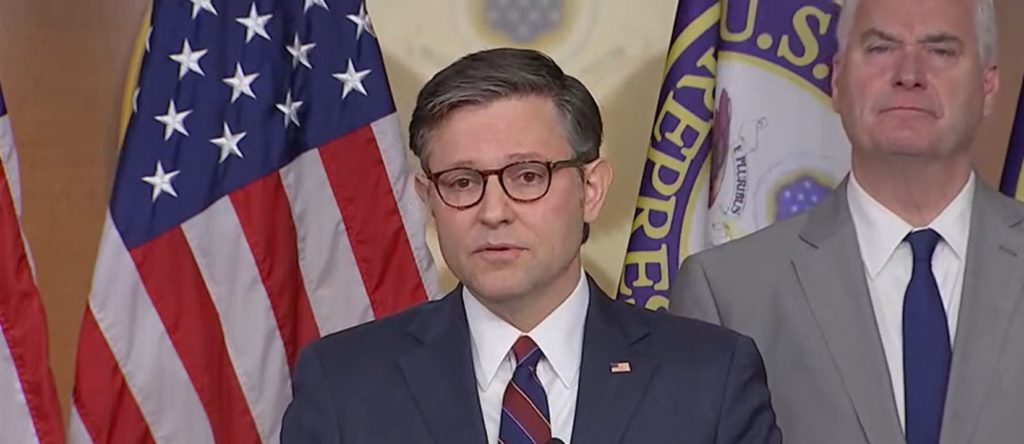
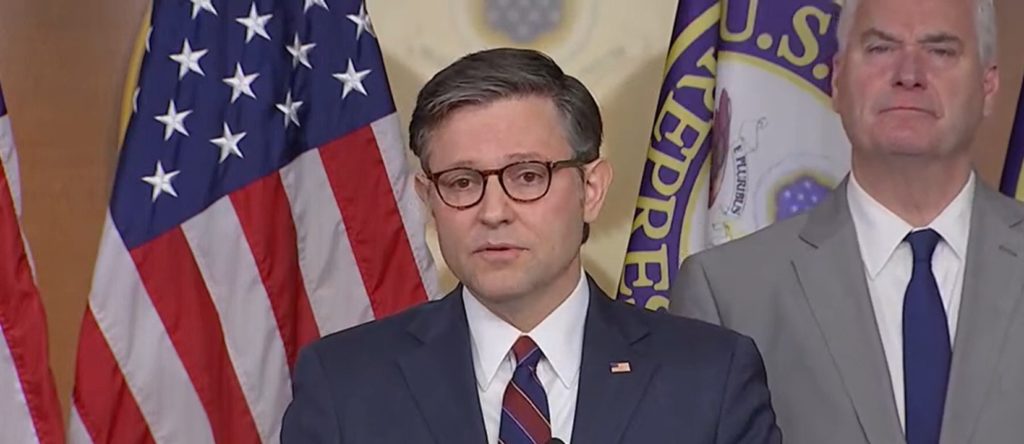
In the first half of the 118th Congress, when McCarthy was speaker, the House of Representatives had passed into law the lowest number of bills of any previous Congress, partially due to the unrest among members of the Freedom Caucus and McCarthy. McCarthy's removal had not put an end to the divided House, and Johnson sparked some anger over his handling of spending negotiations. An effort to oust him from the speakership in May 2024 failed with two-thirds of the House voting to keep him in office.
On October 26, 2023, Johnson met with President Joe Biden for the first time as speaker before attending a bipartisan briefing held at the White House on the administration's proposed funding requests for aid to Ukraine and Israel. On October 30, Johnson suggested rescinding IRS funding from the Inflation Reduction Act to provide Israel $14.3 billion in aid. In November, Johnson proposed a two-tiered stopgap bill that continued spending at levels similar to then-current levels. House conservatives and the Freedom Caucus opposed the bill, but it passed the House on November 14 with the support of 209 Democrats and 127 Republicans. It passed the Senate the next day and was signed by Biden.
On November 17, Johnson announced that 44,000 hours of security footage from the January 6 United States Capitol attack, all of which had previously only been available upon request from criminal defendants and the media, would be released to the general public.
On December 1, the House expelled Republican congressman George Santos by a 311–114 vote; Johnson voted against the expulsion, and called it "a regrettable day".
On February 13, 2024, the House impeached Secretary of Homeland Security Alejandro Mayorkas by a 214–213 vote. The impeachment resolution, championed by Johnson, had been already put up to a vote on February 6, but had failed due to a small Republican rebellion.
On January 7, 2024, congressional appropriators reached an agreement on the topline spending levels for 2024 that was not substantially different from the deal McCarthy negotiated during his tenure as speaker. Hardliners attempted to push Johnson to abandon the deal, initially claiming that he had done so before Johnson clarified that he had not. As negotiations continued over the full-year funding bills, conservatives pushed Johnson to instead endorse a full-year continuing resolution, which under McCarthy's deal would result in automatic spending cuts.
On March 6, 2024, the House passed a $459 billion "minibus" spending package containing six of the twelve appropriations bills. The rightmost faction of the Republican conference harshly opposed the deal, arguing it contained no substantial conservative policy wins. On March 22, the House passed a second $741 billion minibus to fund the remaining government departments; most Republicans voted against the bill, but it passed with Democratic support. The bill's passage, and the decision to rely on Democratic votes to get it through, led Representative Marjorie Taylor Greene to file a motion to vacate Johnson's speakership. Greene could have forced a vote on the motion immediately, but initially chose not to, saying that she merely intended to send Johnson "a warning".
In April 2024, more than two months after the Senate had passed a funding bill for Israel, Taiwan, and Ukraine, Johnson put forward a legislative package providing aid to the three countries in separate bills, each of which passed Congress with bipartisan support and large majorities and was signed into law by President Biden. The legislative package also included a House-passed bill to force the app TikTok to divest from its Chinese Communist Party-controlled parent company, ByteDance, as well as the REPO for Ukrainians Act, a measure that allows the U.S. government to fund the Ukrainian war effort with assets seized from Russian oligarchs.
On May 8, 2024, Greene (who had strongly opposed Johnson's resolve to provide Ukraine with further aid) introduced a motion to vacate Johnson's speakership on the floor, forcing a vote on it within two legislative days. The House voted to table (kill) the motion by a vote of 359 to 43, allowing Johnson to remain speaker. One hundred ninety-six Republicans and 163 Democrats voted to kill the resolution; 11 Republicans and 32 Democrats voted against killing it. The Democrats who supported Johnson said they did so because of the vital role he had played in providing funding for the federal government and for Ukraine.
The 118th Congress, in which Johnson and McCarthy each served as speaker, saw 209 bills enacted into law, among the fewest bills passed by any Congress in decades. Since 2000, the average number of bills passed per Congress had been 372. Since 1989, the average number had been 380. No Congress had enacted fewer laws since the first half of the 20th century.