




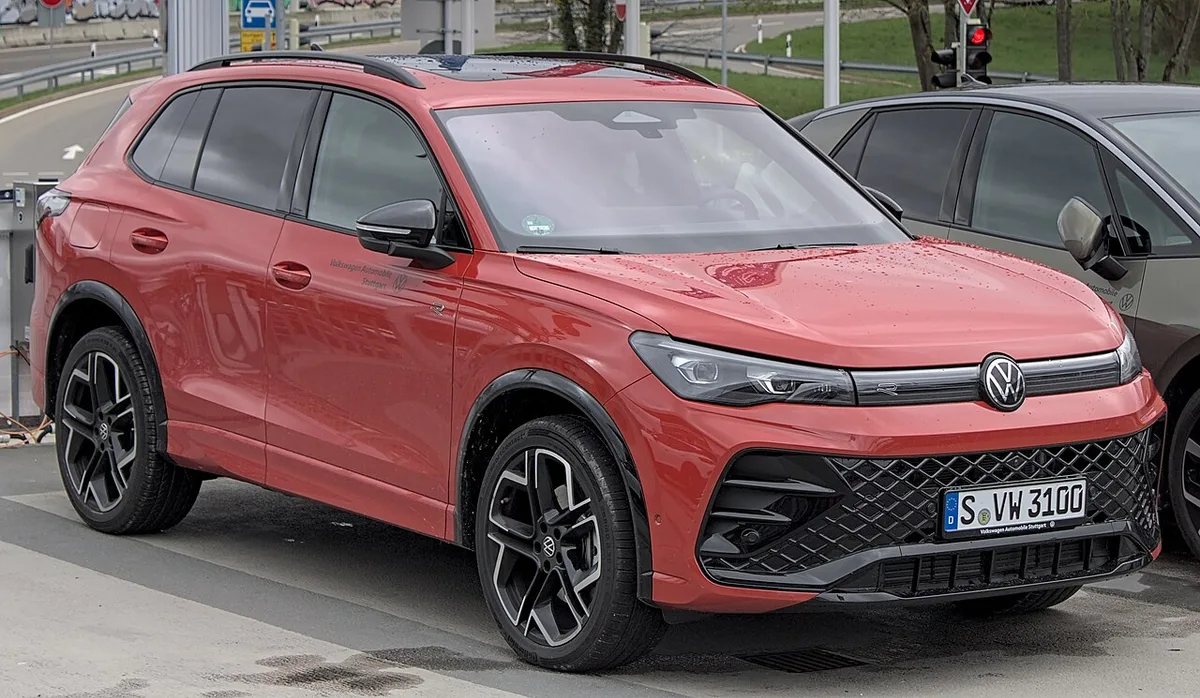
The Audi Q3 is a subcompact luxury crossover SUV produced by Audi since 2011. The Q3 has a transverse-mounted front engine. It was unveiled in April 2007 at the Shanghai motor show. A coupe SUV variant has been produced since the second generation, called the Q3 Sportback.
Since the discontinuation of the Audi A1 and Audi Q2 in 2026, the Q3 is Audi's smallest combustion engine model, alongside the Audi A3.
Contents
First generation (Typ 8U; 2011)
Concept Vehicle: Audi Cross Coupé quattro (2007)
Designed by Julian Hoenig in 2006, it was a concept vehicle with Liquid Silver body colour, 20-inch wheels, fabric folding roof, electrically controlled hood, 4-cylinder 2.0 TDI engine rated at 204 PS (150 kW; 201 hp) and 400 N⋅m (295.02 lbf⋅ft), diesel particulate filter and Bluetec emission control system, quattro permanent four-wheel drive system with Haldex clutch, Audi S tronic dual-clutch gearbox, MacPherson strut front axle and a four-link rear axle, Audi drive select system with 3 modes (dynamic, sport, efficiency), MMI control panel with touch pad and dual-view technology, sound system with the prominent extending tweeters.
The vehicle was unveiled at the Shanghai Motor Show in April 2007.
Initial release
The car uses the Volkswagen Group A (PQ46) platform of the Volkswagen Passat B6, the same as the Volkswagen Tiguan compact SUV. The Q3 slots above the Audi Q2 subcompact crossover SUV. Compared to the compact luxury crossover SUV Q5 and mid-size luxury crossover SUV Q7, which are positioned more for family practicality and off-road performance, the Q3 is aimed as more of a lifestyle/sports automobile. Design and development began following board approval in the second half of 2007. Julian Hoenig's design was chosen for production and frozen in 2009.
The Q3 shares components, transmissions and engines with amongst other vehicles utilising the PQ35 platform, the Volkswagen Golf, Audi A3 and Škoda Yeti.
The vehicle was unveiled at Auto Shanghai 2011.
The vehicles went on sale in June 2011. Early models include 2.0 TFSI quattro (170/211PS), 2.0 TDI (140PS), 2.0 TDI quattro (177PS).
Indian models went on sale in 2012. Early models include 2.0 TDI quattro (177PS).
China models went on sale at the end of July 2012 as an import vehicle. The Changchun-made Audi Q3 entered market in April 2013, which included 35 TFSI (170PS), 35 TFSI quattro (170PS), 40 TFSI quattro (200PS), with 7-speed S Tronic transmissions.
2.0 TDI quattro with 103 kW (138 hp) was introduced in 2012 for Germany market as part of 2012 Paris Motor Show premiere.
2.0 TDI quattro (140PS) was introduced in 2012 for the UK market.
It is a concept vehicle based on Audi Q3 with 2.5 TFSI (2,480 cc (2.48 L; 151 cu in) I5 turbo) engine rated at 314 PS (231 kW; 310 hp) and 400 N⋅m (295.02 lbf⋅ft), 7-speed S tronic transmission, Energy Red body colour, add-on body parts are in matt gray quartz-based paint, flared wheel arches and running boards, five-arm 8.5Jx20 wheels in matt quartz, 255/45 off-road tires, 40 mm wider front and rear track widths and 30 mm higher body ride height over production model.
2014 update
In 2014 the Audi Q3 received a facelift for the 2015 model year. The grille on the 2015 version has a wider chrome surround to it, which touches the headlights at each side. The lower air vents have been enlarged slightly, and the lights themselves have re-profiled LEDs to give the car a more recognisable look in the dark. The wheel arch surrounds and door sills are body coloured on the base model (they used to be black plastic), as is the rear bumper design, which sits below subtly reshaped lower tail light clusters. Also there are new alloy wheel designs to finish off the refresh.
The changes to the inside are even more difficult to spot than those on the outside. Styling-wise, the only thing of note is a new steering wheel design. There is the option to specify blind spot and lane departure warning systems if you wish. The boot remains the same volume at 420 litres, expanding to 1,325 litres when the rear seats are folded flat.
Across the range, each engine has seen an improvement in performance, efficiency or both. The 1.4-litre turbocharged petrol became equipped with cylinder-on-demand technology, which saves fuel by shutting down a couple of cylinders when less power is needed.
The 2.0 TFSI petrol units uprated to produce 180 PS (132 kW; 178 hp) and 220 PS (162 kW; 217 hp). The two diesel motors receive boosts of eight and four horsepower, to 150 PS (110 kW; 148 hp) and 184 PS (135 kW; 181 hp) respectively. The more performance-oriented RS Q3 gains a sizeable 30 PS (22 kW; 30 hp) over the old model, and torque uprated to 332 lb⋅ft (450 N⋅m), marginally up from the old version.
The vehicle was unveiled in 2014 North American International Auto Show.
US models went on sale in late 2014 as 2015 model year vehicles. Early models included 2.0 TFSI (200 PS), 2.0 TFSI quattro (200 PS).
2015 update
Changes include redesign of front lights, grille, and exterior fascia; Alu-optic interior MMI controls and interior upgrades, front and rear parking sensors with rearview camera join wide array of standard equipment, full LED headlights and dynamic rear turn signals on Prestige models.
The vehicles went on sale in February 2015, with delivery of RS Q3 began in the first quarter of 2015. Early models included Q3 2.0 TDI clean diesel (110 kW), Q3 2.0 TDI clean diesel ultra (110 kW), Q3 TDI clean diesel quattro (110/135 kW), Q3 1.4 TFSI COD (110 kW), Q3 1.4 TFSI COD ultra (110 kW), Q3 2.0 TFSI quattro (132/162 kW), RS Q3 2.5 TFSI (250 kW).
Early German models included Q3 1.4 TFSI COD (110 kW), Q3 1.4 TFSI COD ultra (110 kW), Q3 2.0 TFSI (132 kW), Q3 2.0 TFSI quattro (132/162 kW), Q3 2.0 TDI (88/110/135 kW), Q3 2.0 TDI ultra (110 kW), Q3 2.0 TDI quattro (110/135 kW). Q3 2.0 TFSI (132 kW), Q3 2.0 TDI (135 kW) were dropped as of 2016.
US and Canada models went on sale as 2016 model year vehicles. Early models included Q3 2.0 TFSI (147 kW), Q3 2.0 TFSI quattro (147 kW).
Developed at Audi Research & Development in Beijing, it is a version of Q3 with an electrically powered multifunctional longboard integrated into the car's rear bumper.
The vehicle was unveiled in Auto China 2016.
It is a version of RS Q3 with increased engine power to 367 PS (270 kW; 362 hp) and 465 N⋅m (342.97 lbf⋅ft), seven-speed S tronic transmission, matt titanium-look finish parts (frame of the air inlet duct and the quattro logo, singleframe, lateral flaps in the air inlets, trim strips at the side windows, exterior mirror housings, roof rails, upper edge of the diffuser, fins of the roof edge spoiler), Ascari blue metallic body colour, 20-inch wheels in a five twin-spoke V design in matt titanium, red brake calipers bearing the RS logo (optional black calipers), dial instruments in gray faces, white dials and red needles; seats in the color combination black and blue with optional RS performance design package, blue contrast stitching at RS sport leather steering wheel, selector lever gaiter, centre armrest and the floor mats; inlays in carbon twill blue with blue thread is woven into the carbon material.
Second generation (Typ F3; 2018)
The second-generation Audi Q3, built on the MQB A2 platform was officially unveiled on July 25, 2018. On the Nürburgring race track, a sports version was tested, which would be called SQ3, with an even more powerful version of RS Q3 planned.
A Sportback version was revealed in July 2019. The Q3 Sportback is marginally lower, narrower and longer, with different bumpers, side skirts and body cladding. Aimed at the BMW X2, the lower roofline and raked rear hatch result in less headroom, and 0.14 less cubic meters (5 cubic feet) when the rear seats are folded.
In Europe, a plug-in-hybrid EA211 1.4L turbo four came with the 2021 model year in January 2021 in Germany.
RS Q3
The RS Q3 variant was revealed in September 2019; it has the same engine as the first-generation RS Q3 albeit with more power.
Announced in October 2022, the Audi RS Q3 Edition 10 Years is a special edition with some visual changes, such as blacked-out trim, and only 555 units will be built.
Third generation (Typ FJ; 2025)
The third generation Q3 was unveiled on 16 June 2025. The model takes design inspiration from the third-generation Q5. Sales in Germany set to commence in late 2025.
The coupé SUV model, marketed as the Q3 Sportback, was unveiled on 25 August 2025.
Features
There are three suspension designs for the third-generation Q3. Instead of the shifter being mounted on the centre console it is mounted on the steering column. Additional features include a 12-speaker system, ambient lighting on the doors, a 12-inch infotainment system, a 11.9-inch digital cluster, and a 15w phone charger.
Powertrain
There were four powertrain options were confirmed at launch. These include 1.5 and 2.0-litre turbocharged inline-4 petrol engines, a 2.0-litre diesel engine, and the 1.5-litre turbocharged petrol engine paired with a plug-in hybrid powertrain.
These engines are shared with the third-generation Volkswagen Tiguan.
No all-wheel drive versions of the plug-in hybrid and diesel models were confirmed at launch. All-wheel-drive is only available with the 2.0-litre turbocharged petrol engine.