




Volkswagen, Audi Recall 208,000 SUVs Over Steering Defect
A corroded mounting bolt and an already-fractured steering-rack housing sat at the center of the first defect report Volkswagen received from outside North America. The report landed in October 2024. The subject vehicle had come back with those two failed parts.
The bolt was the fastener that secured the steering rack—the assembly that turns the driver’s wheel input into the angle of the front wheels—to the subframe beneath it. Corrosion had taken the bolt. The housing of the rack itself had cracked. That was the concrete record at the outset: one returned vehicle, one corroded bolt, one fractured housing.
Engineers requested the failed components. Through January 2025 a cross-functional investigation pulled in engineering, supplier, production, and materials specialists. Examination of the parts identified a corrosion-induced fracture of the bolt head. Moisture had reached the right-side mounting zone. Engineers traced how water entered that area and which environmental conditions could accelerate the corrosion once it was present. Over the life of the vehicle the fastener corroded until the head broke.

A second field report arrived in August 2025. A third followed in December 2025. As those cases came in, the company kept evaluating surface-treatment alternatives for the bolt, searching for a finish that would resist the same slow attack. In September 2025 it chose a mounting bolt finished in a highly corrosion-resistant polymer coating as the remedy.
The failure sequence is fixed. Corrosion takes the bolt head first. A metallic rattle or knock from the front axle can precede full failure and is a possible warning that the right-side mounting bolt has already broken or is about to. After it snaps, the rack does not fall free. It remains attached to the subframe at the one mount still intact. Force that two mounts once shared now concentrates on that single point and on the housing around it. Keep loading the system and the housing fractures under the strain. Housing fractures concentrate in parking and low-speed maneuvers, when steering loads peak. Once the housing fractures, steering control can be lost, increasing the risk of a crash.
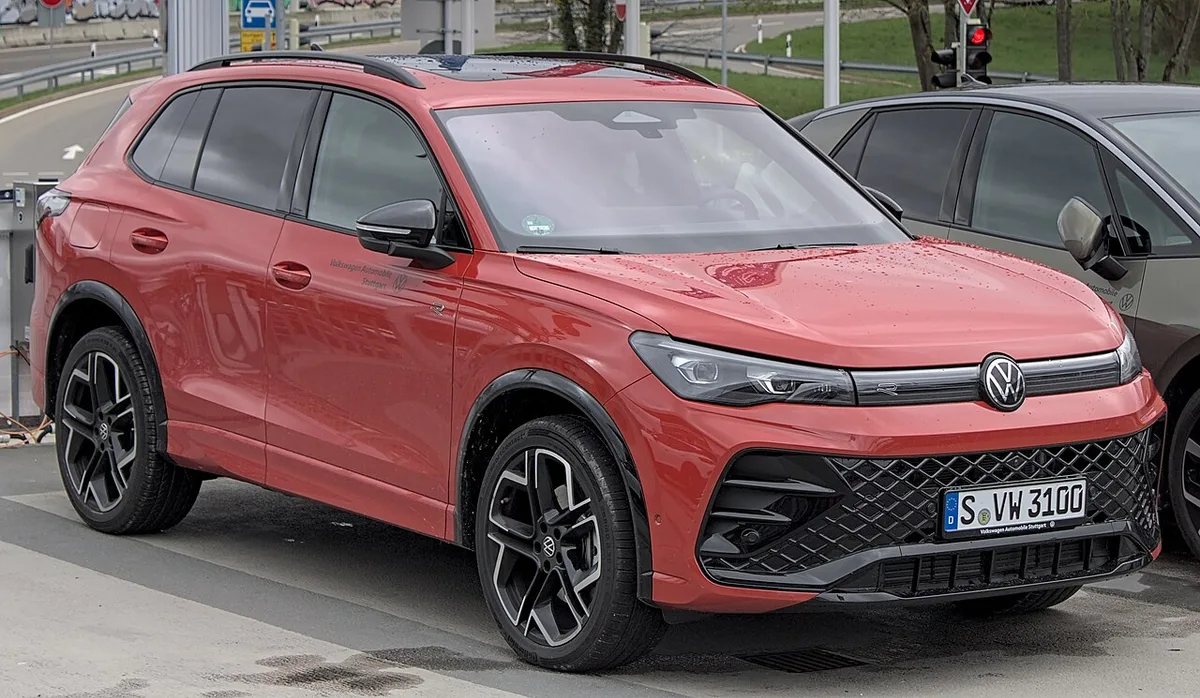
The condition belonged to a particular steering rack fitted to the 2018 Volkswagen Tiguan, the 2018 and 2019 Volkswagen Atlas, and the 2019 through 2021 Audi Q3. The Atlas is Volkswagen’s mid-size crossover SUV, developed mainly for the American market and based on the MQB platform. For the United States and Canada it is produced at the plant in Chattanooga, Tennessee. Introduced at the Los Angeles Auto Show in November 2016, it went on sale in May 2017 as a 2018 model, the first year of its generation. The 2018 Tiguan marked the first model year of its own generation. The Audi Q3 crossovers from 2019 through 2021 left the factory with the same right-side mounting hardware.

In the United States the split ran to 85,713 Tiguans, 82,601 Atlases, and 40,410 Q3s. More than 44,000 additional vehicles were in Canada. The United States population stood at 208,724 vehicles, the figure recorded by the National Highway Traffic Safety Administration for the full campaign.
Volkswagen phased the defect condition out of production through design changes between June 2018 and July 2021. By then the factories had stopped fitting that rack. The vehicles already built still carried the original bolt.
Volkswagen and Audi reported no crashes, fires, injuries, or deaths linked to the steering defect in North America. The companies said they were unaware of any warranty claims, field reports, service reports, or other information associated with the issue anywhere in the region.
In August 2026 the company determined a steering-rack housing fracture might not be immediately apparent to the driver. A housing that had already fractured could leave the vehicle in ordinary service without announcing the failure at the wheel. Nothing in the North American file had yet recorded a crash, an injury, or a death, yet the possibility of a silent fracture meant the defect could advance without a visible warning. The original mounting bolt remained in place across the full fleet. The next step was to take it out and put the polymer-coated fastener in its place.
Dealers will replace the right-side steering-rack mounting bolt with the polymer-coated version at no cost to the owner. The repair process focuses strictly on the bolt replacement and does not require further mechanical checks.
The National Highway Traffic Safety Administration filed the action under campaign number 26V590000. Volkswagen lists the same campaign under codes 48LG and 48VT. The customer service number shared by Volkswagen for this recall is 800-893-5298. Owners can also call the NHTSA vehicle safety hotline at 888-327-4236. Affected vehicle identification numbers are already searchable on the NHTSA website. An owner who enters the seventeen-digit VIN can confirm at once whether a vehicle falls inside the campaign. Authorized dealers nationwide will perform the replacement once an appointment is set.
Owner notification letters are expected to be mailed on November 10, 2026. Those letters will direct owners to schedule a service appointment at a Volkswagen or Audi dealer so the right-side mounting bolt can be replaced.