




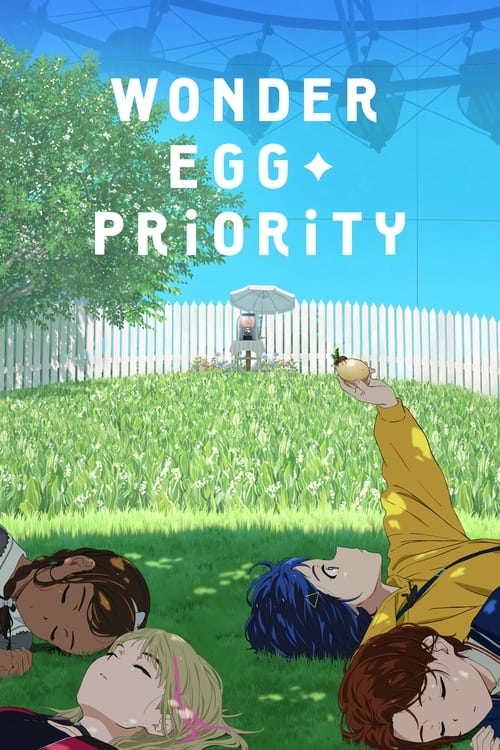



Wonder Egg Priority (Japanese: ワンダーエッグ・プライオリティ, Hepburn: Wandā Eggu Puraioriti) is a Japanese anime television series created and written by Shinji Nojima, and directed by Shin Wakabayashi. Animated by CloverWorks, it is a co-production of Aniplex, Nippon Television, and D.N. Dream Partners, which aired on Nippon TV and other channels from January to March 2021. Additionally, a special episode was released in June of that year. The series centers on Ai Ohto, a teenage hikikomori who stops attending school following her friend’s suicide. After discovering a 'Wonder Egg,' she enters a dream world where she and three other girls—each mourning a lost friend—fight grotesque "Wonder Killers", manifestations of trauma linked to suicides, and their goal is to resurrect their friends by protecting victims in this surreal realm.
Wonder Egg Priority marked Nojima's first anime project, following his work on live-action dramas. Seeking to reach younger audiences and explore stories impractical for live-action, he conceived it as a coming-of-age tale blending live-action realism with anime fantasy. Nippon TV producer-recommended debut TV anime director Wakabayashi assembled a team of mostly inexperienced young animators to realize this vision.
Initially praised by Western critics for its production quality, narrative complexity, and sensitive treatment of difficult themes, Wonder Egg Priority garnered more polarized reviews after its finale. The eleventh episode's focus on a new character's backstory and the special episode's conclusion drew particular criticism. Industry observers noted the production's struggles—an inexperienced team and tight schedule necessitated recruiting foreign hobbyist animators online to complete episodes, with some critics linking these challenges to the inconsistent reception.
Contents
Plot
The series follows Ai Ohto, a junior high school student who is temporarily not attending school, following the suicide of her close friend Koito Nagase. During a late-night walk, Ai is guided by a mysterious voice to a deserted arcade, where she finds a gachapon machine that dispenses a "Wonder Egg". That night, Ai gets drawn into a dream world where the Wonder Egg cracks open to reveal a girl, whom Ai must protect from a horde of monsters called "Seeno Evils". When the voice tells Ai that saving enough people in this world may bring Koito back, she resolves to continue buying Wonder Eggs and protecting their inhabitants. Along the way, Ai meets three other girls in the same situation as her: Neiru Aonuma, Rika Kawai, and Momoe Sawaki.
Characters
Main
Ai Ohto (大戸 アイ, Ōto Ai)
Voiced by: Kanata Aikawa (Japanese); Mikaela Krantz (English)
A 14-year-old girl with heterochromia, which has led her to be the subject of bullying. In the past, Ai became friends with Koito Nagase, a girl that had newly transferred from another high school. The two became close, as they only had each other. Tragedy ensued when Koito unexpectedly committed suicide by jumping off the roof of their school building. Following Koito's suicide, Ai ceased attending school. Ai is buying Wonder Eggs in order to bring Koito back to life, as well as discover the truth as to why Koito committed suicide. Her weapons of choice are a four-color ballpoint pen that can transform into a giant mace, a long, yellow-colored glowing ribbon-like bladed whip, two yellow penlights (light sticks) that can be used as double-bladed weapons, and prayer beads that allow her to see invisible Wonder Killers.
Neiru Aonuma (青沼 ねいる, Aonuma Neiru)
Voiced by: Tomori Kusunoki (Japanese); Dawn M. Bennett (English)
A quiet and reserved 14-year-old girl who makes no initiatives to get to know people. Despite her age, she is the president of a large company. Sometime in the past, Neiru was hospitalized after being violently stabbed by her sister. While recuperating from stabbing in the hospital she was informed that her sister committed suicide after assaulting her by jumping off of a bridge. The assault left Neiru with painful scars across her back, as well as complex feelings regarding her sister. Neiru is buying Wonder Eggs in order to bring her sister back to life. Her weapon of choice is a compass that can transform into either a great sword, two gigantic pliers with reactors, an assault rifle, a sniper rifle, or a pistol.
Rika Kawai (川井 リカ, Kawai Rika)
Voiced by: Shuka Saitō (Japanese); Anairis Quiñones (English)
A brash and outspoken 14-year-old girl who does not hesitate to say what is on her mind. Rika previously was a junior idol, and amassed a small fanbase. After discovering one of her biggest fans—an overweight girl named Chiemi—was shoplifting in order to give her gifts, Rika tried to stop Chiemi's shoplifting by insulting and lying to Chiemi in an attempt to turn Chiemi on her, claiming that she could not be friends with a fan and "would be embarrassed to be seen with a fatty." She would later discover that Chiemi died after starving herself thin. Rika is buying Wonder Eggs in order to bring Chiemi back to life. Her weapon of choice is a pair of two box cutters that act as swords.
Supporting
Koito Nagase (長瀬 小糸, Nagase Koito)
Voiced by: Azusa Tadokoro (Japanese); Suzie Yeung (English)
Ai's best friend. Before the events of the series, she was killed when she accidentally fell from the roof of her school in an incident initially believed to be a suicide. She is also the main reason why Ai is searching for Wonder Eggs so that she can be brought back to life.
Shūichirō Sawaki (沢木 修一郎, Sawaki Shūichirō)
Voiced by: Masatomo Nakazawa (Japanese); Stephen Fu (English)
Momoe's uncle who is also Ai's homeroom teacher and the club advisor of the art club. He later becomes Ai's mother's fiance.
Acca (アカ, Aka)
Voiced by: Yūya Uchida (Japanese); Brendan Blaber (English)
A mannequin-like humanoid who guides Ai and the others to fight in the Egg World for unknown reasons. He is capable of communicating with them telepathically through any object or creature in both the real and Egg World. Compared to his counterpart Ura-Acca, he is more professional, formal, and strict.
Ura-Acca (裏アカ, Ura-aka)
Voiced by: Hiroki Takahashi (Japanese); Ian Sinclair (English)
A mannequin-like humanoid who guides Ai and the others to fight in the Egg World for unknown reasons. He is capable of communicating with them telepathically through any object or creature in both the real and Egg World. Compared to his counterpart Acca, he is more laid-back and willing to let the girls relax. He also seems to be more directly supportive of the girls search for truth, as demonstrated by him "coincidentally" giving Neiru Kotobuki's Egg.
Production
Wonder Egg Priority is a co-production between Aniplex, Nippon Television, and D.N. Dream Partners. It was directed by Shin Wakabayashi, written by Shinji Nojima and features character designs by Saki Takahashi. Taracod served as concept artist, Keisuke Kobayashi as core animator, Yūki Funao as art director, and De De Mouse and Mito as music composers. The series was Wakabayashi's first time serving as series director for a television anime; he had previously directed the web short series 22/7: The Diary of Our Days. Wonder Egg Priority also marked the first time Kanata Aikawa had been cast in a leading voice role, and De De Mouse had been a music composer of an anime work.
Shinji Nojima, a well-known writer of live-action drama television, first conceived Wonder Egg Priority when he observed that live-action dramas had recently been less popular with the younger audience that he wanted to target with his next story. Nojima was attracted to the medium of anime due to his interest in reaching its engaged fandom that would often express their own interpretations in fan works, and his desire to tell a story that would not be feasible in a live-action production. Feeling that many anime leaned too far towards the fantastical, Nojima desired to find a middle ground between the realism of live-action dramas and the more exaggerated qualities of anime. As Nojima lacked familiarity with the anime industry and did not know who would be best to realize his vision, a producer from Nippon TV connected him with Aniplex, Cloverworks and Shin Wakabayashi, who would come to direct the series. Nojima said he did not consult Wakabayashi and the animation team about the scripts, as he was confident in their ability to realize his scripts as a high quality animation, and placed his complete trust in them to realize the story as they felt best. The difference in the half hour timeslot typical of late night anime as opposed to the one hour timeslots for live-action dramas that Nojima was used to was not a major creative consideration for him, as he was confident in his ability to pace the story effectively and therefore instead focused on the number of episode scripts. However, as the plot grew in complexity, he realized it would not be possible for him to finish all of his envisioned narrative in only twelve episodes, and thus some of the plot was cut from the final scripts as a result.
Wonder Egg Priority's visual style was frequently compared by critics to the works of Naoko Yamada; Wakabayashi had previously worked with Yukiko Horiguchi, who formerly contributed character designs to K-On! and Tamako Market, both directed by Yamada, as she also provided the character designs for 22/7. Kevin Cirugeda of SakugaBlog said that though many directors, most recently inspired by Yamada's 2018 film Liz and the Blue Bird, had tried to emulate her style, Wakabayashi's collaboration with Horiguchi enabled him to replicate that style more accurately than any other director who had previously attempted such. Cirugeda did note, however, that Kyoto Animation's unique production pipeline inevitably made a perfect replication of Yamada's style nearly impossible, but that for Wonder Egg Priority, Wakabayashi and lead animator Keisuke Kobayashi had settled on a distinct style of "over-articulation" that was perceived as having "raised the volume" to distract from the small imperfections. The series marked many young animators' debuts in certain production roles, as Wakabayashi and his team recruited such new talents as Yuki Yonemori on episode 3, in his first time working as an episode director, and Yuzu Hori and Yuichiro Komuro, performing episode direction and storyboarding duties respectively, for their first time on episode 4. Episode direction and storyboarding work on most of Wonder Egg Priority's episodes was delegated to a single animator, which Cirugeda believed was ideal as the team "dyed each episode with their own unique flavor," although he noted the possible drawback of overwhelming the inexperienced animation talents recruited to the production.
Production issues
Information from industry insiders and several broadcast events showcase some of the issues the series faced during its production. In one instance, the staff were unable to complete the 8th episode of the series on time, and so a recap episode was instead aired in order to provide more time for the team. The production falling behind and the airing of the recap episode disrupted the overall broadcast schedule, leaving the originally planned twelfth episode initially unreleased, eventually to be reworked into the special episode aired three months later. Said special episode began with a recap segment that took up the first half of the one hour broadcasting timeslot in which it was scheduled, for which it was criticized, as the episode had been advertised as a double length installment. While CloverWorks as a company is considered a "freelancing-heavy studio" (indicating that most of the work on the studio's projects come from freelancers, rather than studio employees), the situation became dire enough for the company to reach out to foreigners online, many of them without Japanese-language literacy or experience working on a television anime, for help with the animation production. Freelance translators Blou and Far were originally contracted for episode 10 of the series, initially helping Croatia-based animator Ani communicate with production assistant Hayato Satō. However, they became more involved in the final episodes, being credited for overseas animation assistance (作画海外協力), animation/English translation assistance (作画英語翻訳協力), and overseas animator part production assistance (海外Animator part制作進行協力) for their contributions in helping recruit and assist foreign animators, and bridging the language barrier between them and the domestic production team. The special episode reportedly entered into the second key animation process only five days before it was aired, prompting a displeased animator to air their grievances in a post on Bilibili.
Although the instance of an episode not being finished on time was widely known due to the recap episode having substituted it, the series as a whole was plagued with issues in which episodes were normally finished only hours before being aired. Several times, members of the series' production team were sent to the hospital, most notably series producer Shouta Umehara who was reported to have been hospitalized two times in a since-deleted tweet. Kevin Cirugeda of Sakugablog attributed the struggles to the production's limited pool of animation staff as well as the systemic shortcomings typical of TV anime production processes which he characterized as "incompatible" with the staff's creative ambitions. Cirugeda suggested that such issues in anime tend to occur due to production committees not caring about the "quality of the product [or its staff] beyond its marketability", which he pointed out Aniplex of being guilty of due to "shamelessly ly[ing]" as the lead company of the Wonder Egg Priority production committee, saying "anyone paying attention could notice what they were trying to hide." The troubled nature of the production was acknowledged by multiple English-language critics in discussions and reviews of the show, who attributed several of their criticisms to the production struggles. The production's use of overseas animators led critics Vrai Kaiser and Mercedez Clewis to express concerns that it might pave the way for future anime productions to do the same, which they worried could lead to similar complicity by production committees in the case of other troubled productions. Blou and Far, in being interviewed by Anime News Network about their experience on the production, advised readers that production assistants are "quite desperate" for help, often attempting to recruit foreigners with minimal regard for their skill in animation or art, and cautioned prospective animators to think carefully about their qualifications and be wary of the potential challenges and drawbacks of accepting any such offers.
Broadcast and release
Wonder Egg Priority aired on Nippon TV's AnichU programming block and other channels from January 13 to March 31, 2021. Kanata Aikawa, Tomori Kusunoki, Shuka Saitō, and Hinaki Yano, under the unit name Anemoneria (アネモネリア), performed both the opening and ending songs, respectively titled "Sudachi no Uta" (巣立ちの歌) and "Life Is Cider" (Life is サイダー, Raifu Izu Saidā). Actress Nao makes a special appearance in episode 7 as Rika's mother, Chiaki Kawai. During the last episode broadcast, it was announced that a special episode would be aired on June 30, 2021. The special was scheduled for a 1-hour timeslot, although in reality, half of that time was taken up by a recap of the main series, making its effective runtime constitute a normal length episode.
Funimation licensed the series and streamed it on its website in North America and the British Isles, in Europe through Wakanim, and in Australia and New Zealand through AnimeLab. On March 30, 2021, Funimation announced the series would be receiving an English dub, with the first two episodes premiering the next day. Following Sony's acquisition of Crunchyroll, the series was moved to Crunchyroll. GaragePlay licensed the series in Southeast Asia and streamed it on Bilibili. The series received a North American Blu-ray release on April 26, 2022.
Reception
Critical response
In English-language coverage, Wonder Egg Priority received near immediate acclaim upon beginning its airing. Reviews in Polygon, Anime News Network, Anime Feminist, and other outlets, were widely euphoric, strongly praising the high quality animation, soundtrack, music, voice acting, and narrative, as well as the handling of sensitive thematic material such as bullying, sexual assault, and suicide, which was generally seen as effective and captivating. The series was commonly described as one of the best new anime of 2021. Comparisons were positively drawn to the work of such directors as Naoko Yamada, Satoshi Kon, and Kunihiko Ikuhara, among others. However, the darker story elements received some criticisms, with some reviewers expressing discomfort with the anime's difficult themes, or voicing concerns that the story could fumble the handling of such topics further down the line. Discussing the production of the first few episodes, Kevin Cirugeda of SakugaBlog praised the quality of the animation, saying that director Shin Wakabayashi had made the most of his team's limitations in emulating Naoko Yamada's work at Kyoto Animation. Noting the "enchanting" first episode as one of the "best premieres" he had seen in recent memory, Cirugeda said it was unsurprising it had immediately attracted an enthusiastic audience.
In a feature for Polygon, Kambole Campbell strongly praised Wonder Egg's refreshing take on magical girl genre tropes, positively highlighting the use of magical realism and flower language (a point at which another comparison to Yamada was drawn) as well as the perceived attention to the "systemic root" of the social issues at the center of the narrative. Numerous other critics have drawn similar comparisons to the magical girl genre, citing such anime as Flip Flappers and Puella Magi Madoka Magica. However, series creator Shinji Nojima has rejected this classification; though Nojima acknowledged the similarity, he has referred to it as a fantasy series. Writing for The A.V. Club, Juan Barquin (reviewing the series' main 12 episodes) called Wonder Egg "spellbinding" and praised it for its perceived interest in catharsis for the abuse victims portrayed within the story, comparing it to rape revenge films.
As Wonder Egg Priority continued its weekly airing, the series garnered a more mixed critical response. A dialogue in the fourth episode, wherein the characters of Acca and Ura-Acca explain that the "Wonder Eggs" only contain girls because motivations of suicides supposedly differ between genders, was widely criticized, prompting Wakabayashi to say on Twitter that a dissenting line of dialogue from Neiru had been cut for time. However, Kevin Cirugeda commented in a later Sakuga Blog post that Nojima, in an interview, had echoed the same sentiment as Acca and Ura-Acca had done in their dialogue, which he criticized as being incongruous with the perceived themes of the story, and said gave the impression that "not everyone is on the same thematic page". Steve Jones of Anime News Network initially called the series a "slam dunk," commending the explorations of idol culture and transgender themes, but described later episodes as "uneven" and having "rough patches". In commenting on the perceived declining quality of the series, Jones attributed it partially to the production difficulties faced by the animation staff. Episode 10, in particular, was praised for its heavy focus on transgender issues through the development of Momoe and introduction of one-off trans male character Kaoru, both by Jones and But Why Tho? contributor Mercedez Clewis, who said it prompted a "full-on ugly cry" due to their emotionally relating to the story as a non-binary woman. However, some criticism was directed at the choice to follow up Momoe's story, widely read as expressing validation of her gender identity as a trans woman, with the "traumatic" conclusion of her being forced to eat her animal companion.


