




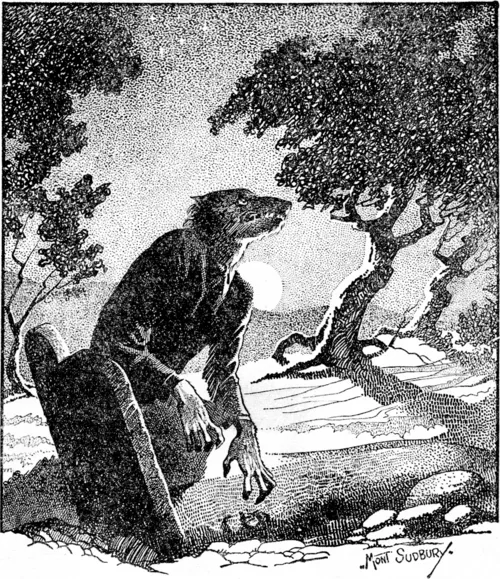
In folklore, a werewolf (from Old English werwulf 'man-wolf'), or occasionally lycanthrope (from Ancient Greek λυκάνθρωπος 'wolf-human'), is an individual who can shapeshift into a wolf or therianthropic hybrid wolf–humanlike creature, either voluntarily or involuntarily due to a curse or other affliction. In modern fiction, especially film, transformations are often depicted as triggered by the full moon and transmitted by a bite or scratch from another werewolf. Early sources for belief in this ability or affliction, called lycanthropy, are Petronius (27–66) and Gervase of Tilbury (1150–1228).
The werewolf is a widespread concept in European folklore, existing in many variants, which are related by a common development of a Christian interpretation of underlying European folklore developed during the Middle Ages. From the early modern period, werewolf beliefs spread to the Western Hemisphere with colonialism. Belief in werewolves developed in parallel with the belief in witches during the late Middle Ages and the early modern period. Like the witchcraft trials as a whole, the trial of supposed werewolves emerged in what is now Switzerland, especially the Valais and Vaud, in the early 15th century and spread throughout Europe in the 16th, peaking in the 17th and subsiding by the 18th century.
The persecution of werewolves and the associated folklore is an integral part of the "witch-hunt" phenomenon, albeit a marginal one, with accusations of lycanthropy being involved in only a small fraction of witchcraft trials. During the early period, accusations of lycanthropy (transformation into a wolf) were mixed with accusations of wolf-riding or wolf-charming. The case of Peter Stumpp (1589) led to a significant peak in both interest in and persecution of supposed werewolves, primarily in French-speaking and German-speaking Europe. The phenomenon persisted longest in Bavaria and Austria, with the persecution of wolf-charmers recorded until well after 1650, the final cases taking place in the early 18th century in Carinthia and Styria.
After the end of the witch trials, the werewolf became of interest in folklore studies and in the emerging Gothic horror genre. Werewolf fiction as a genre has premodern precedents in medieval romances (e.g., Bisclavret and Guillaume de Palerme) and developed in the 18th century out of the "semi-fictional" chapbook tradition. The trappings of horror literature in the 20th century became part of the horror and fantasy genre of modern popular culture.
Contents
Names
The Modern English werewolf descends from the Old English wer(e)wulf, which is a cognate of Middle Dutch weerwolf, Middle Low German warwulf, werwulf, Middle High German werwolf, and West Frisian waer-ûl(e). These terms are generally derived from a Proto-Germanic form reconstructed as *wira-wulfaz ('man-wolf'), itself from an earlier Pre-Germanic form *wiro-wulpos. An alternative reconstruction, *wazi-wulfaz ('wolf-clothed'), would bring the Germanic compound closer to the Slavic meaning, with other semantic parallels in Old Norse úlfheðnar ('wolf-skinned') and úlfheðinn ('wolf-coat'), Old Irish luchthonn ('wolf-skin'), and Sanskrit Vṛkājina ('Wolf-skin').
The Norse branch underwent taboo modifications, with Old Norse vargúlfr (only attested as a translation of Old French garwaf ~ garwal(f) from Marie's lay of Bisclavret) replacing *wiraz ('man') with vargr ('wolf, outlaw'), perhaps under the influence of the Old French expression leus warous ~ lous garous (modern loup-garou), which literally means 'wolf-werewolf'. The modern Norse form varulv (Danish, Norwegian and Swedish) was either borrowed from Middle Low German werwulf, or else derived from an unattested Old Norse *varulfr, posited as the regular descendant of Proto-Germanic *wira-wulfaz. An Old Frankish form *werwolf is inferred from the Middle Low German variant and was most likely borrowed into Old Norman garwa(l)f ~ garo(u)l, with regular Germanic–Romance correspondence w- / g- (cf. William / Guillaume, Wales / Galles, etc.).
The Proto-Slavic noun *vьlko-dlakь, meaning "wolf-haired" (cf. *dlaka, "animal hair", "fur"), can be reconstructed from Serbian vukòdlak, Slovenian vołkodlȃk, and Czech vlkodlak, although formal variations in Slavic languages (*vьrdl(j)ak, *vьlkdolk, *vьlklak) and the late attestation of some forms pose difficulties in tracing the origin of the term. The Greek Vrykolakas and Romanian Vîrcolac, designating vampire-like creatures in Balkan folklores, were borrowed from Slavic languages.
The same form is found in other non-Slavic languages of the region, such as Albanian vurvolak and Turkish vurkolak. Bulgarian vьrkolak and Church Slavonic vurkolak may be interpreted as back-borrowings from Greek. The name vurdalak (вурдалак; 'ghoul, revenant') first appeared in Russian poet Alexander Pushkin's work Pesni, published in 1835. The source of Pushkin's distinctive form remains debated in scholarship.
History
Indo-European comparative mythology
The European motif of the devilish werewolf devouring human flesh harks back to a common development during the Middle Ages in the context of Christianity, although stories of humans turning into wolves take their roots in earlier pre-Christian beliefs.
Their underlying common origin can be traced back to Proto-Indo-European mythology, wherein lycanthropy is reconstructed as an aspect of the initiation of the kóryos warrior class, which may have included a cult focused on dogs and wolves identified with an age grade of young, unmarried warriors. The standard comparative overview of this aspect of Indo-European mythology is McCone's 1987 work.
Classical antiquity
A few references to men changing into wolves are found in Ancient Greek literature and Greek mythology. Herodotus, in his Histories, wrote that according to what the Scythians and the Greeks settled in Scythia told him, the Neuri, a tribe to the northeast of Scythia, were all transformed into wolves once every year for several days and then changed back to their human shape. He added that he was unconvinced by the story, but the locals swore to its truth. The tale was also mentioned by Pomponius Mela.
In the second century BC, the Greek geographer Pausanias related the story of King Lycaon of Arcadia, who was transformed into a wolf because he had sacrificed a child on the altar of Zeus Lycaeus. In the version of the legend told by Ovid in his Metamorphoses, when Zeus visits Lycaon disguised as a commoner, Lycaon wants to test if he is really a god. To that end, he kills a Molossian hostage and serves his entrails to Zeus. Disgusted, the god turns Lycaon into a wolf. However, in other accounts of the legend, like that of Pseudo-Apollodorus's Bibliotheca, Zeus blasts him and his sons with thunderbolts as punishment.
Pausanias also relates the story of an Arcadian man called Damarchus of Parrhasia, who was turned into a wolf after tasting the entrails of a human child sacrificed to Zeus Lycaeus. He was restored to human form 10 years later and became an Olympic champion. This tale is also recounted by Pliny the Elder, who calls the man Demaenetus, quoting Agriopas. According to Pausanias, this was not a one-off event, for men have been transformed into wolves during sacrifices to Zeus Lycaeus since the time of Lycaon. If they abstain from tasting human flesh while wolves, they will be restored to human form nine years later; if they do not abstain, they will remain wolves forever.
Pausanias reports that an ancient painting depicted Euthymus of Locri defeating the spirit that haunted Temesa. The spirit was represented as a terrifying black figure clad in a wolf skin and identified by an inscription as Lycas. Some modern scholars have classified the figure among the werewolves of ancient Greek tradition.
Lykos (Λύκος) of Athens was a wolf-shaped herο whose shrine stood by the jury court, and the first jurors were named after him.
Middle Ages
There is evidence of widespread belief in werewolves in medieval Europe, spanning across the European continent and British Isles. Werewolves were mentioned in medieval law codes, such as that of Cnut the Great, whose Ecclesiastical Ordinances aimed to ensure that "...the madly audacious werewolf do[es] not too widely devastate, nor bite too many of the spiritual flock." Liutprand of Cremona reports a rumor that Bajan, a son of Simeon I of Bulgaria, could use magic to turn himself into a wolf. The works of Augustine of Hippo had a large influence on the development of Western Christianity, being read widely by Christian clergy of the medieval period. These clergymen occasionally discussed werewolves in their works, including in Gerald of Wales's Werewolves of Ossory—found in his Topographica Hibernica—and Gervase of Tilbury's Otia Imperialia; both works were written for royal audiences.
Gervase of Tilbury, in Otia Imperialia, reveals to the reader that belief in such transformations—he also mentions women turning into cats and snakes—was widespread across Europe; he uses the phrase "que ita dinoscuntur" ('it is known') when discussing transformations. Writing in Germany, he also informs the reader that the transformation of men into wolves cannot be easily dismissed, for "...in England we have often seen men change into wolves" ("Vidimus enim frequenter in Anglia per lunationes homines in lupos mutari...").
Further evidence of the widespread belief in werewolves and other human-to-animal transformations can be seen in theological attacks made against such beliefs. Conrad of Hirsau, writing in the 11th century, forbids reading stories in which a person's reasoning is obscured following such a transformation. Conrad specifically refers to the tales of Ovid in his tract. Pseudo-Augustine, writing in the 12th century, follows Augustine of Hippo's argument that no physical transformation can be made by any but God, stating that "...the body corporeally [cannot], be changed into the material limbs of any animal" in his Liber de Spiritu et Anima.
Marie de France's song poem Bisclavret (c. 1200), a Breton lai, is another example: the eponymous nobleman Bisclavret, for reasons not described, had to transform into a wolf every week. When his treacherous wife stole his clothing needed to restore his human form, he escaped the king's wolf hunt by imploring the king for mercy, accompanying the king thereafter. His behavior at court was gentle until his wife and her new husband appeared one day—so much so that his hateful attack on the couple was deemed justly motivated, and the truth was revealed.
Early modern history
There were numerous reports of werewolf attacks – and consequent court trials – in 16th-century France. In some of the cases, there was clear evidence against the accused of murder and cannibalism, but no association with wolves. In other cases, people have been terrified by such creatures, such as that of Gilles Garnier in Dole in 1573, who was convicted of being a werewolf.
Lycanthropy received peak attention in the late 16th to early 17th century as part of the European witch-hunts.
A number of treatises on werewolves were written in France during 1595 and 1615. In 1598, werewolves were sighted in Anjou. In 1602, Henry Boguet wrote a lengthy chapter about werewolves. In 1603, a teenage werewolf was sentenced to life imprisonment in Bordeaux.
In the Swiss Vaud region, werewolves were convicted in 1602 and 1624. A treatise by a Vaud pastor in 1653, however, argued that lycanthropy was purely an illusion. After this, the only further record from the Vaud dates to 1670. A boy claimed he and his mother could change into wolves, which was not taken seriously. At the beginning of the 17th century, witchcraft was prosecuted by James I of England, who regarded "warwoolfes" as victims of delusion induced by "a natural superabundance of melancholic".
After 1650, belief in lycanthropy had mostly disappeared from French-speaking Europe, as evidenced in Diderot's Encyclopedia, which attributed reports of lycanthropy to a "disorder of the brain". Although there were continuing reports of extraordinary wolflike beasts, they were not considered to be werewolves. One such report concerned the Beast of Gévaudan, which terrorized the general area of the former province of Gévaudan, now called Lozère, in south-central France. From 1764 to 1767, it killed upwards of 80 men, women, and children.
The part of Europe which showed more vigorous interest in werewolves after 1650 was the Holy Roman Empire. At least nine works on lycanthropy were printed in Germany between 1649 and 1679. In the Austrian and Bavarian Alps, belief in werewolves persisted well into the 18th century. As late as in 1853, in Galicia, northwestern Spain, Manuel Blanco Romasanta was judged and condemned as the author of a number of murders, but he claimed to be not guilty because of his condition of lobishome (werewolf).
Asian cultures
Common Turkic folklore holds a different, reverential light to the werewolf legends in that Turkic Central Asian shamans, after performing long and arduous rites, would voluntarily be able to transform into the humanoid "Kurtadam" (literally meaning "Wolfman"). Since the wolf was the totemic ancestor animal of the Turkic peoples, they would respect any shaman in such a form.
Lycanthropy as a medical condition
Some modern researchers have tried to explain the reports of werewolf behaviour with recognised medical conditions. In 1963, Dr Lee Illis of Guy's Hospital in London wrote a paper entitled On Porphyria and the Aetiology of Werewolves, in which he argues that historical accounts on werewolves could have been referring to victims of congenital porphyria, stating how the symptoms of photosensitivity, reddish teeth, and psychosis could have been grounds for accusing a person of being a werewolf.
This is argued against by Woodward, who points out how mythological werewolves were almost invariably portrayed as resembling true wolves, and that their human forms were rarely physically conspicuous as porphyria victims. Others have pointed out the possibility of historical werewolves having been people with hypertrichosis, a hereditary condition manifesting itself in excessive hair growth. Woodward dismissed the possibility, as the rarity of the disease ruled it out from happening on a large scale, as werewolf cases were in medieval Europe.
Woodward suggested rabies as the origin of werewolf beliefs, claiming remarkable similarities between the symptoms of that disease and some of the legends. Woodward focused on the idea that being bitten by a werewolf could result in the victim turning into one, which suggested the idea of a transmittable disease like rabies. However, the idea that lycanthropy could be transmitted in this way is not part of the original myths and legends, and only appears in relatively recent beliefs. Lycanthropy can also be met with as the main content of a delusion; for example, the case of a woman has been reported who during episodes of acute psychosis complained of becoming four different species of animals.
Folk beliefs
Characteristics
The beliefs classed together under lycanthropy are far from uniform, and the term is somewhat capriciously applied. The transformation may be temporary or permanent; the were-animal may be the human themself metamorphosed; may be their double whose activity leaves the real human to all appearance unchanged; may be their soul, which goes forth seeking whomever it may devour, leaving its body in a state of trance; or it may be no more than the messenger of the human being, a real animal or a familiar spirit, whose intimate connection with its owner is shown by the fact that any injury to it is believed, by a phenomenon known as repercussion, to cause a corresponding injury to the human being.
Werewolves were said in European folklore to bear telltale physical traits even in their human form. These included the meeting of both eyebrows at the bridge of the nose, curved fingernails, low-set ears and a swinging stride. One method of identifying a werewolf in its human form was to cut the flesh of the accused, under the pretense that fur would be seen within the wound. A Russian superstition recalls a werewolf can be recognized by bristles under the tongue.
The appearance of a werewolf in its animal form varies from culture to culture. It is most commonly portrayed as being indistinguishable from ordinary wolves, except for the fact that it has no tail (a trait thought characteristic of witches in animal form), is often larger, and retains human eyes and a voice. According to some Swedish accounts, the werewolf could be distinguished from a regular wolf by the fact that it would run on three legs, stretching the fourth one backwards to look like a tail.
After returning to their human forms, werewolves are usually documented as becoming weak, debilitated and undergoing painful nervous depression.
One universally reviled trait in medieval Europe was the werewolf's habit of devouring recently buried corpses, a trait that is documented extensively, particularly in the Annales Medico-psychologiques in the 19th century.
Becoming a werewolf
Various methods for becoming a werewolf have been reported, with one of the simplest being the removal of clothing and putting on a belt made of wolfskin, probably as a substitute for the assumption of an entire animal skin (which also is frequently described). In other cases, the body is rubbed with a magic salve.
The 16th-century Swedish writer Olaus Magnus says that the Livonian werewolves were initiated by draining a cup of specially prepared beer and repeating a set formula. In Italy, France and Germany, it was said that a man or woman could turn into a werewolf if he or she, on a certain Wednesday or Friday, slept outside on a summer night with the full moon shining directly on his or her face.
In other cases, the transformation was supposedly accomplished by satanic allegiance for the most loathsome ends, often for the sake of sating a craving for human flesh. "The werewolves", writes Richard Verstegan (Restitution of Decayed Intelligence, 1628),
are certayne sorcerers, who having annoynted their bodies with an ointment which they make by the instinct of the devil, and putting on a certayne inchaunted girdle, does not only unto the view of others seem as wolves, but to their own thinking have both the shape and nature of wolves, so long as they wear the said girdle. And they do dispose themselves as very wolves, in worrying and killing, and most of humane creatures. [sic]
The phenomenon of repercussion, the power of animal metamorphosis, or of sending out a familiar, real or spiritual, as a messenger, and the supernormal powers conferred by association with such a familiar, are also attributed to the magician, male and female, all the world over; and witch superstitions are closely parallel to, if not identical with, lycanthropic beliefs, the occasional involuntary character of lycanthropy being almost the sole distinguishing feature. In another direction, the phenomenon of repercussion is asserted to manifest itself in connection with the bush-soul of the West African and the nagual of Central America; although there is no line of demarcation to be drawn on logical grounds, the assumed power of the magician and the intimate association of the bush-soul or the nagual with a human being are not termed lycanthropy.
The curse of lycanthropy was also considered by some scholars as being the outcome of divine judgment. Werewolf literature shows many examples of God or saints allegedly cursing those who invoked their wrath with lycanthropy. Such is the case of Lycaon, who was turned into a wolf by Zeus as punishment for slaughtering one of his own sons and serving his remains to the gods as a dinner. Those who were excommunicated by the Catholic Church were also said to become werewolves.
Remedies
Various methods have existed for removing the werewolf form. In antiquity, the Ancient Greeks and Romans believed in the power of exhaustion in curing people of lycanthropy. The victim would be subjected to long periods of physical activity in the hope of being purged of the malady. This practice stemmed from the fact that many alleged werewolves would be left feeling weak and debilitated after committing depredations.
In medieval Europe, traditionally, there are three methods one can use to cure a victim of lycanthropy: medicinally (usually via the use of wolfsbane), surgically, or by exorcism. Many of the cures advocated by medieval medical practitioners proved fatal to the patients. A Sicilian belief of Arabic origin holds that a werewolf can be cured of its ailment by striking it on the forehead or scalp with a knife. Another belief from the same culture involves the piercing of the werewolf's hands with nails. Sometimes, less extreme methods were used. In the German lowland of Schleswig-Holstein, a werewolf could be cured if one were to simply address it three times by its Christian name. One Danish belief holds that merely scolding a werewolf will cure it. Conversion to Christianity was a common method of removing lycanthropy in the medieval period. A devotion to St. Hubert has been cited as both cure for and protection from lycanthropes.
Connection to revenants
Before the end of the 19th century, the Greeks believed that the corpses of werewolves, if not destroyed, would return to life in the form of wolves or hyenas that prowled battlefields, drinking the blood of dying soldiers. In the same vein, in some rural areas of Germany, Poland, and Northern France, it was once believed that people who died in mortal sin came back to life as blood-drinking wolves.
These "undead" werewolves would return to their human corpse form at daylight. They were dealt with by decapitation with a spade and exorcism by the parish priest. The head would then be thrown into a stream, where the weight of its sins was thought to weigh it down. Sometimes, the same methods used to dispose of ordinary vampires would be used. The vampire was linked to the werewolf in East European countries, particularly Bulgaria, Serbia and Slovenia. In Serbia, the werewolf and vampire are known collectively as vulkodlak.
Hungary and Balkans
In Hungarian folklore, werewolves are said to live in the region of Transdanubia, and it was thought that the ability to change into a wolf was obtained in infancy, after suffering parental abuse or by a curse. It is told that, at the age of seven, the boy or the girl leaves home at night to go hunting, and can change to a person or wolf whenever they want. The curse can also be obtained in adulthood if a person passes three times through an arch made of birch with the help of a wild rose's spine.
The werewolves were known to exterminate all kind of farm animals, especially sheep. The transformation usually occurred during the winter solstice, Easter and a full moon. Later in the 17th and 18th century, the trials in Hungary were not only conducted against witches, but against werewolves, too, and many records exist documenting connections between the two. Vampires and werewolves are closely related in Hungarian folklore, both being feared in antiquity.
Among the South Slavs, and among the ethnic Kashubian people in present-day northern Poland, there was the belief that if a child was born with hair (now caleld lanugo), a birthmark, or a caul on their head (sometimes called being "born in the caul"), they were supposed to possess shapeshifting abilities. Though capable of turning into any animal they wished, it was commonly believed that such people preferred to turn into a wolf.
Serbian vukodlaks traditionally had the habit of congregating annually in the winter months, when they would strip off their wolfskins and hang them from trees. They would then get a hold of another vulkodlak's skin and burn it, releasing from its curse the vukodlak from whom the skin came.
Caucasus
According to Armenian lore, there are women who, in consequence of deadly sins, are condemned to spend seven years in wolf form. In a typical account, a condemned woman is visited by a wolfskin-toting spirit, who orders her to wear the skin, which causes her to acquire frightful cravings for human flesh soon after. With her better nature overcome, the she-wolf devours each of her own children, then her relatives' children in order of relationship, and finally the children of strangers. She wanders only at night, with doors and locks springing open at her approach. When morning arrives, she reverts to human form and removes her wolfskin. The transformation is generally said to be involuntary. There are alternate versions involving voluntary metamorphosis, where the women can transform at will.
Americas and Caribbean
The Naskapis believed that the caribou afterlife is guarded by giant wolves that kill careless hunters venturing too near. The Navajo people feared witches in wolf's clothing called "Mai-cob".
Woodward thought that these beliefs were due to the Norse colonization of the Americas.
When the European colonization of the Americas occurred, the pioneers brought their own werewolf folklore with them and were later influenced by the lore of their neighbouring colonies and those of the Natives. Belief in the loup-garou present in Canada, the Upper and Lower Peninsulas of Michigan, and upstate New York originates from French folklore influenced by Native American stories on the Wendigo.
In Mexico, there is a belief in a creature called the nagual.
Lougawou
Jé-rouge
Haitian Creole: Jé-rouge (literally red eyes) is a superstition that werewolf spirits that can possess the bodies of unwitting persons and nightly transform them into cannibalistic lupine creatures. The Haitian jé-rouges typically try to trick mothers into giving away their children voluntarily by waking them at night and asking their permission to take their child, to which the disoriented mother may either reply yes or no. The Haitian jé-rouges differ from traditional European werewolves by their habit of actively trying to spread their lycanthropic condition to others, much like vampires.
In Egyptian folklore the Al-Salawa is a werewolf like creature that attacks livestock and small children. In one tale it is said that a village man married a woman who appeared completely human. This woman had a sister in a nearby village. At night, however, she would transform into a Salawa and go to her sister so that together they could dig up graves and eat the corpses. One night, her husband noticed she was missing. He followed her toward the neighboring village's grave yard, he heard his wife say that the corpse in the grave was hard to pull out, so her sister told her to "break its neck" so they could get it out.
In modern fiction
Most modern fiction describes werewolves as vulnerable to silver weapons and highly resistant to other injuries. This feature appears in 19th-century German literature and tales, such as those collected in folklore compilations. The claim that the Beast of Gévaudan, an 18th-century wolf or wolflike creature, was shot by a silver bullet appears to have been introduced by novelists retelling the story from 1935 onwards and not in earlier versions.
19th-century English literary collections of folklore, such as Baring-Gould's The Book of Were-Wolves, included tales depicting shapeshifters as vulnerable to silver: "...till the publican shot a silver button over their heads when they were instantly transformed into two ill-favoured old ladies..." Similarly, an 1840 German tale set c. 1640 described the werewolves of Greifswald being defeated with silver items.
The 1897 novel Dracula and the short story "Dracula's Guest", both written by Bram Stoker, drew on earlier mythologies of werewolves and similar legendary demons and "was to voice the anxieties of an age", and the "fears of late Victorian patriarchy". In "Dracula's Guest", a band of military horsemen coming to the aid of the protagonist chase off Dracula, who is depicted as a great wolf. They state the only way to kill it is by a "Sacred Bullet". This is also mentioned in the main novel Dracula as well. Count Dracula stated in the novel that legends of werewolves originated from his Szekely racial bloodline, who himself is also depicted with the ability to shapeshift into a wolf at will during the night but is unable to do so during the day except at noon.
The 1928 novel The Wolf's Bride: A Tale from Estonia, written by the Finnish author Aino Kallas, tells story of the forester Priidik's wife Aalo living in Hiiumaa in the 17th century, who became a werewolf under the influence of a malevolent forest spirit, also known as Diabolus Sylvarum.
The first feature film to use an anthropomorphic werewolf was Werewolf of London in 1935. The main werewolf of this film is a dapper London scientist who retains some of his style and most of his human features after his transformation, as lead actor Henry Hull was unwilling to spend long hours being made up by makeup artist Jack Pierce. Universal Studios drew on a Balkan tale of a plant associated with lycanthropy as there was no literary work to draw upon, unlike the case with vampires. There is no reference to silver nor other aspects of werewolf lore such as cannibalism.