Critical reappraisal and legacy
Fire Walk with Me was a beautiful experience, in a way. When you're down, when you've been kicked down in the street, and then kicked a few more times till you're really bleeding and some teeth are out, then you really only have up to go. It's so beautiful to be down there.
In Lynch on Lynch (1997), Chris Rodley wrote that "only now is the movie enjoying a degree of cautious but sympathetic critical re-evaluation." The trend grew more visible by the mid-2000s. In 2002, Ed Gonzalez (Slant Magazine) gave the film four out of four stars. In 2003, Slant also included the film in its list of "100 Essential Films." In 2007, critic Mark Kermode (The Guardian) told Lynch that while contemporary critics "didn't just dislike [the film], they were actively hostile towards it," today "people feel it's actually a masterpiece."
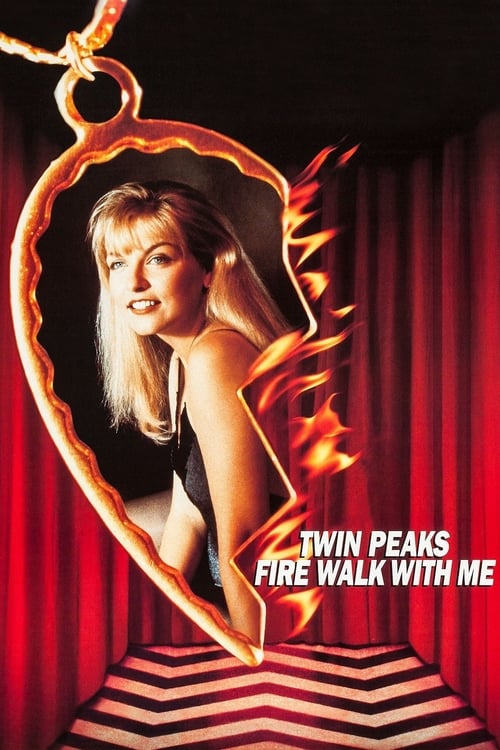
Fire Walk with Me has maintained its reputation in the 2010s and 2020s; in 2014, Robbie Collin (The Telegraph) wrote that "time has passed, and its brilliance is gradually coming into focus, just as Lynch hoped it would." Following Lynch's death in 2025, Esther Zuckerman (The New York Times) called the film "revered." The film placed highly on several retrospective rankings of 1990s films, including #4 by the British Film Institute (2019), #11 by Slant magazine (2012), #18 by IndieWire (2022), and #31 by Time Out (2024). The 2022 Sight & Sound critics' poll ranked the film #211 all-time, tied with (among others) Brief Encounter and Raiders of the Lost Ark. The same poll ranked Fire Walk with Me as Lynch's third-best feature film and fourth-best film, with Mulholland Drive at #8, Blue Velvet at #85, and Twin Peaks: The Return at #152. IGN also ranked it the 76th-best horror movie in history. In 2011, the NME music publication ranked Angelo Badalamenti's soundtrack the greatest film score in history. On the review aggregator website Rotten Tomatoes, 67% of 84 critics' reviews are positive, with an average rating of 7.1/10. The website's consensus reads: "For better or worse, Twin Peaks: Fire Walk with Me is every bit as strange and twisted as you'd expect from David Lynch."
The film and the TV series both benefited from the wave of high-concept cable television dramas in the 2000s and 2010s, colloquially dubbed "Peak TV." Sarah Hughes (The Observer) noted that Twin Peaks was "the show that changed television," and explained that "practically every drama with a mystery at its heart, from Lost to Wayward Pines, has been branded as the new Twin Peaks." Although the show's tension with the formulaic aspects of 1980s–1990s network television was considered "shocking" at the time, the show's more surrealistic aspects, which Fire Walk with Me underscored, were widely copied by a new generation of television showrunners. David Sims (The Atlantic) added that while Fire Walk with Me was "abrasively surreal" and "barely devotes any time to the TV show's core cast outside of Sheryl Lee and Ray Wise," Twin Peaks "practically invented the 'auteurist' idea of creator-driven TV that now pervades every premium network."
The film began shedding its reputation for inaccessibility over the years as the public learned more about sexual abuse and its survivors. In The Best Film You've Never Seen (2013), John Dahl said that Laura Palmer's story "wouldn't be quite as shocking today." Brent Simon (The A.V. Club) added that the subsequent MeToo movement helped open up society to stories like Laura's. Phil Hoad (The Guardian) wrote that while the film remained "unremittingly grim" in 2025, "what seemed in the early 1990s like a self-harming refusal of the series' winning quirkiness now seems ... [like] a striking feat of empathy on Lynch's part".
Several critics have praised the film for disrupting traditional narratives of Americana. Calum Marsh (The Village Voice) wrote that the film exposes "not only the evil buried somewhere in the quintessential middle-class family, but the evil buried somewhere in all of us, and our capacity for it." Scout Tafoya (RogerEbert.com) said that the film showed "the lie we'd been living under Bush and Reagan, that what we needed was a return to family values, to lie about everything that made us uncomfortable." Dom Nero (Esquire) recalled that as a child, he had been taught that speaking backwards (like the characters in Twin Peaks' Red Room) was the work of the Devil, and said that Fire Walk with Me encodes "the concept that demons were hiding in plain sight."
In 1997, Lynch said that "I feel bad that Fire Walk with Me did no business and that a lot of people hated the film. But I really like the film. But it had a lot of baggage with it. It's as free and as experimental as it could be within the dictates it had to follow." He continued Fire Walk with Me's experiments with narrative in his later films, and the premonition-like ambience of the Deer Meadow prologue presaged the "echoing story-within-a-story" of Mulholland Drive. By 2018, he was able to declare that "the collective consciousness changes and people come around. Look at Van Gogh: the guy could not sell one painting and now nobody can afford them."












.jpg?width=400)