



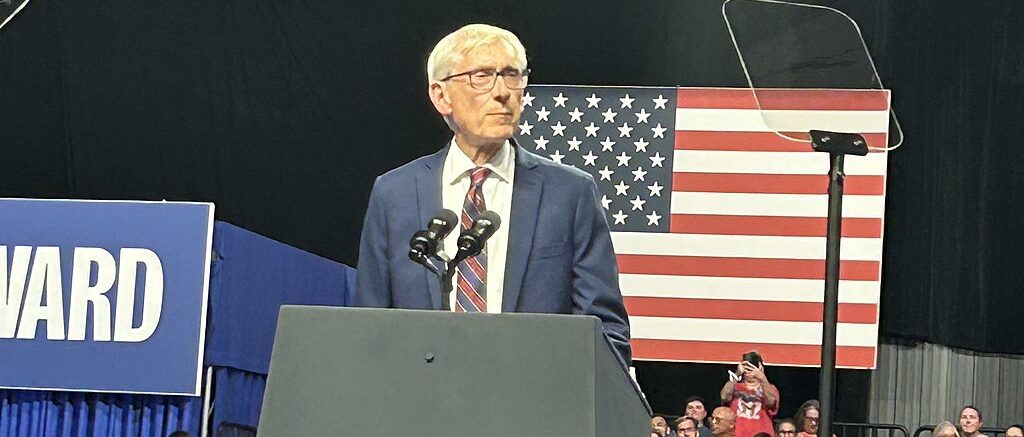


Anthony Steven Evers ( EE-vərz; born November 5, 1951) is an American politician and educator serving since 2019 as the 46th governor of Wisconsin. A member of the Democratic Party, he served from 2009 to 2019 as Wisconsin's 26th superintendent of public instruction.
Born and raised in Plymouth, Wisconsin, Evers was educated at the University of Wisconsin–Madison, where he earned bachelor's, master's, and doctoral degrees in educational administration. After working as a teacher, he became a school administrator, serving as a principal and later as a district superintendent. Evers ran unsuccessfully for Superintendent of Public Instruction in 1993, 1997, and 2001. After his 2001 loss, state superintendent Elizabeth Burmaster appointed him deputy superintendent, a position he held from 2001 to 2009. In 2009, he ran for Superintendent of Public Instruction again and won. He was reelected in 2013 and 2017.
In August 2017, Evers announced that he would run for governor of Wisconsin in the 2018 election. He won the crowded Democratic primary in August 2018 with 41.8% of the vote. Incumbent Republican governor Scott Walker was seen as vulnerable and had been criticized for his education policies. Evers defeated Walker by a margin of 1.1% and was reelected by a larger margin of 3.4% in 2022, defeating Republican nominee Tim Michels.
Evers frequently uses the governor's veto power due to his opposition to much of the Republican-controlled Wisconsin Legislature's agenda. Under Wisconsin law, the governor's veto power is stronger than it is in other U.S. states. Evers has used his veto power more often than any other governor in Wisconsin history, and has used his line-item veto power to change Republican-authored bills. In July 2025, Evers announced he would not seek reelection in 2026.
Contents
Early life and career
Evers was born on November 5, 1951, in Plymouth, Wisconsin, the son of Jean (Gorrow) and Raymond Evers, a physician. His first job was "as a kid, scraping mold off of cheese" in Plymouth. As a young adult, Evers worked as a caregiver in a nursing home. He attended Plymouth High School. He earned bachelor's (1973), master's (1976), and doctoral degrees (1986) in educational leadership from the University of Wisconsin–Madison. He began his professional career as a teacher and media coordinator in the Tomah school district. From 1979 to 1980 he was principal of Tomah Elementary School, and from 1980 to 1984 he was principal of Tomah High School. From 1984 to 1988 Evers was superintendent of the Oakfield school district, and from 1988 to 1992 he was superintendent of the Verona Area School District. From 1992 to 2001 he was administrator of the Cooperative Education Service Agency (CESA) in Oshkosh.
Department of Public Instruction (2001–2019)
Evers first ran for state superintendent, a nonpartisan post, in 1993, losing to John Benson. He ran again in 1997 and placed fifth in the primary. He ran again in 2001 and finished third in the primary. Elizabeth Burmaster won the primary and the general election, and appointed Evers deputy superintendent, a position he held until Burmaster was appointed president of Nicolet College. While serving as Burmaster's deputy, Evers served as president of the Council of Chief State School Officers.
State Superintendent
Evers then ran again in 2009, this time winning. He defeated Rose Fernandez in the general election. In April 2013, Evers defeated Don Pridemore and won reelection. In 2017, Evers defeated Republican candidate Lowell Holtz, a former Beloit superintendent, with about 70% of the vote.
In 2009, Evers used government email accounts to solicit campaign donations during work hours. He and another government employee were fined $250 each for the solicitations.
In 2014, Evers proposed a $1.7 billion increase in state funding for K–12 schools. Wisconsin Governor Scott Walker did not include Evers's proposal in his state budgets, citing the cost. In 2017, Evers called for a tenfold increase in school mental health funding.
In October 2018, a divided federal appeals court found that, because there was a nearby archdiocesan school, Evers had violated neither the U.S. Constitution's Free Exercise Clause nor its Establishment Clause when he denied busing to an independent Catholic school. The U.S. Supreme Court vacated that judgment in 2020 and remanded the case for further consideration. After the Wisconsin Supreme Court answered a question of state law certified by the federal appeals court, the Seventh Circuit ruled in 2021 that the denial of transportation benefits violated Wisconsin law and remanded the case for further proceedings.
Governor of Wisconsin (2019–present)
Elections
On August 23, 2017, Evers announced that he would seek the Democratic nomination for governor of Wisconsin in 2018. He cited his 2017 reelection as state superintendent with over 70% of the vote, as well as his criticism of Governor Walker, as key reasons for deciding to run. Evers launched his first campaign advertisement against Walker on August 28, 2017. Evers won the eight-candidate Democratic primary on August 14, 2018. On November 6, 2018, Evers narrowly defeated Walker in the general election.
Evers sought reelection in 2022. His 2018 running mate, Lieutenant Governor Mandela Barnes, instead chose to run for U.S. Senate. In the August Democratic primary, Evers was unopposed and Brookfield-area state representative Sara Rodriguez was nominated as his running mate. In the general election, Evers and Rodriguez defeated the Republican ticket of Tim Michels and Roger Roth.
Tenure
Evers has frequently used his veto power to oppose legislation passed by the Republican-controlled Wisconsin Legislature. He has used it more frequently than any governor in Wisconsin history, and has used line-item veto power to rewrite Republican-authored bills.
Evers's vetoes have included laws related to election procedures, government powers during a pandemic, education, federal aid, redistricting, guns, police and crime, abortion, social welfare programs, and regulations and licensing.
Before Evers took office, the Republican-led legislature passed new laws weakening the offices of the governor and attorney general. They targeted Evers's authority over economic development issues, required his administration to rewrite thousands of government documents, and required the attorney general to get legislative approval before settling lawsuits. The legislature also restricted voting access. Governor Walker signed all the legislation over Evers's objections. These actions were challenged as unconstitutional, with some voting law changes struck down by a federal district court but later restored by the United States Court of Appeals for the Seventh Circuit.
Also before Evers took office, Walker, the legislature, and the Wisconsin Supreme Court reduced Evers's ability to appoint new administrators. Before leaving office, Walker appointed 82 people and the legislature confirmed them. When a judge declared these appointments unconstitutional, Evers replaced 15 of Walker's appointees. These new appointments were upheld by a Wisconsin Court of Appeals decision but overruled by the Wisconsin Supreme Court. Walker's appointees were reinstated.
The Wisconsin Supreme Court also allowed most of the lame-duck laws the legislature adopted, defeating lawsuits brought by the League of Women Voters and Service Employees International Union. The lawsuits largely hinged on the constitutionality of the legislature holding such votes in "extraordinary sessions"—special sessions not called by the governor. Such sessions are not explicitly authorized by the Constitution of Wisconsin or state law, so litigants contended that the acts of such sessions are not constitutional. The Wisconsin Supreme Court rejected those arguments.
Evers's problems with Republican appointees continued into his term. Late in Evers's first term, many Walker appointees refused to leave office when their terms expired. Evers appointed replacements, but Senate Republicans did not act on the appointments. Evers challenged the holdovers in state court, and the Wisconsin Supreme Court held that appointees whose terms had expired could remain in their positions indefinitely so long as the Senate refused to confirm a replacement. The Senate also rejected a number of Evers's appointees. By March 2024, it had rejected 21 of his appointees; in the previous 40 years, the Senate had rejected four.
Political positions
Abortion
In December 2021, as the United States Supreme Court heard oral argument in Dobbs v. Jackson Women's Health Organization, a case that overturned Roe v. Wade, Evers vetoed five bills that would have restricted access to reproductive healthcare in Wisconsin, saying "as long as I'm governor, I will veto any legislation that turns back the clock on reproductive rights in this state—and that's a promise."
Evers has also signed legislation supported by abortion opponents. In March 2026, he signed legislation by Republicans Rob Hutton and Rick Gundrum that expanded Wisconsin's safe-haven law. The law increased the age at which an infant may be relinquished from 72 hours to 30 days and also authorized the use of newborn infant safety devices. Wisconsin Right to Life applauded the law.
Education
During his 2018 campaign, Evers said he supported more funding for K-12 education and wanted to work with Republicans to do more to help underperforming schools. He would like to expand Pre-K education to all students and continue the freeze of the in-state tuition price for higher education.
In July 2023, Evers made a line-item veto to the state budget for fiscal years 2024 and 2025 that enshrined per pupil increases in school funding of $325 a year until 2425. He did this by striking the hyphen and "20"s from where the budget bill mentioned the 2024–2025 school year. In April 2025, the Wisconsin Supreme Court upheld the validity of this veto; in the majority opinion, justice Jill Karofsky wrote that partial veto power is not constitutionally limited by "how much or how little the partial vetoes change policy, even when that change is considerable".
Gerrymandering
Evers has criticized Wisconsin's legislative maps as "some of the most gerrymandered, extreme maps in the United States," citing as evidence the fact that the state legislature has opposed policies such as legalizing marijuana and expanding Medicaid despite polls showing that a majority of Wisconsinites support both. In January 2020, he created a nonpartisan redistricting commission by executive order with the intent of drawing an alternative map proposal for post-2020 census redistricting to counter the proposal the Republican-controlled legislature has said it will put forward if the issue ends up in the state's court system, as it has under past periods of divided government in Wisconsin.
With the maps stuck in legislative gridlock, both sides sought relief from the courts. The Democrats sued in federal court; federal courts had handled redistricting in Wisconsin every time it had hit gridlock for the past 60 years. Republicans petitioned the Wisconsin Supreme Court, which had not handled a redistricting decision since 1964. The Court, with a 4–3 conservative majority, chose to assume jurisdiction and soon articulated that it would pursue a map with the least changes necessary from the existing one to bring it into compliance with the 2020 census figures. Complying with the Court's rules, Evers and legislative Republicans each submitted maps with only minor changes to the 2011 map. Either map would have left Republicans with significant structural advantages in the legislative elections. But Evers's map better complied with the Court's "least changes" rule, and so the Court's swing vote, Justice Brian Hagedorn, sided with the Court's three liberals to adopt it. Republicans appealed the decision to the United States Supreme Court, which struck down the legislative map in an unsigned opinion, criticizing the flawed process the Wisconsin Supreme Court had used, saying that it failed to properly consider minority representation issues that arose from Evers's map. But the high court did allow Evers's least-change congressional map to stand, since it had no VRA implications. On remand, Hagedorn sided with the court's three conservatives to reject Evers's map and select the Republican alternative. This map was used for the 2022 elections.
In April 2023, Janet Protasiewicz was elected to the Wisconsin Supreme Court, flipping the majority to the liberals. Democratic-aligned interest groups brought new lawsuits, challenging the constitutionality of the 2022 legislative districts. In Clarke v. Wisconsin Elections Commission, the Court struck down the 2022 map on technical grounds and also found that the "least changes" rule had no basis in Wisconsin law or precedent and was therefore invalid. Evers was one of six parties to the lawsuit who proposed remedial redistricting plans. Court-hired consultants soon ruled out the two Republican proposals, saying they were both still gerrymanders. With the Court poised to select one of the four Democratic plans, Republicans in the legislature chose to embrace Evers's proposal. They first passed an amended version of the plan, seeking to protect a handful of incumbents, but Evers vetoed it. Republicans then passed Evers's original map without changes, and Evers signed it into law on February 19, 2024.
Gun control
Evers supports universal background checks for gun purchases. He has also supported an extreme risk protection order act, commonly known as a "red flag law", which would permit family members or police to petition a court to temporarily remove firearms from a person found to pose a danger to themselves or others. Following the December 2024 shooting at Abundant Life Christian School, Evers created a statewide Office of Violence Prevention with $10 million in federal funding. In his 2025 State of the State address, he renewed calls for universal background checks and a red flag law and also proposed a ban on untraceable "ghost guns".
Health care
Evers has said that Scott Walker's decisions about health care in Wisconsin led to higher insurance premiums for residents. He has pointed out that Minnesota accepted a Medicaid expansion and has been more proactive about healthcare overall, resulting in insurance premiums 47% lower than Wisconsin's. Evers supports legislation that would protect residents from higher costs for health insurance due to old age or preexisting conditions. He also supports allowing people to stay on their parents' health insurance plans until age 26. After taking office, Evers directed Attorney General Josh Kaul to withdraw Wisconsin from the multistate lawsuit challenging the Affordable Care Act; the state was dismissed from the case in April 2019.
Using funds from the Infrastructure Investment and Jobs Act and the state Safe Drinking Water Loan Program, Evers's administration allocated more than $402 million in 2023 for drinking-water infrastructure, including lead-service-line replacement and projects addressing contaminants such as PFAS.
Immigration
Evers supports permitting undocumented immigrants living in Wisconsin to obtain driver's licenses, and has called this position "common sense".
In December 2019, in response to Trump's executive order requiring states' consent for refugee resettlement, Evers sent the administration a letter stating that Wisconsin would accept refugees, calling them "part of the fabric of [the] state", and criticizing Trump's refugee policies as "overly cumbersome and inappropriate". In February 2020, Evers sent U.S. Secretary of State Mike Pompeo a letter asking him to halt negotiations with the government of Laos regarding deportations of Wisconsin's Hmong refugee population, who had previously been protected from deportation due to a long record of human rights violations in Laos. In April 2026, Evers signed 2025 Wisconsin Act 240, which allows recipients of Deferred Action for Childhood Arrivals to obtain state occupational credentials if they otherwise meet licensing requirements.
Income tax
During the 2018 campaign, Evers proposed to cut income tax by 10% for Wisconsin residents who earn less than $100,000 per year. He also pledged not to raise taxes, saying, "I'm planning to raise no taxes." Evers's first budget proposal in 2019 increased taxes by $1.3 billion, about 1.5% of the $83 billion state budget. His second proposal reduced his proposed tax increase to $1 billion. Evers's tax increase included raising the gas tax, but the billion-dollar increase in state tax revenue came from reducing tax credits available to large manufacturers and wealthy tax filers with capital gains earnings of more than $300,000 per year. In later years, Evers fulfilled his proposal to cut income taxes by 10% making several line-item vetoes to specific elements, but largely leaving the budget as it was proposed by state Republicans.
Infrastructure
While campaigning for governor, Evers promised to focus on improving roads and bridges. In March 2024, he signed bipartisan bills to increase electric vehicle charging stations.
LGBT rights
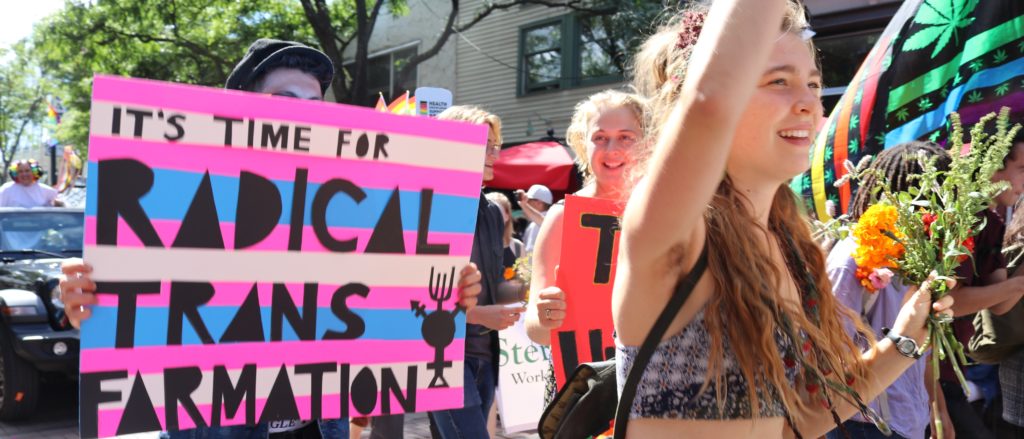
In June 2019, Evers issued an executive order to fly the rainbow flag over the Wisconsin State Capitol for Pride Month, the first time the rainbow flag had flown over the building.
On December 6, 2023, Evers vetoed a bill banning gender-affirming care for minors. He wrote in his veto message, "This type of legislation, and the rhetoric beget by pursuing it, harms LGBTQ people and kids' mental health, emboldens anti-LGBTQ hate and violence, and threatens the safety and dignity of LGBTQ Wisconsinites". Evers said, "I will veto any bill that makes Wisconsin a less safe, less inclusive, and less welcoming place for LGBTQ people and kids."
In April 2024, Evers vetoed a bill that would have barred transgender high school athletes from competing on teams that align with their gender identity. In March 2026, he vetoed five additional bills that would have restricted transgender health care or participation in school sports.
Marijuana legalization
Having campaigned on his support of cannabis in Wisconsin, Evers announced in January 2019 the inclusion of medical marijuana in his state budget as a "first step" toward legalization. On February 7, he announced he would propose legalizing recreational marijuana in his 2021–2023 biennial budget.
Republican legislative leaders have opposed Evers's proposals to legalize recreational marijuana, while some Republicans have supported more limited medical-marijuana legislation. Evers again included recreational and medical marijuana legalization in his 2025–2027 budget proposal, but the Republican-controlled Joint Finance Committee removed the proposal in May 2025.
Personal life
Evers and his wife, Kathy, have three adult children and nine grandchildren.
Evers had esophageal cancer before undergoing surgery in 2008.
Electoral history
Superintendent of Public Instruction (1993)
Evers first ran for Superintendent of Public Instruction in 1993, losing in an election won by John Benson.