Critical response
On the review aggregator website Rotten Tomatoes, 89% of 38 critics' reviews are positive, with an average rating of 7.4/10. Metacritic, which uses a weighted average, assigned the film a score of 59 out of 100, based on 5 critics, indicating "mixed or average" reviews.
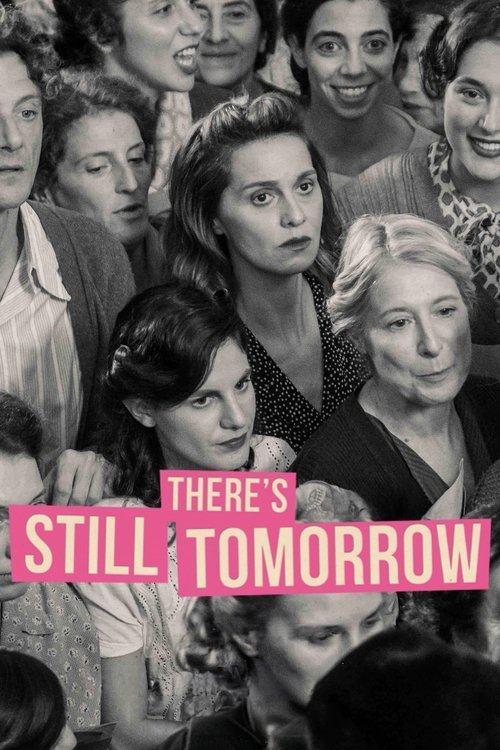
The film received positive reviews from Italian and international film critics, who appreciated its direction and screenplay in addressing issues related to feminism and patriarchy, as well as the acting skills of the actors, especially Cortellesi herself, Valerio Mastandrea, and Romana Maggiora Vergano.
Paolo Mereghetti, reviewing the film for Il Corriere della Sera, wrote that Cortellesi's work is "decidedly remarkable" as the directorial choices "try to find an unobvious balance between a realistic key and a more exemplary and didactic one," finding that some solutions have "naiveté" are "a consequence of the ambition and originality put into the field." The critic claimed that the film aims to "broaden the discourse of Delia and the other women toward a dimension that is no longer just individual but finally collective and social," and that although the film deals with themes "of violence and mistreatment," the project "never shows in its stark realism." Boris Sollazzo of The Hollywood Reporter Roma appreciated the director's ability to take "shots, especially the more emphatic and paroxysmal ones, in a counterintuitive way, to emphasize normality, of a walk or a fight," while the cinematography and editing come across as "as abrupt as it should be, retracing an even visual language of the time, albeit with modern faces and some directorial solutions."
Alessandro De Simone of Ciak also wrote that the film sets itself on the comedy genre with a "courageous contamination between musical Italian neorealism and postmodernism" and "veering at one point almost toward giallo." The journalist noted that although it does not turn out to be all balanced, the script "brings a higher cinematic level" to the project, appreciating "the comic timing and all the performances," especially by Emanuela Fanelli, Paola Tiziana Cruciani, and "the surprise, beautiful" Romana Maggiori Vergani. Dwelling on the themes addressed by the film, Luisa Garribba Rizzitelli of HuffPost italia associated it with the terms "unveiling" and "self-determination," believing that it presents "something revolutionary and full of hope" since it is not addressed "to women [...], but turning to mates, brothers, fathers, [who] can only mirror themselves in the sequence of merciless episodes: the male overpower spoiled by the privileges of the still patriarchal culture." Rizzitelli affirmed that Cortellesi "is showing them not a past time, but the mirror of what is still there today" by imposing in the film's finale "precisely on men, to decide which side they are on, determining, their position with respect to the struggles of feminism."
In a four out of five-star review, Peter Bradshaw of The Guardian wrote that the film is a "storytelling with terrific confidence and panache", which "pays homage to early pictures by Vittorio De Sica and Federico Fellini" through "a piece of narrative sleight-of-hand that borders on magic-neorealism, performed with shameless theatrical flair and marvellously composed in luminous monochrome". Jonathan Romney of Financial Times described the film as "a thoughtful, emotionally satisfying, immensely entertaining one-off, with an ending that smartly dynamites our expectations", prizing Davide Leone cameraworks and Cortellesi direction which "pulls some clever, sometimes risky tricks, shifting between melodrama, farce and some uncomfortable heightened moments". In his review, Screen International critic Allan Hunter paired the film to the classic Italian neorealism cinema, and described it as "an unashamed, old-fashioned melodrama [which] develops into a more considered tale of small victories on the road to female empowerment."