



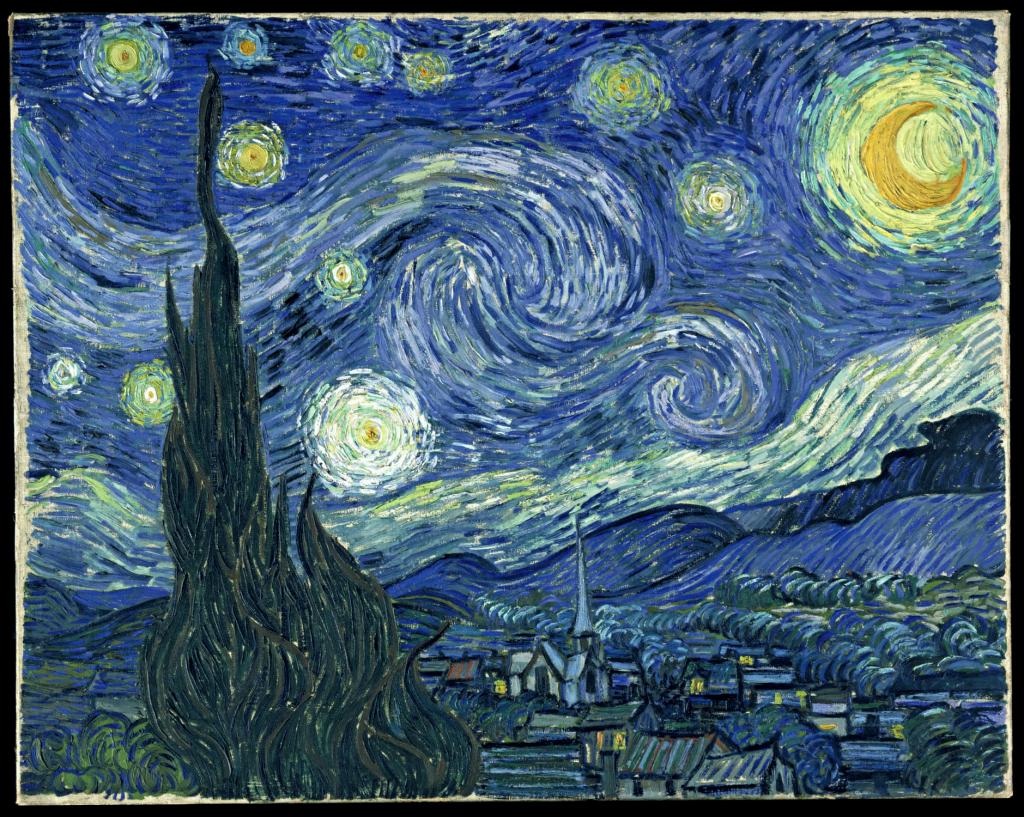
The Starry Night is an oil-on-canvas painting by the Dutch Post-Impressionist painter Vincent van Gogh. Painted in June 1889, it depicts the view from the east-facing window of his asylum room at Saint-Rémy-de-Provence, just before sunrise, with the addition of an imaginary village. It has been in the permanent collection of the Museum of Modern Art in New York City since 1941, acquired through the Lillie P. Bliss Bequest. Described as a "touchstone of modern art", The Starry Night has been regarded as one of the most recognizable paintings in the Western canon.
The painting was created in mid-June 1889, inspired by the view from Van Gogh’s bedroom window at the Saint-Paul-de-Mausole mental asylum near Saint-Rémy-de-Provence. The former monastery functioned as a mental asylum, where Van Gogh voluntarily admitted himself on 8 May 1889, following a mental breakdown and his infamous act of self-mutilation that occurred in late December 1888. Catering to wealthy patients, the facility was less than half full at the time of Van Gogh's admission, allowing the artist access to both a second-story bedroom and a ground-floor studio. During his year-long stay, he remained highly productive, creating many paintings including Irises, a self-portrait, and The Starry Night.
The painting's celestial elements include Venus, which was visible in the sky at the time, and the Moon, although the Moon's depiction is not astronomically accurate. The cypress trees in the foreground were exaggerated in scale compared to other works. Van Gogh's letters suggest he viewed them primarily in aesthetic rather than symbolic terms. The village in the painting is an imaginary addition, based on sketches rather than the actual landscape seen from the asylum.
The Starry Night has been subject to various interpretations, ranging from religious symbolism to representations of Van Gogh’s emotional turmoil. Some art historians link the swirling sky to contemporary astronomical discoveries, while others see it as an expression of Van Gogh’s personal struggles. Van Gogh himself was critical of the painting, referring to it as a "failure" in letters to his brother, Theo. The artwork was inherited by Theo upon Vincent's death. Following Theo's death six months after Vincent's, the work was owned by Theo's widow, Jo, who sold it to Émile Schuffenecker in 1901, who sold it back to Jo in 1905. From 1906 to 1938 it was owned by one Georgette P. van Stolk, of Rotterdam. Paul Rosenberg bought it from van Stolk in 1938 and sold it (by exchange) to the Museum of Modern Art in New York in 1941, which rarely loans it out. Scientific analysis of the painting has confirmed Van Gogh’s use of ultramarine and cobalt blue for the sky, with indian yellow and zinc yellow for the stars and moon.
Contents
The asylum
In the aftermath of the 23 December 1888 breakdown that resulted in the self-mutilation of his left ear, Van Gogh voluntarily admitted himself to the Saint-Paul-de-Mausole lunatic asylum on 8 May 1889. Housed in a former monastery, Saint-Paul-de-Mausole catered to the wealthy and was less than half full when Van Gogh arrived, allowing him to occupy not only a second-story bedroom but also a ground-floor room for use as a painting studio.
During the year Van Gogh stayed at the asylum in Saint-Rémy-de-Provence, the prolific output of paintings he had begun in Arles continued. During this period, he produced some of the best-known works of his career, including the Irises from May 1889, now in the J. Paul Getty Museum, and the blue self-portrait from September 1889, in the Musée d'Orsay. The Starry Night was painted by around 18 June, the date he wrote to his brother Theo to say he had a new study of a starry sky.
The painting
Although The Starry Night was painted during the day in Van Gogh's ground-floor studio, it would be inaccurate to state that the picture was painted from memory. The view has been identified as the one from his bedroom window, facing east, a view which Van Gogh painted variations of no fewer than twenty-one times, including The Starry Night. "Through the iron-barred window", he wrote to his brother, Theo, around 23 May 1889, "I can see an enclosed square of wheat ... above which, in the morning, I watch the sun rise in all its glory."
Van Gogh depicted the view at different times of the day and under various weather conditions, such as the sunrise, moonrise, sunshine-filled days, overcast days, windy days, and one day with rain. While the hospital staff did not allow Van Gogh to paint in his bedroom, he was able there to make sketches in ink or charcoal on paper; eventually, he would base newer variations on previous versions. The pictorial element uniting all of these paintings is the diagonal line coming in from the right depicting the low rolling hills of the Alpilles mountains. In fifteen of the twenty-one versions, cypress trees are visible beyond the far wall enclosing the wheat field. Van Gogh exaggerated their size in six of these paintings, most notably in F717 Wheat Field with Cypresses and The Starry Night, bringing the trees closer to the picture plane.
Also, in addition to that, one of the first paintings of the view was F611 Mountainous Landscape Behind Saint-Rémy, now in Copenhagen. Van Gogh made several sketches for the painting, of which F1547 The Enclosed Wheatfield After a Storm is typical. It is unclear whether the painting was made in his studio or outside. In his 9 June letter describing it, he mentions he had been working outside for a few days. Van Gogh described the second of the two landscapes he mentions he was working on, in a letter to his sister Wil on 16 June 1889. This is F719 Green Wheat Field with Cypress, now in Prague, and the first painting at the asylum he painted en plein air. F1548 Wheatfield, Saint-Rémy de Provence, now in New York, is a study for it. Two days later, Vincent wrote to Theo stating that he had painted "a starry sky".
The Starry Night is the only nocturne in the series of views from his bedroom window. In early June, Vincent wrote to Theo, "This morning I saw the countryside from my window a long time before sunrise with nothing but the morning star, which looked very big". Researchers have determined that Venus (sometimes referred to as the "morning star") was indeed visible at dawn in Provence in the spring of 1889, and was at that time nearly as bright as possible. So the brightest "star" in the painting, just to the viewer's right of the cypress tree, is Venus.
Interpretations
Despite the large number of letters Van Gogh wrote, he said very little about The Starry Night. After reporting that he had painted a starry sky in June, Van Gogh next mentioned the painting in a letter to Theo on or about 20 September 1889, when he included it in a list of paintings he was sending to his brother in Paris, referring to it as a "night study." Of this list of paintings, he wrote, "All in all the only things I consider a little good in it are the Wheatfield, the Mountain, the Orchard, the Olive trees with the blue hills and the Portrait and the Entrance to the quarry, and the rest says nothing to me"; "the rest" would include The Starry Night. When he decided to hold back three paintings from this batch to save money on postage, The Starry Night was one of the paintings he did not send. Finally, in a letter to painter Émile Bernard from late November 1889, Van Gogh referred to the painting as a "failure."
Van Gogh argued with Bernard and especially Paul Gauguin as to whether one should paint from nature, as Van Gogh preferred, or paint what Gauguin called "abstractions": paintings conceived in the imagination, or de tête. In the letter to Bernard, Van Gogh recounted his experiences when Gauguin lived with him from 23 October 1888, to 25 December of the same year. "When Gauguin was in Arles, I once or twice allowed myself to be led astray into abstraction, as you know. . . . But that was a delusion, dear friend, and one soon comes up against a brick wall. . . And yet, once again I allowed myself to be led astray into reaching for stars that are too big—another failure—and I have had my fill of that." Van Gogh here is referring to the expressionistic swirls which dominate the upper center portion of The Starry Night.
Theo referred to these pictorial elements in a letter to Vincent dated 22 October 1889: "I sense what preoccupies you in the new canvases like the village in the moonlight [The Starry Night] or the mountains, but I feel that the search for style takes away the real sentiment of things." Vincent responded in early November, "Despite what you say in your previous letter, that the search for style often harms other qualities, the fact is that I feel greatly driven to seek style if you like, but I mean by that a more manly and more deliberate drawing. If that will make me more like Bernard or Gauguin, I can't do anything about it. But am inclined to believe that in the long run, you'd get used to it." And later in the same letter, he wrote, "I know very well that the studies drawn with long, sinuous lines from the last consignment weren't what they ought to become, however, I dare urge you to believe that in landscapes one will continue to mass things by means of a drawing style that seeks to express the entanglement of the masses."
Provenance
After having initially held it back, Van Gogh sent The Starry Night to Theo in Paris on 28 September 1889, along with nine or ten other paintings. Theo died less than six months after Vincent, in January 1891. Theo's widow Jo became the caretaker of Van Gogh's legacy. In Paris in 1900 she sold the painting to poet Julien Leclercq. In 1901 Leclercq sold it to Gauguin's old friend Émile Schuffenecker. Jo bought the painting back from Schuffenecker and in 1906 sold it to the Oldenzeel Gallery in Rotterdam. From 1906 to 1938 it was owned by Georgette P. van Stolk, of Rotterdam, who sold it to Paul Rosenberg, of Paris and New York. It was through Rosenberg, who in 1940 fled to the United States following the Nazi occupation of France, that the Museum of Modern Art acquired the painting in 1941. According to episode 102 of "The Economics of Everyday Things" podcast, the acquisition was made by exchanging two Cezannes and a Toulouse-Lautrec for it, according to MOMA director Glenn Lowry. Through its acquisition by the Museum of Modern Art, The Starry Night would gain greater attention, now standing as one of the most famous works of Western art.
Painting materials
The painting was investigated by scientists at the Rochester Institute of Technology and the Museum of Modern Art in New York. The pigment analysis has shown that the sky was painted with ultramarine and cobalt blue, and for the stars and the moon, Van Gogh employed the rare pigment indian yellow together with zinc yellow.