




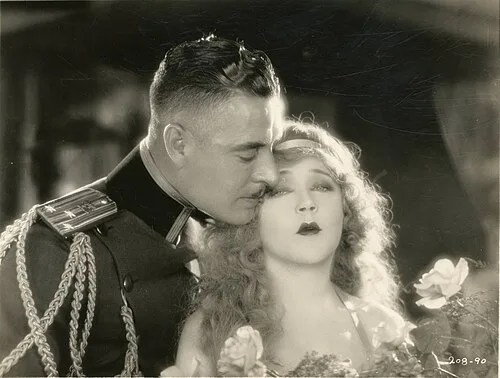
The Merry Widow is a 1925 American silent romantic drama, black comedy film directed and written by Erich von Stroheim. Released by Metro-Goldwyn-Mayer, the film stars Mae Murray, John Gilbert, Roy D'Arcy, and Tully Marshall, with pre-fame uncredited appearances by Joan Crawford and Clark Gable. The film is based on Franz Lehár's 1905 operetta of the same name, and was its second film adaptation, the first being a 1918 Hungarian film directed by Michael Curtiz.
Contents
Plot
As described in film magazine reviews, Prince Danilo meets Sally the dancer and, when he proposes marriage, his uncle, King Nikita I of Monteblanco and Queen Milena object because she is a commoner. Sally marries Baron Sadoja, an old wealthy roue who later dies from a stroke. Prince Danilo’s parents now encourage the marriage. A slurring remark is the cause of a duel between the cousins and Danilo is wounded, sacrificing his cousin whom he believes Sally loves. Crown Prince Mirko is assassinated and Danilo becomes heir to the throne. Sally visits Danilo at the hospital and asks him to marry her.
Cast
Mae Murray as Sally O'Hara
John Gilbert as Prince Danilo Petrovich
Roy D'Arcy as Crown Prince Mirko
Josephine Crowell as Queen Milena
George Fawcett as King Nikita I
Tully Marshall as Baron Sixtus Sadoja
Edward Connelly as Baron Popoff (ambassador)
Uncredited
Selected cast that were uncredited:
Helen Howard Beaumont as Chorus girl
Gertrude Bennett as Hard-Boiled Virginia
Bernard Berger as Boy
Sidney Bracey as Danilo's footman
Estelle Clark as French barber
Albert Conti as Danilo's adjutant
D'Arcy Corrigan as Horatio
Joan Crawford as Extra
Xavier Cugat as Orchestra leader
Anielka Elter as Blindfolded musician
Dale Fuller as Sadoja's chambermaid
Clark Gable as Ballroom dancing extra
Edna Tichenor as Dopey Marie
Zalla Zarana as Frenchie Christine
Edna Simms as Ballroom dancing extra
Production
The film was shot over twelve weeks with a budget of $592,000. Filming was tense as Mae Murray and the film's director, Erich von Stroheim, did not get on well. After production, Metro-Goldwyn-Mayer decided it could no longer work with the director after he added sexually explicit scenes and changed the operetta's libretto.
Reception
Upon its release, the film was both a critical and box office success. Critics praised Murray's dramatic skills while also noting that von Stroheim had "made an actress out of Miss Murray". According to MGM records The Merry Widow took in approximately $1.081 million in theater rentals from the United States and Canada, an additional $852,000 from foreign rentals, and earned a profit of $758,000.
Other adaptations
The Merry Widow was adapted for the screen in 1934, 1952, 1962, and 1994.