Critical reception
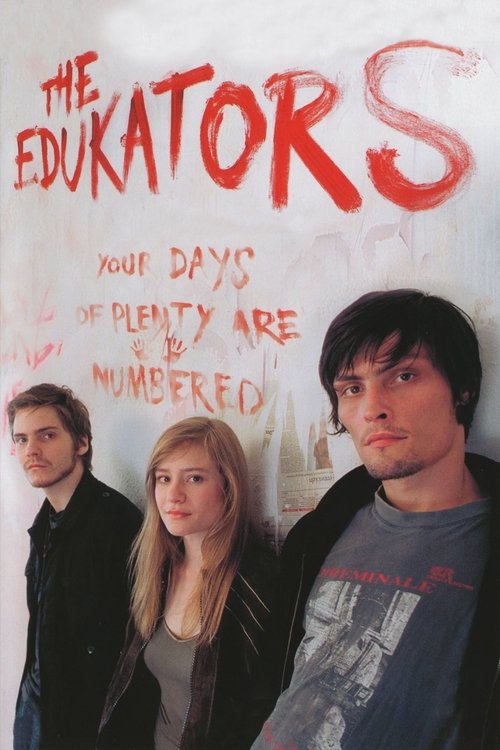
The film was generally well received by critics. Based on 76 reviews collected by Rotten Tomatoes, it has an overall approval rating of 70% from critics and an average score of 6.5 out of 10. According to the website's consensus, "The Edukators engagingly plays out the clash between youthful idealism and older pragmaticism." Metacritic, which assigns a normalised rating from 100 top reviews by mainstream critics, calculated a score of 68 based on 28 reviews, indicating "generally favorable reviews". Stephanie Bunbury of The Age wrote that in Germany it was a "huge hit ... Abroad, however, it has been the butt of plenty of criticism. It is too earnest, too naive, too Teutonic and sincere."
Joe Morgenstern of The Wall Street Journal called The Edukators "an uncommonly smart and interesting" film, and the Austin Chronicle's Marc Savlov said the film was a "smart, kicky little gem that owes as much to Guy Debord and the Situationists." According to Sean Axmaker of the Seattle Post-Intelligencer, it was "a rare film that gets smarter as it goes along ... inject[ing] a satisfying dash of pragmatism every time it seems ready to slip into either unearned idealism or cynical fatalism." Ray Bennett wrote for The Hollywood Reporter, "The Edukators is that rare beast, a terrific movie that boasts intelligent wit, expert storytelling, delightful characters and grown-up dialogue plus suspense and a wicked surprise ending."
A. O. Scott of The New York Times wrote that despite "its shortcomings" on political subjects, it "succeeds brilliantly in telling the story of a man who falls in love with his best buddy's girlfriend and doesn't know what to do about it." Tim Appelo of Seattle Weekly praised "the marvelous acting, the sensitive, utterly realistic treatment of the young-love triangle," adding: "The Edukators is educational—not intellectually, but emotionally." Washington Post critic Stephen Hunter praised the film's realism: "The whole thing feels messy, painful, funny and believable, just like that hideous circus known as real life." The Times' Howard Swains wrote that it "manages to combine political discourse, a love-triangle and a hostage plot, all without sacrificing its graceful humour." Los Angeles Times critic Carina Chocano described it as a "sweet, funny and gripping romantic adventure," and "The only accurate, ironic and poignant depiction of what it's like to be young and socially committed in the WTO era". Chocano choose it as one of the 13 best films released in 2005. Liese Spencer of Sight & Sound also elected it as one of the best five films of 2005.
Not all reviews were positive. The Orlando Sentinel's Roger Moore called The Edukators "a surprisingly generic German 'Stockholm syndrome' romantic triangle thriller," adding: "It ends interestingly, but it would've ended better, and played better, had it been half an hour shorter." In Slant Magazine, Jason Clark wrote that the film needed "a touch of the perverse", but "Weingartner plays out the drama far too earnestly, and the story barely sustains the length of a movie half of its running time." According to Jack Mathews of the New York Daily News, "The dialogue between the captive and the captors gets a little didactic, and the ending is as contrived as it is cynical." Similar criticism of the film's didacticism was made by Brett Michel of Boston Phoenix, Kriss Allison of Stylus Magazine and Glenn Whipp of the Los Angeles Daily News.
Andre Wright wrote for The Stranger, "[It] starts strong, with an ingratiatingly anarchic vibe, but quickly devolves into a dust-dry, hectoring socialist lecture: a cinematic version of Kenner's My First Revolution playset." Jonathan Romney of The Independent said that Weingartner "presents his indictment of the System in crudely stacked terms that make The Edukators very much a teen movie rather than a plausible political statement." In The Times, Wendy Ide wrote: "What could have been an effective piece of drama, a dialogue to cause both sides to question the very foundations of their belief systems, is just a two-hour rant from a wispy bearded idealist whose idea of brotherhood is to sleep with his best friend's girlfriend."
The film has been considered to be part of a "New German Wave" in the cinema. The Deutsche Welle staff considered it to be one of the best German films of 2004 and early 2005. In 2018, the British Film Institute named it one of the ten "great German films of the 21st century". News publisher The Local and DE magazine Deutschland also included the film among the best ten films of Germany in 2018 and 2019 articles.