Critical response
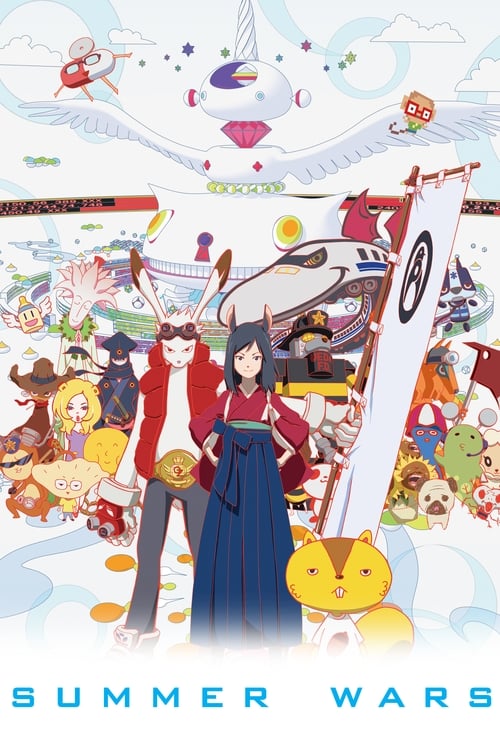
On the review aggregator website Rotten Tomatoes, 78% of 23 critics' reviews are positive, with an average rating of 7.1/10. The website's consensus reads: "Family drama mixes with virtual online action in the breezy and entertaining Summer Wars." Metacritic, which uses a weighted average, assigned the film a score of 63 out of 100, based on 12 critics, indicating "generally favorable" reviews.
Mark Schilling of The Japan Times rated the film 5 out of 5 stars and observed that Summer Wars "may contain familiar elements, beginning with its bashful, moonstruck young hero, but it combines them in ways fresh, contemporary and dazzlingly imaginative". He also said that the film provides a social commentary on the differences between an "analog world" and a "realm of digital devices". Schilling titled his article "The future king of Japanese animation may be with us; Hosoda steps out of Miyazaki's shadow with dazzling new film". He praised Sadamoto, Aoyama and Nishida for producing "scenes of animated spectacle that, in their dazzling fluency of motion and untethered brilliance of invention, makes the usual SF/fantasy anime look childish and dull". Twitch Film published a review by Guillem Rosset who also referenced Miyazaki noting that following The Girl Who Leapt Through Time "cries went out immediately hailing him [Hosoda] as the heir apparent". He claimed that with Summer Wars, "Hosoda is the new king, the best story teller working within the animated medium in Japan and – quite possibly – the world." Rosset praised the film itself as "richly detailed and beautifully written...gorgeous to look at." and "blessed with an extensive cast of stunningly detailed and authentic characters." He concluded by saying "Hosoda has perfectly balanced the need to entertain via the visuals with the rich and satisfying character work that separates him from the massive pack of quality technicians to establish himself as truly a master story teller." He also noted that "The wonderful cast of characters is one of the film's greatest strengths" while also highlighting that, of the virtual world of OZ, "Here the creative minds of Madhouse can let their imagination run wild." With regards to the technical aspects, Rosset called the film "a top class audiovisual show." He concluded by writing "Mamoru Hosada deserves a place as one of the top contemporary Japanese animators. And it's good to know that once the time comes for Miyazaki to retire (not too soon I hope!) there's people capable of following his steps." The Korean newspaper Herald Business saw the film's fantasy theme and gorgeous animation as a differentiator from works produced by Hollywood studios.
Patrick W. Galbraith of Otaku2.com compared the design of OZ to Takashi Murakami's artwork, specifically "the flatness, or slick, polished surfaces" and then contrasted them with the sequences in Nagano noting, "it has a warm and lived in feel to it, aided by a scrupulous attention to detail." Of the story and characters Galbraith wrote that "scenes such as the large family coming together and talking over dinner are heartwarming and hilarious" and compared the movie to "a moving picture book, a family photo album turned back a few decades." He also noted the audience response, reporting sold-out screenings two nights in a row, and highlighting handwritten notes left at the theater by "hordes of fans who on the spot decided to move to Nagano." In conclusion, Galbraith wrote "there is an innocence and purity to this work that really reminds [him] of Miyazaki Hayao and Studio Ghibli back in the day, and the stellar backgrounds invoke Shinkai Makoto." Justin Sevakis of Anime News Network gave the film an 'A' rating and wrote that "decades from now, Summer Wars will be seen as the official arrival of [director] Mamoru Hosoda into the realm of historically important anime directors." He called the film "a near-perfect blend of social satire and science fiction, at once timely and timeless, sardonic and optimistic." and noted that the film is "practically overflowing with sharp social insight in a way we have not seen from anime in years." Sevakis praised Yoshiyuki Sadamoto's character designs and highlighted the visuals as "sharp and consistently great". In summing the film up he called Summer Wars "Incredibly entertaining, and intriguingly intelligent. Accessible and fast-paced. Pretty much perfect." Similarities have been commented on between the film and a previous work of Hosoda, Digimon Adventure: Our War Game. Neo magazine has stated that Our War Game is "plainly a prototype" of Summer Wars. Hosoda has stated that Our War Game "kind of started my idea for Summer Wars," noting that Summer Wars "became the feature-length version of that idea" and allowed him to explore material he was unable to in Our War Game's 40 minute runtime.
Rachel Saltz of The New York Times also gave a positive review of the film. Saltz praised Mamoru Hosoda's direction, and says it "matches the clean, classically composed images of his [Hosoda's] outer story." She further praised the visuals and themes, comparing it to those of director Yasujirō Ozu. In his review for Variety critic Peter Debruge stated that Hosoda's direction "appeals to the hard-to-please teen crowd by taking mind-bending ideas and planting them within a relatable contempo context." He also praised the CG animation in the OZ sequences. Peter Hartlaub of the San Francisco Chronicle praised Hosoda's style and said that it "adds enough dimensions to his characters and kinetic battles that the serene real world seems like a dream state." He also likened Hosoda's style to that of Hayao Miyazaki and Nintendo. Hartlaub complained that Kenji's character is "a bit too over-caffeinated in the first part" and concluded that the film is "the kind of fun and quirky film that you don't see very often in art houses this time of year." Ty Burr of The Boston Globe gave the film 3 out of 4 stars. He stated that "Summer Wars is most appealing in its hushed moments" and also praised Satoko Okudera's writing, stating that it "stakes a claim for the non-virtual world of history and of family ties that stretch back to Japan's medieval era." He also praised the OZ animation sequences as "visually ravishing explorations of white-on-white cyberspace, but the hectic gaming action sequences feel curiously passé." Burr notes that in the film, "it's what's old that's made to seem refreshingly new." Nicolas Rapold of The Village Voice also praised the film's visuals, and said that "it's hard to appreciate things like the character detail amid the insufferably squealy voicing and arbitrary suspense."
Kevin Thomas of the Los Angeles Times praised the film's visuals, stating that "Summer Wars is awesome in its detailed depiction of Oz, which floats in space with an array of satellites, and earthly cityscapes visited by calamities." Thomas also said the film is "also a superb example of Japanese anime, balancing science fiction fantasy with a paean to the timeless value of family life." and called it "a sophisticated yet poignant family entertainment with an appeal beyond Japanese animation buffs." Stephanie Merry of The Washington Post gave the film 2 out of 4 stars. Merry criticized the film's plot, stating that it "ventures into territory both melodramatic and corny." Merry also said that the relationship between Natsuki and Kenji "unfolds as blandly as a Debra Messing rom-com." Frank Scheck of The Hollywood Reporter stated that the "increasingly convoluted narrative may be too difficult to follow for younger viewers," but said that the film's "thematic ambition and dazzling visual style ultimately make it one of the more rewarding anime efforts to reach these [American] shores."
Retrospective reviews of the film have largely confirmed its enduring popularity and reputation. Writing for TheWrap, William Bibbiani named the film one of the ten best animated films of the 2010s (based on the US release date), while Toussaint Egan and Jason DeMarco of Paste Magazine and William Lobley of Empire declared the movie one of the best anime films of all time.