




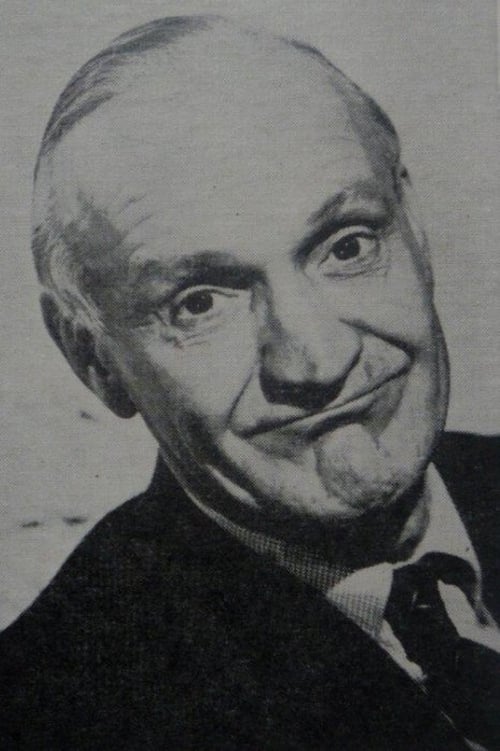
Stanley Unwin (7 June 1911 – 12 January 2002), sometimes known as Professor Stanley Unwin, was a British comic actor and writer.
He invented his own comic language, "Unwinese", referred to in the film Carry On Regardless (1961) as "gobbledygook". Unwinese was a corrupted form of English in which many of the words were altered in playful and humorous ways, as in its description of Elvis Presley and his contemporaries as being "wasp-waist and swivel-hippy". Unwin claimed that the inspiration came from his mother, who once told him that on the way home she had "falolloped (fallen) over" and "grazed her kneeclabbers".
Contents
Early life
Unwin's parents, Ivan Oswald Unwin (1880–1914) and his wife, Jessie Elizabeth (née Brand; 1883–1968), emigrated from England to the Union of South Africa in the early 1900s. Their son was born in Pretoria in 1911. Following his father's death in 1914, owing to the family's poverty Unwin's mother arranged for the family to return to England. She worked as a cook at Bow Road police station. By 1919 Unwin had been sent to the National Children's Home in Congleton, Cheshire. In the late 1920s he studied radio, television and languages at Regent Street Polytechnic in London.
In 1937 he married Frances, with whom he had two daughters and a son. Unwin later stated that Unwinese had its roots in enlivening the bedtime stories that he used to tell his children. In 1940 he was given a job in transmitter maintenance for the BBC and assigned to the Borough Hill transmitting station in Daventry. Unwin, Frances and their nine-month-old daughter, Marion, moved to Long Buckby, in Northamptonshire, where Unwin would live for the rest of his life.
Comedy career
Unwin's early career and training introduced him to wireless and radio communication, and this, coupled with work in the BBC's War Reporting Unit from about 1944, ultimately proved to be his passage into the media.
While based in Birmingham from 1947 to 1951 Unwin made his first, accidental, transmission. While testing equipment he gave the microphone to broadcaster F.R. "Buck" Buckley, who ad-libbed a spoof commentary about an imaginary sport called "Fasche". Buckley then introduced Unwin as "Codlington Corthusite", whereupon Unwin continued the sketch in Unwinese. The recording was broadcast on Pat Dixon's Mirror of the Month programme and a favourable audience reaction led to the commissioning of another sketch, in which Unwin, playing an inhabitant of Atlantis, was interviewed about life in the sunken city. A letter of praise from Joyce Grenfell, whom Unwin admired, gave him confidence and he determined on a career in show business.
After the war, while in Egypt and recording a series of shows by Frankie Howerd, Unwin stood in for the comedian when Howerd fell ill. Unwin's next major breakthrough came when producer Roy Speer introduced him to the comedian Ted Ray. Once Ray had heard Unwin talking, he said simply: "I want him in the series" – namely, The Spice of Life, co-starring June Whitfield and Kenneth Connor. During the mid-1950s Unwin performed in about a dozen shows for Speer and made the acquaintance of Johnnie Riscoe and his daughter, Patsy, who would become his managers for the rest of his career. By the end of the 1950s Unwin had ventured into the film industry, being given a part in the Cardew Robinson film Fun at St Fanny's (1956).
In December 1959 Unwin appeared with Steve Race in a Boxing Day edition of the BBC Light Programme's Just Jazz in an early evening Saturday broadcast of the jazz record programme as "Professor Stanley Unwin, Professor of Jazz Studies at Brewflade University".
In 1968 Unwin was invited to narrate Happiness Stan, a six-song fairy tale about a boy of the same name, taking up the entire side two of the Small Faces' album Ogdens' Nut Gone Flake, which reached number 1 in the UK Albums Chart.
In 1969 appeared in Gerry Anderson's Supermarionation TV series The Secret Service, both in person and as the voice of the puppet character Father Stanley Unwin, whose appearance was based on him. Episodes typically consisted of one or more scenes in which the character of Unwin would attempt to baffle opponents with his gobbledegook. When Lew Grade, Anderson's financial backer and head of distributor ITC, was introduced to the Unwinese dialogue, he cancelled the production on the basis that he believed viewers would not understand what Unwin was saying, despite the fact that such confusion was intentional.
Unwinese
Unwinese, also known as Basic Engly Twenty Fido, was an ornamented and mangled form of English in which many of the words were deliberately corrupted in a playful and humorous manner but which was still largely comprehensible to the listener. Unwin's performances could be hilarious yet disorientating, where the meaning and context were conveyed in a disguised and picturesque style. For example in his talk on music, Populode of the Musicolly, Unwin says:
They do in fact go back to Ethelrebbers Unready, King Albert's burnt capers where, you know, the toast fell in and the dear lady did get a very cross knit and smote him across the eardrome excallybold. The great sword which riseyhuff and Merlin forevermore was the beginning of the Great Constitution of the Englishspeaking peeploders of these islone, oh yes.
Unwinese has been compared to Lewis Carroll's nonsense poetry, such as Jabberwocky, where the sentences sound superficially like English when read aloud but their precise meaning is unclear.
Death and legacy
Unwin died at Danetre Hospital in Daventry on 12 January 2002. He is buried in the churchyard at Long Buckby, with Frances, who predeceased him in 1993. Their gravestone bears the epitaph, "Reunitey in the heavenly-bode – Deep Joy!".
A thanksgiving service was held at St Lawrence's Church in Long Buckby and ended with a rendering of "Bye Bye Blackbird" by John Percival and friends. The valediction had been prepared by Unwin's family in his own style: "Goodly Byelode loyal peeploders! Now all gatherymost to amuse it and have a tilty elbow or a nice cuffle-oteedee – Oh Yes!"
Suns of Arqa released a tribute album to Unwin (entitled Tributey) following his death, featuring a selection of his works with the band over the years, as well as various interviews.
Unwin's work is considered to have been a significant influence on the two books written by John Lennon: In His Own Write (1964) and A Spaniard in the Works (1965).