Costume, set design, and filming
Production and filming of the series ran from June to October 2020, including a mandatory month-long break due to the COVID-19 pandemic. City scenes were filmed in Daejeon, while the island set pieces were filmed on Seongapdo located in Ongjin.
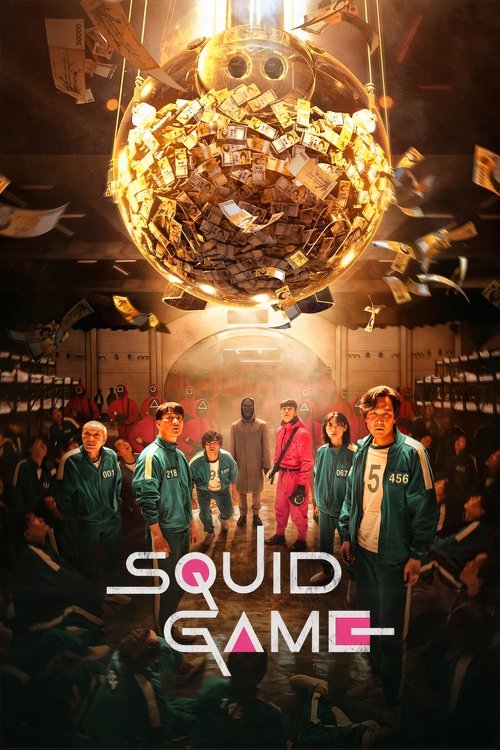
As Netflix was targeting the work for a global audience, the visuals were emphasized and some of the rules of the children's games were simplified to avoid potential issues with the language barrier. The colorful sets and costumes were designed to look like a fantasy world. The players and soldiers each wear a distinctive color, to reduce the sense of individuality and emphasize the difference between the two groups. The green tracksuits worn by the players were inspired by 1970s athletic wear, known as trainingbok (트레이닝복). The maze-like corridors and stairs drew inspiration from the 4-dimensional stair drawings of M. C. Escher including Relativity. Production designer Chae Kyoung-sun said these seemingly infinite stairways represented "a form of bondage for the contestants". The complex network of tunnels between the arena, the dorm, and the administrative office was inspired by ant colonies.
Chae was also inspired by the Saemaul Undong political initiative of the 1970s aimed to modernize rural South Korean villages. The mint green and pink color theme throughout the show were a common theme from South Korean schools in the 1970s and 1980s. Green-suited characters develop associations of fear with pink through its use in guard outfits and the stairway room.
The players' dormitory was envisioned with the concept of "people who are abandoned on the road" according to Chae; this was also used in the tug-of-war game. The room was designed using white tiles and the curved opening like a vehicular tunnel. The bed and stairs initially were laid out to look like warehouse shelves, but as the episodes progressed and these furnishing used as makeshift defenses, they took the appearance of broken ladders and stairs, implying the way these players were trapped with no way out, according to Chae. The dinner scene that took place in the eighth episode was inspired by the art installation The Dinner Party by Judy Chicago. Walls of many of the areas where the games took place were painted in skies inspired by The Empire of Light series by René Magritte.
The crew spent the most time crafting the set for the Marbles game, creating a mix of realism and fakeness as to mirror the life and death nature of the games themselves. Chae stated that this set was designed as a combination of small theatrical stages, each stage representing parts of Player 001's memories. The VIP room was one of the last pieces to be designed, and Chae said that they decided on an animal-based theme for both the costumes and room for this; "The VIPs are the kind of people who take other people's lives for entertainment and treat them like game pieces on a chessboard, so I wanted to create a powerful and instinctive look for the room."
Most sets were a combination of practical sets and chroma key backgrounds. For example, in the Glass Stepping Stones scenes, the set, designed as if in a circus tent for the players performing for the VIPs, was only 1.5 metres (4.9 ft) off the ground, using chroma key screens to simulate the height in post-production. In filming, this was far enough from the ground to make the actors nervous, which contributed to the scene. The tug-of-war set was actually set more than 10 metres (33 ft) off the ground, which further created anxiety for some of the actors with fears of heights.
The robot doll in the first episode, "Red Light, Green Light", was inspired by Young-hee, a character who appeared on the covers of South Korean textbooks Chul-soo and Young-hee in the 1970s and 1980s, and her hairstyle was inspired by Hwang's daughter's. The doll singsongs, in Korean, "Mugunghwa flower has blossomed", referring to the Hibiscus syriacus, the national flower of South Korea. The use of this familiar character was meant to juxtapose memories of childhood and unsettling fear in the players, according to Chae. Similarly, the set for the dalgona game, using giant pieces of playground equipment, were to evoke players' memories of their childhood, and was a common place where South Korean children would have played dalgona with friends. The dalgona used in "The Man with the Umbrella" were made by a street vendor from Daehangno.
Throughout the series, the trio of circle, triangle, and square shapes appear frequently on the cards given to recruit players, on the guards' masks, and in the show's title card in most language adaptations. These are shapes associated with the playing field for the children's game of Squid (ojingeo). They are also used to represent the hierarchy of the guards within the complex. Following from the comparison with an ant colony, the guards with circles are considered the workers, triangles as the soldiers, and squares as the managers (see also: Korean honorifics).
Principal photography for the second season was scheduled to start in July 2023 and was expected to last for "at least 10 months". On July 10, staff members of the production faced a controversy involving allegations of mistreatment towards citizens during filming at Incheon Airport. The production company issued an official apology on the matter. Filming was reportedly underway in August 2023. Filming took place simultaneously with the third season and wrapped in June 2024.
The second season's new voting system, differing significantly from the first season, allows players to vote after every game whether to continue the competition or leave with a share of the accumulated prize money. In an interview with The Hollywood Reporter, Hwang explained that the new red-and-blue voting system was designed to emphasize the idea of forced division and the pressure to take sides. The redesigned dormitory set includes large red and blue symbols and lines that physically split the room.