





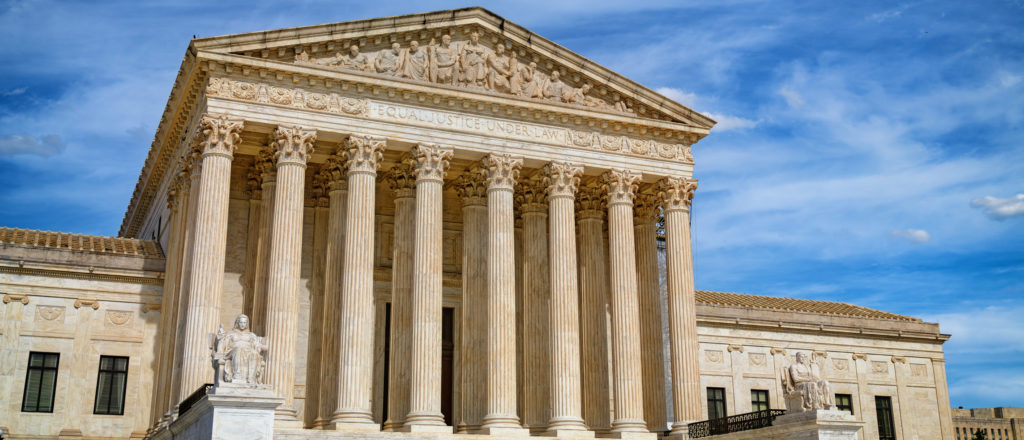
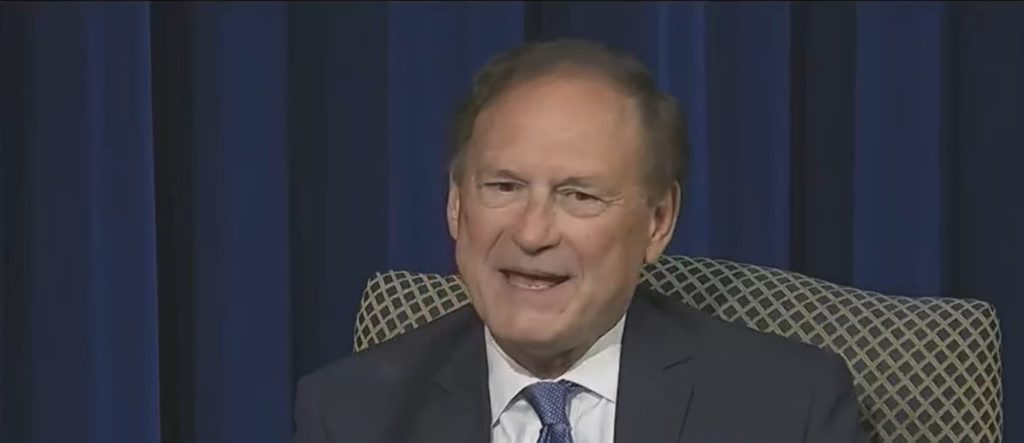
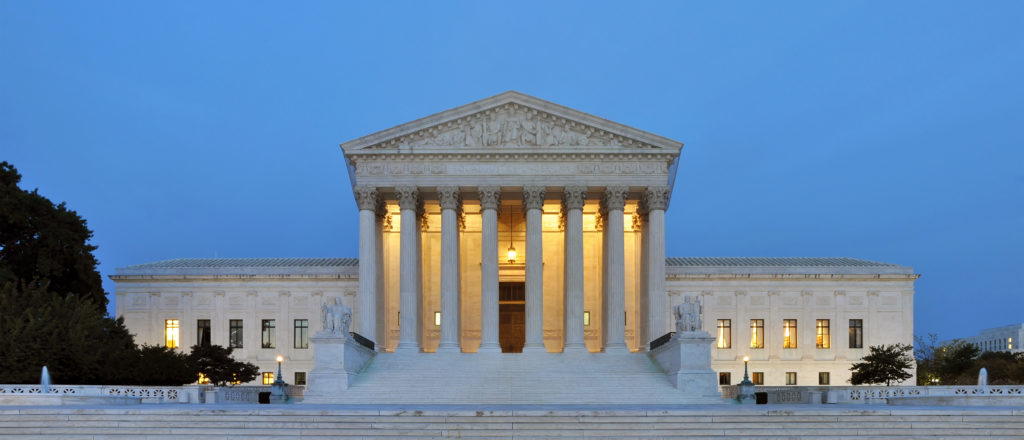
Samuel Anthony Alito Jr. ( ə-LEE-toh; born April 1, 1950) is an American jurist who serves as an associate justice of the Supreme Court of the United States. He was nominated to the high court by President George W. Bush on October 31, 2005, and has served on it since January 31, 2006. After Antonin Scalia, Alito is the second Italian American justice to serve on the U.S. Supreme Court.
Alito was raised in Hamilton Township, New Jersey, and graduated from Princeton University and Yale Law School. After law school, he worked as an assistant attorney general for the Office of Legal Counsel and served as the U.S. attorney for the District of New Jersey. In 1990, Alito was appointed as a judge on the U.S. Court of Appeals for the Third Circuit, where he served until joining the Supreme Court. He has called himself a "practical originalist" and is a member of the Supreme Court's conservative bloc.
Alito has written majority opinions in the landmark cases McDonald v. Chicago (2010) on firearm rights, Burwell v. Hobby Lobby (2014) on insurance coverage, Janus v. AFSCME (2018) on public-sector union security agreements, and Dobbs v. Jackson Women's Health Organization (2022) on abortion.
Contents
Early life and education
Alito was born in Trenton, New Jersey, on April 1, 1950. He was the son of Samuel A. Alito Sr. (born Salvatore Alati; 1914–1987), a Calabrian immigrant from Saline Joniche, a town in the municipality of Montebello Jonico, in the province of Reggio Calabria.. His mother was Rose Fradusco (1914–2013), an Italian-American whose parents came from Palazzo San Gervasio in Basilicata. Alito's paternal grandfather, Antonino Alati (1880–1963; anglicized to Anthony Alito), sailed from Italy to Philadelphia in 1913 aboard the SS Ancona. Alito's father earned a master's degree at Rutgers University and was a high school teacher and later the first director of the New Jersey Office of Legislative Services, a state government position he held from 1952 to 1984. Alito's mother was a schoolteacher.
Alito grew up in Hamilton Township, New Jersey, a suburb of Trenton. He attended Steinert High School, where he graduated in 1968 as the class valedictorian, subsequently matriculating at Princeton University. In 1972, he graduated with a Bachelor of Arts, summa cum laude, from the Woodrow Wilson School of Public and International Affairs. His senior thesis, supervised by political scientist Walter F. Murphy, was entitled "An Introduction to the Italian Constitutional Court".
At Princeton, Alito chaired a student conference in 1971 called "The Boundaries of Privacy in American Society", which supported curbs on domestic intelligence gathering and anticipated the need for a statute and a court to oversee national security surveillance. The conference report itself also called for the decriminalization of sodomy, and urged an end to discrimination against gay people in hiring. Alito also led the American Whig-Cliosophic Society's Debate Panel during his time at Princeton. He avoided Princeton's eating clubs, joining Stevenson Hall instead.
In December 1969, while a sophomore at Princeton, Alito received a low lottery number of 32 in the Selective Service drawing. He became a member of the school's Army ROTC program. Alito was commissioned a second lieutenant in the United States Army Reserve in 1972. He began his military duty after graduating from law school in 1975 and served on active duty from September to December while attending the Signal Officer Basic Course at Fort Gordon, Georgia. Alito was promoted to first lieutenant and captain, and completed his service obligation as a member of the inactive reserve before being honorably discharged in 1980.
Early legal career
After graduating from law school, Alito clerked for Third Circuit appeals judge Leonard I. Garth in Newark, New Jersey, in 1976 and 1977. He interviewed with Supreme Court Justice Byron White for a clerkship but was not hired. Between 1977 and 1981, Alito was Assistant United States Attorney, District of New Jersey. There, he served under the then-chief of the appeals division Assistant U.S. Attorney, Maryanne Trump Barry (Barry, the eldest sister of Donald Trump, later became a federal judge). While an Assistant U.S. Attorney for New Jersey, he prosecuted many cases involving drug trafficking and organized crime.
From 1981 to 1985, Alito was Assistant to U.S. Solicitor General Rex E. Lee. In that capacity he argued 12 cases before the Supreme Court for the federal government. Alito lost only two of the cases he argued before the Supreme Court. In Thornburgh v. American College of Obstetricians & Gynecologists (1986), the Supreme Court ruled against Solicitor General Charles Fried after he rejected a memo by Alito urging him to avoid directly attacking the constitutional right to an abortion.
From 1985 to 1987, Alito was Deputy Assistant Attorney General under Charles J. Cooper in the Office of Legal Counsel during the tenure of Attorney General Edwin Meese. John F. Manning worked under Alito there. Between 1986 and 1987, Alito authored nearly 470 pages of memoranda, in which he argued for expanding his client's law enforcement and personnel authorities. In his 1985 application for Deputy Assistant Attorney General, Alito espoused conservative views, naming William F. Buckley, Jr., the National Review, Alexander Bickel, and Barry Goldwater's 1964 presidential campaign as major influences. He also expressed concern about Warren Court decisions in the areas of criminal procedure, the Establishment Clause, and reapportionment.
From 1987 to 1990, Alito was the United States Attorney for the District of New Jersey. When he arrived, the office had begun the prosecution of 20 defendants accused of being mob affiliates of Anthony Accetturo. In August 1988, the two-year trial, then the longest federal criminal trial in history, ended in the acquittal of all 20 after less than two days of jury deliberations. Alito soon hired Michael Chertoff as his chief deputy.
After an FBI agent was shot in the line of duty in 1988, Alito personally handled the trial, assigning himself the then-novice Stuart Rabner as an assistant, and securing the shooter's conviction. In March 1988, Alito sought a rehearing of extradition proceedings against two Indian men, represented by Ron Kuby, who were accused of being terrorist assassins, after Alito discovered that the death threats his prosecutor, Judy G. Russell, had received had been sent to her by herself. The prosecutor was later found not guilty of obstruction of justice by reason of insanity, after psychiatrists found she may have suffered from schizophrenia, with up to four distinct personalities. In 1989, Alito prosecuted a member of the Japanese Red Army for planning a terrorist bombing in Manhattan.
Court of Appeals judge
Nomination and confirmation
Third Circuit Judges Leonard I. Garth, for whom Alito clerked, and Maryanne Trump Barry, under whom Alito worked as an assistant U.S. Attorney, recommended Alito's judicial nomination to President George H. W. Bush. On February 20, 1990, Bush nominated Alito to the United States Court of Appeals for the Third Circuit, to a seat vacated by John Joseph Gibbons. The American Bar Association rated Alito "Well Qualified" at the time of his nomination. He was confirmed by unanimous consent in the Senate on April 27, 1990, and received his commission three days later. As a Third Circuit judge, his chambers were in Newark, New Jersey.
Notable opinions
Abortion
On a Third Circuit panel, the majority in Planned Parenthood v. Casey overturned one part of a law regulating abortion, the provision mandating that married women first inform their husbands if they sought an abortion. Alito, the third judge on the panel, disagreed, arguing that he would have upheld the spousal notification requirement along with the rest of the law.
Federalism
A dissenting opinion in United States v. Rybar, 103 F.3d 273 (3d Cir. 1996), arguing that a U.S. law banning private citizens from owning submachine guns was similar to one struck down by the Supreme Court in United States v. Lopez and thus outside the authority of Congress under the Commerce Clause of the U.S. Constitution.
A majority opinion in Chittister v. Department of Community & Economic Development, 226 F.3d 223 (3d Cir. 2000). This case concerned an employee's claim of wrongful termination under the Family and Medical Leave Act against the Commonwealth of Pennsylvania. States are free to maintain sovereign immunity under the U.S. Constitution. Since Pennsylvania had maintained its immunity to such suits, Alito affirmed the lower court's dismissal of the employee's claims.
First Amendment
A majority opinion in Saxe v. State College Area School District, 240 F.3d 200 (3d Cir. 2001), holding that a public school district's anti-harassment policy was unconstitutionally overbroad and therefore violated First Amendment guarantees of free speech.
A majority opinion in ACLU v. Schundler, 168 F.3d 92 (3d Cir. 1999), holding that a government-sponsored holiday display consisting solely of religious symbols was impermissible, but that a mixed display including both secular and religious symbols was permissible if balanced in a generally secular context.
A dissenting opinion in C. H. v. Oliva (3d Cir. 2000), arguing that the removal and subsequent replacement in "a less conspicuous spot" of a kindergartener's religious themed poster was, at least potentially, a violation of his right to free expression.
U.S. Supreme Court
Nomination and confirmation
On July 1, 2005, Associate Justice Sandra Day O'Connor announced her retirement from the Supreme Court effective upon the confirmation of a successor. President George W. Bush first nominated John Roberts to the vacancy, but when Chief Justice William Rehnquist died on September 3, Bush withdrew Roberts's nomination to fill O'Connor's seat and instead nominated Roberts to the Chief Justiceship. On October 3, Bush nominated Harriet Miers to replace O'Connor. Miers withdrew her acceptance of the nomination on October 27 after encountering widespread opposition.
On October 31, Bush announced that he was nominating Alito to O'Connor's seat, and he submitted the nomination to the Senate on November 10. Alito was unanimously rated "well qualified" to fill the Associate Justice post by the American Bar Association's Standing Committee on Federal Judiciary, which measures the professional qualifications of a nominee. The committee rates judges as "not qualified", "qualified", or "well qualified". Leonard Leo was selected to play a role in shepherding Alito's appointment through the Senate.
Alito's confirmation hearing was held from January 9 to 13, 2006. Two active-duty members of the Third Circuit, Judge Maryanne Trump Barry and Chief Judge Anthony J. Scirica, testified in Alito's confirmation hearing, as did five senior and retired circuit judges. Alito responded to some 700 questions over 18 hours of testimony. He rejected the use of foreign legal materials in the Constitution, did not state a position on cameras in courtrooms (he had supported them while on the 3rd Circuit), said Congress could choose to outlaw LGBT employment discrimination in the United States if it wished, and told then-Senator Joe Biden (D-DE) that he endorsed a weak version of the unitary executive theory.
On January 24, his nomination was voted out of the Senate Judiciary Committee on a 10–8 party line vote. Democratic Senators characterized Alito as a hard-right conservative in the mold of Clarence Thomas or Robert Bork. Alito professed reluctance to commit to any type of ideology, stating he would act as an impartial referee. He said he would look at abortion with an open mind but would not state how he would rule on Roe v. Wade if that decision were to be challenged.
Democrats on the committee asked Alito about his past association with Concerned Alumni of Princeton. Alito said that he had listed an affiliation with the group on his application to Ronald Reagan's Justice Department in order to establish his conservative credentials: "You have to look at the question that I was responding to and the form that I was filling out... I was applying for a position in the Reagan administration. And my answers were truthful statements, but what I was trying to outline were the things that were relevant to obtaining a political position." But during the confirmation hearings, he disavowed the group, whose views were criticized as racist and sexist, saying: "I disavow them. I deplore them. They represent things that I have always stood against and I can't express too strongly."
Tenure
Alito delivered his first written Supreme Court opinion on May 1, 2006, in Holmes v. South Carolina, a case involving the right of criminal defendants to present evidence that a third party committed the crime. From the beginning of the Rehnquist Court to the nomination of Justice Elena Kagan, each new justice has been given a unanimous opinion to write as their first Supreme Court opinion; this practice is designed to help "break in" new justices so that each justice has at least one unanimous, uncontroversial opinion under their belt. Alito wrote for a unanimous court in ordering a new trial for Bobby Lee Holmes due to South Carolina's rule that barred such evidence based on the strength of the prosecution's case, rather than on the relevance and strength of the defense evidence itself. His other majority opinions in his first term were in Zedner v. United States, Woodford v. Ngo, and Arlington Central School District Board of Education v. Murphy.
In his first term, Alito compiled a fairly conservative record. For example, in the three reargued cases (Garcetti v. Ceballos, Hudson v. Michigan and Kansas v. Marsh), Alito created a 5–4 majority by voting with the four other conservative Justices – Chief Justice John G. Roberts and Justices Antonin Scalia, Anthony Kennedy, and Clarence Thomas. He further voted with the conservative wing of the court on Sanchez-Llamas v. Oregon and Rapanos v. United States. Alito also dissented in Hamdan v. Rumsfeld alongside Justices Scalia and Thomas.
Alito delivered the Supreme Court Historical Society's 2008 Annual Lecture, "The Origin of the Baseball Antitrust Exemption". The lecture was published in two journals.
In 2023, Martin–Quinn scores suggested that Alito was the most conservative Supreme Court justice. While his voting record is conservative, he does not always join the opinions of the Court's other conservative justices. On February 1, 2006, in Alito's first decision on the Supreme Court, he voted with the majority (6–3) to refuse Missouri's request to vacate the stay of execution issued by the Eighth Circuit for death-row inmate Michael Taylor. Justices Roberts, Scalia and Thomas were in favor of vacating the stay; Missouri had twice asked the justices to lift the stay and permit the execution. Moreover, despite having been at one time nicknamed "Scalito", Alito's views have differed from those of Scalia (and Thomas), as in the Michael Taylor case and various other cases of the 2005 term. A fierce critic of reliance on legislative history in statutory interpretation, Scalia was the only member of the Court in Zedner v. United States not to join a section of Alito's opinion that discussed the legislative history of the statute in question. In two higher-profile cases, one involving the constitutionality of political gerrymandering and one involving campaign finance reform (LULAC v. Perry and Randall v. Sorrell), Alito adopted narrow positions, declining to join the bolder positions advanced by either philosophical side of the Court. According to a SCOTUSblog analysis of 2005 term decisions, Alito and Scalia concurred in the result of 86% of decisions in which both participated, and concurred in full in 75%. Alito also differed from Scalia in applying originalism flexibly to arrive at conservative outcomes "with plodding consistency", rather than following it so strictly as to occasionally produce outcomes unfavorable to conservatives.
Personal life
In 1985, Alito married Martha-Ann Bomgardner, a law librarian who met him during his trips to the library as a law clerk. They have two children; Martha-Ann left her profession to raise them. In early 2025, the second Trump administration appointed Alito's son Philip to the Treasury Department's general counsel. Alito resided with his family in West Caldwell, New Jersey, before his Supreme Court nomination. He has since moved to Fairfax County, Virginia.
Since Stephen Breyer's retirement in 2022, Alito has been the only military veteran on the Court. He is a baseball fan and a longtime fan of the Philadelphia Phillies. The Phillie Phanatic was a special guest at his Supreme Court welcome dinner.
In 2013, as part of the ongoing fallout from the Edward Snowden case, former National Security Agency analyst Russell Tice revealed that, during 2002 and 2003, the National Security Agency targeted Alito's phones, and those of his staff and his family, for surveillance.
Teaching
As an adjunct professor at Seton Hall University School of Law in Newark from 1999 to 2004, Alito taught courses in constitutional law and an original course on terrorism and civil liberties. In 1995, he received the school's Saint Thomas More Medal "in recognition of his outstanding contributions to the field of law". On May 25, 2007, he delivered the commencement address at Seton Hall Law's commencement ceremony and received an honorary law degree from the school.
As a visiting professor at Duke University School of Law, Alito taught Current Issues in Constitutional Interpretation in fall 2011 and a course in the Master of Laws in Judicial Studies program in summer 2012.
Ethical questions
Accusations of accepting gifts
On June 20, 2023, ProPublica published an investigation of Alito's relationship with billionaire businessman Paul Singer, focusing on a trip Alito and Singer took to a luxury fishing resort in Alaska and suggesting Alito "violated a federal law that requires justices to disclose most gifts", such as private jet travel. The article said he should have recused himself in cases involving Singer and that he was obligated to disclose certain benefits as gifts on his 2008 Financial Disclosure Report. Legal ethics experts quoted in ProPublica called Alito's behavior "unacceptable".
Shortly before publication of the ProPublica article, Alito published an op-ed in The Wall Street Journal challenging the article's assertions and claiming that the source "misleads its readers". His preemptory challenge maintained that ProPublica's charges were invalid. Alito further contended that because of an exemption in the Court's reporting rules for "personal hospitality", he was not required to disclose private air transport for social trips. His unconventional decision to bypass reporters' questions and preempt the story via a separate publication took ProPublica's reporters by surprise. The decision to publish the op-ed was criticized both within the Wall Street Journal and by media critics, in part because it lacked fact-checking.
The ProPublica report on unreported gifts to both Alito and Thomas led several members of Congress to call for ethics reform for the Supreme Court. This included a Senate Judiciary Committee proposal to establish a code of ethics for the Court. In a July 2023 Wall Street Journal opinion column, Alito wrote, "Congress did not create the Supreme Court [...] I know this is a controversial view, but I'm willing to say it. No provision in the Constitution gives them the authority to regulate the Supreme Court—period." This declaration led to further debate among lawmakers. Senator Chris Murphy said the Constitution gives Congress power to oversee the Court: "It is just wrong on the facts to say that Congress doesn't have anything to do with the rules guiding the Supreme Court. In fact, from the very beginning, Congress has set those rules."
In 2024, The Guardian and The New York Times reported that Alito accepted $900 tickets from Princess Gloria von Thurn und Taxis for a music festival at Saint Emmeram's Abbey.
Flag display controversy
On January 17, 2021, an upside-down American flag was flown outside Alito's residence in Fairfax County, Virginia. The upside-down flag, traditionally a signal of distress, had been displayed a week earlier by supporters of President Donald Trump during the January 6 Capitol attack and by members of the Stop the Steal movement seeking to overturn the 2020 election results. In the summer of 2023, the Pine Tree Flag was flown at Alito's beach house on Long Beach Island in New Jersey. It was one of the flags used during the American Revolution, and has been used by Christian nationalists; it was also carried during the Capitol attack. The flag displays, reported by The New York Times, caused controversy, including questions about judicial impartiality. During the flag's presence, the Supreme Court was considering the appeal in United States v. Fischer (2023), a case involving the January 6 Capitol attack.
A secret recording by advocacy journalist Lauren Windsor captured Martha-Ann Alito discussing the event in June 2024. Martha-Ann Alito said, "I want a Sacred Heart of Jesus flag because I have to look across the lagoon at the Pride flag for the next month", adding that she would be "changing the flags" when her husband was "free of this nonsense" and that she would come with her own flag, which would be white with yellow and orange flames and read "vergogna" ("shame" in Italian). She also told Windsor that she would "get" "the media", adding: "Look at me. Look at me. I'm German, from Germany. My heritage is German. You come after me, I'm going to give it back to you".
Reactions were mixed, with most Democrats condemning Alito and most Republicans defending him. Senate Committee on the Judiciary chairman Dick Durbin requested Alito's recusal from cases involving the January 6 Capitol attack or the 2020 presidential election. House Committee on the Judiciary member Steve Cohen introduced a resolution to censure Alito. Forty-five representatives, joined by ranking member of the House Judiciary Committee Hank Johnson, signed a letter requesting Alito's recusal. Senator Tom Cotton called the controversy an intimidation attempt, while Senator Lindsey Graham said hoisting the upside-down flag was "not good judgment".
Alito responded that he had no involvement in hoisting either flag, saying: "I was not even aware of the upside-down flag until it was called to my attention" and "My wife is fond of flying flags. I am not". In an interview with Fox News, he reiterated that the flag was flown in response to a dispute with a neighbor, clarifying that his wife was upset about a "Fuck Trump" sign. He told Fox News host Shannon Bream that the neighbor blamed him for the January 6 Capitol attack and called his wife a "cunt".