



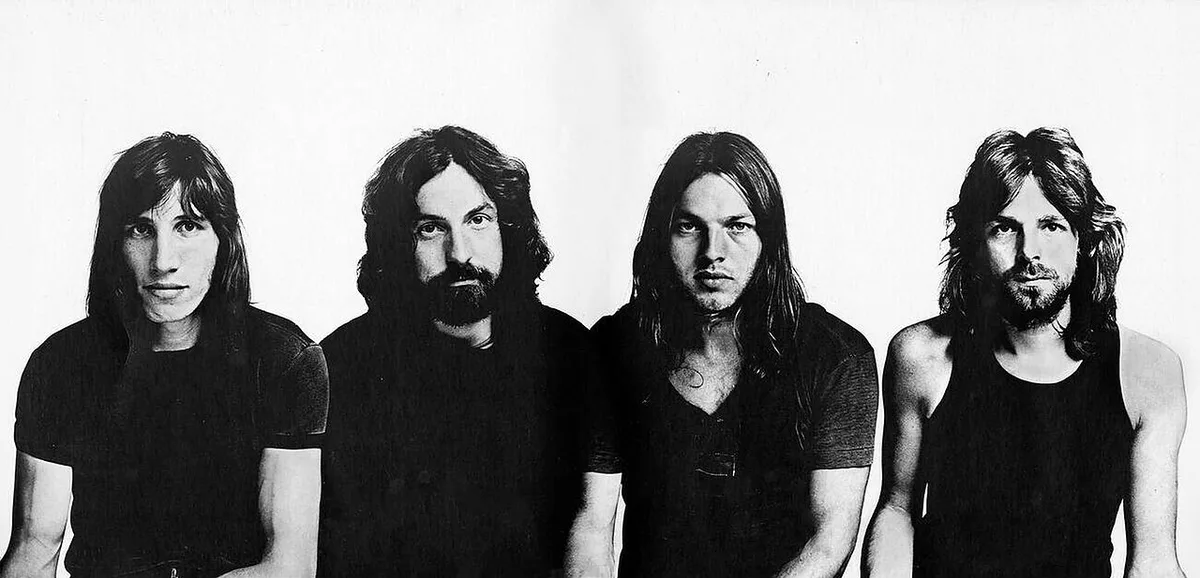
George Roger Waters (born 6 September 1943) is an English singer-songwriter, musician and political activist. In 1965, he co-founded the rock band Pink Floyd as the bassist. Following the departure of the band's main songwriter Syd Barrett in 1968, Waters became Pink Floyd's principal lyricist, co-lead vocalist and conceptual leader until his departure in 1985.
Pink Floyd achieved international success with the concept albums The Dark Side of the Moon (1973), Wish You Were Here (1975), Animals (1977), The Wall (1979), and The Final Cut (1983). By the early 1980s, they had become one of the most acclaimed and commercially successful groups in popular music. Amid creative differences, Waters left in 1985 and began a legal dispute over the use of the band's name and material. They settled out of court in 1987. His solo work includes the studio albums The Pros and Cons of Hitch Hiking (1984), Radio K.A.O.S. (1987), Amused to Death (1992), and Is This the Life We Really Want? (2017). In 2005, he released Ça Ira, an opera translated from Étienne and Nadine Roda-Gils's libretto about the French Revolution.
In 1990, Waters staged one of the largest rock concerts in history, The Wall – Live in Berlin. As a member of Pink Floyd, he was inducted into the US Rock and Roll Hall of Fame in 1996 and the UK Music Hall of Fame in 2005. Later in 2005, he reunited with Pink Floyd for the Live 8 global awareness event, their only appearance with Waters since 1981. He has toured extensively as a solo act since 1999. He performed The Dark Side of the Moon for his world tour of 2006–2008, and The Wall Live, his tour of 2010–2013, was the highest-grossing tour by a solo artist at the time.
Waters incorporates political themes in his work, many of them considered radical. He supports socialism, has defended Vladimir Putin and the Russian invasion of Ukraine, and has been ruled by a court to have made defamatory comments. Waters is a prominent supporter of Palestine in the Israeli–Palestinian conflict and Gazan genocide. He supports the Boycott, Divestment and Sanctions (BDS) movement against Israel, and describes Israel's treatment of Palestinians as apartheid. Elements of his live show and some of his comments, such as his likening of Israel to Nazi Germany, have drawn accusations of antisemitism, which Waters has dismissed as a conflation with anti-Zionism. Waters has been dropped, banned or sanctioned by a wide variety of entities in reaction to his comments, including Major League Baseball, BMG Rights Management, the German city of Frankfurt, multiple Argentine hotels, and the country of Poland. Waters has contributed to financing a land deal that returned 4.5 acres of private property to the Shinnecock Nation. The land includes the Shinnecock Nation's ancestral burial grounds.
Contents
Early years
Waters was born on 6 September 1943, the younger of two boys, to Mary (née Whyte; 1913–2009) and Eric Fletcher Waters (1913–1944), in Great Bookham, Surrey. His father, the son of a coal miner and Labour Party activist, was a schoolteacher, a devout Christian, and a Communist Party member. His older brother, John, predeceased him.
In the early years of the Second World War, Waters's father was a conscientious objector who drove an ambulance during the Blitz. He later changed his stance on pacifism, joined the Territorial Army and was commissioned into the 8th Battalion, Royal Fusiliers, as a second lieutenant on 11 September 1943. He was killed five months later on 18 February 1944 at Aprilia, during the Battle of Anzio, when Roger was five months old. He is commemorated in Aprilia and at the Cassino War Cemetery. On 18 February 2014, Waters unveiled a monument to his father and other war casualties in Aprilia, Italy, and was made an honorary citizen of Anzio. Following her husband's death, Mary Waters, also a teacher, moved with her two sons to Cambridge and raised them there. Waters's earliest memory is of the V-J Day celebrations.
Waters attended Morley Memorial Junior School in Cambridge and then the Cambridgeshire High School for Boys (now Hills Road Sixth Form College) with Syd Barrett. The future Pink Floyd guitarist David Gilmour lived nearby on Mill Road and attended the Perse School. At 15, Waters was chairman of the Cambridge Youth Campaign for Nuclear Disarmament (YCND), having designed its publicity poster and participated in its organisation. He was a keen sportsman and a highly regarded member of the high school's cricket and rugby teams. He was unhappy at school, saying: "I hated every second of it, apart from games. The regime at school was a very oppressive one ... The same kids who are susceptible to bullying by other kids are also susceptible to bullying by the teachers."
Waters initially considered a career in mechanical engineering. In 1962, after a series of aptitude tests suggested he was suited to architecture, he enrolled at the Regent Street Polytechnic School of Architecture, London, where he met his future Pink Floyd bandmates Nick Mason and Richard Wright.
1965–1985: Pink Floyd
Formation and Barrett-led period
By September 1963, Waters and Mason had lost interest in their studies and moved into a lower flat in Stanhope Gardens, owned by Mike Leonard, a part-time tutor at the Regent Street Polytechnic. Waters, Mason and Wright first played music together in late 1963, in a band formed by the vocalist Keith Noble and bassist Clive Metcalfe. They usually called themselves Sigma 6, but also used the name the Meggadeaths. Waters played rhythm guitar, Mason played drums, Wright played any keyboard he could arrange to use, and Noble's sister Sheilagh provided occasional vocals. In the early years the band performed during private functions and rehearsed in a tearoom in the basement of Regent Street Polytechnic.
When Metcalfe and Noble left to form their own group in September 1963, the remaining members asked Barrett and the guitarist Bob Klose to join. Waters switched to the bass. By January 1964, the group became known as the Abdabs, or the Screaming Abdabs. During late 1964, the band used the names Leonard's Lodgers, Spectrum Five and, eventually, the Tea Set. In late 1965, the Tea Set had changed their name to the Pink Floyd Sound, later the Pink Floyd Blues Band and, by early 1966, Pink Floyd.
By early 1966, Barrett was Pink Floyd's frontman, guitarist, and songwriter. He wrote or co-wrote all but one track of their debut LP The Piper at the Gates of Dawn, released in August 1967. Waters contributed the song "Take Up Thy Stethoscope and Walk" (his first sole writing credit) to the album. By late 1967, Barrett's deteriorating mental health and increasingly erratic behaviour rendered him "unable or unwilling" to continue in his capacity as Pink Floyd's songwriter and lead guitarist.
In early March 1968, to discuss the band's future, Barrett, Mason, Waters, and Wright met with the band's managers, Peter Jenner and Andrew King, of the rock music management company they had all founded, Blackhill Enterprises. Barrett agreed to leave Pink Floyd, and the band "agreed to Blackhill's entitlement in perpetuity" regarding "past activities". Their new manager, Steve O'Rourke, made a formal announcement about the departure of Barrett and the arrival of Gilmour in April 1968.
Waters-led period
After Barrett's departure in March 1968, Waters began to chart Pink Floyd's artistic direction. In 1970, he composed—in collaboration with Ron Geesin—Music from The Body, a soundtrack for Roy Battersby's documentary The Body.
Waters said he wanted to "drag [Pink Floyd] kicking and screaming back from the borders of space, from the whimsy that Syd was into, to my concerns, which were much more political and philosophical". He became a dominant songwriter and the band's principal lyricist, sharing lead vocals with Gilmour and sometimes Wright. Throughout the late 1970s, he was the band's dominant creative figure until his departure in 1985. He wrote most of the lyrics to the five Pink Floyd albums preceding his departure, starting with The Dark Side of the Moon (1973) and ending with The Final Cut (1983), while exerting progressively more creative control. Every Waters studio album from The Dark Side of the Moon onwards has been a concept album.
With lyrics entirely by Waters, The Dark Side of the Moon is one of the most successful rock albums ever. It spent 736 consecutive weeks on the Billboard 200 chart—until July 1988—and sold over 40 million copies worldwide. As of 2005, it continued to sell over 8,000 copies a week. According to the Pink Floyd biographer Glenn Povey, Dark Side of the Moon is the world's second-bestselling album and the United States' 21st-bestselling album. In 2006, asked if he felt his goals for Dark Side had been accomplished, Waters said his wife wept the first time he played it for her: "You then hear it with fresh ears when you play it for somebody else. And at that point I thought to myself, 'Wow, this is a pretty complete piece of work,' and I had every confidence that people would respond to it.
Waters's thematic ideas became the impetus for the concept albums The Dark Side of the Moon (1973), Wish You Were Here (1975), Animals (1977) and The Wall (1979)—written largely by Waters—and The Final Cut (1983), written entirely by him. The cost of war and the loss of his father became a recurring theme, from "Corporal Clegg" (A Saucerful of Secrets, 1968) and "Free Four" (Obscured by Clouds, 1972) to "Us and Them" from The Dark Side of the Moon, "When the Tigers Broke Free", first used in the feature film The Wall (1982), later included with "The Fletcher Memorial Home" on The Final Cut, an album dedicated to his father. The theme and composition of The Wall was influenced by his upbringing in an English society depleted of men after World War II.
Departure and legal battles
Amidst creative differences, Waters left Pink Floyd in 1985 and began a legal battle with the band regarding their continued use of the name and material. In December 1985, Waters issued a statement to EMI and CBS invoking the "Leaving Member" clause in his contract. In October 1986, he initiated High Court proceedings to formally dissolve the Pink Floyd partnership. In his submission to the High Court he called Pink Floyd a "spent force creatively." Gilmour and Mason opposed the application and announced their intention to continue as Pink Floyd. Waters said he had been forced to resign like Barrett had been years earlier, and decided to leave the band based on legal considerations, saying: "If I hadn't, the financial repercussions would have wiped me out completely."
Waters did not want the band to use the name Pink Floyd without him. He said later: "I would be distressed if Paul McCartney and Ringo Starr made records and went on the road calling themselves the Beatles. If John Lennon's not in it, it's sacrilegious ... To continue with Gilmour and Mason, getting in a whole bunch of other people to write the material, seems to me an insult to the work that came before." In December 1987, Waters and Pink Floyd reached an agreement. Waters was released from his contractual obligation with O'Rourke, and he retained the copyrights to the Wall concept and the inflatable Animals pig. Pink Floyd released three studio albums without him: A Momentary Lapse of Reason (1987), The Division Bell (1994) and The Endless River (2014). According to a 1999 interview with Gilmour, Waters declined an invitation to perform The Dark Side of the Moon with Pink Floyd at Earls Court, London.
In 2005, Waters said the period of his departure had been a "bad, negative time", and that he regretted his part in the negativity: "Why should I have imposed my feeling about the work and what it was worth on the others if they didn't feel the same? I was wrong in attempting to do that." In 2013, Waters said he regretted the lawsuit and had failed to appreciate that the Pink Floyd name had commercial value independent of the band members.
1984–present: solo career
1984–1989: The Pros and Cons of Hitch Hiking and Radio K.A.O.S.
In 1984, Waters released his first solo album, The Pros and Cons of Hitch Hiking, which dealt with Waters's feelings about monogamy and family life versus "the call of the wild." The protagonist, Reg, finally chooses love and matrimony over promiscuity. The album features the guitarist Eric Clapton, the jazz saxophonist David Sanborn, and artwork by Gerald Scarfe. Kurt Loder described The Pros And Cons of Hitch Hiking as a "strangely static, faintly hideous record". Rolling Stone rated the album a "rock bottom one star". Years later, Mike DeGagne of AllMusic praised its "ingenious symbolism" and "brilliant use of stream of consciousness within a subconscious realm", rating it four out of five.
Waters toured the album with Clapton, a new band, and new material; the shows included a selection of Pink Floyd songs. Waters débuted his tour in Stockholm on 16 June 1984. The tour drew poor ticket sales and some performances at larger venues were cancelled; Waters estimated that he lost £400,000 on the tour. In March and April 1985, played a tour of smaller venues in North America on a tour called "Pros and Cons Plus Some Old Pink Floyd Stuff".The Pros and Cons of Hitch Hiking was certified gold in the US.
In 1986, Waters contributed songs and a score to the soundtrack of the animated film When the Wind Blows, based on the book by Raymond Briggs. His band, featuring Paul Carrack, was credited as the Bleeding Heart Band. In 1987, Waters released Radio K.A.O.S., a concept album based on a mute man named Billy from an impoverished Welsh mining town who has the ability to tune into radio waves in his head. Billy learns to communicate with a radio DJ, and eventually to control the world's computers. Angry at the state of the world in which he lives, he simulates a nuclear attack. Waters followed the release with a tour.
1989–1999: The Wall – Live in Berlin and Amused to Death
In November 1989, the Berlin Wall fell, and in July 1990 Waters staged one of the largest and most elaborate rock concerts in history, The Wall – Live in Berlin, on the vacant terrain between Potsdamer Platz and the Brandenburg Gate. The show reported an attendance of 200,000, though some estimates are as much as twice that, with approximately one billion television viewers. Leonard Cheshire asked Waters to perform the concert to raise funds for charity. Waters's musicians included Joni Mitchell, Van Morrison, Cyndi Lauper, Bryan Adams, Scorpions, and Sinéad O'Connor.
Waters also used an East German symphony orchestra and choir, a Soviet marching band, and a pair of helicopters from the US 7th Airborne Command and Control Squadron. Designed by Mark Fisher, the wall was 25 metres tall and 170 metres long and was built across the set, and Scarfe's inflatable puppets were recreated on an enlarged scale. Many rock icons received invitations to the show, though Gilmour, Mason, and Wright did not. Waters released a double album of the performance, which has been certified platinum by the RIAA.
In 1990, Waters hired manager Mark Fenwick and left EMI for a worldwide deal with Columbia. He released his third studio album, Amused to Death, in 1992. The record was influenced heavily by the events of the Tiananmen Square protests of 1989 and the Gulf War, and a critique of the notion of war becoming the subject of entertainment, particularly on television. The title was derived from the book Amusing Ourselves to Death by Neil Postman. Patrick Leonard, who worked on A Momentary Lapse of Reason, co-produced the album. Jeff Beck played lead guitar on many of the album's tracks, which were recorded with a cast of musicians at ten different recording studios.
It is Waters's most critically acclaimed solo recording, garnering comparison to his work with Pink Floyd. Waters described the record as a "stunning piece of work", ranking it alongside Dark Side of the Moon and The Wall as one of the best of his career. The song "What God Wants, Pt. 1" reached number 35 in the UK in September 1992 and number 5 on Billboard's Mainstream Rock Tracks chart in the US. Amused to Death was certified Silver by the British Phonographic Industry.
Sales of Amused to Death topped out at around one million and there was no tour in support of the album. Waters first performed material from it seven years later during his In the Flesh tour. In 1996, Waters was inducted into the US and UK Rock and Roll Halls of Fame as a member of Pink Floyd.
1999–2004: In the Flesh tour and Wall Broadway production
In 1999, after a 12-year hiatus from touring and a seven-year absence from the music industry, Waters embarked on the In the Flesh tour, performing both solo and Pink Floyd material. The tour was a financial success in the US; though Waters had booked mostly smaller venues, tickets sold so well that many of the concerts were upgraded to larger ones. The tour eventually stretched across the world and spanned three years. A concert film was released on CD and DVD, In the Flesh – Live. During the tour, Waters played two new songs "Flickering Flame" and "Each Small Candle" as the final encore to many of the shows. In June 2002, he completed the tour with a performance in front of 70,000 people at the Glastonbury Festival of Performing Arts, playing 15 Pink Floyd songs and five songs from his solo catalogue.
Miramax announced in 2004 that a production of The Wall was to appear on Broadway with Waters playing a prominent role in the creative direction. Reports stated that the musical contained not only the original tracks from The Wall, but also songs from Dark Side of the Moon, Wish You Were Here and other Pink Floyd albums, as well as new material. On the night of 1 May 2004, recorded extracts from the opera, including its overture, were played on the occasion of the Welcome Europe celebrations in the accession country of Malta. Gert Hof mixed recorded excerpts from the opera into a continuous piece of music which was played as an accompaniment to a large light and fireworks display over Grand Harbour in Valletta. In July 2004, Waters released two new tracks online: "To Kill the Child", inspired by the 2003 invasion of Iraq, and "Leaving Beirut", an anti-war song inspired by his travels in the Middle East as a teenager.
2005: Pink Floyd reunion and Ça Ira
In January 2005, following the 2004 Indian Ocean earthquake and subsequent tsunami disaster, Waters performed "Wish You Were Here" with Eric Clapton during a benefit concert which aired on the American network NBC. In July that year, Waters reunited with Mason, Wright, and Gilmour for their final performance together at the Live 8 concert in London's Hyde Park. This was Pink Floyd's only appearance with Waters since their final performance of The Wall at Earls Court London 24 years earlier. They played a 23-minute set consisting of "Speak to Me/Breathe"/"Breathe (Reprise)", "Money", "Wish You Were Here", and "Comfortably Numb". Waters told the Associated Press that while the experience of playing with Pink Floyd again was positive, the chances of a bona fide reunion would be "slight" considering his and Gilmour's continuing musical and ideological differences. Though Waters had differing ideas about which songs they should play, he "agreed to roll over for one night only". In November 2005, Pink Floyd were inducted into the UK Music Hall of Fame by Pete Townshend of the Who.
In September 2005, Waters released Ça Ira (pronounced [sa iˈʁa], French for "it will be fine"; Waters added the subtitle, "There is Hope"), an opera in three acts translated from the late Étienne Roda-Gil's French libretto based on the historical subject of the French Revolution. Ça Ira was released as a double CD album, featuring baritone Bryn Terfel, soprano Ying Huang and tenor Paul Groves.
Set during the early French Revolution, the original libretto was co-written in French by Roda-Gil and his wife Nadine Delahaye. Waters had begun rewriting the libretto in English in 1989, and said about the composition: "I've always been a big fan of Beethoven's choral music, Berlioz and Borodin ... This is unashamedly romantic and resides in that early 19th-century tradition, because that's where my tastes lie in classical and choral music."
Waters appeared on television to discuss the opera, but the interviews often focused on his relationship with Pink Floyd, something Waters would "take in stride", a sign Pink Floyd biographer Mark Blake believes is "a testament to his mellower old age or twenty years of dedicated psychotherapy". Ça Ira reached number 5 on the Billboard Classical Music Chart in the United States.
2006–2009: The Dark Side of the Moon Live
In June 2006, Waters began the two-year Dark Side of the Moon Live world tour. The first half of the show featured both Pink Floyd songs and Waters's solo material; the second included a complete performance of The Dark Side of the Moon, the first time in more than three decades that Waters had performed it. The shows ended with an encore from the third side of The Wall. The elaborate staging, by the concert lighting designer Marc Brickman, included laser lights, fog machines, pyrotechnics, psychedelic projections, and inflatable floating puppets (Spaceman and Pig) controlled by a "handler" dressed as a butcher, and a full 360-degree quadraphonic sound system. Mason joined Waters for the Dark Side of the Moon set and the encores on some 2006 performances.
In March 2007, the Waters song "Hello (I Love You)" featured in the science fiction film The Last Mimzy. Waters released it as a single, on CD and via download, and described it as "a song that captures the themes of the movie, the clash between humanity's best and worst instincts, and how a child's innocence can win the day". He performed at California's Coachella Festival in April 2008 and was to be among the headlining artists at Live Earth 2008 in Mumbai, India, in December 2008, but the concert was cancelled following the 26 November terrorist attacks in Mumbai. In April 2008, Waters discussed a possible new album with the tentative name Heartland.
2010s: The Wall Live and Is This the Life We Really Want?
In June 2010, Waters released a cover of "We Shall Overcome", a protest song rewritten and arranged by Guy Carawan and Pete Seeger. He performed with Gilmour at the Hoping Foundation Benefit Evening in July 2010. The set comprised a cover of the Phil Spector song "To Know Him Is to Love Him", which was played in early Pink Floyd soundchecks, followed by "Wish You Were Here", "Comfortably Numb", and "Another Brick in the Wall (Part Two)".
In September 2010, Waters began the Wall Live tour, an updated version of the original Pink Floyd tour, featuring a complete performance of The Wall. At the O2 Arena in London on 12 May 2011, Gilmour and Mason again performed with Waters on "Comfortably Numb", and "Outside the Wall". For the first half of 2012, the tour topped worldwide concert ticket sales, having sold more than 1.4 million tickets globally. By 2013, the Wall Live had become the highest-grossing tour by a solo artist. Waters performed at the Concert for Sandy Relief at Madison Square Garden on 12 December 2012. On 24 July 2015, he headlined the Newport Folk Festival in Newport, Rhode Island, accompanied by the band My Morning Jacket and two singers from the group Lucius. Waters performed at the Desert Trip festival in October 2016.
Waters released his first solo album in nearly 25 years, Is This the Life We Really Want?, on 2 June 2017. It was produced by the Radiohead producer Nigel Godrich. Godrich was a fan of Waters's work with Pink Floyd, but was critical of his solo work and encouraged him to make a concise album showcasing his lyrics. Waters returned to North America in 2017 with the Us + Them Tour, performing Pink Floyd and solo material.
On 26 October 2018, Sony Classical Masterworks released an adaptation of Igor Stravinsky's theatrical work The Soldier's Tale narrated by Waters. On 18 April 2019, Waters joined Nick Mason's Saucerful of Secrets on stage at the Beacon Theatre to sing "Set the Controls for the Heart of the Sun". Waters was one of the ten highest-grossing concert acts of the decade.
2020s: This is Not a Drill, Pink Floyd disputes and The Dark Side of the Moon Redux
In January 2020, Waters announced a new arena tour, This Is Not a Drill, that would tour North America and finish one month before the 2020 presidential election. The tour was rescheduled to 2022 due to the COVID-19 pandemic. The concerts were held from July to October 2022, and expanded with dates in Europe from March to June 2023. In 2021, Waters said he had begun writing a memoir during the pandemic. In December 2022, he released an EP, The Lockdown Sessions, comprising six new versions of songs from his solo career and Pink Floyd.
Waters continued to quarrel with Gilmour. In 2021, Waters wrote publicly of their disputes over Pink Floyd reissues and credits, accusing Gilmour of distorting the truth, and complained that Gilmour would not allow him to use Pink Floyd's website and social media channels. Rolling Stone noted that Waters and Gilmour had "hit yet another low point in their relationship".
Early in 2023, Waters gave an interview in which he criticised Pink Floyd's 2022 track "Hey, Hey, Rise Up!", which was released in support of Ukraine. Shortly afterwards, Polly Samson, the wife of Gilmour and a lyricist for Pink Floyd, wrote on Twitter that Waters was antisemitic and "a lying, thieving, hypocritical, tax-avoiding, lip-synching, misogynistic, sick-with-envy megalomaniac". Gilmour replied on Twitter: "Every word demonstrably true." Waters released a statement saying he was aware of the "incendiary and wildly inaccurate" comments and was "taking advice as to his position". Asked by Piers Morgan to respond, Waters said: "No comment. Oh, shut up ... They're public, and I'm private."
For the 50th anniversary of The Dark Side of the Moon, Waters recorded a new version, The Dark Side of the Moon Redux, released on 6 October 2023. It features spoken-word sections and no guitar solos, to "bring out the heart and soul of the album musically and spiritually". In a press release, Waters wrote: "Dave, Rick, Nick, and I were so young when we made [the original], and when you look at the world around us, clearly the message hasn't stuck. That's why I started to consider what the wisdom of an 80 year old could bring to a reimagined version." In October, Waters held two concerts at the London Palladium, where he performed The Dark Side of the Moon Redux, spoke on topics such as Julian Assange and read from his unpublished memoir.
Political views and activism
Israeli–Palestinian conflict and accusations of antisemitism
Waters is a vocal supporter of Palestine in the Israeli–Palestinian conflict. He is a member of Boycott, Divestment and Sanctions (BDS), a campaign for an international boycott of Israel. Waters first saw the West Bank barrier in 2006, at the request of Palestinian supporters, when he was scheduled to perform in Tel Aviv. He subsequently moved a Tel Aviv concert to Neve Shalom and called for the barrier's removal: "The wall is an appalling edifice to behold. It is policed by young Israeli soldiers who treated me, a casual observer from another world, with disdainful aggression." He has repeatedly described Israel's treatment of Palestinians as apartheid. In 2023, he was one of the principal signers of an open letter called Artists Against Apartheid.
Waters has criticised numerous other artists who have performed in Israel. In 2015, Waters published an open letter in Salon criticising the rock band Bon Jovi for performing in Tel Aviv. In 2017, he urged Radiohead to cancel a concert there, signing a letter with 50 others, and was co-signatory on an open letter asking Nick Cave to cancel his. Neither Radiohead nor Cave cancelled their concerts. Waters narrated a 2016 documentary, The Occupation of the American Mind: Israel's Public Relations War in the United States, about the methods they claim are used by Israel to shape American public opinion.
In 2013, Rabbi Abraham Cooper, the associate dean of the Jewish human rights organisation the Simon Wiesenthal Center, accused Waters of antisemitism for including a giant pig balloon bearing a Star of David in his concerts. Waters responded that it was one of several religious and political symbols in the show and not an attempt to single out Judaism as an evil force.
In December 2013, in an interview in CounterPunch, Waters compared the Israeli treatment of Palestinians to Nazi Germany, saying: "The parallels with what went on in the 1930s in Germany are so crushingly obvious." He said the reason why few celebrities had joined the BDS movement in the United States was because "the Jewish lobby is extraordinary powerful here and particularly in the industry that I work in, the music industry". The Anti-Defamation League charged that Waters's remarks were antisemitic. The American rabbi Shmuley Boteach responded to Waters in the New York Observer: "That you would have the audacity to compare Jews to monsters who murdered them shows you have no decency, you have no heart, you have no soul." Speaking in New York afterwards, Waters said supporters of Israel often attack critics as antisemitic as a "diversionary tactic" by conflating anti-Zionism with antisemitism.
Russian invasion of Ukraine
A week before the Russian invasion of Ukraine in February 2022, Waters told an RT interviewer that rumours of Russia launching an invasion were "bullshit" and Russophobic propaganda. After the invasion, Waters said that US President Joe Biden was "fuelling the fire in the Ukraine... that is a huge crime", and questioned why the US was not encouraging Ukraine "to negotiate, obviating the need for this horrific, horrendous war". Responding to accusations that he was placing the responsibility to negotiate on the country that was invaded, Waters said that Russia was responding to provocations from NATO: "This war is basically about the action and reaction of NATO pushing right up to the Russian border—which they promised they wouldn't do." In another interview, Waters said the attack on Ukraine was "probably the most provoked invasion ever" and he refused to "see Russia from the current Russo-phobic perspective".
On 5 September 2022, Waters published an open letter to Olena Zelenska, the First Lady of Ukraine. He accused Ukrainian "extreme nationalists" of starting the war and made no mention of Russia's responsibility for the invasion. He argued that the West should not provide Ukraine with weapons, and that Western governments were prolonging the war with their support. Waters urged her husband to end the war based on the Minsk agreements. Waters's This Is Not a Drill concerts in Poland were cancelled following local outrage over his comments.
In a February 2023 interview in The Daily Telegraph, Waters echoed Russian propaganda by saying "Nazis" are "in control of the government" of Ukraine. Waters further said that "the Ukraine is a deeply divided country. In fact, it's not really a country at all, it's only been there since Khrushchev, 1956. So it's a patchy sort of vague experiment". He once called Vladimir Putin a gangster but, after listening to a podcast linked to the anti-NATO hacking group Ghostwriter, Waters felt he "may be leading his country to the benefit of all of the people of Russia". Waters's former bandmate David Gilmour and his wife Polly Samson responded by calling him a "Putin apologist". On 8 February, Waters gave a speech to the United Nations Security Council at the Russian government's behest. He condemned the invasion of Ukraine as illegal, but said it was "not unprovoked" and also "condemned the provocateurs" and called for a ceasefire. Waters was praised by Russia's deputy UN ambassador, Dmitry Polyanskiy. Ukraine's UN ambassador, Sergiy Kyslytsya, denounced Waters as "another brick in the wall" of Russian "disinformation and propaganda".
Other views
Waters supported the Countryside Alliance and opposed the Hunting Act of 2004, calling it "a terrible piece of legislation". He joined a march of 100,000 people in opposition to it at Hyde Park. Waters said that whether or not he supported hunting, it was important to defend it as a right.
In 2007, Waters became a spokesman for Millennium Promise, a non-profit organisation fighting poverty and malaria. That July, he participated in the American leg of the Live Earth concert, aimed at raising awareness about global climate change.
In 2015, Waters said that socialism was "a good thing", and called for socialised healthcare in the United States. He endorsed the Labour leader Jeremy Corbyn in the 2019 UK general election, describing him as a "beacon of hope". In 2023, Tanya Gold wrote for UnHerd that "Waters believes that a Jewish conspiracy overthrew Jeremy Corbyn, fixed the result of the 2019 general election, and controls Keir Starmer". This was a reference to comments he made that year that numerous media outlets had been trying to destroy him for his support of human rights in Palestine. Waters had said: "They’re trying to cancel me like they cancelled Jeremy Corbyn and Julian Assange. I will not be cancelled."
Waters is supportive of veterans, which he partly attributes to the death of his father in World War II. He allocates a block of tickets for veterans at his shows. For a few years he performed with a group of wounded veterans that was arranged through the United States National Military Medical Center. In 2012, he led a benefit for United States military veterans, Stand Up for Heroes, and invited a group of combat-wounded veterans, MusiCorps, to perform with him.
Waters opposed Brexit. Following the June 2016 referendum, he said: "I thought we were better than that. I was wrong." After the April 2018 Douma chemical attack carried out by the Syrian government, Waters called civil defence volunteers, the White Helmets, "a fake organisation that exists only to create propaganda for the jihadists and terrorists" trying to incite the West to "start dropping bombs on people in Syria".
In 2018, Waters included the Brazilian far-right presidential candidate Jair Bolsonaro in a list of "neo-fascists" displayed on a screen at his concert in São Paulo, which drew mixed responses from the crowd. In a concert in Rio de Janeiro that October, he acknowledged the murdered Brazilian councilwoman Marielle Franco and brought her daughter, sister and widow on stage. In an interview with the online music magazine BrooklynVegan, he said he tried to visit the progressive politician Lula da Silva, who was imprisoned on corruption charges; Waters said "the only reason Lula is in prison is because he would have won the election".
Artistry
Waters's primary instrument in Pink Floyd was the bass guitar. However, he said in 1992 that he was "never a bass player" and had never been interested in playing musical instruments. Gilmour said he, not Waters, had played many bass parts on Pink Floyd records, and that Waters had not been interesting in improving. According to Mason in 2018, Waters feels that "everything should be judged on the writing rather than the playing". Guy Pratt, who has played bass with Pink Floyd and Gilmour since Waters' departure, said he said he viewed Waters more as Pink Floyd's "grand conceptualist" than their bassist.
Waters briefly played a Höfner bass, but replaced it with a Rickenbacker RM-1999/4001S. In 1970, it was stolen along with the rest of Pink Floyd's equipment in New Orleans. He began using Fender Precision Basses in 1968, originally alongside the Rickenbacker 4001, and then exclusively after the Rickenbacker was lost in 1970. First seen at a concert in Hyde Park, London, in July 1970, the black P-Bass was rarely used until April 1972, when it became his main stage guitar. On 2 October 2010, it became the basis for a Fender Artist Signature model.
Waters endorses Rotosound Jazz Bass 77 flat-wound strings. He has used Selmer, WEM, Hiwatt, and Ashdown amplifiers but used Ampeg for later tours. He has employed delay, tremolo, chorus, stereo panning and phaser effects.
Waters experimented with the EMS Synthi A and VCS 3 synthesisers on Pink Floyd pieces such as "On the Run", "Welcome to the Machine", and "In the Flesh?" He played electric and acoustic guitar on Pink Floyd tracks using Fender, Martin, Ovation and Washburn guitars. He played electric guitar on the Pink Floyd song "Sheep", from Animals, and acoustic guitar on several Pink Floyd recordings, such as "Pigs on the Wing 1 & 2", also from Animals, "Southampton Dock" from The Final Cut, and on "Mother" from The Wall. A Binson Echorec 2 delay effect was used on his bass lead track "One of These Days". Waters plays trumpet during concert performances of "Outside the Wall".
The Pink Floyd critic Mike Cormack wrote that Waters is "surely the greatest lyricist in all of rock music", citing the use of trochaic tetrameter in the refrain of "Time" and the "exquisite phrasing" of "Your Possible Pasts". He wrote that the lyrics of "Comfortably Numb" were "the greatest ever in rock music".
Personal life
In 1969, Waters married his childhood sweetheart, Judith Trim, a schoolteacher and potter. She was featured on the gatefold sleeve of the original release of the Pink Floyd album Ummagumma, but her image was excised from CD reissues. They had no children and divorced in 1975. Trim died in 2001. In 1976, Waters married Carolyne Christie, the niece of the third Marquess of Zetland. They had a son, Harry Waters, who has played keyboards with Waters's touring band since 2002, and a daughter, India Waters, who has worked as a model. Christie and Waters divorced in 1992. In 1993, Waters married Priscilla Phillips. They had a son, Jack Fletcher. Their marriage ended in 2001. In 2004, Waters became engaged to the actress and filmmaker Laurie Durning. They married on 14 January 2012 and filed for divorce in September 2015. Waters married his fifth wife, Kamilah Chavis, in October 2021. Waters has homes in Long Island and Hampshire. He is an atheist.
Discography
Core catalogue
Solo albums
The Pros and Cons of Hitch Hiking (1984)
Radio K.A.O.S. (1987)
Amused to Death (1992)
Is This the Life We Really Want? (2017)
Soundtracks
Music from The Body (with Ron Geesin) (1970)
When the Wind Blows (1986)
Re-recordings
The Lockdown Sessions (2022)
The Dark Side of the Moon Redux (2023)
Classical
Ça Ira (2005)
Igor Stravinsky's The Soldier's Tale (2018)
Tours
The Pros and Cons of Hitch Hiking (1984–1985)
K.A.O.S. On the Road (1987)
In the Flesh (1999–2002)
The Dark Side of the Moon Live (2006–2008)
The Wall Live (2010–2013)
Us + Them Tour (2017–2018)
This Is Not a Drill (2022–2023)
Live band members
Current members
Roger Waters – lead vocals, bass guitar, rhythm guitars, piano (1984–present)
Jon Carin – piano, keyboards, programming, lap steel guitar, rhythm guitars, vocals (1999–2000, 2006–present)
Dave Kilminster – lead guitars, talk box, vocals (2006–present); additional bass guitar (2006–2013)
Gus Seyffert – rhythm guitars, bass guitar, backing vocals (2017–present)
Jonathan Wilson – lead and rhythm guitars, vocals (2017–present)
Joey Waronker – drums, percussion (2017–present)
Robert Walter – organ, keyboards (2022–present)
Shanay Johnson – backing vocals (2022–present)
Amanda Belair – backing vocals (2022–present)
Seamus Blake – saxophone (2022–present)