



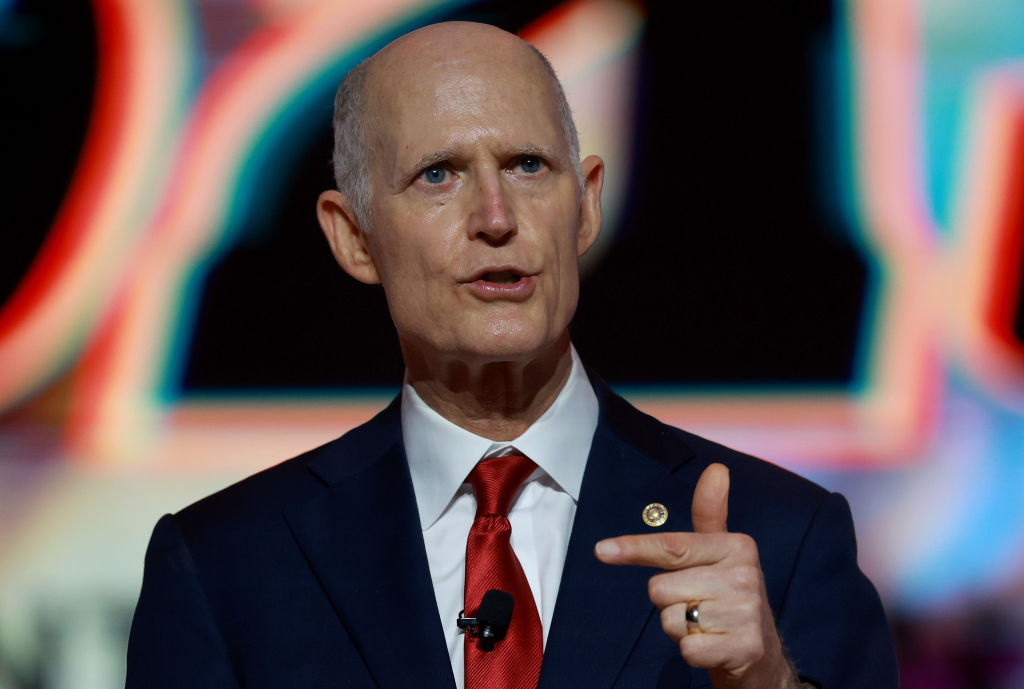
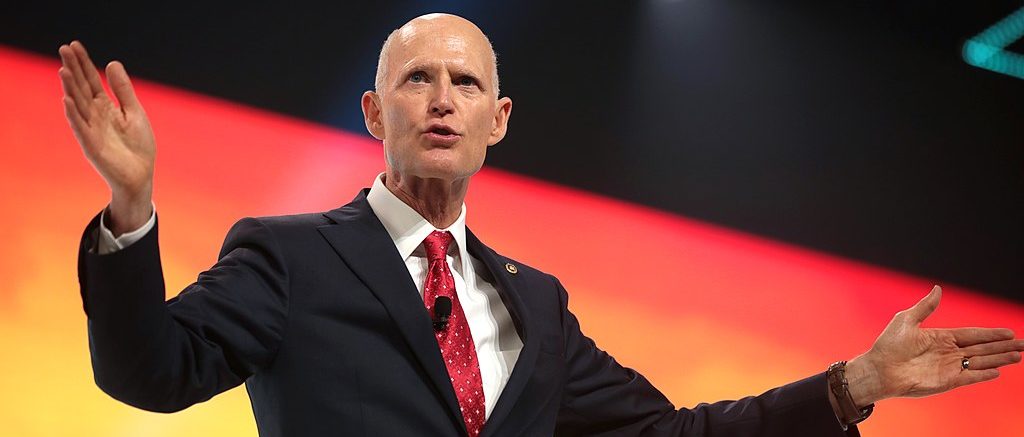
Richard Lynn Scott (né Myers; born December 1, 1952) is an American attorney, businessman, politician, and Navy veteran serving as the senior United States senator from Florida, a seat he has held since 2019. A member of the Republican Party, he served from 2011 to 2019 as the 45th governor of Florida.
Scott is a graduate of the University of Missouri–Kansas City and the Dedman School of Law at Southern Methodist University. In 1987, after serving in the U.S. Navy and becoming a law firm partner, he co-founded Columbia Hospital Corporation. Columbia later merged with another corporation to form Columbia/HCA, which eventually became the nation's largest for-profit health care company. During Scott's tenure as CEO of Columbia/HCA, a federal investigation was launched into allegations of colossal Medicare and Medicaid fraud. Scott resigned from his role as CEO on July four months after the investigation began. (The DOJ announced in 2003 that it had settled the case against Columbia/HCA for $1.7 billion in damages and penalties—at the time, the largest case of Medicare fraud in US history). After he resigned from Columbia/HCA, Scott gained notoriety for pleading the Fifth Amendment 75 times in depositions. He later became a venture capitalist, and pursued other business interests.
Scott ran for governor of Florida in 2010, defeating Bill McCollum in a vigorously contested Republican primary election and Democratic nominee Alex Sink by just over one point in the general election. Scott was reelected in 2014, again by just over one point, against former governor Charlie Crist. He was barred by term limits from running for reelection in 2018 and instead ran for the U.S. Senate.
Scott won the 2018 U.S. Senate election, defeating incumbent Democrat Bill Nelson in a close election that triggered a mandatory recount. He was reelected in 2024, defeating Democratic nominee Debbie Mucarsel-Powell by over 12 points. He became Florida's senior senator in 2025, when Marco Rubio resigned from the Senate to become Secretary of State.
Contents
Early life and education
Rick Scott was born Richard Lynn Myers on December 1, 1952, in Bloomington, Illinois. He never met his biological father, Gordon William Myers, whom Scott's mother, Esther J. Scott, described as an abusive alcoholic. Scott's parents divorced in his infancy.
In 1954, Esther married Orba George Scott Jr., a truck driver. Orba adopted Rick, who took his stepfather's surname and became known as Richard Lynn Scott. Scott was raised in North Kansas City, Missouri, the second of five children. His family was lower-middle-class and struggled financially; Esther Scott worked as a clerk at J. C. Penney, among other jobs.
Scott graduated from North Kansas City High School in 1970. He attended community college for a year and then enlisted in the United States Navy. In 1972, he married Ann Holland, whom he met in high school, at a Baptist church in Kansas City. Scott had completed naval bootcamp just before the wedding. Afterward, he was sent to a naval posting in Newport, Rhode Island, where he and his wife lived for 15 months. He served there as a radarman on the USS Glover (FF-1098), which during his enlistment spent time dry docked in Boston and sailed to ports in Bermuda and Puerto Rico. Scott was in the Navy for 29 months, including training.
After the Navy, Scott and his wife moved to Kansas City, where he attended college on the G.I. Bill. He graduated in 1975 from the University of Missouri–Kansas City with a Bachelor of Business Administration. He earned a Juris Doctor from Southern Methodist University. The Texas Bar licensed him to practice law in 1978.
Career
Scott made his first foray into business while working his way through college and law school, initially buying and reviving a failing doughnut shop (the Flavor Maid Do-Nut) by adding workplace delivery instead of relying on foot traffic. He later bought and revived another doughnut shop. After graduating from law school, Scott worked as an attorney at the law firm of Johnson & Swanson in Dallas, Texas.
Columbia Hospital Corporation
In 1988, Scott and Richard Rainwater, a financier from Fort Worth, each put up $125,000 in working capital in their new company, Columbia Hospital Corporation; they borrowed the remaining money needed to purchase two struggling hospitals in El Paso for $60 million. Then they acquired a neighboring hospital and shut it down. Within a year, the remaining two were doing much better. By the end of 1989, Columbia Hospital Corporation owned four hospitals with a total of 833 beds.
In 1992, Columbia made a stock purchase of Basic American Medical, which owned eight hospitals, primarily in Southwestern Florida. In September 1993, Columbia did another stock purchase, worth $3.4 billion, of Galen Healthcare, which had been spun off by Humana Inc. several months earlier. At the time, Galen had approximately 90 hospitals. After the purchase, Galen stockholders had 82% of the stock in the combined company, with Scott still running the company.
Columbia/HCA
In April 1987, Scott made his first attempt to buy the Hospital Corporation of America (HCA). While still a partner at Johnson & Swanson, Scott formed the HCA Acquisition Company with two former executives of Republic Health Corporation, Charles Miller and Richard Ragsdale. With financing from Citicorp conditional on acquisition of HCA, the proposed holding company offered $3.85 billion for 80 million shares at $47 each, intending to assume an additional $1.2 billion in debt, for a total $5 billion deal. After HCA declined the offer, the bid was withdrawn.
In 1994, Columbia Hospital Corporation merged with HCA, "forming the single largest for-profit health care company in the country." Scott became CEO of Columbia/HCA. According to The New York Times, "[in] less than a decade, Mr. Scott had built a company he founded with two small hospitals in El Paso into the world's largest health care company – a $20 billion giant with about 350 hospitals, 550 home health care offices and scores of other medical businesses in 38 states."
On March 19, 1997, investigators from the Federal Bureau of Investigation, the Internal Revenue Service, and the Department of Health and Human Services served search warrants at Columbia/HCA facilities in El Paso and on dozens of doctors with suspected ties to the company. Eight days after the initial raid, Scott signed his last SEC report as a hospital executive. Four months later, the board of directors pressured him to resign as chairman and CEO. He was succeeded by Thomas F. Frist Jr. Scott was paid $9.88 million in a settlement, and left owning 10 million shares of stock then worth more than $350 million. The directors had been warned in the company's annual public reports to stockholders that incentives Columbia/HCA offered doctors could run afoul of a federal anti-kickback law passed to limit or eliminate instances of conflicts of interest in Medicare and Medicaid.
In 2000, during a deposition for a civil suit unrelated to the fraud investigation, Scott pleaded the Fifth Amendment 75 times. In settlements reached in 2000 and 2002, Columbia/HCA pleaded guilty to 14 felonies and agreed to a $600+ million fine in what was at the time the largest health care fraud settlement in U.S. history. Columbia/HCA admitted systematically overcharging the government by claiming marketing costs as reimbursable, by striking illegal deals with home care agencies, and by filing false data about use of hospital space. It also admitted to fraudulently billing Medicare and other health programs by inflating the seriousness of diagnoses and to giving doctors partnerships in company hospitals as a kickback for the doctors referring patients to HCA. It filed false cost reports, fraudulently billed Medicare for home health care workers, and paid kickbacks in the sale of home health agencies and to doctors to refer patients. In addition, it gave doctors "loans" never intended to be repaid, free rent, free office furniture, and free drugs from hospital pharmacies.
Venture capitalist
After leaving Columbia/HCA in 1997, Scott launched Richard L. Scott Investments, based in Naples, Florida (originally in Stamford, Connecticut), which has stakes in health care, manufacturing and technology companies. Between 1998 and 2001, he purchased 50% of CyberGuard Corporation for approximately $10 million. Among his investors was Metro Nashville finance director David Manning.
In 2006, CyberGuard was sold to Secure Computing for more than $300 million. In February 2005, Scott purchased Continental Structural Plastics, Inc. (CSP) in Detroit, Michigan. In July 2006, CSP purchased Budd Plastics from ThyssenKrupp, making CSP the largest industrial composites molder in North America.
In 2005–2006, Scott provided the initial round of funding of $3 million to Alijor.com (named for the first three letters of his two daughters' names), which offered hospitals, physicians, and other health care providers the opportunity to post information about their prices, hours, locations, insurance accepted, and personal backgrounds online. Scott co-founded the company with his daughter Allison.
In 2008, Alijor was sold to HealthGrades. In May 2008, Scott purchased Drives, one of the world's leading independent designers and manufacturers of heavy-duty drive chain-based products and assemblies for industrial and agricultural applications and precision-engineered augers for agricultural, material handling, construction and related applications. Scott reportedly has an interest in a chain of family fun centers/bowling alleys, S&S Family Entertainment, in Kentucky and Tennessee led by Larry Schmittou, a minor league baseball team owner.
America's Health Network (AHN)
In July 1997, Columbia/HCA Healthcare purchased a controlling interest in America's Health Network (AHN), the first 24-hour health care cable channel. The company pulled out of the deal on the day of the closing because Scott and Vandewater were terminated, causing the immediate layoffs of more than 250 people in Orlando. Later that same year, Scott became majority owner of AHN.
In 1998, Scott and Vandewater led a group of investors who gave AHN a major infusion of cash so that the company could continue to operate. By early 1999, the network was available in 9.5 million American homes.
In mid-1999 AHN merged with Fit TV, a subsidiary of Fox; the combination was renamed The Health Network. Later that year, in a deal between News Corp. and WebMD, the latter received half-ownership of The Health Network. WebMD planned to relaunch The Health Network as WebMD Television in the fall of 2000, with new programming, but that company announced cutbacks and restructuring in September 2000, and, in January 2001, News Corp. regained 100% ownership. In September 2001, Fox Cable Networks Group sold The Health Network to its main rival, the Discovery Health Channel, for $155 million in cash plus a 10% equity stake in Discovery Health.
Solantic
Solantic, based in Jacksonville, Florida, was co-founded in 2001 by Scott and Karen Bowling, a former television anchor Scott met after Columbia bought what is now Memorial Hospital in 1995.
Solantic opened its first urgent care center in 2002. It provides urgent care services, immunizations, physicals, drug screening, and care for injured workers. The corporation attracts patients who do not have insurance, cannot get appointments with their primary care physicians, or do not have primary care physicians. Solantic is an alternative to the emergency department care that these types of patients often seek, or to not seeing a doctor at all. In 2006, Scott said that his plans for Solantic were to establish a national brand of medical clinics.
In August 2007, the company received a $40 million investment from a private equity firm and said that it expected to open 35 clinics by the end of 2009, with annual revenues of $100 million once all these clinics were open, compared to $20 million at the time. As of March 2009, Solantic had 24 centers, all in Florida.
Solantic was the target of an employment discrimination suit that claimed that there had been a policy to not hire elderly or obese applicants, preferring "mainstream" candidates. It was settled for an undisclosed sum on May 23, 2007. Scott responded to Salon regarding the claims of discrimination pointing out that "currently 53 percent of Solantic's employees are white, 20 percent black and 17 percent Hispanic."
Pharmaca
In 2003, Scott invested $5.5 million in Pharmaca Integrative Pharmacies, which operates drugstores/pharmacies in the Western United States that offer vitamins, herbal medicine, skin products, homeopathic medicines, and prescriptions.
Other work
In the 1990s, Scott was a partner of George W. Bush as co-owner of the Texas Rangers.
Early political career
Conservatives for Patients' Rights
In February 2009, Scott founded Conservatives for Patients' Rights (CPR), which he said was intended to put pressure on Democrats to enact health care legislation based on free-market principles. As of March 2009, he had given about $5 million for a planned $20 million ad campaign by CPR.
Governor of Florida
Elections
On April 9, 2010, Scott announced his candidacy for the Republican nomination for governor of Florida.
Susie Wiles, former communications chief to Jacksonville Mayor John Peyton, was Scott's campaign manager, and Tony Fabrizio was his chief pollster. It was reported on May 7 that Scott's campaign had already spent $4.7 million on television and radio ads. His first video advertisement was released to YouTube on April 13.
During the primary campaign, Scott's opponent, Bill McCollum, made an issue of Scott's role at Columbia/HCA. Scott countered that the FBI had never targeted him. Marc Caputo of the Miami Herald contended that a 1998 bill McCollum sponsored would have made it more difficult to prosecute Medicare fraud cases, and was counter to his current views and allegations. Scott won the August primary with 46.4% of the vote to McCollum's 43.4%.
In the general election, Scott faced Democratic nominee Alex Sink. By October 25, Scott had spent $60 million of his own money on the campaign, compared to Sink's reported $28 million. Scott campaigned as part of the Tea Party movement.
The Fort Myers News-Press quoted Scott as saying he had spent roughly $78 million of his own money on the campaign, although other figures indicate he spent slightly over $75 million. He defeated Sink by around 68,000 votes, or 1.29%. He took office as the 45th governor of Florida on January 4, 2011.
In October 2011, Scott announced that he would run for reelection in 2014. His political funding committee, Let's Get to Work, had raised $28 million for his campaign as of May 2014.
As of early June 2014, Scott had spent almost $13 million since March on television advertisements attacking former governor Charlie Crist, who then appeared to be the likely Democratic nominee, and who was eventually nominated. The ads resulted in a tightening of the race, mainly due to a decline in Crist's favorability ratings, while Scott's favorability ratings did not increase.
By late September 2014, Scott's television ad spending had exceeded $35 million and in mid-October reached $56.5 million, compared to $26.5 million by Crist. On October 22 it was reported that Scott's total spending had exceeded $83 million and he announced that, having previously said he would not do so, he would invest his own money into the campaign, speculated to be as much as $22 million.
Tenure
During Hurricane Irma, Scott led Florida through the largest mass evacuation in U.S. history. He signed a repeal of Florida's 1985 growth management laws, reduced funding for water management districts, reduced oversight at the Florida Department of Environmental Protection, and supported increased funding for Everglades restoration. Scott supported permanent tax cuts and "focused on job numbers rather than on running state agencies or making sweeping policy changes".
Scott had a 26 percent approval rating in December 2011, the lowest among U.S. governors, but it steadily increased during the rest of his governorship. It stood at 45 percent in August 2015, and at 57 percent in April 2017. In the aftermath of Hurricane Irma later that year, Scott's approval rating saw a high of 61 percent. Shortly before he left office, his ratings had fallen to 47 percent approving and 41 percent disapproving.
In 2013, Scott signed the Timely Justice Act (HB 7101) to overhaul the processes for capital punishment in Florida. The Supreme Court of the United States struck down part of this law in January 2016 in Hurst v. Florida, declaring, in an 8–1 decision, that a judge determining the aggravating facts to be used in considering a death sentence with only a non-binding recommendation from the jury based on a majority vote was insufficient and violated the Sixth Amendment guarantee of a jury trial.
The Florida Legislature passed a new statute to comply with Hurst v. Florida, changing the sentencing method to require a 10-juror supermajority for a sentence of death with a life sentence as the alternative. In October 2016, the Florida Supreme Court struck down this new sentencing scheme, holding that a death sentence must be issued by a unanimous jury. The Florida Supreme Court ruled the law "cannot be applied to pending prosecutions", which means that until the Florida legislature acts, there is no procedure or law allowing a prosecutor to seek the death penalty; the status of sentences passed under the twice struck down provisions was unresolved. The January 2016 United States Supreme Court Hurst decision also left those sentences' status unresolved. The Court granted Hurst a new sentencing hearing after its decision.
During Scott's tenure, Florida executed more inmates (28) than had been executed under any other governor in the state's history. Governor Ron DeSantis later beat this record.
U.S. Senate
Elections
After months of speculation about a potential run, Scott officially announced on April 9, 2018, that he would challenge incumbent Democratic U.S. Senator Bill Nelson in the 2018 election.
Scott defeated Rocky De La Fuente in the Republican primary. In the general election, Scott's involvement in a large Medicare fraud case stirred controversy. Scott responded with ads accusing Nelson of having cut Medicare benefits and stolen from Medicare; fact-checkers found that both of Scott's assertions were false. During the campaign, Scott called Nelson a "socialist", an assertion PolitiFact described as "pants-on-fire" false. Scott sought to avoid mentioning Trump and at times criticized or distanced himself from actions of the Trump administration, whereas in the past he had used his friendship with Trump to boost his profile and had been an early and vocal supporter of Trump in 2016. Trump endorsed Scott for Senate.
The initial election results showed Scott leading Nelson by 12,562 votes, or 0.15% of the vote. Under Florida law, a manual recount is triggered if election results show a margin of less than 0.5% of the vote. Both candidates filed lawsuits in connection with the recount. After the recount, Florida elections officials announced on November 18, 2018, that Scott had prevailed. Scott received 50.05% of the vote to Nelson's 49.93%; the margin of victory was 10,033 votes out of 8.19 million votes cast. Nelson then conceded. It was the most expensive Senate race in the nation in 2018. After the race, Scott's Super PAC, New Republican PAC, received criticism from across the political spectrum for its aggressive practices and was the subject of several FEC complaints for multiple violations of federal election law; the Super PAC's finances are chaired by hedge fund billionaire Ken Griffin, who personally donated at least $10 million to the PAC.
Scott ran for a second Senate term. He defeated Democratic nominee Debbie Mucarsel-Powell, a former congresswoman by over 12 percentage points. Scott became Florida's senior senator in January 2025, when Marco Rubio resigned to become Secretary of State.
Tenure
The Senate term for the 116th Congress began on January 3, 2019, but Scott's term as governor ended on January 8. On December 4, 2018, Scott's office announced that he would finish his term as governor and not resign early. Scott attended the ceremonial swearing-in of his successor as governor, Ron DeSantis, on the morning of January 8, 2019, in front of Florida's historic Old Capitol. Scott left the ceremony early to fly to Washington, D.C., and was sworn in to the Senate by Vice President Mike Pence later that afternoon.
In January 2019, Scott encouraged Trump to declare a national emergency to build a border wall if Congress would not give him the funds to do so. In February 2019, when Trump declared a national emergency, Scott applauded the decision.
In April 2019, amid calls for an American military intervention in Venezuela, Scott said that the Maduro regime was perpetrating a "genocide" and that the U.S. was "not aggressive enough" about the situation. Fact-checkers and experts described Scott's assertion of a genocide as false and misguided. Scott called on the U.S. to position its military assets to be prepared to respond to events in Venezuela.
In May 2020, Scott voted for an amendment co-sponsored by Senators Steve Daines and Ron Wyden that would have required federal intelligence and law enforcement agencies to obtain federal court warrants when collecting web search engine data from American citizens, nationals, or residents under the Foreign Intelligence Surveillance Act (FISA).
After Supreme Court Justice Ruth Bader Ginsburg died on September 18, 2020, Scott sided with Senator Mitch McConnell and called on her replacement to be voted on before that year's presidential election.
After Donald Trump lost the 2020 presidential election while making false claims of fraud, Scott voted to object to seating the electors from Pennsylvania but voted against the other objection raised for seating the electors from Arizona. Both objections were rejected by the Senate, 92–7 and 93–6, respectively.
In April 2021, Scott ran unopposed for the chairmanship of the National Republican Senatorial Committee and was formally selected on November 10, 2020, succeeding Senator Todd Young.
119th United States Congress Committee assignments
Source:
Committee on Armed Services
Subcommittee on Personnel
Subcommittee on Seapower (Chairman)
Subcommittee on Readiness and Management Support
Committee on Homeland Security and Governmental Affairs
Committee on the Budget
Special Committee on Aging (Chairman)
Committee on Foreign Relations
Net worth and investments
Scott's net worth was estimated at US$219 million in 2010, $84 million in 2012, and $133 million in 2013. On July 1, 2015, it was reported that Scott's net worth had grown to $147 million, $149 million on December 31, 2016, and $232 million on December 31, 2017. For August 2018, his net worth was estimated at $255 million. Based on financial disclosure reports covering 2020, Business Insider reports that Scott has a minimum net worth of just over $200 million, making him the wealthiest member of Congress.
Creation of "blind trust"
Early in his gubernatorial tenure, Scott said he created a blind trust for his holdings to avoid the appearance of a conflict of interest. In October 2018, The New York Times reported that the trust in question was blind in name only, and that there were various ways in which Scott could know what his precise holdings were. The holdings in question included investments in companies and funds that Scott could have had an impact on through his administration's policies. The trust in question was managed by one of Scott's former personal assistants from before he became governor.
In February 2019, Scott announced that he would no longer keep his holdings in a trust.
Controversial investments
In 2017, Scott and his wife held stocks in firms that did business with the Maduro government in Venezuela and a shipping firm with close ties to Russia. Scott had been a harsh critic of the Maduro regime and chastised companies that invested in Venezuela, saying, "Any organization that does business with the Maduro regime cannot do business with the state of Florida." By 2018, Scott and his wife no longer held stocks in the firms with links to Russia or Venezuela.
In a July 2018 financial disclosure statement, Scott and his wife reported earnings of at least $2.9 million in hedge funds registered in the Cayman Islands, a well-known tax haven. The financial statement said that the assets were held in a blind trust and a 2018 campaign spokesperson said Scott did not have a role in selecting particular investments.
Scott and his wife invested at least $3 million in the parent company of All Aboard Florida, a rail investment company that proposed to build high-speed rail between Orlando and Tampa. In 2018, Scott supported the efforts of the company to build the rail and get taxpayer-financing. He had previously, early in his tenure as governor, rejected $2.3 billion in federal funding to develop high-speed rail between Tampa and Orlando. Scott stated the original project was fiscally irresponsible given the recession, and he supported a public-private partnership approach when the state's finances were in order.
Scott was an investor in the firm Conduent Inc., which was awarded a $287 million Florida contract in 2015 to manage SunPass, the toll program in the state of Florida. Due to glitches in SunPass, motorists were charged bank fees and overdraft charges, and the Florida Department of Transportation was criticized for failing to take action. Scott, a Conduent investor, defended the department's handling of the SunPass controversy.
IRS leak
Scott revealed that he was among the victims of Charles E. Littlejohn's IRS tax data leak that targeted people of high net worth when he wrote a letter to Merrick Garland protesting the single felony charge. Speaking in court in 2024, Scott testified, "every American is a victim here" and said the plea agreement was a political scheme.
Personal life
On April 20, 1972, Scott, then aged 19, married his high school sweetheart, Frances Annette Holland (born May 11, 1952), who was also 19 years old. The couple has two daughters and six grandsons. They live in Naples, Florida, and are founding members of Naples Community Church.
Swatting
Scott was swatted in December as part of the 2023 swatting of American politicians. His residence was the target of another swatting attempt in November 2025, though he was not home at the time of the incident.
Awards and honors
Time magazine, America's 25 Most Influential People, June 1996
Financial World magazine, silver award for the CEO of the Year, 1995
Columbia University School of Nursing, Second Century Award for Excellence in Health Care (1995)
Americans for Prosperity, "Pioneers for Prosperity" Award, 2024