Reception
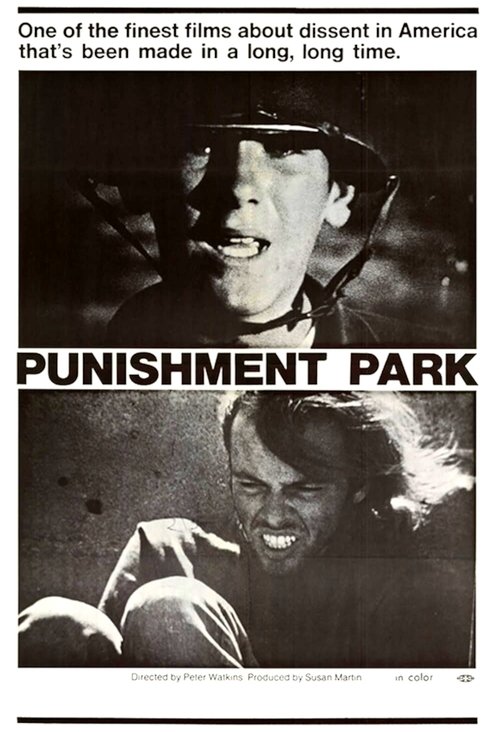
One of Watkins' intentions for the film was to provoke strong emotional and intellectual responses. Few people had impartial reactions to the film. As Watkins foresaw, this produced debates after the viewings of the film similar to the debates that take place in the film. There were many extremely negative reactions to the film, largely due to the unconventional form or because it was viewed as an indictment against the United States. Some even linked the film to communism, claiming that the film expresses a Communist philosophy. However, many more people were critical that a British director would make a film about American political problems in a time of crisis. The film was heavily attacked when it was released at the 1971 New York Film Festival and Hollywood studios refused to distribute it.
The film proved to be especially polarizing within the United States. Vincent Canby of The New York Times sharply attacked the film: "A film of such unvarnished, misguided self-assurance that one sits through the hysterical first ten minutes only to realize that, fundamentally, one is dealing with a masochist's dream come true." In The New-York Magazine, Judith Crist noted with emphasis that Watkins was permitted "...to declare the U.S. a completely fascist state," and described the film as "offensive," one in which "no one expresses an original or positive thought." Michael Kerbel of The Village Voice took less issue with the content as opposed to the presentation: "It is not [Watkins'] perception of the dangers one might object to, but rather the manner in which he presents them...his films function as hysterical exploitation, not like serious investigations." Despite this, he still had a positive review: "The film expresses exactly what is happening in this country."
The San Francisco Chronicle's was positive: "An indictment of devastating impact, a drama that leaves one frozen, and a prediction that makes one shudder. Polemical, without question, but...Watkins has created a deeply disturbing film." The U.S. edition of the Rolling Stone named Punishment Park one of the 10 best films of the year.
In Watkins' home of Great Britain, The Sun polemicized his work: "Propagandist Peter Watkins drifts helpless in his utterly hopeless trains of thought." Other critics, including those from The Sunday Times and The Listener, acknowledged the film's intent and plausibility, but still felt that the message was undermined by its stylistic execution. The Observer also described the film as "hysterical and obsessive," but also "thoughtful," concluding with "Every thinking person should see it."
The Scotsman praised it as being "blunt, uncompromising, and brilliant." Even the right-wing tabloid The Daily Mail noted the film retrospectively: "Some years ago, we dismissed the film as the delusion of a sick mind. Today, its documentary undertones are terrifyingly real."
Critics and film historians that specialized in the sci-fi genre also offered mixed assessments of the film. While Alan Frank described it as "boring, shrill, and almost unwatchable" in the Science Fiction and Fantasy Film Handbook, The Aurum Film Encyclopedia praised Punishment Park as, alongside The War Game, "...the most successful of Watkins' examinations of the present by means of reconstructions of the future...a powerful and desperate, albeit occasionally convoluted, indictment of potential oppression."
In Germany, the Catholic journal Stimmen der Zeit (Voice of the Times) stated: "One can dismiss Punishment Park as a malicious dystopia; however, one can also quite seriously label it a nightmare of today's America." The Lexikon des internationalen Films (Lexicon of International Films) viewed it as a "brilliantly staged mock-documentary" and "an attack against fascist tendencies in the USA - a factually exaggerated, yet as a psychological study, highly convincing fable." In 2006, Die Zeit (The Times) observed that the film "fits neatly into prevailing patterns of perception: after all, ever since September 11 the thought is that reality re-enacts cinematic fantasies, and not the other way around. Yet in the case of Punishment Park, the startling visual resemblance smooths over the underlying differences. Above all, the film remains a historical document of the 1968 revolt."
In spite of the controversy at the time of its release, the film has received a positive critical reappraisal in the years since. In 2005, The Guardian wrote that "twenty-five years on, Peter Watkins's dystopian nightmare still grips, imagining hippies and radicals getting tortured for quasi-judicial sport by the National Guard". As of 2023, it holds a 92% "Fresh" rating on Rotten Tomatoes.