




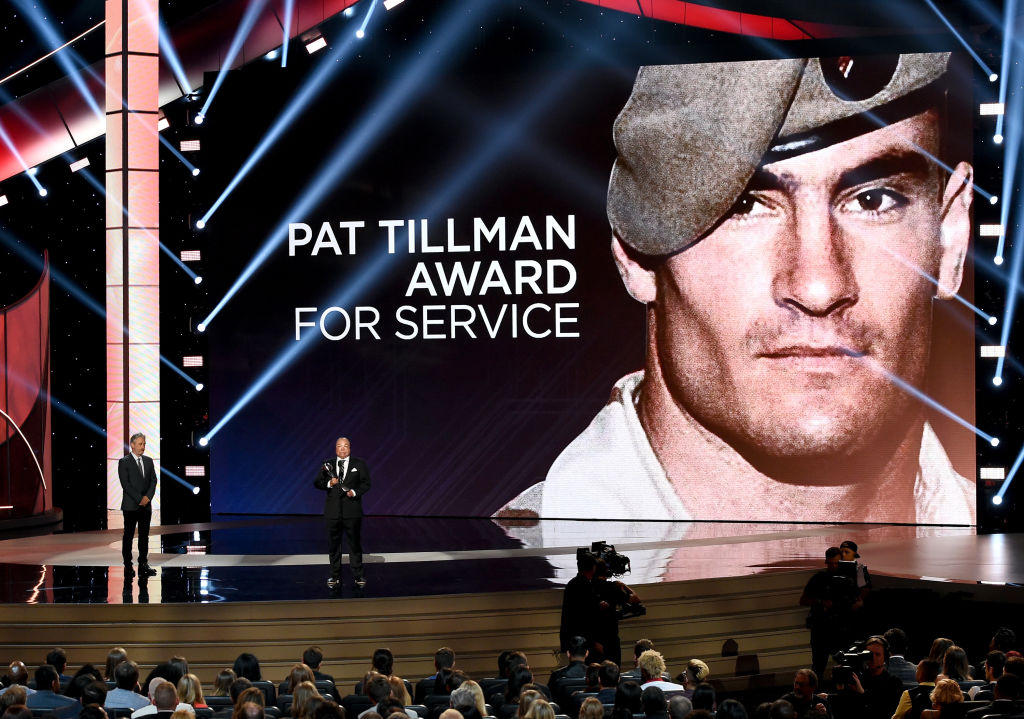
Patrick Daniel Tillman (November 6, 1976 – April 22, 2004) was an American professional football player for the Arizona Cardinals of the National Football League (NFL) who left his sports career and enlisted in the United States Army Special Operations in May 2002 in the aftermath of the September 11 attacks. His service in Iraq and Afghanistan, as well as his subsequent death, received significant media attention, especially when it was discovered he had been killed by friendly fire.
Tillman played college football for the Arizona State Sun Devils, earning first-team All-American honors in 1997. After four seasons in the NFL, Tillman joined the Army Rangers and served several combat tours before he was killed in the mountains of Afghanistan. At first, the Army reported that Tillman had been killed by enemy fire. A month later, on May 28, 2004, the Pentagon notified the Tillman family that he was actually killed by friendly fire. The family and other critics allege that the Department of Defense delayed the disclosure until weeks after Tillman's memorial service out of a desire to protect the image of the U.S. military. In 2007, the Pentagon released a report ruling Tillman's death as accidental.
Tillman was posthumously promoted from specialist to corporal. He also posthumously received the Silver Star and Purple Heart medals.
Contents
Early life and education
Tillman was born on November 6, 1976, in Fremont, California, to Patrick Kevin and Mary Tillman (née Spalding). The oldest of three sons, Tillman played competitive football. He went to Bret Harte Middle School and helped lead Leland High School to the Central Coast Division I Football Championship. Tillman did not always play football. In his freshman year of high school, he was catcher for his baseball team, but did not make the varsity team. In his sophomore year he decided to concentrate on football. Tillman then went to Arizona State University on a football scholarship.
Tillman was very close to his family and high school friends. He repeatedly mentioned in his personal journals during wartime service that he drew strength from and deeply valued his closest friendships, parents, wife, and family. Tillman was very committed to his high school sweetheart, Marie Ugenti, whom he married shortly before his enlistment in the Army. He also was very close with his brother, Kevin, who enlisted with and served alongside him.
College years
He started his college career as a linebacker for Arizona State University in 1994, when he secured the last remaining scholarship for the team. Tillman excelled as a linebacker at Arizona State, despite being relatively small for the position at 5 ft 11 in (1.80 m) tall. As a junior, he helped his team go undefeated that season as well as helping them make it to the Rose Bowl that year. In 1997, he was voted the Pac-10 Defensive Player of the Year. In the same year, Tillman was also named Arizona State's MVP.
Pat Tillman majored in marketing and graduated in three and a half years with a 3.85 GPA. He also earned many academic awards including: the Clyde B. Smith Academic Award in 1996 and 1997; The Sporting News Honda Scholar-Athlete of the Year in 1997; and the 1998 Sun Angel Student Athlete of Year. He was the sole inductee of the East–West Shrine Bowl Hall of Fame in 2005 and was also selected to the East–West Shrine Bowl All-Century Team. Tillman was inducted into the College Football Hall of Fame in 2010, and the Arizona Sports Hall of Fame in 2018.
Professional football career (1998–2002)
In the 1998 NFL draft, Tillman was selected as the 226th pick by the Arizona Cardinals, and given a signing bonus of $21,000 (equivalent to $41,481 in 2025). Tillman moved over to play the safety position in the NFL and started ten of 16 games in his rookie season.
At one point in his NFL career, Tillman turned down a five-year, $9 million contract offer from the St. Louis Rams out of loyalty to the Cardinals.
Sports Illustrated football writer Paul Zimmerman named Tillman to his 2000 NFL All-Pro team after Tillman finished with 155 tackles (118 solo), 1.5 sacks, two forced fumbles, two fumble recoveries, nine pass deflections, and one interception for 30 yards.
Tillman finished his career with totals of 340 tackles, 2.5 sacks, three interceptions for 37 yards, three forced fumbles, 15 pass deflections, and three fumble recoveries in 60 career games. In addition, he also had 1 rush attempt for 4 yards and returned 3 kickoffs for 33 yards.
In May 2002, eight months after the September 11 attacks, and after completing the 15 remaining games of the 2001 season which followed the attacks, Tillman turned down a contract offer of $3.6 million ($6 million in 2025) over three years from the Cardinals to enlist in the U.S. Army.
U.S. Army service (2002–2004)
Tillman and his brother Kevin enlisted on May 31, 2002. In September 2002, they completed basic training together. The two brothers completed the Ranger Indoctrination Program in late 2002 and were assigned to the 2nd Ranger Battalion in Fort Lewis, Washington. Tillman resided in University Place with his wife before being deployed to Iraq. After participating in the invasion of Iraq as part of Operation Iraqi Freedom, in September 2003, he entered Ranger School at Fort Benning, Georgia; he graduated on November 28, 2003.
Tillman was subsequently deployed to Afghanistan, and posted at FOB Salerno.
Death
On April 22, 2004, he was reported to have been killed by enemy combatants. An Afghan Militia Force allied soldier, Sayed Farhad, was also killed in the action. Tillman's platoon leader, First Lieutenant David Uthlaut, and his radiotelephone operator (RTO), 19-year-old Jade Lane, were wounded in the incident. The Army initially claimed that Tillman and his unit were attacked in an apparent ambush on a road outside of the village of Spera about 25 miles (40 km) southwest of Khost, near the Pakistan border. It was not until after his burial that investigations by the Department of Defense and U.S. Congress were launched, eventually ruling his death as having come by friendly fire.
Specialist Russell Baer, who served alongside Tillman in Iraq, claimed Tillman had told him that the Iraq War was "so fucking illegal" and that he opposed then-President George W. Bush.
An investigation by the U.S. Army Criminal Investigation Division (CID) concluded that Tillman and the Afghan militia soldier were killed by friendly fire when one part of his platoon fired upon the other in confusion, after nearby gunfire was mistakenly believed to be from enemy combatants. The CID Report summary, dated March 19, 2007, stated that: ... during their movement through the canyon road, Serial 2 [Tillman's platoon had to split up because of a broken HMMWV; the parts were called Serial 1 and 2] was ambushed and became engaged in a running gun battle with enemy combatants. Serial 1 [Tillman's portion of the platoon] had just passed through the same canyon without incident and were approximately one kilometer ahead of Serial 2. Upon hearing explosions, gunfire, and sporadic radio communication from Serial 2, Serial 1 dismounted their vehicles and moved on foot, to a more advantageous position to provide overwatch and fire support for Serial 2's movement out of the ambush. Upon exiting the gorge, and despite attempts by Serial 1 to signal a "friendly position", occupants of the lead vehicle of Serial 2 opened fire on Tillman's position, where he was fatally shot.
The Army Special Operations Command initially claimed that there was an exchange with hostile forces. After a lengthy investigation conducted by Brigadier General Gary M. Jones, the U.S. Department of Defense concluded that both the Afghan militia soldier's and Tillman's deaths were due to friendly fire aggravated by the intensity of the firefight.
Aftermath
A report described in The Washington Post on May 4, 2005, prepared at the request of Tillman's family by Brigadier General Gary M. Jones, revealed that in the days immediately following Tillman's death, Army investigators were aware that Tillman had been killed by friendly fire, shot three times in the head at less than 10 yards away, according to Army doctors. Jones reported that senior Army commanders, including General John Abizaid, knew of this fact within days of the shooting, but nevertheless approved the awarding of the Silver Star, Purple Heart, and a posthumous promotion to the rank of Corporal.
Lieutenant General Stanley McChrystal approved the Silver Star citation on April 28, 2004, which gave a detailed account of Tillman's death including the phrase "in the line of devastating enemy fire," but the next day he sent a P4 confidential memo warning senior government members that Tillman might actually have been killed by friendly fire. Senior commanders within the U.S. Central Command, including former Commander of the United States Central Command (CENTCOM) General John Abizaid, were notified by the P4 memo, which described Tillman's "highly possible" friendly fire, four days before Tillman's nationally televised memorial service during which he was lauded as a war hero for dying while engaging the enemy.
Jones reported that members of Tillman's unit burned his body armor and uniform in an apparent attempt to hide that he was killed by friendly fire. His notebook, in which, according to author Jon Krakauer, Tillman had recorded some of his thoughts on Afghanistan, was also burned, "a blatant violation of protocol." Several soldiers were punished by being removed from the United States Army Rangers. Jones believed that Tillman should retain his medals and promotion, since, according to Jones, he intended to engage the enemy and behaved heroically.
Tillman's family was not informed of the finding that he was killed by friendly fire until weeks after his memorial service, although at least some senior Army officers knew prior to the service. According to Krakauer in Where Men Win Glory, the extensive coverup that followed included the military's order that Tillman's comrades lie to his family at the funeral. Tillman's parents have sharply criticized the Army's handling of the incident. Tillman's mother believed that "this lie was to cover their image," while Tillman's father believed that the Army "purposely interfered in the investigation" because of the effect it could have on recruitment.
Legacy
Memorials and tributes
After his death, family and friends of Tillman including his widow Marie Tillman established the Pat Tillman Foundation to carry forward Tillman's legacy by inspiring and supporting those striving for positive change in themselves and the world. Marie would serve as executive director and then chair of the board.
A highway bypass around the Hoover Dam has a bridge bearing Tillman's name. Completed in October 2010, the Mike O'Callaghan–Pat Tillman Memorial Bridge spans the Colorado River between Nevada and Arizona.
Lincoln Law School of San Jose has established the Pat Tillman Scholarship in honor of Tillman. Tillman's father earned his Juris Doctor from Lincoln in 1983.
On Sunday, September 19, 2004, all teams of the NFL wore a memorial decal on their helmets in honor of Tillman. The Arizona Cardinals continued to wear this decal throughout the 2004 season. Former Cardinals quarterback Jake Plummer requested to also wear the decal for the entire season, but the NFL turned him down, saying his helmet would not be uniform with the rest of the Denver Broncos. Plummer later grew a full beard and his hair long in honor of Tillman, who had such a style in the NFL before cutting his hair and shaving his beard off to fit military uniform guidelines.
The Cardinals retired his number 40, and Arizona State did the same for the number 42 he wore with the Sun Devils. The Cardinals have named the plaza surrounding their State Farm Stadium in Glendale Pat Tillman Freedom Plaza. Later, on November 12, 2006, during a Cardinals game versus the Cowboys, a bronze statue was revealed in his honor. ASU also named the football locker room entryway to Sun Devil Stadium the "Pat Tillman Memorial Tunnel" and made a "PT-42" patch that they place on the neck of their uniforms as a permanent feature. In 2011, Pat Tillman Veteran's Center in the lower level of the Memorial Union opened on the Tempe campus. Before the 2013 season, the Tillman Tunnel was renovated with new graphics and signage. Double doors separate the locker room from the tunnel, and a television with a sound system displays Tillman's career highlights. The gate which opens to the field features an image of Pat Tillman facing the field, looking as if he is leading the team out.
Criticisms
After reports of Tillman's anti-war views became public, Ted Rall, who had previously written a comic calling Tillman a "fool" and "idiot", said that he was wrong to have assumed Tillman to be a "right wing poster child" when Tillman regarded the invasion of Iraq as illegal.
Then-Lieutenant Colonel Ralph Kauzlarich, Regimental Executive Officer at Forward Operating Base Salerno on Khost, Afghanistan, under which Tillman was serving at the time of his death, and led the second investigation into Tillman's death, made statements about the Tillman family's search for the truth based on Tillman's atheism. In comments to ESPN, Kauzlarich said: "These people have a hard time letting it go. It may be because of their religious beliefs" and "When you die, I mean, there is supposedly a better life, right? Well, if you are an atheist and you don't believe in anything, if you die, what is there to go to? Nothing. You are worm dirt. So for their son to die for nothing and now he is no more ... I do not know how an atheist thinks, I can only imagine that would be pretty tough."
Kauzlarich conducted the second investigation into Tillman's death which lasted a week, from May 8 to 15, 2004. Brigadier General Rodney Johnson, the Commanding General of the United States Army Criminal Investigations Command, testified before Congress that he found these statements "totally unacceptable". Acting Department of Defense Inspector General Thomas Gimble also testified that he was "shocked" that Lieutenant Colonel Kauzlarich would make these statements. According to AP analysis, three lower-level officers are expected to be punished, and Kauzlarich may be one of the three. Tillman's mother continues to reject the Pentagon's characterization of the officers' offenses as "errors" in reporting Tillman's death, because several officers have said they made conscious decisions not to tell the Tillman family that friendly fire was suspected.
Media analyses
Reviews by The New York Times reporter Dexter Filkins of Jon Krakauer's book Where Men Win Glory: The Odyssey of Pat Tillman noted that the book did well to compile the facts and "nauseating" details regarding the coverup of Tillman's death. "After Tillman's death, Army commanders violated many of their own rules, not to mention elementary standards of decency, to turn the killing into a propaganda coup for the American side," Filkins wrote.
A documentary film, The Tillman Story, was shown at the Sundance Film Festival on January 23, 2010, and was released in August 2010.
On October 19, 2006, Kevin Tillman broke his silence about his brother's death, lashing out at the Iraq War (and American foreign policy in general) in a 660-word essay published on Truthdig, a progressive online journal of news and opinion. The essay was widely distributed and was cited in The New York Times and Associated Press.
Personal life
Tillman was an atheist. According to speakers at his funeral, he was very well-read, having read a number of religious texts including the Bible, Quran, and the Book of Mormon, as well as transcendentalist authors such as Ralph Waldo Emerson and Henry David Thoreau. However, responding to religious overtones at the funeral by Maria Shriver and John McCain, his youngest brother, Richard, said, "Just make no mistake, he'd want me to say this: He's not with God, he's fucking dead, he's not religious." Richard added, "Thanks for your thoughts, but he's fuckin' dead." Another article quotes Tillman as having told then-general manager of the Seattle Seahawks, Bob Ferguson, in December 2003, "You know I'm not religious."
The September 25, 2005, edition of the San Francisco Chronicle newspaper reported that Tillman held views which were critical of the Iraq War. According to Tillman's mother, a friend of Tillman had arranged a meeting for Tillman with author Noam Chomsky, a prominent critic of American foreign and military policy, to take place after his return from Afghanistan.
Awards and decorations
Silver Star Citation
Citation:
The President of the United States of America, authorized by Act of Congress July 9, 1918 (amended by an act of July 25, 1963), takes pride in presenting the Silver Star (Posthumously) to Corporal Patrick D. Tillman, United States Army, for gallantry in action while serving with the 2nd Battalion, 75th Ranger Regiment, during action in Afghanistan on 22 April 2004, against an armed enemy while serving as a Rifle Team Leader in support of Operation ENDURING FREEDOM. Caught between the crossfire of an enemy near ambush, Corporal Tillman put himself in the line of devastating enemy fire as he maneuvered his fire team to a covered position from which they could effectively employ their weapons on known enemy positions. His audacious leadership and courageous example under fire inspired his men to fight at great risk to their own personal safety, resulting in the enemy's withdrawal, his platoon's safe passage from the ambush kill zone, and his mortal wound. Corporal Tillman's personal courage, tactical expertise, and professional competence directly contributed to his platoon's overall success and survival. In making the ultimate sacrifice for his team and platoon, Corporal Patrick D. Tillman reflected great credit upon himself, the Joint Task Force, and the United States Army.
Awards
In addition to his military awards, Tillman received the Arthur Ashe Courage Award from ESPN in 2003, as part of that year's ESPY Awards ceremony.