




Oracle Corporation is an American multinational technology company headquartered in Austin, Texas. Co-founded in Santa Clara, California, in 1977 by Bob Miner, Ed Oates, and current chairman of the board and chief technology officer Larry Ellison, Oracle is among the 50 largest companies in the world by market cap, and ranked 66th on the Forbes Global 2000 as of 2025.
The company sells database software (particularly the Oracle Database), enterprise applications, and cloud infrastructure and hardware. Oracle's core application software is a suite of enterprise software products, including enterprise resource planning (ERP), human capital management (HCM), customer experience (CX) and supply chain management (SCM) software.
Contents
History
Larry Ellison, Bob Miner, and Ed Oates co-founded Oracle on June 16, 1977, in Santa Clara, California, as Software Development Laboratories (SDL). Beginning as consultants with a background in large-scale memory after a project for Ampex, Ellison took inspiration from the 1970 paper written by Edgar F. Codd on relational database management systems (RDBMS) named "A Relational Model of Data for Large Shared Data Banks." He heard about the IBM System R database from an article in an IBM research journal provided by Oates. Ellison wanted to make Oracle's product compatible with System R, but failed to do so as IBM kept the error codes for its DBMS a secret. SDL changed its name to Relational Software, Inc (RSI) in 1979, then again to Oracle Systems Corporation in 1983, to align itself more closely with its flagship product Oracle Database. The name also drew from the codename of a 1977 project for the Central Intelligence Agency, Oracle's first customer; the company received permission to use the code name for the new product. (According to Oracle executive Mike Humphries, Miner told him that the new company had the choice of the CIA database project or another offer to develop a compiler for the PDP-4, and the founders flipped a coin to decide.)
Miner served as a senior programmer, and Oates also worked in development. The three founders decided that Ellison was the worst programmer so he became the salesman. Understanding both customers and technology, Ellison designed database tables that he used to demonstrate the power of SQL to customers. By February 1983 the Rosen Electronics Letter said that Oracle was "the most comprehensive offering we've seen" among databases, with good marketing and a substantial installed base encouraging developers to write software for it. The newsletter said that revenue in fiscal 1983 would be about $8 million and would double in 1984. On March 12, 1986, the company had its initial public offering. In 1989, Oracle moved its world headquarters to the Redwood Shores neighborhood of Redwood City, California, though its campus was not completed until 1995. The company hired so many from top universities that Humphries compared it to "Cargill buying crops". Some new employees worked as receptionists or distributed coffee until more suitable positions became available.
Oracle in the late 1980s began selling enterprise software running on the database, starting with financial software, then manufacturing. Many at Oracle wanted to discontinue applications; the first several versions were weak, they competed with the company's independent software vendors and value-added reseller partners, and applications were never profitable for Oracle until after 2000. Selling them (and acquiring vendors such as JD Edwards and PeopleSoft, the latter being the second hostile takeover in the history of software) nonetheless allowed Oracle to compete with SAP; by the mid-2000s it was the world's largest enterprise software vendor. The company's Ken Jacobs later said:
Products and services
Oracle provides cloud infrastructure, AI services, database and database management software, enterprise applications, analytics, and developer tools that help businesses manage their data, operations, and IT environments.
Software applications
Oracle provides software applications, such as integrated enterprise software applications, Oracle Fusion Cloud Applications, human capital management (HCM), customer relationship management (CRM), and supply chain management (SCM).
Databases
The Oracle Database was released in 2004 as 10g. Subsequently, the product was released several times, with the newest issue released as 12c in 2018. Oracle released its Autonomous Database in 2018, Oracle Database 23ai in 2024, and issued its newest release Oracle AI Database 26ai in 2025.
Additionally, Oracle Corporation acquired and developed the following additional database technologies:
Berkeley DB, which offers embedded database processing
Oracle Rdb, a relational database system running on OpenVMS platforms. Oracle acquired Rdb in 1994 from Digital Equipment Corporation. Oracle has since made many enhancements to this product and development continues as of 2008.
TimesTen, which features in-memory database operations
Oracle Essbase, which continues the Hyperion Essbase tradition of multi-dimensional database management
MySQL, a relational database management system licensed under the GNU General Public License, initially developed by MySQL AB
Oracle NoSQL Database, a scalable, distributed key-value NoSQL database
Data centers
In March 2026, Oracle announced plans to build 72 multicloud data centers embedded with Microsoft, Amazon, and Google clouds. At the same time, Oracle had more than 200 live or in-progress cloud regions throughout the world—more than any of its competitors. The multicloud database side of the business grew 817% in Q2 of fiscal year 2026.
Oracle’s data center expansion has drawn opposition from some residents and environmental groups over concerns about water consumption, energy demand, air quality, and the effects of large-scale construction on surrounding communities. Such concerns have emerged around projects including the planned Project Jupiter campus in southern New Mexico, where critics have questioned the development’s water and power requirements and its potential effects on local resources.
Oracle and its development partners have announced measures intended to reduce the environmental impact of new data centers. The planned Port Washington, Wisconsin, campus is expected to use closed-loop liquid cooling, match non-renewable energy consumption with renewable-energy purchases, and pursue LEED certification. Project Jupiter’s developers replaced plans for gas turbines and diesel generators with solid oxide fuel cells and have said the campus will use recycled, non-potable water to reduce freshwater consumption.
Middleware
Oracle Fusion Middleware is a family of middleware software products, including application server, system integration, business process management (BPM), user interaction, content management, identity management and business intelligence (BI) products.
Oracle Secure Enterprise Search (SES), Oracle's enterprise-search offering, gives users the ability to search for content across multiple locations, including websites, XML files, file servers, content management systems, enterprise resource planning systems, customer relationship management systems, business intelligence systems, and databases.
Product Lines
Oracle Applications, software sold by Oracle based on its own database, first appeared in the late 1980s. Oracle Corporation maintains a number of product lines, such as:
Oracle E-Business Suite
PeopleSoft Enterprise
PeopleSoft EnterpriseOne (Later renamed, JD Edwards EnterpriseOne)
PeopleSoft World (Later renamed, JD Edwards World)
Siebel
JD Edwards
Merchandise Operations Management (Formerly Retek)
Planning & Optimisation
Store Operations (Formerly 360Commerce)
Enterprise management
Oracle Enterprise Manager (OEM) is a web-based monitoring and management tool for Oracle products (and for some third-party software), including database management, middleware management, application management, hardware and virtualization management and cloud management.
The Primavera products of Oracle's Construction & Engineering Global Business Unit (CEGBU) consist of project-management software.
Development software
Oracle Corporation's tools for developing applications include (among others):
Oracle Designer – a CASE tool which integrates with Oracle Developer Suite
Oracle Developer – which consists of Oracle Forms, Oracle Discoverer and Oracle Reports
Oracle JDeveloper, a freeware IDE
NetBeans, a Java-based software-development platform
Oracle APEX – low-code platform for web-oriented development
Oracle SQL Developer, an integrated development environment for working with SQL-based databases
Oracle SQL*Plus Worksheet, a component of Oracle Enterprise Manager (OEM)
OEPE, Oracle Enterprise Pack for Eclipse
Open Java Development Kit
Oracle Developer Studio – a software generation system for the development of C, C++, Fortran, and Java software
Oracle Visual Builder Studio
Operating systems
Oracle Corporation develops and supports two operating systems: Oracle Solaris and Oracle Linux.
Hardware
The Sun hardware range acquired by Oracle Corporation's purchase of Sun Microsystems
Oracle SPARC T-series servers and M-series mainframes developed and released after Sun acquisition
Engineered systems: pre-engineered and pre-assembled hardware/software bundles for enterprise use
Exadata Database Machine – hardware/software integrated storage
Exalogic Elastic Cloud – hardware/software integrated application server
Exalytics In-Memory Machine – hardware/software integrated in-memory analytics server
Oracle Database Appliance
Big Data Appliance – integrated map-reduce/big data solution
SPARC SuperCluster T4-4 – a general purpose engineered system
Services
Oracle Cloud is a cloud computing service offered by Oracle Corporation providing servers, storage, network, applications and services through a global network of Oracle Corporation managed data centers. The company allows these services to be provisioned on demand over the Internet.
Oracle Cloud provides Infrastructure as a Service (IaaS), Platform as a Service (PaaS), Software as a Service (SaaS) and Data as a Service (DaaS). These services are used to build, deploy, integrate and extend applications in the cloud.
Oracle has continued to make updates to its generative AI service, which is built and supported on Oracle Cloud Infrastructure and large language models (LLM) from Cohere as of 2023, Meta's Llama as of 2024, and xAI's Grok 3 as of 2025. The company has also been working to integrate generative AI into its other services. In April 2025, Oracle incorporated HeatWave GenAI into its database. In September 2025, Oracle and OpenAI signed a $300 billion contract for 4.5 gigawatts of power capacity over five years. In October 2025, Oracle and Microsoft announced a partnership to enhance supply chain efficiency and responsiveness for manufacturers. It was also announced that Oracle will offer cloud services using Advanced Micro Devices' upcoming MI450 artificial intelligence chips.
OPERA Cloud is a property management software (PMS) positioned under Oracle Hospitality. It's available across 236 countries and territories. In 2026, IHG Hotels & Resorts onboarded OPERA Cloud as its official PMS. In 2025, Accor onboarded it as its official PMS, moving away from Mews (software). In 2023, it was a market leader among PMSs.
Marketing
Sales practices
In 1990, Oracle laid off 10% (about 400 people) of its work force because of accounting errors. This crisis came about because of Oracle's "up-front" marketing strategy, in which sales people urged potential customers to buy the largest possible amount of software all at once. The sales people then booked the value of future license sales in the current quarter, thereby increasing their bonuses. This became a problem when the future sales subsequently failed to materialize. Oracle eventually had to restate its earnings twice, and also settled (out of court) class-action lawsuits arising from its having overstated its earnings. Ellison stated in 1992 that Oracle had made "an incredible business mistake".
Humphries described the cause ("building for years") as a combination of technical problems that benefited rivals, and the sales force using side letters and other improper tactics to meet the company's longstanding goal of doubling revenue each year. Ellison hired ("bring in adults", Jerry Held said) new executives Jeff Henley and Raymond J. Lane, who helped the company recover from what Ken Jacobs later described as a "near death experience", in which Oracle required an investment from a Japanese steel company to meet payroll.
Competition
The relational database industry was unusually concentrated. Besides being headquartered near each other in the San Francisco Bay area, database technology experts attended the same universities and served on the same standards committees (with Jim Gray serving as neutral arbiter as companies tried to get competing proposals enacted). Sales and marketing people were both fierce rivals and often moved between the companies, even as engineers socialized with each other. The smaller, later-founded database vendors viewed Oracle as their top enemy, with Bob MacDonald of Informix Software calling Oracle "the evil empire", while Humphries described his company as "the Klingons of" the bay.
Held later described his company's philosophy as "it's not good enough for Oracle to win. It was important for somebody else to lose". Ingres was its first major competitor; Oracle's strategy of focusing on one opponent at a time. Even publicly complimenting other rivals "to take the pressure off", Held said, while effective, caused it to neglect Sybase as a threat. Conversely, when Sybase had technical problems "it was: how do you put every ounce of product marketing, sales effort and focus on that". IBM's endorsement of SQL in Db2 in the early 1980s benefited Oracle and forced rivals like Ingres and Informix Corporation to adopt SQL to compete. Oracle acknowledged IBM as the standard while emphasizing its own superiority, touting "total IBM SQL compatibility" while IBM's software ran "only on IBM mainframes". By the mid-1980s the company described its database as "the last DBMS", bragging that Oracle now had larger database revenue than dBASE maker Ashton-Tate, and stating that Microsoft, Ashton-Tate, and Sybase's planned Microsoft SQL Server "jumped on Oracle's SQL bandwagon".
MacDonald credited Oracle with "being marketing oriented before any of the competitors ... pushing the envelope on selling the future way ahead of the rest of us". Stu Schuster of Sybase said "Larry taught us a lot about marketing". While other database companies' brochures emphasized technical features, Oracle advertisements showed an Oracle jet fighter shooting down Ashton-Tate and Borland biplanes; dBASE, IBM, and Db2 were among the many competitors Oracle marketing criticized by name. Conversely, another Oracle ad quoted Microsoft's Bill Gates, Sun's Scott McNealy, Hewlett-Packard's John A. Young, and Apple Computer's John Sculley as agreeing with Ellison on Oracle's database breakthroughs. Larry Rowe of Ingres said "you could never come up with a strategy to beat Oracle because whatever you said today, two days later Ellison was saying it with more marketing dollars". Jacobs said, by contrast:
Slogans
"Information driven"
For the Oracle Database: "Can't break it, can't break in" and "Unbreakable"
"Enabling the Information Age"
"Enabling the Information Age Through Network Computing"
As of 2008: "The Information Company"
As of 2010: "Software. Hardware. Complete."
As of late 2010: "Hardware and Software, Engineered to Work Together"
As of mid 2015: "Integrated Cloud Applications and Platform Services"
Corporate affairs
Finances
Oracle was ranked No. 82 in the 2018 Fortune 500 list of the largest United States corporations by total revenue. According to Bloomberg, Oracle's CEO-to-employee pay ratio is 1,205:1. The CEO's compensation in 2017 was $108,295,023. Oracle is one of the approved employers of ACCA and the median employee compensation rate was $89,887.
Personnel
Larry Ellison: ex-executive chairman and CTO (since September 2014), co-founder of the company, previously CEO (1977–2014), previously chairman (1990–2004). As of September 2021, he owned 42% of the company. As of 2025 Ellison remains a top executive but no longer CEO.
Safra Catz: executive vice chair (since September 2025), previously CEO (2014–2025), co-president (since 2004) and CFO. In 2016, she was ranked tenth on Fortune's Most Powerful Women list.
Jeff Henley: vice chairman (since September 2014), previously chairman (2004–2014) and CFO (1991–2004).
Mark Hurd: former CEO (2014–2019), previously co-president (2010–2014). In 2007, Mark Hurd was ranked No. 16 on Fortune's list of the 25 Most Powerful People in Business. He died in 2019.
Charles Phillips: former co-president and director (2003–2010); replaced by Mark Hurd.
Bob Miner: co-founder of the company and co-architect of Oracle Database. Led product design and development for Oracle Database (1977–1992). Spun off a technology group within Oracle in 1992. Oracle board member until 1993. He died in 1994.
Ed Oates: co-founder of the company. Retired from Oracle in 1996.
Umang Gupta: former vice president and general manager (1981–1984). Wrote the first business plan for the company. He died in 2022.
Bruce Scott: The first hired employee (after the co-founders; employee number 4) at Oracle (then Software Development Laboratories). Scott served as the co-author and co-architect of the Oracle database up to Version 3. He left Oracle in 1982.
Marc Benioff: former protégé of Ellison and the youngest to be promoted to vice president at the time. He left to found and lead Salesforce in 1999.
Controversies
Trashgate
In 2000, Oracle attracted attention from the computer industry and the press after hiring private investigators to uncover unfavorable information from organizations sympathetic to rival Microsoft. During the investigation, Oracle was accused of attempting to purchase trash from a janitor at the Association for Competitive Technology. This resulted in an antitrust trial against Microsoft.
The Chairman of Oracle Corporation, Larry Ellison, defended his company's hiring of an East Coast detective agency, calling the snooping a "public service". The investigation reportedly included a $1,200 offer to janitors at the Association for Competitive Technology to look through Microsoft's trash.
"Can't break it, can't break in"
In 2002, Oracle Corporation marketed many of its products using the slogan "Can't break it, can't break in", or "Unbreakable".
However, two weeks after its introduction, David Litchfield, Alexander Kornbrust, Cesar Cerrudo and others demonstrated a suite of successful attacks against Oracle products. Oracle Corporation's chief security officer Mary Ann Davidson said that, rather than representing a literal claim of Oracle's products' impregnability, she saw the campaign in the context of fourteen independent security evaluations that Oracle Corporation's database server had passed.
Relationship with John Ashcroft
In 2004, then-United States Attorney General John Ashcroft sued Oracle Corporation to prevent it from acquiring a multibillion-dollar intelligence contract. After Ashcroft's resignation from government, he founded a lobbying firm, The Ashcroft Group, which Oracle hired in 2005. With the group's help, Oracle went on to acquire the contract.
Cover Oregon Healthcare Exchange
Oracle Corporation was awarded a contract by the State of Oregon's Oregon Health Authority (OHA) to develop Cover Oregon, the state's healthcare exchange website, as part of the U.S. Patient Protection and Affordable Care Act. When the site tried to go live on October 1, 2013, it failed, and registrations had to be taken using paper applications until the site could be fixed.
In August 2014, Oracle Corporation sued Cover Oregon for breach of contract, and then later that month the state of Oregon sued Oracle Corporation, in a civil complaint for breach of contract, fraud, filing false claims and "racketeering". In September 2016, the two sides reached a settlement valued at over $100 million to the state, and a six-year agreement for Oracle to continue modernizing state software and IT.
Class action tracking lawsuit
In August 2022, a class action lawsuit was filed against Oracle by the law firm Lieff Cabraser. The lawsuit alleged that Oracle engaged in "deliberate and purposeful surveillance of the general population via their digital and online existence", specifically focusing on Oracle operating a surveillance machine that tracked and recorded personal data in real-time. The litigants alleged that through such surveillance, the company violated the Federal Electronic Communications Privacy Act, California's state constitution, the California Invasion of Privacy Act, competition law, and California Common Law.
The lawsuit was settled in July 2024 for $115 million.
Violations of the Foreign Corrupt Practices Act
Between 2011 and 2024, Oracle was investigated for engaging in bribery practices that violated the Foreign Corrupt Practices Act across its subsidiaries in South Africa, India, Turkey, and the United Arab Emirates. In all instances, the company settled with the United States Securities and Exchange Commission.
Reaction to the Gaza war
Following the beginning of the Gaza war in 2023, Oracle's top executives, including Safra Catz and Larry Ellison, publicly aligned the company with Israel's military operations. They issued statements of solidarity, paid double salaries to Israeli employees, and donated to organizations connected to Israel's wartime response. In 2024, Catz said to Israeli business news outlet CTech, "For employees, it's clear: if you're not for America or Israel, don't work here". In 2025, The Intercept spoke with Oracle employees who supported Palestine, but were afraid to speak out in their workplace. Sixty-eight Oracle employees signed an open letter criticizing the company's ties to Israel.
Fraud Accusations by the US Department of Justice
On July 29, 2010, the United States Department of Justice (DoJ) filed suit against Oracle Corporation alleging fraud. The lawsuit argues that the government received deals inferior to those Oracle gave to its commercial clients. The DoJ added its heft to an already existing whistleblower lawsuit filed by Paul Frascella, who was once senior director of contract services at Oracle. It was settled in 2011.
Lawsuit against Google
Oracle, the plaintiff, acquired ownership of the Java computer programming language when it acquired Sun Microsystems in January 2010. The Java software includes sets of pre-developed software code to allow programs and apps to accomplish common tasks in a consistent manner. The pre-developed code is organized into separate "packages" which each contain a set of "classes". Each class contains numerous methods, which instruct a program or app to do a certain task. Software developers "became accustomed to using Java's designations at the package, class, and method level".
Oracle and Google (the defendant) tried to negotiate an agreement for Oracle to license Java to Google, which would have allowed Google to use Java in developing programs for mobile devices using the Android operating system. However, the two companies never reached an agreement. After negotiations failed, Google created its own programming platform, which was based on Java, and contained 37 copied Java packages as well as new packages developed by Google.
HP and Oracle lawsuit
On June 15, 2011, HP filed a lawsuit in California Superior Court in Santa Clara, claiming that Oracle had breached an agreement to support the Itanium microprocessor used in HP's high-end enterprise servers. Oracle called the lawsuit "an abuse of the judicial process" and said that had it known SAP's Léo Apotheker was about to be hired as HP's new CEO, any support for HP's Itanium servers would not have been implied.
On August 1, 2012, a California judge said in a tentative ruling that Oracle must continue porting its software at no cost until HP discontinues its sales of Itanium-based servers. HP was awarded $3 billion in damages against Oracle in 2016. HP argued Oracle's canceling support damaged HP's Itanium server brand. Oracle had announced that it would appeal both the decision and damages, but the decision stayed.
GSA business bidding ban
On April 20, 2012, the US General Services Administration banned Oracle from the most popular portal for bidding on GSA contracts for undisclosed reasons. Oracle has previously used this portal for around four hundred million dollars a year in revenue. In 2011, Oracle settled with the General Services Administration for $199.5 million in a lawsuit filed under the False Claims Act.
Events and acquisitions
Acquisition of Sun Microsystems
In January 2010, Oracle completed its acquisition of Sun Microsystems, valued at more than $7 billion, a move that transformed Oracle from solely a software company to a manufacturer of both software and hardware. The acquisition was delayed for several months by the European Commission because of concerns about MySQL, but was unconditionally approved in the end. In September 2011, U.S. State Department Embassy cables were leaked to WikiLeaks. One cable revealed that the U.S. pressured the E.U. to allow Oracle to acquire Sun.
The Sun acquisition was closely watched by free software users and some companies, due to the fear that Oracle might end Sun's traditional support of free projects. Since the acquisition, Oracle has discontinued OpenSolaris and StarOffice, and sued Google over the Java patents Oracle acquired from Sun.
Cerner acquisition
On December 20, 2021, Oracle announced that it agreed to acquire Cerner Corporation (now Oracle Health and Oracle Life Sciences) for approximately US$28.3 billion, creating a dedicated Industry Business Unit within the company. Cerner is the largest international supplier of health information technology, such as electronic health records (EHR), revenue cycle solutions, and biomedical device integration platforms, and has its headquarters in Kansas City, Missouri, US. The deal closed in early July 2022 after receiving final approval from European regulators, making it Oracle's largest acquisition and one of the largest in corporate history.
Oracle's purchase of Cerner was part of an effort to introduce Oracle products into the healthcare market, particularly in the United States although Oracle plans to expand Cerner's global operations.
In September 2024, Oracle announced new investments and the release of Oracle Clinical Digital Assistant, a generative AI system that automatically creates consultation documentation and proposes orders.
Oracle has acquired the following technology companies:
PeopleSoft (2005), an ERP company
Siebel (2006), a CRM company
BEA Systems (2008), an enterprise infrastructure software company
Dyn (2016), an internet infrastructure company
DataFox (2018), a predictive intelligence software company
Datascience (2018), a data analysis company
Iridize (2018), a user training company
LiveData Utilities (2020), a utilities network management company
Oracle Health data breach
In March 2025, a threat actor claimed to have stolen 6 million data records from Oracle Health (formerly Cerner). Oracle claimed that its Oracle Cloud Infrastructure was not breached and that no customer data from it was exposed. Some legacy Cerner servers experienced unauthorized access, but Oracle has not confirmed the scale of impact. In April 2025, the Cybersecurity and Infrastructure Security Agency (CISA) issued a warning to Oracle customers to secure their environments.
U.S. TikTok's operations
On September 13, 2020, Bloomberg News reported that Oracle won a bidding war with other U.S.-based companies to take over social media company TikTok's operations in the United States following the company's pressure to forcibly be shut down by the Trump administration. Oracle was described as a "trusted tech partner" by TikTok. On September 19, 2020, the Trump administration approved of the sale of TikTok's US operations to Oracle "[delaying] — by one week — restrictions that were originally to take effect" on September 20 as indicated by the United States Department of Commerce.
As September 25, 2025, TikTok was bought by Silver Lake and Abu Dhabi's MGX. Oracle will own 45% of the app in the US, and ByteDance 35% after delays with the ban for the 4th time.
Oracle will store data of US TikTok users on its cloud computers, and it will be involved in the new TikTok spinoff's cybersecurity.
Anduril partnership
Oracle partnered with the arms company Anduril Industries to provide their Lattice military software platform to the governments of United States, United Kingdom and Australia.
Offices
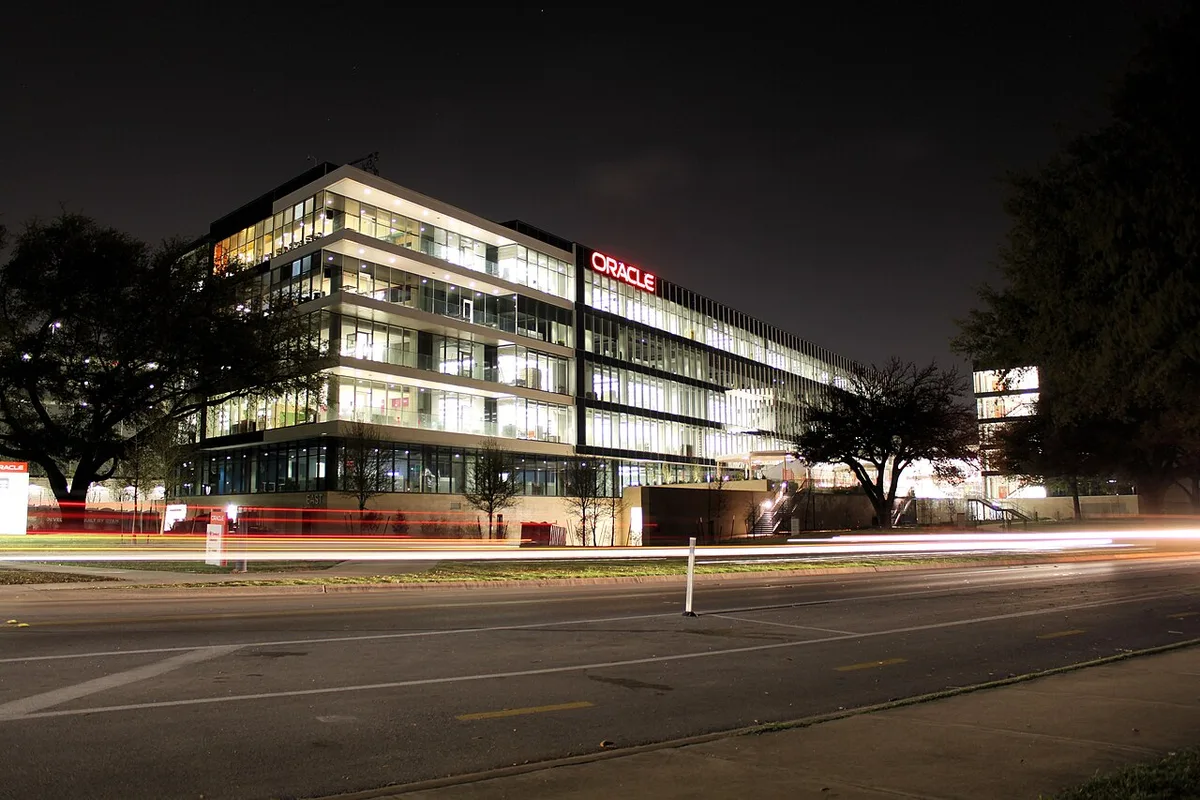
Oracle Corporation's world headquarters are located in Austin, Texas. In April 2024, Oracle announced plans to build its largest office hub, with 8,500 jobs, in Nashville, Tennessee.
Oracle has a large office complex located on the San Francisco Peninsula in the Redwood Shores area of Redwood City. This complex was home to Oracle world headquarters from 1989 to 2020. It is located on the former site of Marine World/Africa USA, which moved from Redwood Shores to Vallejo in 1986. Oracle Corporation originally leased two buildings on the Oracle Parkway site, moving its finance and administration departments from the corporation's former headquarters on Davis Drive, Belmont, California. Eventually, Oracle purchased the complex and constructed four additional buildings.
The distinctive Oracle Parkway buildings, nicknamed the Emerald City, served as sets for the futuristic headquarters of the fictional company "NorthAm Robotics" in the Robin Williams film Bicentennial Man (1999). The campus also represented the headquarters of Cyberdyne Systems in the movie Terminator Genisys (2015).
Corporate structures
Oracle Corporation operates in multiple markets and has acquired many companies to help it do so. In some cases these companies became the starting points for global business units (GBUs) targeting particular vertical markets. Oracle Corporation's GBUs include:
Communications
Construction and engineering (formerly the Primavera GBU)
Energy and Water
Financial services
Food and Beverages
Health sciences
Hospitality
Retail
Sponsorships
In 1994 and 1995, Oracle sponsored Benetton Formula.
From 2001 to 2021, Sean Tucker's stunt biplane was sponsored by Oracle and performed frequently at air shows around the US.
In October 2006, the Golden State Warriors and the Oracle Corporation announced a 10-year agreement in which the Oakland Arena would become known as the Oracle Arena. The agreement ended after the 2018–2019 NBA season when the Warriors relocated to the Chase Center in San Francisco. In January 2019, the San Francisco Giants entered into a 20-year agreement to rename its stadium Oracle Park.
Larry Ellison's sailing team competes as Oracle Team USA. The team won the America's Cup twice, in 2010 (as BMW Oracle Racing) and in 2013, despite being penalized for cheating.
From the 2022 Formula One season, Oracle signed a five-year deal worth $500 million to become title sponsors of Red Bull Racing, after already being a sponsor effective from the 2021 season.