Filming and design
Tarantino aimed to portray 1960s Hollywood as seen through the eyes of a child, stating:the jumping off point was going to be my memory – as a six-year old sitting in the passenger seat of my stepfather's Karmann Ghia. And even that shot, that kind of looks up at Cliff as he drives by the Earl Scheib, and all those signs, that's pretty much my perspective, being a little kid ...
Principal photography began on June 18, 2018, in Los Angeles, California, and wrapped on November 1, 2018. Tarantino's directive was to turn Los Angeles of 2018 into Los Angeles of 1969 without computer-generated imagery. For this, he tapped into previous collaborators for production: editor Fred Raskin, cinematographer Robert Richardson, sound editor Wylie Stateman and makeup artist Heba Thorisdottir. He also brought first-time collaborators, production designer Barbara Ling, based on her work recreating historical settings in The Doors, and costume designer Arianne Phillips. Despite Tarantino's intent, the production wound up using more than 75 digital visual effects shots by Luma Pictures and Lola VFX, mainly to cover up modern billboards and erasing non-1960s buildings from driving shots.
To film at the Pussycat Theater, production designer Barbara Ling and her team covered the building's LED signage and reattached the theater's iconic logo, rebuilding the letters and neon. Ling said the lettering on every marquee in the film is historically accurate. To restore Larry Edmunds Bookshop, she reproduced the original storefront sign and tracked down period-appropriate merchandise, even recreating book covers. Her team restored the Bruin and Fox Village theaters, including their marquees, and the storefronts around them. Stan's Donuts, across the street from the Bruin, got a complete makeover.
The Playboy Mansion scene was shot at the actual mansion. Tarantino was adamant about filming there, but obtaining permission took a while, since the mansion had been sold to a private owner following Hugh Hefner's death. Tarantino and Ling met with the new owner to discuss the parts they wanted to use, but he was reluctant since the property was in the middle of a renovation. After long negotiations, he agreed, and Ling was able to dress the vacant mansion, front courtyard, and backyard for the party scene, evoking as much of the 1960s appearance of the mansion as possible. The dance sequence for the scene was choreographed by Toni Basil who knew Sharon Tate and once dated Jay Sebring. She also choreographed Dalton's Hullabaloo scene. Though the film is set in 1969, the mansion was actually not acquired by Playboy until 1971, resulting in an obvious anachronism.
Several important scenes were shot at the Musso & Frank Grill, which was a "must have" location for Tarantino according to Rick Schuler, supervising location manager. "I feel so lucky that there's a place like the Musso & Frank Grill, one that exists now exactly how it has always been," Tarantino said. "It was fantastic being able to shoot at an iconic landmark that is so authentic and connected to Hollywood."
The scenes involving the Tate–Polanski house were not filmed at Cielo Drive, the winding street where the 3,200 square-foot house once stood. The house was razed in 1994 and replaced with a mansion nearly six times the size. Scenes involving the house were filmed at three different locations around Los Angeles, one for the interior, one for the exterior, and a Universal City location for the scenes depicting the iconic cul-de-sac driveway.
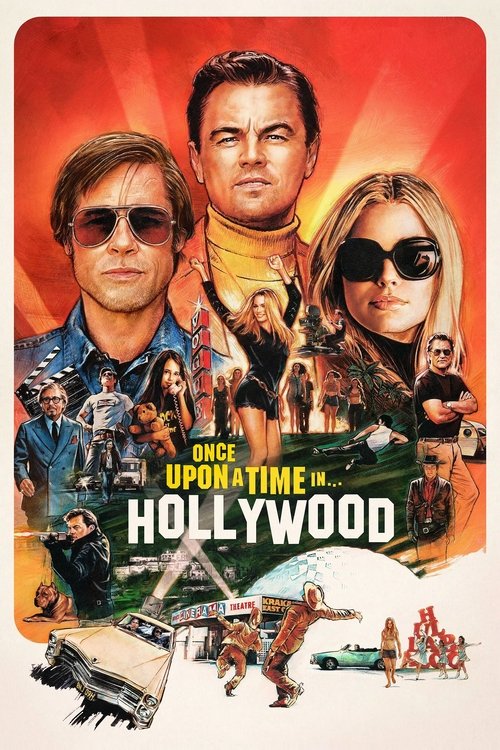
Film poster artist Steven Chorney created the poster for Once Upon a Time in Hollywood as a reference to The Mod Squad. He and Renato Casaro created the posters for the films within the film, Nebraska Jim, Operation Dyn-O-Mite, Uccidimi Subito Ringo Disse il Gringo, Hell-Fire Texas, and Comanche Uprising, which was reprinted for Dalton's home parking spot. Mad magazine caricaturist Tom Richmond created the covers of Mad and TV Guide featuring Dalton's Jake Cahill modeled after the art of Jack Davis.
Tarantino told Richardson, who was serving as cinematographer on a Tarantino film for the sixth time, "I want [it] to feel retro, but I want [it] to be contemporary." They wanted the vibe of the 1960s era to be reflected in the image. Tarantinos goal was to emulate a Technicolor look with vibrant colours . So Richardson decided to shoot on Kodak Vision3 35 mm with Panavision cameras and old anamorphic lenses (C- and E-series). For Bounty Law, they shot in black and white, and brief sequences in Super 8 and 16 mm Ektachrome. In the film, Lancer was shot on a retrofitted Western street backlot at Universal Studios, designed by Ling. Richardson crossed Lancer with Alias Smith and Jones for the retro-future look Tarantino wanted. The way they filmed Lancer was not possible in 1969, but Tarantino wanted his personal touch on it. The daily footage review ('dailies') was conducted in Los Angeles at Fotokem, where the material was developed and transferred to negative film. And some reviews were done directly on-site to save time.
Richardson said that shooting the film touched him personally: "The film speaks to all of us... We are all fragile beings with a limited time to achieve whatever it is we desire... that at any moment that place will shift... so take stock in life and have the courage to believe in yourself." In order to build the Lancer set Ling watched "Enormous amounts of episodes" of the series. She built a western town filled with adobe buildings. For Bounty Law, she went for a dusty, dirty, early Deadwood look, to separate it from the "Moneyed Lancer world".
Spahn Ranch was recreated in detail over about a three-month period. A wildfire completely destroyed the ranch in 1970, so the scenes for the film were filmed at nearby Corriganville Movie Ranch in Simi Valley, which was also a movie ranch at one time. Tarantino made sure to use dogs in the scenes. He said in real life, many dogs lived on the ranch and made it feel alive. He even made sure some dogs were moving around in every shot. He was inspired to use the dogs in this manner from the way Francis Ford Coppola used helicopters in Apocalypse Now during the Robert Duvall scenes.
To improve the use of practical effects, Leonardo DiCaprio was allowed to light stunt coordinators on fire while shooting scenes with a flamethrower. The exterior of the Van Nuys drive-in theater scene was filmed at the Paramount Drive-in theater, since the Van Nuys Drive-in theater no longer exists. As the camera rises up over the theater, the shot transitions to a miniature set with toy cars. For some of the driving scenes, the Hollywood Freeway and Marina Freeway in Los Angeles were shut down for hours to fill them with vintage cars. The scene depicting Bruce Lee training Jay Sebring was filmed at Sebring's actual house.
The scene in which Rick Dalton flubs his lines in Lancer was not in the screenplay, but rather an idea DiCaprio had on set while filming. Afterwards Tarantino came up with the idea for Dalton's "freakout" scene in his trailer, taking inspiration from Robert De Niro's performance in Martin Scorsese's Taxi Driver. Tarantino stated, "It's got to be like Travis Bickle when he's in his apartment by himself." DiCaprio improvised the entire scene.







.jpg?width=400)


_(cropped).jpg?width=400)