Hollywood
Eddy was "discovered" by Hollywood when he substituted at the last minute for the noted diva Lotte Lehmann at a sold-out concert in Los Angeles on February 28, 1933. He scored a professional triumph with 18 curtain calls, and several film offers immediately followed. After much agonizing, he decided that being seen on screen might boost audiences for what he considered his "real work", his concerts. (Also, like his machinist father, he was fascinated with gadgets and the mechanics of the new talking pictures.) Eddy's concert fee rose from $500 to $10,000 per performance.
Eddy signed with Metro-Goldwyn-Mayer (MGM), where he made the first 15 of his 19 feature films. His contract guaranteed him three months off each year to continue his concert tours. MGM was not sure how to use him, and he spent more than a year on salary with little to do. His voice can be heard singing "Daisy Bell" on the soundtrack of the 1933 Pete Smith short Handlebars. He sang one song each in Broadway to Hollywood and Dancing Lady (both 1933). Louis B. Mayer was unimpressed, and Eddy was prepared to leave MGM when his six-month option expired, preferring concerts and opera.
By November 1933, Eddy and MacDonald had their first date at a party at the home of Doris Kenyon. On November 9, they both sang on a national radio broadcast celebrating Marie Dressler’s birthday. MacDonald attended Eddy’s Los Angeles recital on November 21 and his San Francisco recital on November 22. Before Eddy’s option lapsed, MacDonald persuaded Mayer to extend it so Eddy could co-star with her in Naughty Marietta. She insisted he have equal billing and on his singing one of her proposed songs, “Neath the Southern Moon.” Mayer agreed, and Naughty Marietta was filmed during Eddy’s two contract extensions. The trades announced his casting in January 1934.
MacDonald had a prior commitment to The Merry Widow, her final pairing with Maurice Chevalier. The production was expensive and lengthy, with English and French versions filmed simultaneously. Eddy used the interval to return to concerts and opera. MGM used him only once during this period, in the B-picture Student Tour. Again, he sang one song but played himself as a famous concert artist. He also had a very short scene giving advice to a young woman.
Naughty Marietta was the surprise hit of 1935. Its key song, "Ah! Sweet Mystery of Life", became a hit and earned Eddy his first gold record. He also sang "Tramp, Tramp, Tramp" and "I'm Falling in Love with Someone". The film was nominated for an Oscar for Best Picture, received the Photoplay Gold Medal Award as Best Picture, and was voted one of the Ten Best Pictures of 1935 by the New York film critics. Critics singled out Eddy for praise:
"A new movie star emerged from the Capitol screen..." — New York Daily News.
"The screen has found a thrilling thrush, possessed not only of a rare vocal tone, but of a personality and form and features cast in the heroic mold." – New York American.
"Eddy ... has a brilliant baritone voice. He is engaging and good looking..." – Richard Watts, Jr., in the New York Herald.
Eddy appeared in seven more MGM films with Jeanette MacDonald:
Rose Marie (1936) is probably his most-remembered film. Eddy sang "Song of the Mounties" and "Indian Love Call" by Rudolf Friml. His definitive portrayal of the steadfast Mountie became a popular icon, frequently spoofed in cartoons and TV skits, and even generating travesties on stage (Little Mary Sunshine, 1959). One long-lived imitation, Dudley Do-Right , began as a cartoon character on The Rocky and Bullwinkle Show (1959-1964) and went on to be portrayed by Brendan Fraser in a live-action film, Dudley Do-Right (1999). When the Mounties retired their classic red jackets and campaign hats in 1970, except for ceremonial attire, hundreds of newspapers accompanied the story with a photo of Nelson Eddy as Sgt. Bruce in Rose Marie, made 34 years earlier.
Maytime (1937) is regarded as one of Eddy's best films. "Will You Remember" by Sigmund Romberg brought Eddy another gold record. Frank Nugent wrote in The New York Times that the film [was] "the most entrancing operetta the screen has given us. ... and it affirms Nelson Eddy's preeminence among the baritones of filmdom".
The Girl of the Golden West (1938) had an original score by Sigmund Romberg and reused the David Belasco stage plot also employed by Giacomo Puccini for La Fanciulla del West.
Sweethearts (1938) was MGM's first three-strip Technicolor feature, incorporating Victor Herbert's 1913 stage score into a modern script by Dorothy Parker. It won the Photoplay Gold Medal Award as Best Picture of the Year.
New Moon (1940) based on Romberg's 1927 Broadway hit, became one of Eddy's most popular films, although in 1978 it was included in the book The Fifty Worst Films of All Time. His key songs were "Lover, Come Back to Me", "Softly as in a Morning Sunrise", "Wanting You", and "Stout Hearted Men".
Bitter Sweet (1940) was a Technicolor film version of Noël Coward's 1929 operetta. The love theme was "I'll See You Again". Eddy played a Viennese singing teacher who elopes with his pretty English pupil and takes her to live in Vienna.
I Married an Angel (1942), adapted from the Rodgers and Hart stage musical about an angel who loses her wings on her wedding night, suffered from censorship problems. Eddy sang "Spring Is Here" and the title song.
Nelson Eddy also starred in films with other leading ladies:
Rosalie (1937), with Eleanor Powell, offered a score by Cole Porter. In his first solo-starring film, the script called for Eddy to portray a football-playing West Point pilot who pursues a princess-in-disguise to Europe. Eddy recorded the title song.
Let Freedom Ring (1939), with Virginia Bruce, was a Western. Eddy got to beat up rugged Oscar winner Victor McLaglen and preserve freedom and the American way from bad guys, a popular theme just before World War II.
Balalaika (1939), with Ilona Massey, was based on the 1936 English operetta by George Posford and Bernard Grün. Eddy is a prince in disguise, in love with a commoner during the Russian Revolution. The title song became one of his standards.
The Chocolate Soldier (1941), with Metropolitan Opera star Risë Stevens, was a stylish musical adaptation of Ferenc Molnár's The Guardsman. Eddy played a dual role and turned in one of his best performances.
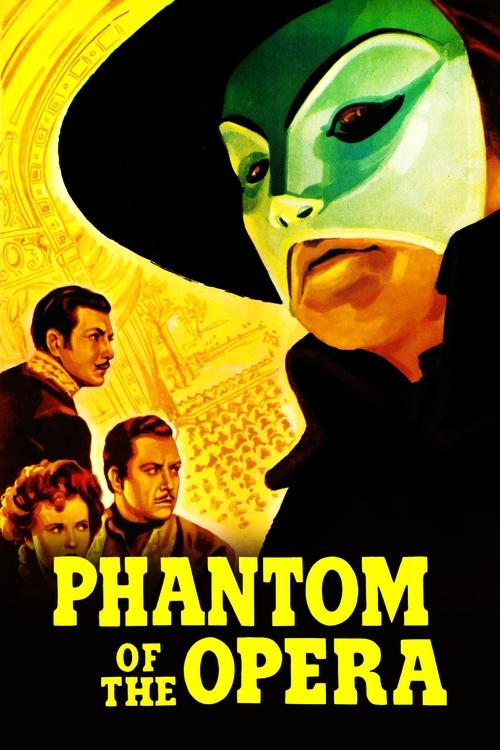
Phantom of the Opera (1943) was Eddy's first film after he left MGM at the end of his seven-year contract. This lavish Technicolor musical also starred Claude Rains as the Phantom and Susanna Foster as Christine.
Knickerbocker Holiday (1944) was based on the popular stage musical by Kurt Weill and Maxwell Anderson. It co-starred Charles Coburn (singing the classic "September Song") and Constance Dowling.
Make Mine Music (1946) was a Walt Disney animated package film. Eddy provided all the singing and speaking voices for the touching final segment, "The Whale Who Wanted to Sing at the Met," later released as a short, Willie, the Operatic Whale, by Disney in 1954. Using a technique based on his technical experiments with his home recording equipment, Eddy was able to sing sextets with himself on the soundtrack, providing all the voices from bass to soprano.
Northwest Outpost (1947) co-starred Ilona Massey. Rudolf Friml provided the songs for a story of Fort Ross, a Russian settlement in the Wild West of California. It was made at Republic Studios and turned out to be Eddy's final film.
After Eddy and MacDonald left MGM in 1942, several unrealized films remained that would have reunited the team. Eddy signed with Universal in 1943 for a two-picture deal. The first was Phantom of the Opera and the second would have co-starred MacDonald. She filmed her two scenes for Follow the Boys, then both stars severed ties with Universal. Eddy was upset with how Phantom of the Opera turned out.
Among their later other proposed projects were East Wind; Crescent Carnival, a book optioned by MacDonald; and The Rosary, the 1910 best-seller, which Eddy had read as a teen and pitched to MGM as a "comeback" film for MacDonald and himself in 1948. Other suggested projects included remakes of The Vagabond King (1930 film), The Desert Song (1929 film) and Mayerling (1936 film). Under the name "Isaac Ackerman" he wrote a biopic screenplay about Chaliapin, in which he was to play the lead and also a young Nelson Eddy, but it was never produced. He also wrote two movie treatments for MacDonald and himself, Timothy Waits for Love and All Stars Don't Spangle.