




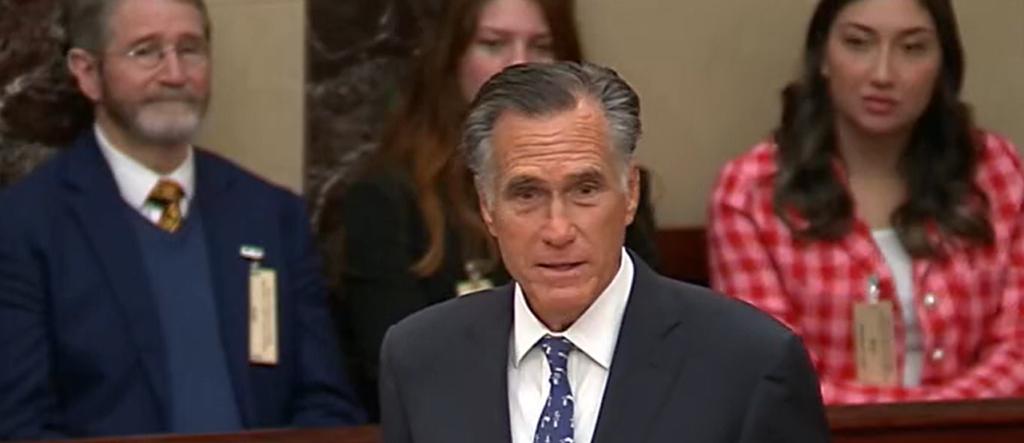
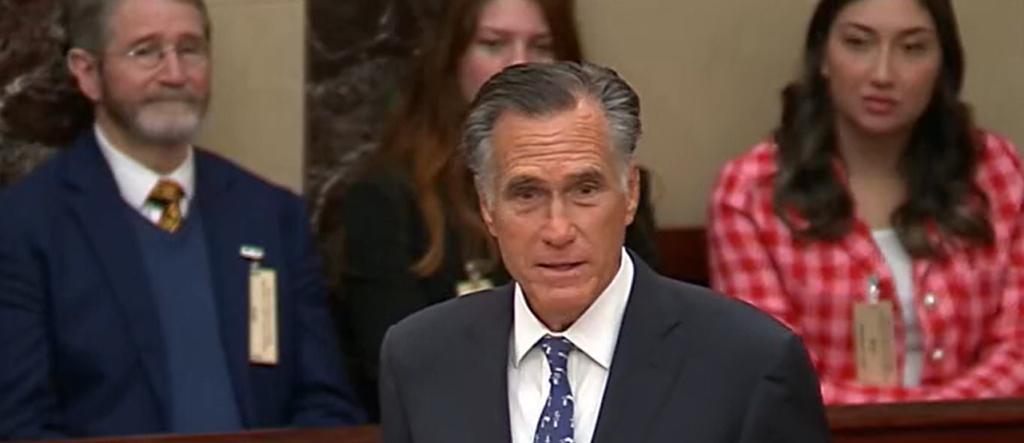
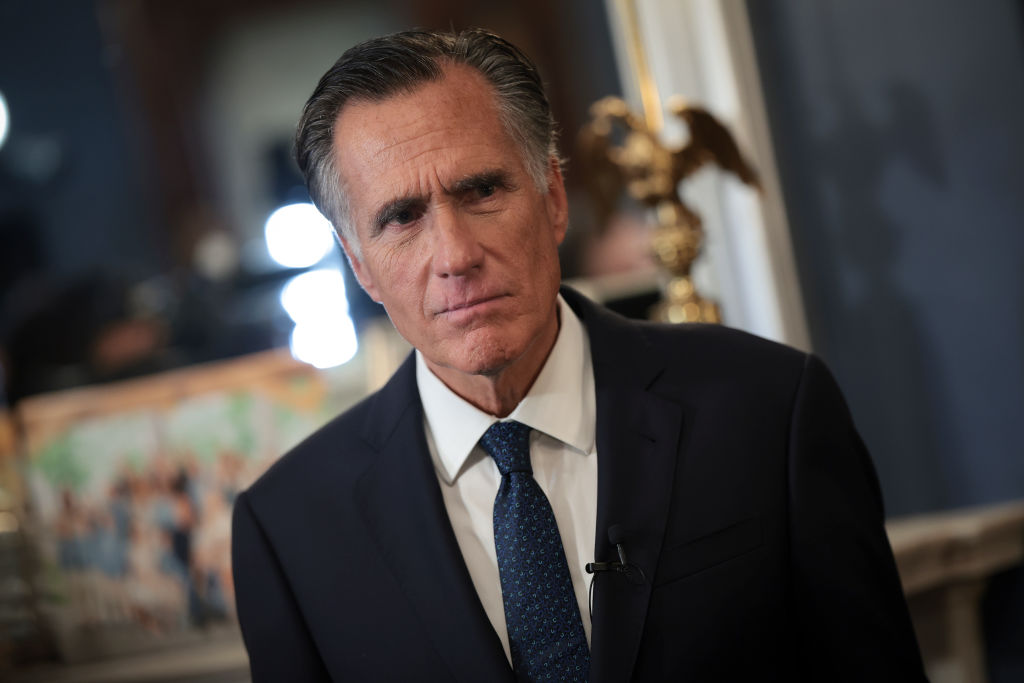
Willard Mitt Romney (born March 12, 1947) is an American businessman and retired politician who served as a United States Senator from Utah from 2019 to 2025 and as the 70th governor of Massachusetts from 2003 to 2007. A member of the Republican Party, he was the party's nominee in the 2012 presidential election.
The youngest child of former Michigan governor and U.S. Housing and Urban Development Secretary George W. Romney, and a member of the prominent Romney family, Romney was born in Detroit, and raised in Bloomfield Hills, Michigan. After attending Stanford University, he served as a missionary in France for the Church of Jesus Christ of Latter-day Saints (LDS Church). After earning joint JD–MBA degrees from Harvard University in 1975, Romney moved to Boston and joined Bain & Company in 1977, later becoming its chief executive officer. In 1984 he co-founded Bain Capital, which grew into one of the nation's largest private equity firms.
Romney ran as the Republican nominee in the 1994 United States Senate election in Massachusetts, losing to the Democratic incumbent Ted Kennedy. Subsequently, he resumed his position at Bain Capital and later moved to Utah, where a successful stint as president and CEO of the then-struggling 2002 Winter Olympics led to the relaunch of Romney's political career. He subsequently won the 2002 Massachusetts gubernatorial election. As governor, Romney helped develop and later signed a health care reform law (commonly referred to as "Romneycare") that provided near-universal health insurance access and presided over the prevention of a projected $1.2–1.5 billion deficit through a combination of spending cuts and the cessation of corporate tax loopholes.
Romney did not seek reelection as governor in 2006 and instead sought the 2008 Republican presidential nomination, which he lost to Senator John McCain. He won the nomination for the next presidential election, choosing Paul Ryan as his running mate. He lost the general election to incumbent President Barack Obama. After reestablishing residency in Utah, Romney successfully ran for the U.S. Senate in 2018, becoming the first person in modern U.S. history to be elected governor and U.S. senator of different states.
Throughout his political career, Romney has generally been considered a moderate or neoconservative Republican. During his term in the Senate, he marched alongside Black Lives Matter protesters, voted to confirm Ketanji Brown Jackson to the U.S. Supreme Court, supported gun control measures, and became the first senator in U.S. history to vote to convict a president of his own party in an impeachment trial when he voted to convict Donald Trump during his first impeachment trial in 2020; he also voted to convict in Trump's second trial in 2021. He did not vote for Trump in the 2016, 2020, and 2024 presidential elections, has long been hawkish on relations with Iran, China, and Russia, and is a staunch supporter of Israel and Ukraine. In 2023, he announced he would not seek reelection and retired from the Senate when his term expired in 2025.
Contents
Early and personal life
Heritage and youth
Willard Mitt Romney was born on March 12, 1947, at Harper University Hospital in Detroit, Michigan, one of four children of automobile executive George W. Romney and actress and homemaker Lenore Romney (née LaFount). His mother was from Logan, Utah, and his father was born to American parents in a Mormon colony in Chihuahua, Mexico. A fifth-generation member of the LDS Church, he is a great-grandson of Miles Park Romney and a great-great-grandson of Miles Romney, who converted to Mormonism in its first decade. Another great-great-grandfather, Parley P. Pratt, helped lead the early church.
Romney has three older siblings: Margo, Jane, and Scott. He was named after a family friend, businessman J. Willard Marriott, and his father's cousin, Milton "Mitt" Romney. Romney was called "Billy" until kindergarten, when he expressed a preference for "Mitt". In 1953, the family moved from Detroit to the affluent suburb of Bloomfield Hills and his father became the chairman and CEO of American Motors the following year and helped the company return to profitability. By 1959, his father had become a nationally known figure, and Mitt idolized him.
Romney attended public elementary schools until seventh grade, when he enrolled as one of only a few Mormon students at Cranbrook School, a private upscale boys' preparatory school. Many students there came from backgrounds even more privileged than his. While not particularly athletic, he also did not distinguish himself academically. He participated in his father's successful 1962 gubernatorial campaign, and later worked as an intern in the governor's office. Romney took up residence at Cranbrook when his newly elected father began spending most of his time at the state capitol.
At Cranbrook, Romney helped manage the ice hockey team, and joined the pep squad. During his senior year, he joined the cross country running team. He belonged to 11 school organizations and school clubs, including the Blue Key Club, a booster group he had started. Romney was involved in several pranks while attending Cranbrook. He has since apologized for them, stating that some of them may have gone too far. In March of his senior year, he began dating Ann Davies. The two became informally engaged around the time he graduated from high school in June 1965.
College, France mission, marriage, and children
Romney attended Stanford University during the 1965–66 academic year but was largely removed from the emerging counterculture of the 1960s. Romney joined a counterprotest against a sit-in at Stanford's administration building, itself opposing draft status tests in 1966. He continued to enjoy occasional pranks.
In July 1966, he began a 30-month stint in France as an LDS Church missionary, a traditional rite of passage in his family. Living under strict missionary rules and modest conditions, Romney found the work challenging and later recalled periods of discouragement as many of his efforts were rejected. He initially became demoralized and later recalled it as the only time when "most of what I was trying to do was rejected." He later estimated 10 to 20 converts for his entire mission.
Despite these difficulties, Romney rose steadily through the mission's leadership ranks. He became a zone leader in Bordeaux and later an assistant to the mission president in Paris. He frequently debated French critics of American involvement in the Vietnam War, and their opposition often strengthened his resolve. In June 1968, Romney was seriously injured in an automobile accident that killed the wife of the mission president. After the unrest caused by the May 1968 general strike and student uprisings, he helped restore morale and organization within the mission. By the end of his service in December 1968, he was overseeing 175 missionaries, had helped the mission achieve its highest annual baptism total in a decade, and had developed a lifelong affection for France and its people while becoming fluent in French.
Upon returning to the United States, Romney reunited with Ann Davies, and the two decided to marry. They wed in March 1969 and settled in Utah; Romney enrolled at Brigham Young University (BYU), where Ann had been studying. Having missed much of the anti-Vietnam War movement while abroad, Romney expressed the view that American involvement in Vietnam had been misguided, though he supported the Cambodian Incursion by the administration of Richard Nixon as a sincere attempt to end the war. During the military draft for the war, Romney sought and received two student deferments, then a ministerial deferment while living in France. He later sought and received two additional student deferments. When those ran out, he drew number 300 in the December 1969 draft lottery, ensuring he would not be drafted.
LDS Church service
During his business career, Romney held several positions in the church's local lay clergy. In the early 1970s, he served in a ward bishopric. He then served for a time as a seminary teacher and then as a member of the high council of the Boston stake while Richard L. Bushman was stake president.
In 1977, he became a counselor to the president of the Boston Stake. He served as bishop of the ward at Belmont, Massachusetts, from 1981 to 1986. As such, in addition to home teaching, he also formulated Sunday services and classes using LDS scriptures to guide the congregation. After the destruction of the Belmont meetinghouse by a fire of suspicious origins in 1984, he forged links with other religious institutions, allowing the congregation to rotate its meetings to other houses of worship during the reconstruction of the Belmont building.
From 1986 to 1994, Romney was president of the Boston Stake, which included more than a dozen wards in eastern Massachusetts and almost 4,000 church members. He organized a team to handle financial and management issues, sought to counter anti-Mormon sentiment, and tried to solve social problems among poor Southeast Asian converts. An unpaid position, his local church leadership often took 30 or more hours a week of his time, and he became known for his considerable energy in the role. He also earned a reputation for avoiding any overnight travel that might interfere with his church responsibilities.
Romney took a hands-on role in the Boston Stake's matters, helping in domestic maintenance efforts, visiting the sick, and counseling burdened church members. A number of local church members later credited him with turning their lives around or helping them through difficult times. Others, rankled by his leadership style, desired a more consensus-based approach. Romney tried to balance the conservative directives from church leadership in Utah with the desire of some Massachusetts members to have a more flexible application of religious doctrine. He agreed with some requests from a liberal women's group that published Exponent II calling for changes in the way the church dealt with women, but he clashed with women he felt were departing too much from doctrine. In particular, he counseled women not to have abortions except in the rare cases allowed by LDS doctrine and encouraged unmarried women facing unplanned pregnancies to give their babies up for adoption. Romney later said that the years spent as an LDS minister gave him direct exposure to people struggling financially and empathy for those with family problems.
Health
Romney was treated for prostate cancer in the summer of 2017. In 2024, Romney admitted he was worried about being at risk of Alzheimer's disease due to years of working in high-stress jobs.
Business career
Management consulting
After receiving his JD–MBA from Harvard, Romney passed the Michigan bar exam but decided to pursue a career in business rather than law. He was recruited by several large companies but joined the Boston Consulting Group (BCG), reasoning that working as a management consultant for a variety of companies would better prepare him for a future position as a chief executive. Part of a 1970s wave of top graduates who chose to go into consulting rather than join a large company directly, he found his legal and business education useful in his job. He applied BCG principles such as the growth-share matrix, and executives viewed him as having a bright future there. At BCG, he was a colleague of Benjamin Netanyahu, with whom he formed a friendship that has lasted for more than 50 years.
In 1977, he was hired by Bain & Company, a management consulting firm in Boston formed a few years earlier by Bill Bain and several other ex-BCG employees. Bain later said of the 30-year-old Romney, "He had the appearance of confidence of a guy who was maybe ten years older." Unlike other consulting firms, which issued recommendations and then departed, Bain & Company immersed itself in a client's businesses and worked with them until changes were implemented. Romney became a vice president of the firm in 1978, working with such clients as the Monsanto Company, Outboard Marine Corporation, Burlington Industries, and Corning Incorporated. Within a few years, the firm considered him one of its best consultants. In fact, clients sometimes preferred to use him rather than more-senior partners.
Two family incidents during this time later surfaced during Romney's political campaigns. A state park ranger in 1981 told Romney his motorboat had an insufficiently visible license number and that he would face a $50 fine if he took the boat onto the lake. Disagreeing about the license and wanting to continue a family outing, Romney took it out anyway, saying he would pay the fine. The ranger arrested him for disorderly conduct. The charges were dropped several days later. In 1983, on a 12-hour family road trip, he placed the family's dog in a windshield-equipped carrier on the roof of their car, and then washed the car and carrier after the dog suffered a bout of diarrhea. The dog incident in particular later became fodder for Romney's critics and political opponents.
Private equity
In 1984, Romney left Bain & Company to co-found and lead the spin-off private equity investment firm Bain Capital. He initially refrained from accepting Bill Bain's offer to head the new venture until Bain rearranged the terms in a complicated partnership structure so that there was no financial or professional risk to Romney. Bain and Romney raised the $37 million needed to start the new operation, which had seven employees. Romney held the titles of president and managing general partner. Though he was the sole shareholder of the firm, publications also called him managing director or CEO.
Initially, Bain Capital focused on venture capital investments. Romney set up a system in which any partner could veto one of these potential opportunities, and he personally saw so many weaknesses that few venture capital investments were approved in the initial two years. The firm's first significant success was a 1986 investment to help start Staples Inc., after founder Thomas G. Stemberg convinced Romney of the market size for office supplies and Romney convinced others; Bain Capital eventually reaped a nearly sevenfold return on its investment, and Romney sat on Staples's board of directors for over a decade.
Romney soon switched Bain Capital's focus from startups to the relatively new business of leveraged buyouts: buying existing companies with money mostly borrowed from banking institutions using the newly bought companies' assets as collateral, taking steps to improve the companies' value, and then selling those companies when their value peaked, usually within a few years. Bain Capital lost money in many of its early leveraged buyouts, but then found deals that made large returns. The firm invested in or acquired Accuride Corporation, Brookstone, Domino's Pizza, Sealy Corporation, Sports Authority, and Artisan Entertainment, as well as some lesser-known companies in the industrial and medical sectors. Much of the firm's profit was earned from a relatively small number of deals; Bain Capital's overall success-to-failure ratio was about even.
Romney discovered few investment opportunities himself (and those that he did often failed to make money for the firm). Instead, he focused on analyzing the merits of possible deals that others brought forward and on recruiting investors to participate in them once approved. At Bain Capital, Romney spread profits from deals widely within the firm to keep people motivated, often keeping less than 10% for himself. Data-driven, he often played the role of a devil's advocate during exhaustive analysis of whether to go forward with a deal. He wanted to drop a Bain Capital hedge fund that initially lost money, but other partners disagreed with him and it eventually made billions. He opted out of the Artisan Entertainment deal, not wanting to profit from a studio that produced R-rated films. Romney served on the board of directors of Damon Corporation, a medical testing company later found guilty of defrauding the government; Bain Capital tripled its investment before selling off the company, and the fraud was discovered by the new owners (Romney was never implicated). In some cases, Romney had little involvement with a company once Bain Capital acquired it.
1994 U.S. Senate campaign in Massachusetts
For much of his business career, Romney did not take public political stances. He had kept abreast of national politics since college, and the circumstances of his father's presidential campaign loss had irked him for decades. He remained an Independent and voted for Massachusetts Democrat Paul Tsongas in the 1992 presidential primaries.
By 1993, encouraged by his wife Ann and inspired by his father's political career, he began considering a run for office. Seeing an opportunity to challenge longtime Democratic U.S. senator Ted Kennedy, in part due to the unpopular Democratic congress and the recent William Kennedy Smith trial in which Kennedy's reputation had suffered. Romney switched to the Republican Party in October 1993 and announced his candidacy in February 1994, taking leave from Bain Capital and stepping down from his church leadership role.
Romney quickly emerged as the strongest Republican candidate, winning the party convention and primary against John Lakian by large margins. In the general election, he presented himself as a successful businessman and political outsider who had created jobs and supported moderate positions on social issues. The race became the most competitive of Kennedy's career, with polls showing the candidates essentially tied by September. However, Kennedy effectively highlighted Romney's shifting positions on issues such as abortion and criticized Bain Capital's role in layoffs at an Ampad plant, blunting Romney's momentum.
Kennedy and Romney held a widely watched late October debate that had no clear winner, but by then, Kennedy had pulled ahead in polls and remained so. Romney spent $3 million of his own money on the race and more than $7 million overall. Despite a disastrous showing for Democrats nationwide, Kennedy won the election with 58% of the vote to Romney's 41%, the smallest margin in any of Kennedy's reelection campaigns for the Senate.
The day after the election, Romney returned to Bain Capital, but the loss had a lasting effect; he told his brother, "I never want to run for something again unless I can win." When his father died in 1995, Mitt donated his inheritance to BYU's George W. Romney Institute of Public Management. He also became vice-chair of the board of the Points of Light Foundation, which had embraced his father's National Volunteer Center. Romney felt restless as the decade neared a close; making more money held little attraction for him. Although no longer in a local leadership position in his church, he still taught Sunday School. During the long and controversial approval and construction process for the $30-million Mormon temple in Belmont, he feared that, as a political figure who had opposed Kennedy, he would become a focal point for opposition to the structure. He thus kept to a limited, behind-the-scenes role in attempts to ease tensions between the church and local residents.
2002 Winter Olympics
In 1998, Ann Romney learned that she had multiple sclerosis; Mitt described watching her fail a series of neurological tests as the worst day of his life. After experiencing two years of severe difficulties with the disease, she found – while living in Park City, Utah, where the couple had built a vacation home – a combination of mainstream, alternative, and equestrian therapies that enabled her to lead a lifestyle mostly without limitations. When her husband received a job offer to take over the troubled organization responsible for the 2002 Winter Olympics and Paralympics, to be held in Salt Lake City in Utah, she urged him to accept it; eager for a new challenge, as well as another chance to prove himself in public life, he did. On February 11, 1999, the Salt Lake Organizing Committee for the Olympic and Paralympic Winter Games of 2002 hired Romney as its president and CEO.
Before Romney took over, the event was $379 million short of its revenue goals. Officials had made plans to scale back the Games to compensate for the fiscal crisis, and there were fears it might be moved away entirely. In addition, the Games' image had been damaged by allegations of bribery against top officials including prior committee president and CEO Frank Joklik. The Salt Lake Organizing Committee forced Joklik and committee vice president Dave Johnson to resign. Utah power brokers, including Governor Mike Leavitt, searched for someone with a scandal-free reputation to take charge of the Olympics. They chose Romney based on his business and legal expertise as well as his connections to both the LDS Church and the state. The appointment faced some initial criticism from both non-Mormons and Mormons that it represented cronyism and made the Games seem too Mormon-dominated. Romney donated to charity the $1.4 million in salary and severance payments he received for his three years as president and CEO, and also donated $1 million to the Olympics.
Romney restructured the organization's leadership and policies. He reduced budgets and boosted fundraising, alleviating corporate sponsors' concerns while recruiting new ones. Romney worked to ensure the Games's safety after the September 11 attacks by coordinating a $300 million security budget. He oversaw a $1.32 billion budget, 700 employees, and 26,000 volunteers. The federal government provided approximately $400 million to $600 million of that budget, much of it a result of Romney's having aggressively lobbied Congress and federal agencies. It was a record level of federal funding for the staging of a U.S. Olympics. An additional $1.1 billion of indirect federal funding came to the state in the form of highway and transit projects.
Governor of Massachusetts (2003–2007)
Election
In 2002, the administration of acting Massachusetts governor Jane Swift was weakened by political missteps and personal scandals, leading many Republicans to doubt her ability to win reelection. Party leaders and the White House encouraged Romney to run for governor, attracted by his high profile and perceived electability. After Swift announced on March 19, 2002, that she would not seek the Republican nomination, Romney entered the race and faced no primary opposition. Democrats challenged his eligibility, arguing that he had not met Massachusetts' seven-year residency requirement, but the bipartisan State Ballot Law Commission unanimously ruled that he had maintained sufficient ties to the state to qualify.
Romney again ran as a political outsider and moderate Republican, emphasizing his private sector experience and Olympics record as evidence of his ability to address Massachusetts' fiscal challenges. His campaign employed innovative microtargeting techniques and sought to soften his corporate image through staged "work days", in which Romney performed blue-collar jobs such as herding cows and baling hay, unloading a fishing boat, and hauling garbage. Although the Democratic nominee, Massachusetts State Treasurer Shannon O'Brien, led in the polls late in the race, Romney regained momentum with advertisements criticizing her record and economic stewardship, and associating her husband with the Enron scandal. He contributed more than $6 million of his own money to a campaign that raised nearly $10 million and won the November 5, 2002, election with 50 percent of the vote to O'Brien's 45 percent.
Tenure
Romney was sworn in as the 70th governor of Massachusetts on January 2, 2003. He faced a Massachusetts state legislature with large Democratic majorities in both houses, and had picked his cabinet and advisors based more on managerial abilities than partisan affiliation. He declined a governor's salary of $135,000 during his term. Upon entering office in the middle of a fiscal year, he faced an immediate $650 million shortfall and a projected $3 billion deficit for the next year. Unexpected revenue of $1.0–1.3 billion from a previously enacted capital gains tax increase and $500 million in new federal grants decreased the deficit to $1.2–1.5 billion. Through a combination of spending cuts, increased fees, and removal of corporate tax loopholes, the state achieved surpluses of around $600–700 million during Romney's last two full fiscal years in office, although it began running deficits again after that.
Romney supported raising various fees, including those for drivers' licenses and gun licenses, to raise more than $300 million. He increased a special gasoline retailer fee by $0.02 per US gallon ($0.0053/L), generating about $60 million per year in additional revenue. Opponents said the reliance on fees sometimes imposed a hardship on those who could least afford them. Romney also closed tax loopholes that brought in another $181 million from businesses over the next two years and over $300 million for his term. He did so in the face of conservative and corporate critics who viewed these actions as tax increases.
The state legislature, with the governor's support, cut spending by $1.6 billion, including $700 million in reductions in state aid to cities and towns. The cuts also included a $140 million reduction in state funding for higher education, which led state-run colleges and universities to increase fees by 63% over four years. Romney sought additional cuts in his last year as governor by vetoing nearly 250 items in the state budget; the legislature overrode all the vetoes.
The cuts in state spending put added pressure on localities to reduce services or raise property taxes, and the share of town and city revenues coming from property taxes rose from 49% to 53%. The combined state and local tax burden in Massachusetts increased during Romney's governorship. He did propose a reduction in the state income tax rate, but the legislature rejected it.
Romney sought to bring near-universal health insurance coverage to the state. This came after Staples founder Tom Stemberg told him at the start of his term that doing so would be the best way he could help people. Another factor was that the federal government, owing to the rules of Medicaid funding, threatened to cut $385 million in those payments to Massachusetts if the state did not reduce the number of uninsured recipients of health care services. Although the idea of universal health insurance had not come to the fore during the campaign, Romney decided that because people without insurance still received expensive health care, the money spent by the state for such care could be better used to subsidize insurance for the poor.
2008 presidential campaign
Romney formally announced his candidacy for the 2008 Republican nomination for president on February 13, 2007, in Dearborn, Michigan. Again casting himself as a political outsider, his speech frequently invoked his father and his family, and stressed experiences in the private, public, and voluntary sectors that had brought him to this point.
The campaign emphasized Romney's highly profitable career in the business world and his stewardship of the 2002 Olympics. He also had political experience as a governor, together with a political pedigree courtesy of his father (as well as many biographical parallels with him). Ann Romney, who had become an advocate for those with multiple sclerosis, was in remission and was an active participant in his campaign, helping to soften his political personality. Media stories called the 6-foot-2-inch (1.88 m) Romney handsome; a number of commentators noted that with his square jaw and ample hair graying at the temples, he matched a common image of what a president should look like.
Romney's liabilities included having run for senator and serving as governor in one of the nation's most liberal states and having taken positions in opposition to the party's conservative base during that time. Late during his term as governor, he had shifted positions and emphases to better align with traditional conservatives on social issues. Skeptics, including some Republicans, charged Romney with opportunism and a lack of core principles. As a Mormon, he faced suspicion and skepticism by some in the Evangelical wing of the party.
For his campaign, Romney assembled a veteran group of Republican staffers, consultants, and pollsters. But he was little-known nationally, and hovered around 10% support in Republican preference polls for the first half of 2007. He proved the most effective fundraiser of any of the Republican candidates and also partly financed his campaign with his own personal fortune. These resources, combined with the mid-year near-collapse of nominal front-runner John McCain's campaign, made Romney a threat to win the nomination and the focus of the other candidates' attacks. Romney's staff suffered from internal strife; Romney himself was at times indecisive, often asking for more data before making a decision.
During all his political campaigns, Romney has avoided speaking publicly about Mormon doctrines, referring to the U.S. Constitution's prohibition of religious tests for public office. But persistent questions about the role of religion in his life, as well as Southern Baptist minister and former governor of Arkansas Mike Huckabee's rise in the polls based on an explicitly Christian-themed campaign, led to Romney's December 6, 2007, "Faith in America" speech. In it, Romney declared, "I believe in my Mormon faith and endeavor to live by it. My faith is the faith of my fathers. I will be true to them and to my beliefs." He added that he should be neither elected nor rejected because of his religion, and echoed Senator John F. Kennedy's famous speech during his 1960 presidential campaign in saying, "I will put no doctrine of any church above the plain duties of the office and the sovereign authority of the law." Instead of discussing the specific tenets of his faith, he said he would be informed by it, saying: "Freedom requires religion just as religion requires freedom. Freedom and religion endure together, or perish alone." Academics later studied the role religion played in the campaign.
Activity between presidential campaigns
Romney supported the Bush administration's Troubled Asset Relief Program in response to the 2008 financial crisis, later saying that it prevented the U.S. financial system from collapsing. During the U.S. automotive industry crisis of 2008–2010, he opposed a bailout of the industry in the form of direct government intervention, and argued that a managed bankruptcy of struggling automobile companies should instead be accompanied by federal guarantees for post-bankruptcy financing from the private sector.
After the 2008 election, Romney laid the groundwork for a 2012 presidential campaign by using his Free and Strong America political action committee (PAC) to raise money for other Republican candidates and pay his existing political staff's salaries and consulting fees. A network of former staff and supporters around the nation were eager for him to run again. He continued to give speeches and raise funds for Republicans, but fearing overexposure, turned down many potential media appearances. He also spoke before business, educational, and motivational groups. From 2009 to 2011, he served on the board of directors of Marriott International, founded by his namesake J. Willard Marriott. He had previously served on it from 1993 to 2002.
In 2009, the Romneys sold their primary residence in Belmont and their ski chalet in Utah, leaving them an estate along Lake Winnipesaukee in Wolfeboro, New Hampshire, and an oceanfront home in the La Jolla district of San Diego, California, which they had bought the year before. The La Jolla home proved beneficial in location and climate for Ann Romney's multiple sclerosis therapies and for recovering from her late 2008 diagnosis of mammary ductal carcinoma in situ and subsequent lumpectomy. Both it and the New Hampshire estate were near some of their grandchildren. Romney maintained his voting registration in Massachusetts, however, and bought a smaller condominium in Belmont during 2010. In February 2010, Romney had a minor altercation with LMFAO member Skyler Gordy, known as Sky Blu, on an airplane flight.
Romney released his book, No Apology: The Case for American Greatness, in March 2010, and undertook an 18-state book tour to promote it. In the book, he writes of his belief in American exceptionalism, and presents his economic and geopolitical views rather than anecdotes about his personal or political life. It debuted atop The New York Times Best Seller list. Romney donated his earnings from the book to charity.
2012 presidential campaign
Primary election
On April 11, 2011, Romney announced, in a video taped outdoors at the University of New Hampshire, that he had formed an exploratory committee for a run for the Republican presidential nomination. Quinnipiac University political science professor Scott McLean said, "We all knew that he was going to run. He's really been running for president ever since the day after the 2008 election."
Romney stood to benefit from the Republican electorate's tendency to nominate candidates who had previously run for president, and thus appeared to be next in line to be chosen. The early stages of the race found him as the apparent front-runner in a weak field, especially in terms of fundraising prowess and organization. Perhaps his greatest hurdle in gaining the Republican nomination was party opposition to the Massachusetts health care reform law that he had shepherded five years earlier. As many potential Republican candidates with star power and fundraising ability decided not to run (including Mike Pence, John Thune, Haley Barbour, Mike Huckabee, and Mitch Daniels), Republican party figures searched for plausible alternatives to Romney.
On June 2, 2011, Romney formally announced the start of his campaign. Speaking on a farm in Stratham, New Hampshire, he focused on the economy and criticized Obama's handling of it. He said, "In the campaign to come, the American ideals of economic freedom and opportunity need a clear and unapologetic defense, and I intend to make it – because I have lived it."
Romney raised $56 million in 2011, more than double the amount raised by any of his Republican opponents, and refrained from spending his own money on the campaign. He initially pursued a low-key, low-profile strategy. Michele Bachmann staged a brief surge in polls, which preceded a poll surge in September 2011 by Rick Perry, who had entered the race the month before. Perry and Romney exchanged sharp criticisms of each other during a series of debates among the Republican candidates. The October 2011 decisions of Palin and Chris Christie not to run effectively settled the field of candidates. Perry faded after poor performances in those debates, while Herman Cain's "long-shot" bid gained popularity until allegations of sexual misconduct derailed it.
Romney continued to seek support from a wary Republican electorate; at this point in the race, his poll numbers were relatively flat and at a historically low level for a Republican front-runner. After the charges of flip-flopping that marked his 2008 campaign began to accumulate again, Romney said in November 2011: "I've been as consistent as human beings can be." In the month before voting began, Newt Gingrich experienced a significant surge – taking a solid lead in national polls and most of the early caucus and primary states – before settling back into parity or worse with Romney following a barrage of negative ads from Restore Our Future, a pro-Romney Super PAC.
General election
Polls consistently indicated a tight race for the November general election. Negative ads from both sides dominated the campaign, with Obama's proclaiming that Romney shipped jobs overseas while at Bain Capital and kept money in offshore tax havens and Swiss bank accounts. A related issue dealt with Romney's purported responsibility for actions at Bain Capital after taking the Olympics post. Romney faced demands from Democrats to release additional years of his tax returns, an action a number of Republicans also felt would be wise; after being adamant that he would not do that, he released summaries of them in late September. During May and June, the Obama campaign spent heavily and was able to paint a negative image of Romney in voters' minds before the Romney campaign could construct a positive one.
In July 2012, Romney visited the United Kingdom, Israel, and Poland, meeting leaders in an effort to raise his credibility as a world statesman. Comments he made about the readiness of the 2012 Summer Olympics were perceived as undiplomatic by the British press. Israeli Prime Minister (and former BCG colleague) Benjamin Netanyahu embraced Romney, though some Palestinians criticized him for suggesting that Israel's culture led to their greater economic success.
On August 11, 2012, the Romney campaign announced Representative Paul Ryan of Wisconsin as his running mate. On August 28, 2012, the 2012 Republican National Convention in Tampa, Florida, officially nominated Romney for president. Romney became the first LDS Church member to be a major-party presidential nominee.
In mid-September, a video surfaced of Romney speaking before a group of supporters in which he said that 47% of the nation pays no income tax, are dependent on the federal government, see themselves as victims, and will support Obama unconditionally. He went on to say, "And so my job is not to worry about those people. I'll never convince them that they should take personal responsibility and care for their lives." After facing criticism about the tone and accuracy of these comments, he at first characterized them as "inelegantly stated", then a couple of weeks later commented: "I said something that's just completely wrong." Exit polls published following the election showed that voters never saw Romney as someone who cared about people like them.
In an interview on CNN with Wolf Blitzer, Romney called Russia "our number one geopolitical foe". At the time an innocuous response to a foreign policy question, it became a focal point for Democratic attacks on Romney during the campaign. Hillary Clinton, then secretary of state, called Romney's position "dated" and said Russia had been an ally in solving problems, while Joe Biden, then vice president, accused Romney of having a "Cold War mentality" and being "uninformed" on foreign policy. John Kerry, then a senator, called Romney's comments "breathtakingly off target" and reiterated that position at the Democratic National Convention, saying, "He's even blurted out the preposterous notion that Russia is our number one political geopolitical foe." Romney defended his remarks, saying, "The nation which consistently opposes our actions at the United Nations has been Russia ... Russia is a geopolitical foe in that regard", and continued to defend his position in the presidential debates.
Subsequent activities
During the first year after his defeat, Romney generally kept a low profile, with his ordinary daily activities around San Diego captured via social media glimpses. In December 2012, he joined the board of Marriott International for a third stint as a director. In March 2013, Romney gave a reflective interview on Fox News Sunday, saying, "It kills me not to be there, not to be in the White House doing what needs to be done." He again expressed regret at the "47 percent" remark, saying "There's no question that hurt and did real damage to my campaign." (He echoed both those sentiments a year later.) Romney began working as executive partner group chairman for Solamere Capital, a private capital firm in Boston owned by his son Tagg. He was also involved in supporting several charitable causes.
The Romneys bought a home in the Deer Valley area of Park City, Utah, and a property in Holladay, Utah, where they planned to tear down an existing house and build a new one. They also gained long-sought permission to replace their La Jolla home with a much bigger one, including a car elevator that had brought some derision during the 2012 campaign. Romney and his siblings continued to own a cottage in a gated community called Beach O' Pines south of Grand Bend, Ontario, which has been in the family for more than 60 years. With the new acquisitions the couple briefly had five homes, near each of their five sons and their families, and the couple continued to spend considerable time with their grandchildren, who by 2013, numbered 22. They then sold the condominium in Belmont and decided to make their main residence in Utah, switching their voter registration. The 2014 documentary film Mitt showed a behind-the-scenes, family-based perspective on both of Romney's presidential campaigns and received positive reviews for humanizing Romney and illustrating the toll campaigning takes.
Romney thought he might be branded a "loser for life" and fade into an obscurity like his fellow former Massachusetts governor Michael Dukakis (a similar figure with no obvious base of political support who had lost what his party considered a winnable presidential election) but, to the surprise of many political observers, that did not happen. Romney reemerged onto the political scene in the run-up to the 2014 U.S. midterm elections, endorsing, campaigning, and fundraising for a number of Republican candidates, especially those running for the U.S. Senate.
2016 presidential election
By early 2014, the lack of a clear mainstream Republican candidate for the 2016 presidential election led some supporters, donors, and pollsters to suggest that Romney stage a third run. Regarding such a possibility, Romney at first refused. Nevertheless, speculation continued: Obama's declining popularity led to remorse among some voters; the 2014 Russian military intervention in Ukraine made Romney's "number one geopolitical foe" remark look prescient; and an August 2014 poll of Iowa Republicans showed Romney with a large lead there over other potential 2016 candidates. A July 2014 CNN poll showed Romney with a 53% to 44% lead over Obama in a hypothetical election "redo".
By early 2015, Romney was considering the idea and contacting his network of supporters. In doing so he was positioning himself in the invisible primary – the preliminary jockeying for the backing of party leaders, donors, and political operatives – against former Florida governor Jeb Bush, who had already set a likely campaign in motion and would be a rival to Romney for establishment Republican support. Despite support in some quarters for a third bid for the presidency, there was a backlash from conservatives who wanted a fresher face without a history of presidential losses, and many of Romney's past donors were not willing to commit to him again. On January 30, 2015, Romney announced that he would not run for president in 2016, saying that while he thought he could win the nomination, "one of our next generation of Republican leaders" would be better positioned to win the general election.
Relationship with Donald Trump
As the presidential election went into primary season, Romney had not endorsed anyone but was one of the Republican establishment figures who were becoming increasingly concerned about the front-runner status of New York businessman Donald Trump. Romney publicly criticized Trump for not releasing his taxes, saying there might be a "bombshell" in them. Trump responded by calling Romney "one of the dumbest and worst candidates in the history of Republican politics". In a March 3, 2016 speech at the Hinckley Institute of Politics, Romney made a scathing attack on Trump's personal behavior, business performance, and domestic and foreign policy stances. He called him a "con man" who relied on his father's loans and "a phony, a fraud", adding: "He's playing members of the American public for suckers. If we Republicans choose Donald Trump as our nominee, the prospects for a safe and prosperous future are greatly diminished". In response, Trump called Romney a "choke artist". Romney's speech represented an unprecedented attack by a major U.S. party's most recent presidential nominee against the party's current front-runner for the nomination.
Romney encouraged Republicans to engage in tactical voting, by supporting whichever of the remaining rivals had the best chance to beat Trump in any given state. As such, Romney announced he was voting for, although not endorsing, Ted Cruz for president in the March 22 Utah caucus. As the race went on, there was some evidence that tactical voting was occurring, and some partial arrangements were formed among candidates, but by May 3, Trump had defeated all his opponents and became the party's presumptive nominee. Romney announced that he would not support Trump in the general election, saying, "I am dismayed at where we are now. I wish we had better choices."
In June, Romney said that he would not vote for Democratic nominee Hillary Clinton, saying: "It's a matter of personal conscience. I can't vote for either of those two people." He suggested that he might vote for a third-party candidate, or write in his wife's name, saying she would be "an ideal president". When pressed on which of Trump and Clinton was more qualified to be president, Romney quoted P. J. O'Rourke: "Hillary Clinton is wrong on every issue, but she's wrong within the normal parameters."
Romney considered voting for the Libertarian ticket of former Republican governors Gary Johnson and Bill Weld (the latter, like Romney, also a former governor of Massachusetts), saying that he would "get to know Gary Johnson better and see if he's someone who I could end up voting for", adding that "if Bill Weld were at the top of the ticket, it would be very easy for me to vote for Bill Weld for president." In September, he called for Johnson to be included in the presidential debates and in October it emerged that Independent candidate Evan McMullin was using an email list of 2.5 million Romney supporters to raise money. McMullin's chief strategist said that it was purchased from Romney for President and that "we'll let other folks discuss what that may mean and certainly never speak for [Romney]." A spokeswoman for Romney said that the list had been "rented by several political candidates in the presidential primary, and by countless other political and commercial users in the time since the 2012 campaign" and Romney made no public comment on McMullin's candidacy. Romney and his wife cast early ballots in Utah, but he declined to say who he voted for. In May 2018, Romney revealed that he had cast a write-in vote for his wife Ann.
2018 Utah U.S. Senate campaign
September and October 2017 press reports said that should U.S. Senator Orrin Hatch retire, Romney would run for that seat in 2018. On January 2, 2018, after Hatch announced that he would retire, many speculated that he was considering a Senate campaign. On February 16, 2018, Romney formally launched his campaign with a video message posted on Facebook and Twitter.
At the state Republican nominating convention held on April 21, 2018, Romney received 1,585 delegate votes (49.1%), finishing second to State Representative Mike Kennedy, with 1,642 delegate votes (50.9%). Since neither Romney nor Kennedy garnered the 60% of delegate votes necessary to claim the endorsement, they competed in a June 26 primary election. In the primary, Romney defeated Kennedy, 71.7–28.3%.
Romney was elected U.S. senator from Utah on November 6, defeating Democratic nominee Jenny Wilson, 62.6% to 30.9%.
With his election, Romney became the third person to have served as governor of one state and senator from another state. (The other two were William W. Bibb, who served as a U.S. senator from Georgia and then the first governor of Alabama, and Sam Houston, who was the sixth governor of Tennessee before becoming a U.S. senator from Texas.)
U.S. Senate (2019–2025)
Tenure
Shortly before assuming office, Romney wrote a Washington Post editorial strongly criticizing Trump's character. Ronna McDaniel, Romney's niece and the chair of the Republican National Committee, called his comments "disappointing and unproductive", while Trump wrote that he "[w]ould much prefer that Mitt focus on Border Security and so many other things where he can be helpful". By November 9, 2019, Romney was just one of three Republican senators, along with Susan Collins of Maine and Lisa Murkowski of Alaska, who declined to co-sponsor a resolution opposing the impeachment inquiry process into Trump. He was one of two Republicans (with Collins) who joined all Democrats voting to allow impeachment witnesses.
Romney condemned the 2019 Sri Lanka Easter bombings, saying: "As we celebrate the miracle of Easter, we hold in our hearts the victims of the senseless violence in Sri Lanka and their loved ones."
After many called for Representative George Santos to step down after being investigated by the House Ethics Committee, Romney confronted Santos during President Biden's 2023 State of the Union Address, saying he "shouldn't be in Congress".
In the October 2019 issue of The Atlantic, Romney revealed that he used a secret Twitter account to keep tabs on political conversation there, saying, "What do they call me, a lurker?" Shortly thereafter, Slate found a Twitter account with the name Pierre Delecto. The account was registered in July 2011, followed about 700 people, and had eight followers at the time it was discovered. It had tweeted 10 times, always in reply to other tweets. The next day, Romney confirmed ownership of the account.
On February 5, 2020, after Romney read a prepared text on the Senate floor decrying "corrupting an election to keep oneself in office" as "perhaps the most abusive and destructive violation of one's oath of office that I can imagine", he broke ranks with the Republican majority as the sole Republican senator to vote to convict Trump in his first impeachment trial, thereby becoming, according to press reports, the first U.S. senator in United States history to vote to convict a president of the same political party.
Fallout from the vote included Romney's being formally censured by various Republican organizations outside of Utah; in comparison, anger against Romney among Republicans within Utah was more muted, and his impeachment vote, according to opinion polling, was supported by Utah Democrats. Jason Perry, director of the University of Utah's Hinckley Institute of Politics, said, "Democrats in Utah were more excited about Mitt Romney's vote than [Utah] Republicans were disappointed." Republicans for the Rule of Law ran various ads thanking Romney.
Committee assignments
During the 117th Congress, Romney sat on the following committees:
Committee on Foreign Relations
Subcommittee on East Asia, the Pacific and International Cybersecurity Policy (Ranking Member)
Subcommittee on Europe and Regional Security Cooperation
Subcommittee on Near East, South Asia, Central Asia and Counterterrorism
Committee on Homeland Security and Governmental Affairs
Subcommittee on Emerging Threats and Spending Oversight
Subcommittee on Governmental Operations and Border Management
Committee on Budget (2021–present)
Committee on Health, Education, Labor, and Pensions
Subcommittee on Children and Families
Subcommittee on Employment and Workplace Safety
Political positions
In addition to calling for cuts in federal government spending to help reduce the national debt, Romney proposed measures intended to limit the growth of entitlement programs, such as introducing means testing and gradually raising the eligibility ages for receipt of Social Security and Medicare. He supported substantial increases in military spending and promised to invest more heavily in military weapons programs while increasing the number of active-duty military personnel. He was very supportive of the directions taken by the budget proposals of Paul Ryan, though he later proposed his own budget plan.
Romney pledged to lead an effort to repeal the Patient Protection and Affordable Care Act ("Obamacare") and replace it with a system that gives states more control over Medicaid and makes health insurance premiums tax-advantaged for individuals in the same way they are for businesses. He favored repeal of the Dodd–Frank Wall Street Reform and Consumer Protection Act and the Sarbanes–Oxley Act and intended to replace them with what he called a "streamlined, modern regulatory framework".
He also promised to seek income tax law changes that he said would help to lower federal deficits and would stimulate economic growth. These included reducing individual income tax rates across the board by 20%, maintaining the Bush administration-era tax rate of 15% on investment income from dividends and capital gains (and eliminating this tax entirely for those with annual incomes less than $200,000), cutting the top tax rate on corporations from 35% to 25%, and eliminating the estate tax and the Alternative Minimum Tax. He promised that the loss of government revenue from these tax cuts would be offset by closing loopholes and placing limits on tax deductions and credits available to taxpayers with the highest incomes, but said that details would have to be worked out with Congress.
Romney opposed the use of mandatory limits on greenhouse gas emissions to deal with global warming. He stated that he believed climate change is occurring, but that he did not know how much of it could be linked to human activity. He was a proponent of increased domestic oil drilling, hydraulic fracturing ("fracking"), building more nuclear power plants, and reducing the regulatory authority of the Environmental Protection Agency.
Romney called Russia America's "number one geopolitical foe", a position many ridiculed him for, including former secretary of state Madeleine Albright, who later publicly apologized to him. He has asserted that preventing Iran from obtaining nuclear capability should be America's "highest national security priority". Romney stated his strong support for Israel. He planned to formally label China a currency manipulator and take associated counteractions unless China changed its trade practices. Romney supported the Patriot Act, the continued operation of the Guantanamo Bay detention camp, and use of enhanced interrogation techniques against suspected terrorists. He described same-sex marriage as a "state issue" while running for Senate in 1994 and opposed a constitutional ban on same-sex marriage in 2002. Romney opposed same-sex marriage and civil unions, but favored domestic partnership legislation that gives certain legal rights to same-sex couples. In 2011, he signed a pledge promising to seek passage of a constitutional amendment to define marriage as the union of one man and one woman. In 2022, Romney reversed his previous position on federal marriage, and was one of 12 Republicans voting to advance legislation to codify same-sex marriage into federal law by voting for the Respect for Marriage Act.
Electoral history
Awards and honors
Non-academic awards and honors
People magazine included Romney in its 50 Most Beautiful People list for 2002, and in 2004, a foundation that promotes the Olympic truce gave him its inaugural Truce Ideal Award. The Cranbrook School gave him its Distinguished Alumni Award in 2005. In 2008, he shared with his wife Ann the Canterbury Medal from the Becket Fund for Religious Liberty, for "refus[ing] to compromise their principles and faith" during the presidential campaign. In 2012, Time magazine included Romney in their List of The 100 Most Influential People in the World.
In 2021, Romney received the Profile in Courage Award for being the only member of his party to vote to convict Donald Trump during his first impeachment trial.
In 2024, Romney received the annual Legislative Achievement Award from the National Emergency Management Association for his efforts in creating the Wildland Fire Mitigation and Management Commission in Utah.