




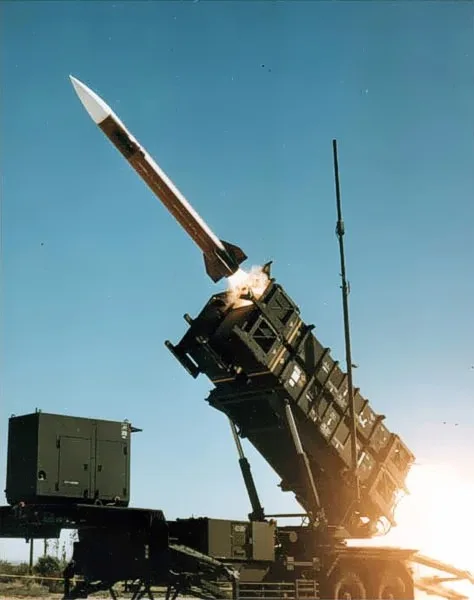

The MIM-104 Patriot is a mobile interceptor missile surface-to-air missile (SAM) system, the primary such system used by the United States Army and several allied states. It is manufactured by the U.S. defense contractor Raytheon and derives its name from the radar component of the weapon system. The AN/MPQ-53 at the heart of the system is known as the "Phased Array Tracking Radar to Intercept on Target", which is a backronym for "Patriot". In 1984, the Patriot system began to replace the Nike Hercules system as the U.S. Army's primary high to medium air defense (HIMAD) system and the MIM-23 Hawk system as the U.S. Army's medium tactical air defense system. In addition to defending against aircraft, Patriot is the U.S. Army's primary terminal-phase anti-ballistic missile (ABM) system. As of 2016, the system is expected to stay fielded until at least 2040.
Patriot uses an advanced aerial interceptor missile and high-performance radar systems. Patriot was developed at Redstone Arsenal in Huntsville, Alabama, which had previously developed the Safeguard ABM system and its component Spartan and hypersonic Sprint missiles. The symbol for Patriot is a drawing of a Revolutionary War–era minuteman.
The MIM-104 Patriot has been widely exported. Patriot was one of the first tactical systems in the U.S. Department of Defense (DoD) to employ lethal autonomy in combat. The system was deployed in the 1991 Gulf War, and made successful intercepts in the 2003 Iraq War. In August 2014 batteries first downed UAVs when Israeli Air Defense Command engaged two Hamas drones during the 2014 Gaza War. Patriot systems have been used since 2015 by the Saudi and Emirati air forces in the Yemeni Civil War, against Houthi missiles. Since 2023, Ukraine has operated Patriot systems in the Russo-Ukrainian War, downing Russian Su-34 and Su-35 fighters, Mi-8 helicopters, and Kinzhal ballistic missiles.
Contents
Introduction
Prior to the Patriot, Raytheon was involved in a number of surface to air missile programs, including FABMDS (Field Army Ballistic Missile Defense System), AADS-70 (Army Air-Defense System – 1970) and SAM-D (Surface-to-Air Missile – Development). In 1975, the SAM-D missile successfully engaged a drone at the White Sands Missile Range. In 1976, it was renamed the PATRIOT Air Defense Missile System. The MIM-104 (Mobile Interceptor Missile 104) Patriot combined several new technologies, including the MPQ-53 passive electronically scanned array radar and track-via-missile guidance.
Full-scale development of the system began in 1976 and it was deployed in 1984. Patriot was used initially as an anti-aircraft system. In 1988, it received an upgrade providing limited capability against tactical ballistic missiles (TBM), designated PAC-1 (Patriot Advanced Capability 1). The most recent upgrade by manufacturer Lockheed Martin, designated PAC-3, is a nearly total system redesign of the interceptor missiles, this time designed from the outset with the capability to engage and destroy tactical ballistic missiles. The Army plans to upgrade the Patriot system as part of the Integrated Air and Missile Defense system designed to tie into a broader air defense architecture using an Integrated Battle Command System (IBCS).
Patriot equipment
The Patriot system has four major operational functions: communications, command and control, radar surveillance, and missile guidance. The four functions combine to provide a coordinated, secure, integrated, mobile air defense system.
The Patriot system is modular and highly mobile. A battery-sized element can be installed in less than an hour. All components, consisting of the fire control section (radar set, engagement control station, antenna mast group, electric power plant) and launchers, are truck- or trailer-mounted. The radar set and launchers with missiles are mounted on M860 semi-trailers, which are towed by Oshkosh M983 HEMTTs.
Missile reloading is accomplished using a M985 HEMTT truck with a Hiab crane on the back. This crane is larger than the standard Grove cranes found on regular M977 HEMTT and M985 HEMTT cargo body trucks. The crane truck, known as a Guided Missile Transporter (GMT), removes spent missile canisters from the launcher and replaces them with fresh missiles. Because the crane nearly doubles the height of the HEMTT when not stowed, crews informally refer to it as the "scorpion tail". A standard M977 HEMTT with a regular-sized crane is sometimes referred to as the Large Repair Parts Transporter (LRPT).
The heart of the Patriot battery is the fire control section, consisting of the AN/MPQ-53 or −65/65A Radar Set (RS), the AN/MSQ-104 or −132 Engagement Control Station (ECS), the OE-349 Antenna Mast Group (AMG), and the EPP-III Electric Power Plant (EPP). The system's missiles are transported on and launched from either the M901 Launching Station (LS), which can carry up to four PAC-2 missiles; the M902 LS, with sixteen PAC-3 missiles; or the M903 LS, which can be configured to carry PAC-2, PAC-3, and MSE/SkyCeptor missiles in various combinations. A Patriot battalion is also equipped with the Information Coordination Central (ICC), a command station designed to coordinate the launches of a battalion and uplink Patriot to the JTIDS or MIDS network.
The AN/MPQ-53/65 Radar Set is a passive electronically scanned array radar equipped with IFF, electronic counter-countermeasure (ECCM), and track-via-missile (TVM) guidance subsystems.
The AN/MPQ-53 Radar Set supports PAC-2 units, while the AN/MPQ-65 Radar Set supports PAC-2 and PAC-3 units. The main difference between these two radars is the addition of a second travelling-wave tube (TWT), which gives the −65 radar increased search, detection, and tracking capability. The radar antenna array consists of over 5,000 elements that "deflect" the radar beam many times per second.
Variants
MIM-104A
Patriot was first introduced with a single missile type: the MIM-104A. This was the initial "Standard" missile, still known as "Standard" today. In Patriot's early days, the system was used exclusively as an anti-aircraft weapon, with no capability against ballistic missiles. This was remedied during the late 1980s when Patriot received its first major system overhaul with the introduction of the Patriot Advanced Capability missile and concurrent system upgrades.
MIM-104B (PAC-1)
Patriot Advanced Capability (PAC-1), known today as the PAC-1 upgrade, was a software-only upgrade. The most significant aspects of this upgrade were changing the way the radar searched and the way the system defended its assets. Instead of searching low to the horizon, the top of the radar's search angle was lifted to near vertical (89 degrees) from the previous angle of 25 degrees. This was done as a counter to the steep parabolic trajectory of inbound ballistic missiles. The search beams of the radar were tightened, and while in "TBM search mode" the "flash", or the speed at which these beams were shot out, was increased significantly.
While this increased the radar's detection capability against the ballistic missile threat set, it decreased the system's effectiveness against traditional atmospheric targets, as it reduced the detection range of the radar as well as the number of "flashes" at the horizon. Because of this, it was necessary to retain the search functions for traditional atmospheric threats in a separate search program, which could be easily toggled by the operator based on the expected threat.
The ballistic missile defense capability changed the way Patriot defended targets. Instead of being used as a system to defend a significant area against enemy air attack, it was now used to defend much smaller "point" targets, which needed to lie within the system's TBM "footprint". The footprint is the area on the ground that Patriot can defend against inbound ballistic missiles.
In the 1980s, Patriot was upgraded in relatively minor ways, mostly via its software. The most significant of these was a special upgrade to discriminate and intercept artillery rockets in the vein of the multiple rocket launcher, which was seen as a significant threat from North Korea. This feature has not been used in combat and has since been deleted from U.S. Army Patriot systems, though it remains in South Korean systems. Another upgrade was the introduction of another missile type, designated MIM-104B and called "anti stand-off jammer" (ASOJ) by the Army. This variant is designed to help Patriot engage and destroy ECM aircraft at standoff ranges. It works similar to an anti-radiation missile in that it flies a highly lofted trajectory and then locates, homes in on, and destroys the most significant emitter in an area designated by the operator.
MIM-104C (PAC-2)
In the late 1980s, tests began to indicate that, although Patriot was certainly capable of intercepting inbound ballistic missiles, it was questionable whether the MIM-104A/B missile was capable of destroying them reliably. This necessitated the introduction of the PAC-2 missile and system upgrade.
For the system, the PAC-2 upgrade was similar to the PAC-1 upgrade. Radar search algorithms were further optimized, and the beam protocol while in "TBM search" was further modified. PAC-2 saw Patriot's first major missile upgrade, with the introduction of the MIM-104C, or PAC-2 missile. This missile was optimized for ballistic missile engagements. Major changes to the PAC-2 missile were the size of the projectiles in its blast-fragmentation warhead, changed from around 2 grams to around 45 grams, and the timing of the pulse-Doppler radar fuze, which was optimized for high-speed engagements, though it retained its old algorithm for aircraft engagements if necessary.
Engagement procedures were optimized, changing the method of fire the system used to engage ballistic missiles. Instead of launching two missiles in an almost simultaneous salvo, a brief delay between 3 and 4 seconds was added, in order to allow the second missile launched to discriminate a ballistic missile warhead in the aftermath of the explosion of the first.
PAC-2 was first tested in 1987 and reached Army units in 1990, just in time for deployment to the Middle East for the Persian Gulf War. It was there that Patriot was first regarded as a successful ABM system and proof that ballistic missile defense was indeed possible. The complete study on its effectiveness remains classified.
In April 2013, Raytheon received U.S. Army approval for a second recertification, extending the operational life of the worldwide inventory of Patriot missiles from 30 to 45 years.
MIM-104D (PAC-2/GEM)
There were more upgrades to PAC-2 systems throughout the 1990s and into the 21st century, mostly centering on software. The PAC-2 missiles were modified significantly—four separate variants became known collectively as guidance enhanced missiles (GEM).
The main upgrade to the original GEM missile was a new, faster proximity fuzed warhead. Tests had indicated that the fuze on the original PAC-2 missiles were detonating their warheads too late when engaging ballistic missiles with an extremely steep ingress, and as such it was necessary to shorten this fuze delay. The GEM missile was given a new "low noise" seeker head designed to reduce interference in front of the missile's radar seeker, and a higher performance seeker designed to better detect low radar cross-section targets. The GEM was used extensively in Operation Iraqi Freedom (OIF), during which air defense was highly successful.
MIM-104E (PAC-2/GEM+)
Just prior to OIF, it was decided to further upgrade the GEM and PAC-2 missiles. This upgrade program produced missiles known as the GEM-T and the GEM-C, the "T" designator referring to tactical ballistic missiles, and the "C" designator referring to cruise missiles. These missiles were both given a totally new nose section, which was designed specifically to be more effective against low altitude, low RCS targets like cruise missiles. The GEM-T was given a new fuze which was further optimized against ballistic missiles and a new low noise oscillator which increases the seeker's sensitivity to low radar cross-section targets. The GEM-C is the upgraded version of the GEM, and the GEM-T is the upgraded version of the PAC-2. The GEM+ entered service in November 2002.
In 2018, Raytheon upgraded the GEM-T guidance system with solid-state gallium nitride (GaN) transmitters. Domestic U.S. production of PAC-2 GEM-T missiles remains ongoing, with a contracted backlog of approximately 1,500 missiles and a near-term demand of an additional 1,000 missiles, while the company is producing roughly 20 missiles a month with plans to expand to 35 missiles a month by the end of 2027.
As of April 2024 a consortium of Patriot operators consisting of Germany, Romania, Spain, and the Netherlands had placed an order for 1,000 PAC-2 GEM-T missiles, with the bulk of production to take place in Germany in a purpose-built MBDA plant. On November 18, 2024 Boris Pistorius participated in a ground-breaking ceremony at the plant site in Schrobenhausen. "The new facility will cover an area of approximately 6,000 square meters and create more than 300 new jobs. Construction is scheduled for completion in September 2026." General Christian Freuding maintained in July 2025 that the output of the plant would be "under European control".
MIM-104F (PAC-3 CRI)
The PAC-3 upgrade is a significant upgrade to nearly every aspect of the system. It took place in three stages deployed in 1995, 1996 and 2000, and units were designated Configuration 1, 2, or 3.
New software update known as PDB 5 (PDB standing for "post deployment build") was released in 1999 with initial support for Configuration-3 ground units and PAC-3 missiles. The system itself saw another upgrade of its WCC, and the communication setup was given a complete overhaul. Due to this upgrade, PAC-3 operators can now see, transmit, and receive tracks on the Link 16 Command and Control (C2) network using a Class 2M Terminal or MIDS LVT Radio. This capability greatly increases the situational awareness of Patriot crews and other participants on the Link 16 network that are able to receive the Patriot local air picture.
The software can now conduct a tailored TBM search, optimizing radar resources for search in a particular sector known to have ballistic missile activity, and can support a "keepout altitude" to ensure ballistic missiles with chemical warheads or early release submunitions (ERS) are destroyed at a certain altitude. For Configuration 3 units, the Patriot radar was completely redesigned, adding another traveling wave tube (TWT) that increased the radar's search, detection, tracking, and discrimination abilities. The new radar is designated AN/MPQ-65. It is capable, among other things, of discriminating whether an aircraft is crewed and which of multiple reentering ballistic objects are carrying ordnance.
The PAC-3 upgrade carried with it a new missile design, nominally known as MIM-104F and called PAC-3 by the Army. First deployed in 1997, the PAC-3 missile evolved from the Strategic Defense Initiative's ERINT missile, and so it is dedicated almost entirely to the anti-ballistic missile mission. Due to miniaturization, a single canister can hold four PAC-3 missiles, as opposed to one PAC-2 missile per canister. The PAC-3 missile is more maneuverable than previous variants, due to 180 tiny pulse solid propellant rocket motors mounted in the forebody of the missile, called Attitude Control Motors, or ACMs, which serve to fine align the missile trajectory with its target to achieve hit-to-kill capability.
The most significant upgrade to the PAC-3 missile is the addition of a Ka band active radar seeker. This allows the missile to drop its uplink to the system and acquire its target itself in the terminal phase of its intercept, which improves the reaction time of the missile against a fast-moving ballistic missile target. The PAC-3 missile is accurate enough to select, target, and home in on the warhead portion of an inbound ballistic missile. The active radar gives the warhead a "hit-to-kill" (kinetic kill vehicle) capability that eliminates the need for a traditional proximity-fused warhead. The missile still has a small explosive warhead, called a lethality enhancer, a warhead which launches 24 low-speed tungsten fragments in a radial direction to make the missile cross-section greater and enhance the kill probability. This greatly increases the lethality against ballistic missiles of all types.
PAC-3 MSE
Lockheed Martin Missiles and Fire Control is the prime contractor on the PAC-3 Missile Segment Enhancement upgrade (MSE) to the Patriot air defense system which will make the missile more agile and extend its range by up to 50%.
Patriot's PAC-3 MSE interceptor was selected as the primary interceptor for the new MEADS system when its design and development program began in 2004. MEADS is designed with plug-and-fight capabilities to support data exchange with external sensors and launchers through standardized open protocols for integrated air and missile defense (IAMD), so that MEADS elements can interoperate with allied forces on the move, attaching to and detaching from the battle management network as necessary. MEADS was scheduled to enter service alongside Patriot by 2014, with expectations that existing Patriot batteries will be gradually upgraded with MEADS technology in the long run. Because of economic conditions, in 2013 the U.S. chose to upgrade its Patriot systems instead of buying the MEADS system.
The PAC-3 Missile Segment upgrade consists of the PAC-3 MSE missile, a very agile hit-to-kill interceptor, the M903 Launching Station, a fire solution computer, and an Enhanced Launcher Electronics System (ELES). The PAC-3 Missile Segment Enhancement (MSE) interceptor increases altitude and range through a more powerful dual-pulse motor for added thrust, larger fins that collapse inside current launchers, and other structural modifications for more agility. The PAC-3 MSE is capable of intercepting longer-range theater ballistic missiles. The U.S. Army accepted the first PAC-3 MSE interceptors in October 2015, and Initial Operational Capability (IOC) was declared in August 2016.
The new M903 Launching System has a modular design capable of holding a total of 4 PAC-3 launching canisters (16 missiles), 12 PAC-3 MSE canisters (in 3 rows of 4), or 4 PAC-2 GEM canisters. It can mix different missiles, such as 6 PAC-3 MSE canisters (in 3 rows of 2) and either two PAC-3 canisters (8 missiles) or two PAC-2 canisters on the same launcher, down to combinations of a single PAC-2 canister, a single PAC-3 canister (4 missiles), 4 PAC-3 MSE canisters (in 2 rows of 2) or 2 PAC-3 MSE canisters in a single row. In December 2023 it was stated that production of Patriot interceptors was 550 a year and would be increased to 650 a year in 2024.
In February 2023, Lockheed Martin showcased integration of PAC-3 MSE missile with Mk 41 VLS used by Aegis BMD and Aegis Ashore. Lockheed announced it is spending $100 million to integrate the missile with the Aegis combat system and plans to test whether it can fire the missiles from a vertical launch system tied into Aegis's command-and-control technology and the SPY-1 radar in early 2024. In 2024, it was integrated with Aegis and launched from a Mark 70 Payload Delivery System VLS launcher at White Sands Missile Range. The PAC-3 MSE interceptor is viewed as a potential long-term replacement for the SM-2 interceptor due to its "high agility" and proven capabilities for "counter-hypersonic, ballistic missile, and cruise missile defense in various tight envelopes". According to Chris Mang, of Lockheed Martin's Missiles and Fire Control division, "the missile's capabilities are only enhanced when it's put in a maritime context and paired with the Aegis system, which has a lot more power than the Army's radar systems." The PAC-3 MSE would fill the gap in engagement envelope at low altitudes and shorter ranges against maneuvering threats, where the SM-6 missile (which must first be boosted to high altitudes before diving down on it target) cannot easily engage; According to Mang, the PAC-3 MSE's miniaturized attitude control motors allow it to engage these targets at ranges under a kilometer. Though PAC-3 MSE is the primary contender for this replacement, PAC-3 CRI missiles are also capable of being fired from the same platforms and are considered a follow-on option if the US Navy shows interest; compared to PAC-3 MSE they provide greater magazine depth (due to quad-pack capability in a VLS cell vs. the MSE's single missile per cell) but are less performant.
SkyCeptor (PAAC-4)
In August 2013, Raytheon and Rafael Advanced Defense Systems announced plans for Patriot Advanced Affordable Capability-4 (PAAC-4), which would integrate the Stunner interceptor from the jointly-funded David's Sling program with Patriot PAC-3 radars, launchers, and engagement control stations. The two-stage, multimode seeking Stunner would replace single-stage, radar-guided PAC-3 missiles produced by Lockheed Martin, providing improved operational performance at 20 percent of the $2 million unit cost of PAC-3 missiles. Israeli program officials have said that a previous teaming agreement between Raytheon and Rafael would allow the U.S. company to assume prime contractor status, and produce at least 60 percent of the Stunner missile in the United States.
In 2016 Raytheon announced that it had been authorized to bid SkyCeptor, a Stunner derivative, as part of its Polish Patriot bid. In March 2017 it was announced that Poland will acquire 8 Patriot batteries, with the majority of missiles deployed being SkyCeptors and only a small number of Patriot PAC-3 MSE missiles. Ultimately, Poland did not procure SkyCeptor missiles, ordering a new short-range air defence system based on CAMM and CAMM-ER missiles, integrated with Patriot batteries through the IBCS battle command system.
Electromecanica Ploiești, Romania, will start local production of SkyCeptor missile interceptors by 2026.
Upgrades
PAC-3 system upgrades continue under the International Engineering Services Program (IESP) which includes all countries that rely on the Patriot for integrated air and missile defense - as of 2022, the United States of America, The Netherlands, Germany, Japan, Israel, Saudi Arabia, Kuwait, Taiwan, Greece, Spain, South Korea, United Arab Emirates, Qatar, Romania, Sweden, Poland, Bahrain, and Switzerland.
The PDB 6 software update was released in 2004. This update allowed Configuration-3 to discriminate targets of all types, including anti-radiation missile carriers, helicopters, unmanned aerial vehicles, and cruise missiles.
The PDB 7 system upgrade was released in 2013. It improves radar search capabilities with a transition to digital signal processing, resulting in much better reliability and 30% longer range comparing to analog circuits. Processing power of the new command and control computer is higher by several orders of magnitude. Operator's monochrome CRT displays with hard-wired buttons were replaced by two 30-inch (760 mm) color touchscreen LCD monitors.
The PAC-3 Missile Segment Enhancement (MSE) upgrade was fielded in 2015. It includes a new fin design and a more powerful rocket engine.
In 2017, the AN/MPQ-65 radar was upgraded with active electronically scanned array (AESA) solid-state gallium nitride (GaN) transmitters in place of conventional traveling-wave tubes with a passive array of transmitters. The new radar has been redesignated AN/MPQ-65A. It includes a bolt-on replacement antenna array and two smaller rear panel arrays which provide 360-degree coverage.
During 2018–2023, Raytheon Company will further enhance the system under a modernization task order from the U.S. Army, resulting in Configuration-3+. The order includes five annual, indefinite delivery/indefinite quantity task order awards with a total contract ceiling of more than $2.3 billion, funded by Patriot partner states. The initial $235 million award was allocated in January 2018.
The PDB 8 upgrade released in 2018 includes redesigned fire control computers which support MSE capabilities, new weapons control computers with increased processing power, and software enhancements to radar search and target detection and identification which help reduce friendly fire incidents. The latest PDB 8.1 software started testing in 2019 and will reach operational status by 2023. It adds a revamped game-style GUI named Warfighter to Machine Interface (WMI) which employs 3D graphics to render the terrain and the airspace.
Patriot battalion
In the U.S. Army, the Patriot System is designed around the battalion echelon. A Patriot battalion consists of a headquarters battery, which includes the Patriot ICC and its operators, a maintenance company, and between four and six "line batteries", which are the actual launching batteries that employ the Patriot systems. Each line battery consists of (nominally) six launchers and three or four platoons: Fire Control platoon, Launcher platoon, and a Headquarters/Maintenance platoon - either a single platoon or separated into two separate units, at the battery commander's discretion.
The Fire Control platoon is responsible for operating and maintaining the "big 4", radar, the engagement control station, the antenna mast group, and the electric power plant. The launcher platoon operates and maintains the launchers. The Headquarters/Maintenance platoon(s) provide the battery with maintenance support and a headquarters section. The Patriot line battery is commanded by a captain and usually consists of between 70 and 90 soldiers. The Patriot battalion is commanded by a lieutenant colonel and can include as many as 600 soldiers.
Once deployed, the system requires a crew of only three individuals to operate. The Tactical Control Officer (TCO), usually a lieutenant, is responsible for the operation of the system. The TCO is assisted by the Tactical Control Assistant (TCA). Communications are handled by the third crewmember, the communications system specialist. A "hot-crew" composed of an NCOIC (usually a Sergeant) and one or more additional launcher crew members is on-hand to repair or refuel launching stations. A reload crew is on standby to replace spent canisters after missiles are launched. The ICC crew is similar to the ECS crew at the battery level, except its operators are designated as the Tactical Director (TD) and the Tactical Director Assistant (TDA).
Patriot battalions prefer to operate in a centralized fashion, with the ICC controlling the launches of all of its subordinate launching batteries through the secure UHF PADIL communications network.
The dismounted Patriot ICC (D-PICC) is a set of equipment which is composed of the same hardware as that at battalion level, but which distributes command and control over the launching batteries, which allows the batteries to disperse over a wider geographic area, with no loss of command and control. D-PICC is deploying to Pacific Command first.
Operation
Following is the process a PAC-2 firing battery uses to engage a single target (an aircraft) with a single missile:
A hostile aircraft is detected by the AN/MPQ-65 Radar. The radar examines the track's size, speed, altitude, and heading, and decides whether or not it is a legitimate track or "clutter" created by RF interference.
If the track is classified by the radar as an aircraft, in the AN/MSQ-104 Engagement Control Station, an unidentified track appears on the screen of the Patriot operators. The operators examine the speed, altitude and heading of the track. Additionally, the IFF subsystem "pings" the track to determine if it has any IFF response.
Based on many factors, including the track's speed, altitude, heading, IFF response, or its presence in "safe passage corridors" or "missile engagement zones", the ECS operator, the TCO (tactical control officer), makes an ID recommendation to the ICC operator, the TD (tactical director).
The TD examines the track and decides to certify that it is hostile. Typically, the engagement authority for Patriot units rests with the Regional or Sector Air Defense Commander (RADC/SADC), who will be located either on a U.S. Navy guided missile cruiser or on a USAF AWACS aircraft. A Patriot operator (called the "ADAFCO" or Air Defense Artillery Fire Control Officer) is colocated with the RADC/SADC to facilitate communication to the Patriot battalions.
The TD contacts the ADAFCO and correlates the track, ensuring that it is not a friendly aircraft.
The ADAFCO obtains the engagement command from RADC/SADC, and delegates the engagement back down to the Patriot battalion.
Once the engagement command is received, the TD selects a firing battery to take the shot and orders them to engage.
The TCO instructs the TCA to engage the track. The TCA brings the system's launchers from "standby" into "operate".
Operational history
Persian Gulf War (1991)
Prior to the First Gulf War, ballistic missile defense was an unproven concept in war. During Operation Desert Storm, in addition to its anti-aircraft mission, the Patriot was assigned to shoot down incoming Iraqi Scud or Al Hussein short range ballistic missiles launched at Israel and Saudi Arabia. The first combat use of Patriot occurred January 18, 1991, when it engaged what was later found to be a computer glitch. There were actually no Scuds fired at Saudi Arabia on January 18. This incident was widely misreported as the first successful interception of an enemy ballistic missile in history.
Throughout the war, Patriot missiles attempted engagement of over 40 hostile ballistic missiles. The success of these engagements, and in particular how many of them were real targets, is still controversial. Postwar video analysis of presumed interceptions by Massachusetts Institute of Technology (MIT) professor Theodore Postol suggests that no Scud was actually hit. This analysis is contested by Peter D. Zimmerman, who claimed that photographs of the fuselage of downed Scud missiles in Saudi Arabia demonstrated that the Scud missiles were fired into Saudi Arabia and were riddled with fragments from the lethality enhancer of Patriot Missiles.
On February 25, 1991, an Iraqi Al Hussein Scud missile hit the barracks in Dhahran, Saudi Arabia, killing 28 soldiers from the U.S. Army's 14th Quartermaster Detachment.
A government investigation revealed that the failed intercept at Dhahran had been caused by a software error in the system's handling of timestamps. The Patriot missile battery at Dhahran had been in operation for 100 hours, by which time the system's internal clock had drifted by one-third of a second. Due to the missile's speed this was equivalent to a miss distance of 600 meters.
The radar system had successfully detected the Scud and predicted where to look for it next. However, the timestamps of the two radar pulses being compared were converted to floating point differently: one correctly, the other introducing an error proportionate to the operation time so far (100 hours) caused by the truncation in a 24-bit fixed-point register. As a result, the difference between the pulses was wrong, so the system looked in the wrong part of the sky and found no target. With no target, the initial detection was assumed to be a spurious track and the missile was removed from the system. No interception was attempted, and the Scud impacted on a makeshift barracks in an Al Khobar warehouse, killing 28 soldiers, the first Americans to be killed from the Scuds that Iraq had launched against Saudi Arabia and Israel.
US-led invasion of Iraq (2003)
Patriot was deployed to Iraq a second time in 2003, this time to provide air and missile defense for the forces conducting Operation Iraqi Freedom (OIF). Patriot PAC-3, GEM, and GEM+ missiles both had a very high success rate, intercepting Al-Samoud 2 and Ababil-100 tactical ballistic missiles. No longer-range ballistic missiles were fired during that conflict. The systems were stationed in Kuwait and Iraq, and successfully destroyed a number of hostile surface-to-surface missiles using the new PAC-3 and guidance enhanced missiles.
Patriot missile batteries were involved in three friendly fire incidents. On March 23, 2003, a Royal Air Force Tornado was shot down, killing both crew members, Flight Lieutenant Kevin Barry Main (pilot) and Flight Lieutenant David Rhys Williams (navigator/WSO). On March 24, 2003, a USAF F-16CJ Fighting Falcon fired a HARM anti-radiation missile at a Patriot missile battery after the Patriot's radar had locked onto and prepared to fire at the aircraft, causing the pilot to mistake it for an Iraqi surface-to-air missile system because the aircraft was in air combat operations and was on its way to a mission near Baghdad. The HARM destroyed the Patriot's radar system with no casualties. Afterwards the Patriot Radar was examined and continued to operate, but was replaced due to a chance that a fragment might have penetrated it and gone undetected.
On April 2, 2003, two PAC-3 missiles shot down a USN F/A-18 Hornet, killing U.S. Navy Lieutenant Nathan D. White of VFA-195, Carrier Air Wing Five.
Post-2003 service in Iraq
A US Army Patriot battery in Erbil, Iraq shot down at least one Iranian ballistic missile during the 2024 Iranian strikes in Israel.
Service with Israel
The Israeli Air Defense Command operated MIM-104D Patriot (PAC-2/GEM+) batteries with Israeli upgrades. The Israel Defense Forces' designation for the Patriot weapon system was "Yahalom" (Hebrew: יהלום, diamond). On April 30, 2024, the Israeli Air Force published an article stating that their Patriot batteries would be decommissioned in two months, being replaced by "more advanced air systems". According to The War Zone, the Patriot was replaced by the David's Sling and Arrow systems.
Following the announcement, Ukraine initiated talks on obtaining retired Israeli Patriot systems in April 2024. On January 28, 2025, a US defense official confirmed to the CNN that 90 ex-Israeli interceptors were transferred to Ukraine via the United States. Reportedly Kyiv will also receive components for the system, including radars, after being refurbished in the US.
During Operation Protective Edge, Patriot batteries of the Israeli Air Defense Command intercepted and destroyed two unmanned aerial vehicles launched by Hamas. The interception of a Hamas drone in July 2014, was the first time in the history of the Patriot system's use that it successfully intercepted an enemy aircraft.
In Israeli service in the Syrian civil war, Patriot has primarily been active in drone and air defense, rather than a missile defense capacity. In August 2014, a Syrian unmanned aerial vehicle was shot down by an Israeli Air Defense Command MIM-104D Patriot missile near Quneitra, after it had penetrated the airspace over the Israeli-controlled Golan Heights. In September 2014, a Syrian Air Force Sukhoi Su-24 was shot down in similar circumstances.
Since 2014, Israeli Patriots have missed several Syrian drones, including two misses in July 2016 and another in June 2018; as well as several successful shootdowns against Syrian drones in April 2017 July 11 and 13, 2018, as well as against a Hezbollah intelligence drone attempting to infiltrate Israel in September 2017 through the Golan. On July 24, 2018, an Israeli Patriot missile shot down a Syrian Sukhoi Su-22 fighter which had crossed into Israeli airspace.
Service with Saudi Arabia
Patriot has continued to see usage in Saudi Arabia against Houthi missile attacks. In June 2015, a Patriot battery was used to shoot down a Scud missile, fired at Saudi Arabia by Houthi rebels in response to the Saudi Arabian-led intervention in Yemen. Another Scud was fired at an electricity station in Jizan Province and intercepted by a Saudi Patriot in August 2015. Saudi Arabia claims that another long-range ballistic missile was fired toward Mecca and intercepted by a Saudi Patriot in October 2016. Houthi sources said that the missile's intended target was the air force base in King Abdulaziz International Airport in Jeddah, 65 km (40 miles) north-west of Mecca. In March 2018, another missile, apparently fired from Yemen, was intercepted by a Patriot missile over Riyadh. Videos showed one interceptor exploded just after launch and another did a "U turn" midair toward Riyadh. During the Abqaiq–Khurais attack in September 2019, the six battalions of Patriot missile defense systems owned by Saudi Arabia failed to protect its oil facilities from attacks by multiple drones and suspected cruise missiles. The United States removed two of its four Patriot antimissile batteries securing oil fields in Saudi Arabia in May 2020, following an easing of tensions with Iran. They were to be replaced by Saudi's own Patriot batteries. In February 2021, a Patriot battery intercepted a ballistic missile over Riyadh that was fired by Houthis as a Formula E race was held on the outskirts of the city in Diriyah, attended by Crown Prince Mohammed bin Salman.
Service with the United Arab Emirates
According to Brigadier General Murad Turaiq, the commander of some of the Yemeni forces allied to the Saudi-led coalition currently fighting in Yemen, Patriot air defense systems deployed to Yemen by the United Arab Emirates (UAE) have successfully intercepted two ballistic missiles fired by Houthi forces. General Turaiq told the Abu Dhabi-based The National newspaper on November 14, 2015, that the first missile was shot down late the previous day in the Al-Gofainah area and a second was intercepted before it hit the building hosting the control centre for forces operating in Marib and Al-Baydah provinces. Airbus Defence and Space satellite imagery obtained by IHS Jane's showed two Patriot fire units, each with two launchers, deployed at the Safir airstrip in Marib province on October 1.
Talisman Sabre Exercise
In July 2021, the US Army used a battery of Patriot missiles in the Exercise Talisman Saber in the Shoalwater Bay Training Area in Queensland, Australia. The US Army test fired Patriot PAC-2 interceptor missiles and successfully intercepted target drones.
Service with Eastern Europe
Russia's 2014 invasion of Crimea led to a "sales burst" for the Patriot system, with Romania, Poland, and Sweden signing onto the system between the start of the invasion and the wider invasion of Ukraine in 2022. In response to Russia's invasion of Ukraine, on March 9, 2022, the U.S. European Command announced that it would send two Patriot air defense systems to Poland to "proactively counter any potential threat to U.S. and Allied forces and NATO territory". Poland asked Germany to transfer the Patriots to Ukraine. Germany declined. On December 19, Ukraine President Zelenskyy talked about negotiating personally with US President Biden over a potential transfer of Patriot missile systems. He said they offer "a (better) distance, radius of reflection, protection". Ukrainian Foreign Minister Dmytro Kuleba said that this was the most difficult diplomatic issue they had faced. One day later, the Biden administration announced it would be delivering another $1.85 billion in aid to Ukraine that would include a Patriot battery. During a meeting with Zelenskyy in front of the press at the White House on December 21, Biden confirmed that the United States would send a Patriot battery to Ukraine, noting that it would take "months" to train the "dozens" of soldiers needed to operate the system, probably in Germany. Providing a Patriot missile system is seen as a symbol of Western engagement in the conflict, although its range is only local.
Other nations subsequently announced plans to send their own Patriot batteries. On January 5, 2023, Germany announced that it would supply one Patriot battery to Ukraine as a part of their own military aid package. On January 17, 2023, the Netherlands announced it too will send one launcher, and added a second launcher on January 20. The Dutch government announced it will send launchers (Dutch: lanceerinrichtingen) and missiles, not complete systems (a battery) which includes radars, etc. On April 19, a German government website announced that the country had delivered a Patriot system to Ukraine. A second Patriot battery was delivered on April 27 from the United States. On August 9, 2023, it was announced that Germany would provide an additional complete Patriot battery to Ukraine. The system was delivered on December 13 after the Ukrainian crew completed training in Germany.
So, during 2023, three Patriot batteries were delivered to Ukraine.
Patriot has had a successful track record in Ukraine during the Russo-Ukrainian War, successfully intercepting a wide range of Russian weaponry and aircraft. It has shot down Russian aircraft like Su-34 fighters flying nearly 100 miles away, and intercepted missiles as far as 130 miles away, according to defense NGO reports. During October 2023, under a program called "FrankenSAM" Western and Soviet air defence technologies are being combined in Ukraine. One of three programs involves a Ukrainian radar guiding a Patriot missile. It has been tested and is expected to be operational by winter.
Demands on Patriot systems
Including the United States, 18 countries operate Patriot missile systems. Outside the US, only Japan's Mitsubishi Heavy Industries appears to build Patriot missiles, under licence from various US companies. This has led to a demand on the US Army. Patriot batteries are the most deployed units in the US Army by early 2021. Some units have had a six-month deployment extended up to 15 months. The missile is currently being used in active service in Saudi Arabia. In active use by the IDF in the "southern Negev desert". The Patriot missile batteries are also seeing active service in Ukraine, where there are three batteries in service. To refill US stockpiles, Japan has modified its export rules to allow export of missiles to the United States. Previously only specific components could be exported; now entire missiles can be exported. They cannot be sent directly to Ukraine, however they can backfill US stockpiles. Recent withdrawal of the missiles from the Middle East were done to help deal with a potential crisis in the Pacific. Likewise Germany has withdrawn its three Patriot units from Poland.
In January 2024, NATO announced a plan to purchase approximately 1000 Patriot missiles. A $5.5 billion contract was awarded to Raytheon and MBDA to establish a new production facility in Germany. The U.S. is also ramping up production domestically. In 2018, Lockheed Martin was building 350 PAC-3 MSE missiles annually and was working to ramp up its production to 500 missiles a year prior to Russia's full-scale invasion of Ukraine in February 2022. In December 2023, Lockheed hit their production goal of 500 missiles per year, and is "fully funded by the U.S. Army to build 550 missiles annually" at its new 85,000-square-foot Camden, Arkansas facility. Lockheed has announced plans to ramp up production of PAC-3 MSE interceptors to 650 annually by 2027, though it notes this will be done through internal investment, having not received Army funding for the production increase. Lockheed also intends to increase export shipments for the missile, with six new international customers signing letters of approval in 2023. Aerojet Rocketdyne, which produces the PAC-3 MSE motor, opened a 51,000-square-foot production facility next to Lockheed's Camden site in 2022, and has increased rocket motor production by 60% from 70,000 in 2021 to 115,000 in 2023 across all types including the PAC-3 MSE rocket motor.
On June 20, 2024, the US government was set to announce the suspension of all exports of Patriot missiles and systems "until Ukraine has enough to defend itself from Russia's air attacks". This decision affects five countries who have agreed to the suspension. The Romanian government has announced that it will send a "full" Patriot battery to Ukraine, provided that the US government "help(s) cover the gap".
Operators
Current operators:
Current
Egypt
Egyptian Air Defense Forces: In 1999, Egypt acquired 32 Patriot-3 (MIM-104-F/PAC-3) missile systems from the United States for $1.3 billion.
Germany
German Air Force (9 systems with 72 launchers + 8 systems with 64 launchers on order)
Flugabwehrraketengeschwader 1
Air Defence Missile Group 21 (Flugabwehrraketengruppe 21)
Air Defence Missile Group 24 (Flugabwehrraketengruppe 24)
Air Defence Missile Group 26 (Flugabwehrraketengruppe 26)
Air Defence Missile Group 61 (Flugabwehrraketengruppe 61)
Greece
Hellenic Air Force
350 Guided Missiles Wing
21st Guided Missile Squadron
22nd Guided Missile Squadron
23rd Guided Missile Squadron
24th Guided Missile Squadron
25th Guided Missile Squadron
26th Guided Missile Squadron
Japan
Japan Air Self-Defense Force
Air Defense Missile Training Unit (ADMTU) (PAC-2 & PAC-3)
Future
Morocco
Royal Moroccan Army
PAC-3 ordered and to be operated by Royal Moroccan Army.
Switzerland
Swiss Air Force - Air2030 BODLUV programme
5 batteries selected in 2022, contracted in 2023 for US$1,225,368,567
70 Raytheon MIM-104E GEM-T (PAC-2) missiles
3 TOC-C (Tactical Operation Center Coordination)
5 AN/MSQ-132 TOC-E (Tactical Operation Center Execution)
5 AN/MPQ-65A radars
5 EPP RADAR-V electrical generators for radar
17 M903 launching stations
OE-349 Antenna Mast Group (UHF communications array)
72 Lockheed Martin PAC-3 MSE ordered in 2023 for CHF 300 million
Former
Israel
Israeli Air Force
Israeli Air Defense Command
Operated 8 PAC-2/GEM+ "Yahalom" batteries. Replaced by the David's Sling and Arrow systems in 2024. In January 2025, a US defense official confirmed that about 90 interceptors along with one battery was sent to Ukraine.