




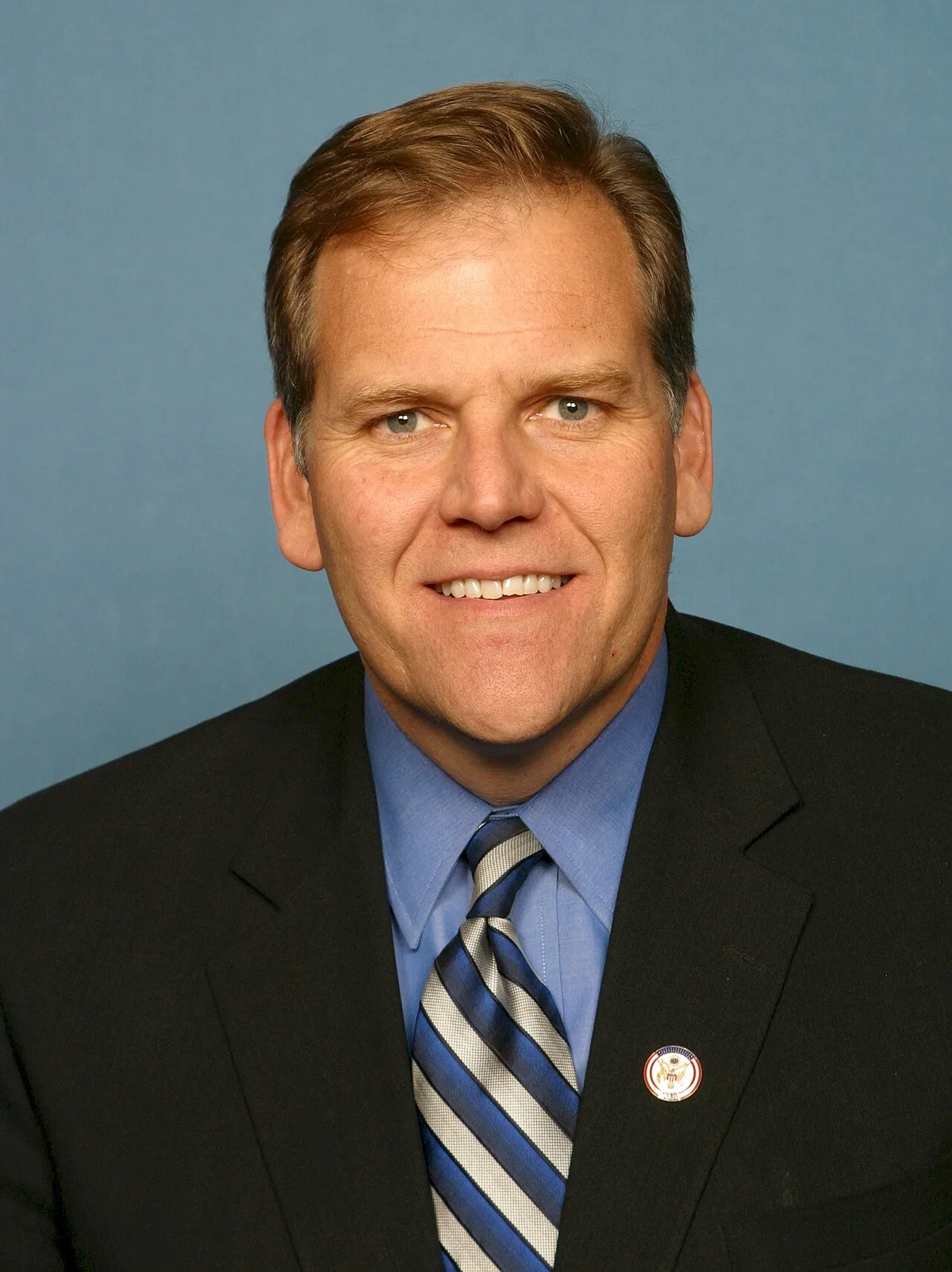

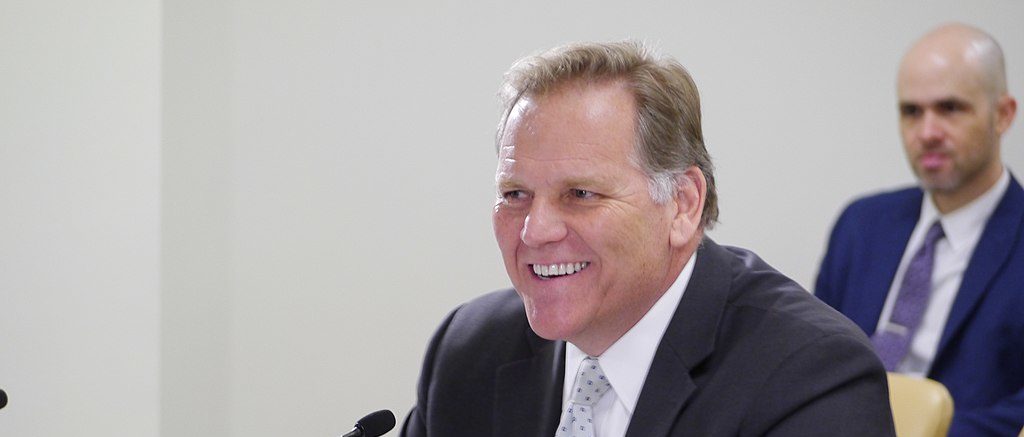
Michael J. Rogers (born June 2, 1963) is an American law enforcement officer and politician who served from 2001 to 2015 as the U.S. representative for Michigan's 8th congressional district. A member of the Republican Party, he chaired the United States House Permanent Select Committee on Intelligence from 2011 to 2015.
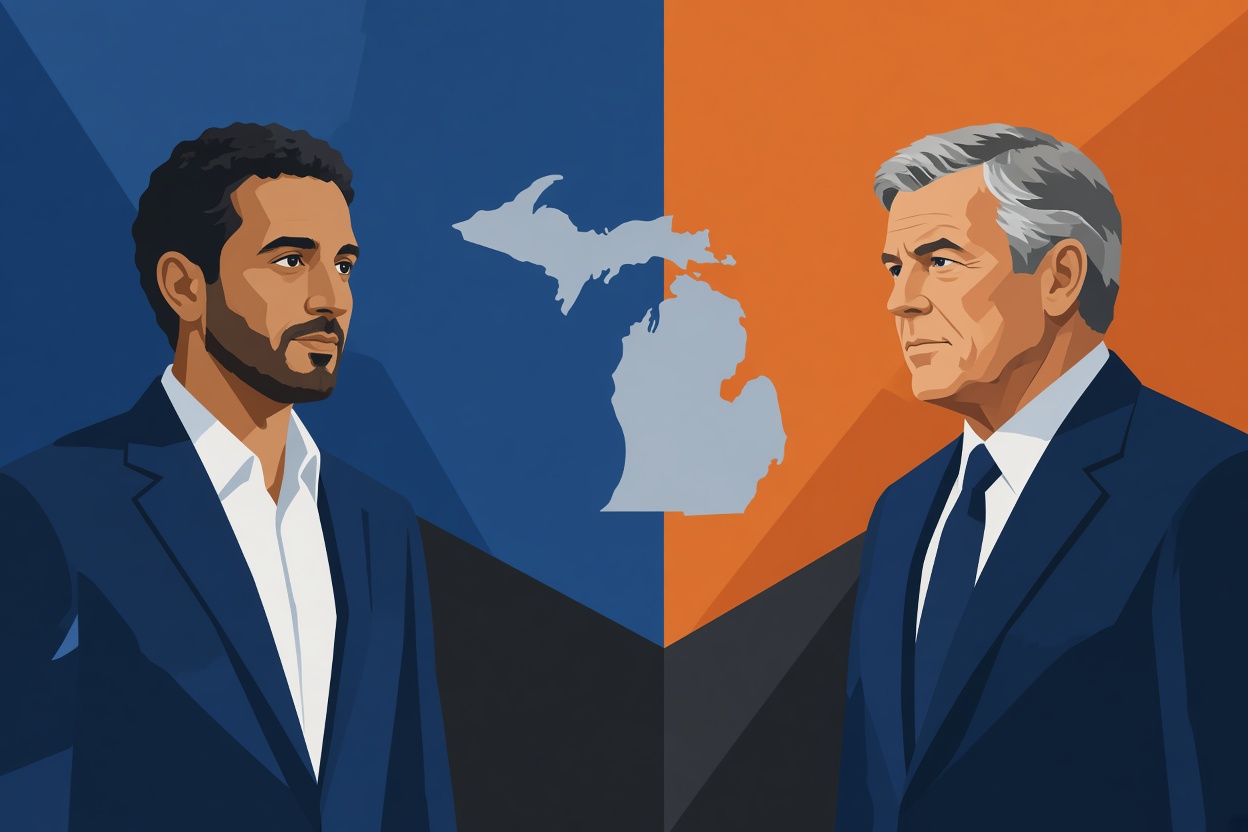
Rogers was the Republican nominee in the 2024 U.S. Senate election in Michigan, narrowly losing to the Democratic nominee, Elissa Slotkin. In the 2026 election, he is again the Republican nominee and faces Democratic nominee Abdul El-Sayed.
Contents
Early life and career
Rogers was born in Livonia, Michigan, the son of Joyce A. and John C. Rogers, and spent his early years in neighboring Redford Township. His family moved to Brighton Township in Livingston County, where he graduated from Howell High School in 1981. He graduated from Adrian College in 1985 with a bachelor's degree in criminal justice and sociology. Rogers served in the United States Army from 1985 to 1989. Rogers is on Telefónica's Technical and Security Advisory Committee and a board member of IP3 International.
Law enforcement career
From 1989 to 1994, Rogers worked as a special agent with the Federal Bureau of Investigation in its Chicago office, specializing in organized crime and public corruption. He is a member of the Society of Former Special Agents of the Federal Bureau of Investigation. In 2017, Rogers was interviewed to be director of the FBI after James Comey was dismissed.
Michigan Senate
Rogers was first elected in 1994. In 1998, he won a second term with 68% of the vote. He represented Clinton, Livingston, and Shiawassee Counties. Rogers wrote legislation creating the Michigan Education Savings Program.
U.S. House of Representatives
Elections
Rogers was elected to the United States House of Representatives from Michigan's 8th district in one of the nation's closest congressional races of 2000. He defeated Democratic State Senator Dianne Byrum by 111 votes. In 2002, the district was redrawn to be much friendlier to Republicans, losing its share of heavily Democratic Genesee County while being pushed further east into the solidly Republican northern part of Oakland County and also gaining Republican-leaning Clinton County, north of Lansing.
Tenure
Rogers's measure to make education savings plans free of federal taxes was adopted in 2003 (see Economic Growth and Tax Relief Reconciliation Act of 2001). His health savings account program for low-income families covered by Medicaid was signed into law on February 8, 2008. Rogers was the primary sponsor of the Respect for America's Fallen Heroes Act, H.R. bill 5037, which President George W. Bush signed into law on May 29, 2006. The CBO has said that Rogers's H.R. 1206 to make it easier for states to obtain waivers from some Medical Loss Ratio requirements would add $1.1 billion to the deficit between 2013 and 2022.
On November 30, 2011, Rogers introduced the Cyber Intelligence Sharing and Protection Act (CISPA). He introduced and supported the Intelligence Authorization Act for Fiscal Years 2014 and 2015 (H.R. 4681; 113th Congress), a bill that would authorize a variety of intelligence agencies and their appropriations for fiscal years 2014 and 2015. In March 2014, Rogers announced he would not seek an eighth House term. He later launched "Something to Think About", a daily radio segment. Former Michigan State Senator Mike Bishop won the Republican primary and defeated Democratic nominee Eric Schertzing.
Committee assignments
Committee on Energy and Commerce
Subcommittee on Communications and Technology
Subcommittee on Health
Permanent Select Committee on Intelligence (Chairman)
As chair of the full committee, Rep. Rogers was entitled serve as an ex officio member of all subcommittees.
U.S. Senate campaigns
2024
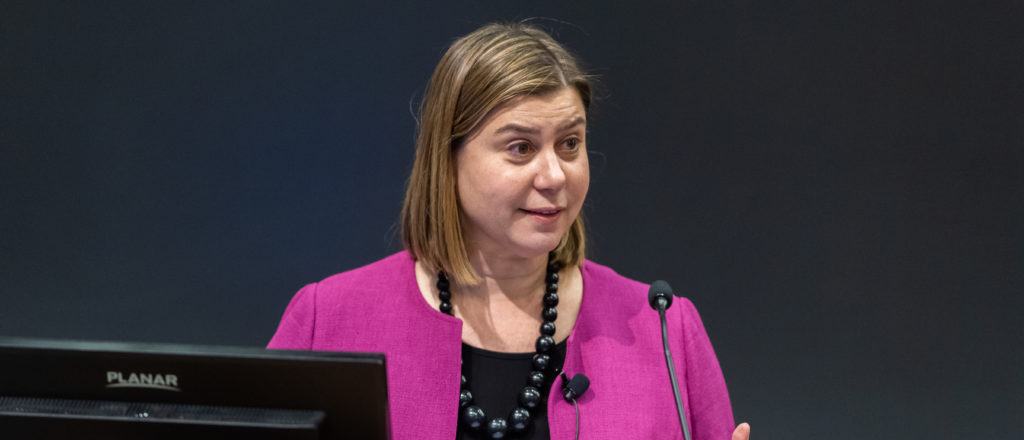
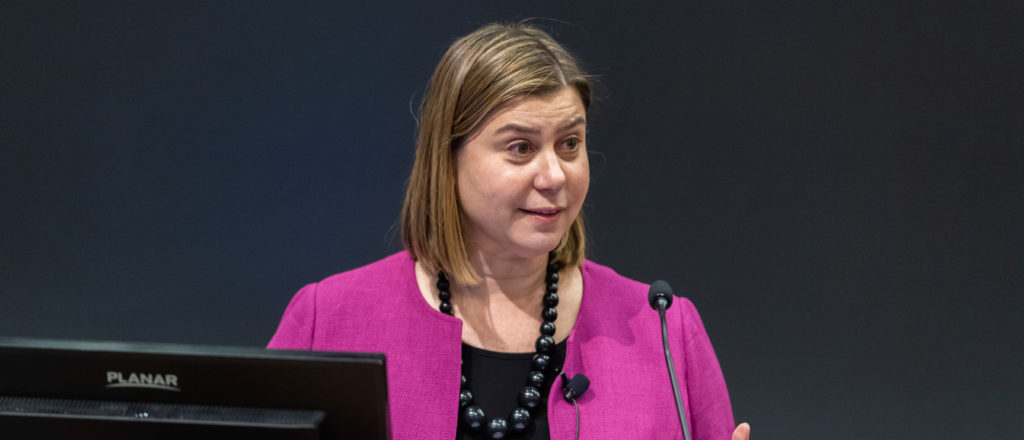
In August 2023, Rogers announced his candidacy for the U.S. Senate to succeed the retiring Democrat Debbie Stabenow. He won the Republican primary with over 60% of the vote on August 6, 2024, and was the Republican nominee in the general election. He lost to Democratic nominee Elissa Slotkin in the general election by fewer than 20,000 votes, while Donald Trump won the state in the concurrent presidential election by just over 80,000 votes.
2026
On April 14, 2025, Rogers announced his candidacy for his state's other U.S. Senate seat.
Rogers's campaign focused on state and local issues while avoiding national topics. He described the election as a "change election" and said that voters should hold Michigan Democrats responsible for issues including rising utility rates and declining manufacturing employment.
Running unopposed, he won the Republican primary on August 4, 2026. He will face Democratic nominee Abdul El-Sayed in the general election on November 3, 2026. Following El-Sayed's primary victory, Rogers has sought to court Democratic and independent support in the state. He has criticized El-Sayed's support for Medicare for All and opposition to Israel–United States relations during the Gaza war, receiving endorsements from retiring state representative Karen Whitsett, rabbi Asher Lopatin, and several Jewish businesspeople.
Political positions
Abortion
Rogers opposes abortion. In October 1994, during his first run for Michigan Senate, he told the Lansing State Journal that he supported "all restrictions on abortion", and in 2000, Rogers supported the Human Life Amendment.
In 2003 and 2005, Rogers co-sponsored legislation to rescind federal approval of the abortion-inducing medication mifepristone. along with the Right to Life Act, which would define human life and legal personhood as beginning at the moment of fertilization. In 2009, Rogers co-sponsored legislation to provide full constitutional protections for "the right to life of each born and preborn human person" and in October 2010, Rogers said he opposed abortion in all cases except to "prevent the death of the mother".
In 2013, he voted in favor of federal legislation to ban most abortions after 20 weeks of pregnancy and impose criminal penalties against doctors of up to five years in prison for violations.
In a March 2023 interview, Rogers said, "I'm a pro-life guy, I've voted pro-life, and I don't walk away from that", and in October 2023, Rogers said he supported the U.S. Supreme Court's 2022 decision Dobbs v. Jackson Women's Health Organization, which overturned Roe v. Wade.
In October 2024, Rogers said he would not attempt to change Michigan's 2022 constitutional amendment protecting legal access to abortion, saying the issue should be left to the states.
Economic policy
Rogers has supported Trump's plans for tariffs on foreign-made goods. He has said the main factor driving higher housing and consumer costs is high interest rates that could be reduced by "reining in outsized federal spending."
Foreign policy
As a congressman, Rogers opposed constructing a bridge connecting Detroit and Windsor and instead supported the construction of a second Ambassador Bridge span, which Canada opposed. In 2026, Rogers supported Trump's threats to keep the Gordie Howe International Bridge between Michigan and Canada from opening. Rogers said it would be useful as part of the trade war with Canada during the second Trump administration.
Rogers supported Trump's decision to launch strikes on Iran during the June 2025 Twelve-Day War.
In February 2026, Rogers posted his support for initial strikes during the 2026 Iran war. In March 2026, Rogers initially said of the war's impact on gas prices, "We're gonna be fine; we got plenty of oil". He said, "You'll get your oil, because we're going to pump our oil right here in America, and we got plenty." Rogers's 2026 Senate campaign said the resulting 2026 Strait of Hormuz crisis underscored the necessity of energy independence. In June 2026, Rogers said he supported the then ongoing negotiations under the auspices of the 60-day Islamabad Memorandum, which expired in August. He related the memorandum of understanding (MoU) to decreased gas and fertilizer prices. In August, Rogers said Trump had the authority to continue the war without congressional approval, but that he should pursue that approval regardless: "The commander-in-chief has the authority and the ability to do a lot of what he's doing. I just think working with the legislature is probably a better idea."
Rogers is a longtime supporter of Israel and was aligned with AIPAC during his tenure in Congress.
In July 2025, Rogers said of opposition to Israel's conduct in the Gaza war, "it is very short-sighted and politically naive to walk in and say we're not going to allow Israel to defend itself." He said he had encountered more criticism of Israel compared to previous years, and that not enough had been done to counter that, including within the Republican Party.
In August 2026, Rogers attended AIPAC fundraisers, but he has asked AIPAC not to campaign for him, fearing it could hurt his chances.
Health care
Rogers has voted repeatedly against Medicare negotiating drug prices, arguing a free market solution would be more effective. Rogers has called for ending key provisions of the Affordable Care Act, and opposed extended subsidies for the Affordable Care Act.
Immigration
Rogers has blamed "open borders" for increases in crime in the United States and supports a border wall and increased immigration enforcement.
LGBTQ rights
Rogers opposed Title IX protections introduced during the Biden administration against gender identity discrimination and spoke out against transgender athletes participating in women's and girls' sports, calling the issue personal to him.
In 2025, Rogers appointed senior leaders to his Senate campaign's faith coalition who had openly opposed same-sex marriage and LGBTQ rights.
Opioids
In 2003, Rogers first introduced the National Pain Care Policy Act, which would expand access to prescription opioids but did not include penalties for over-prescribing. While in Congress, Rogers received $226,000 in donations from companies that are now paying Michigan and other states in settlements over their roles in the opioid epidemic, including Johnson & Johnson, AmerisourceBergen, Cardinal Health, and McKesson.
In response to criticism of campaign donations he received from opioid manufacturers, Rogers acknowledged in September 2016 that drug companies considered him a "champion" of their industry.
Personal life
Rogers has been married to his second wife, Kristi Rogers, since 2010. He has two children from his first marriage. Rogers's older brother Bill was a state representative in Michigan.
Rogers sits on the Atlantic Council's Board of Directors. He is also the David M. Abshire Chair at the Center for the Study of the Presidency & Congress, an Intelligence Project Senior Fellow at Harvard University's Belfer Center, a member of George Mason University's National Security Institute Board of Advisors, and the chair of the board of trustees for the Mitre Corporation.
In 2022, Rogers purchased a home in Cape Coral, Florida, before moving back to Michigan ahead of his 2024 run for the U.S. Senate.