Plot
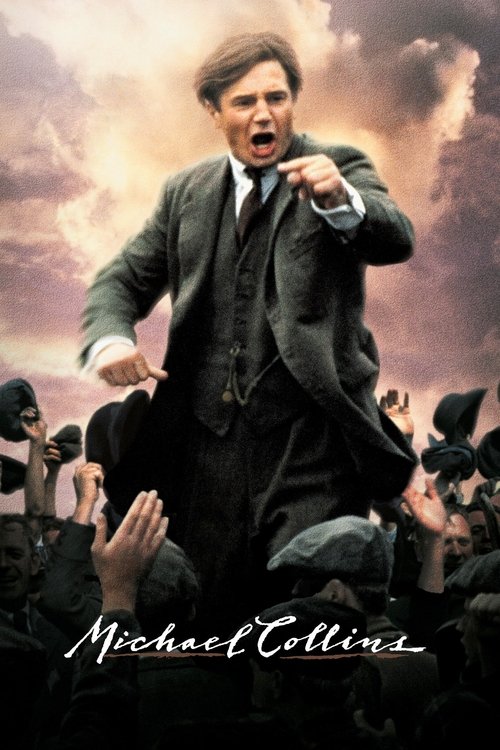
At the close of the Easter Rising in 1916, the besieged Irish republicans surrender to the British Army at the republicans' headquarters in Dublin. Several key figures of the Rising, including Patrick Pearse, Thomas MacDonagh, Tom Clarke and James Connolly, are executed by firing squad. Only Éamon de Valera is spared from execution due to his American citizenship, but is imprisoned alongside Michael Collins and Harry Boland.
The 1918 Irish general election results in the victorious Sinn Féin party unilaterally declaring Irish independence and in so doing beginning the Irish War of Independence. De Valera is elected President and Collins is appointed Director of Intelligence for the emerging IRA. Ned Broy, officially a member of the loyalist G Division, sympathises with the independence cause and tips Collins off that the Castle intends to arrest the entire Cabinet that evening. De Valera, sensing that the arrest will spark a worldwide outcry, dissuades his cabinet from going into hiding and persuades them to allow their arrests to take place. Collins and Boland evade arrest, though there is no response to the wider action.
As the last senior leader still free, Collins begins a counter-intelligence campaign with help from Broy. Numerous assassinations of agents and Irish collaborators are carried out by the IRA's Dublin Brigade. De Valera soon breaks out of Lincoln Prison, but announces on his return to Ireland that he will go to the United States to seek President Woodrow Wilson's official recognition of the Irish Republic. The war continues to intensify; the British assign SIS Officer Soames to counter the Irish Republican Army, though he and several of his agents are killed in an attack orchestrated by Collins. To retaliate, the Black and Tans are sent to Dublin to open fire on unarmed citizens who were in support of an independent Ireland; culminating in a massacre at Croke Park, in which 14 people are killed during a peaceful Gaelic football game. Broy's assistance to Collins is also discovered by Soames, who subsequently has Broy tortured and killed.
De Valera returns from the USA having been unable to secure President Wilson's support. The British hint at direct communication with the Irish, though Collins' guerilla campaign has boded poorly for Ireland's image. De Valera therefore decrees that the Irish Republican Army must fight as a conventional military, though Collins knows that this will just lead to another defeat against the might of the British Empire. Adamant in his approach to securing peace, de Valera orders a siege on The Custom House, but the Irish Republican Army suffers heavy casualties and the attack fails catastrophically. Despite the desperate situation the Irish Republican Army now finds itself in, the British unexpectedly call for a cease to the conflict.
Collins is sent to London to negotiate Irish interests as part of the Anglo-Irish Treaty, which is signed in 1921. Though Ireland is not immediately granted independence, the treaty enables Ireland to achieve it over time while remaining a British dominion during the interim as well as losing six of the nine Ulster counties, which will remain under British control. De Valera, who sought unconditional independence for Ireland, is furious upon learning of this and he and his supporters, including Boland, resign in protest. The subsequent people's vote backs the terms of the treaty, but de Valera rejects the result and in 1922 leads an attack on the Four Courts in Dublin. The National Army, led by Collins, is ordered to recapture it. In the subsequent Battle of Dublin, Boland is murdered.
Devastated upon learning of his friend's death, Collins journeys to West Cork, where de Valera is in hiding, to mediate peace. Collins, however, is misdirected by de Valera's associates and is led into an ambush in which he is shot and killed. Kitty Kiernan, Collins' love interest, is informed of his death just as she tries on a wedding gown.













.jpg?width=400)


