




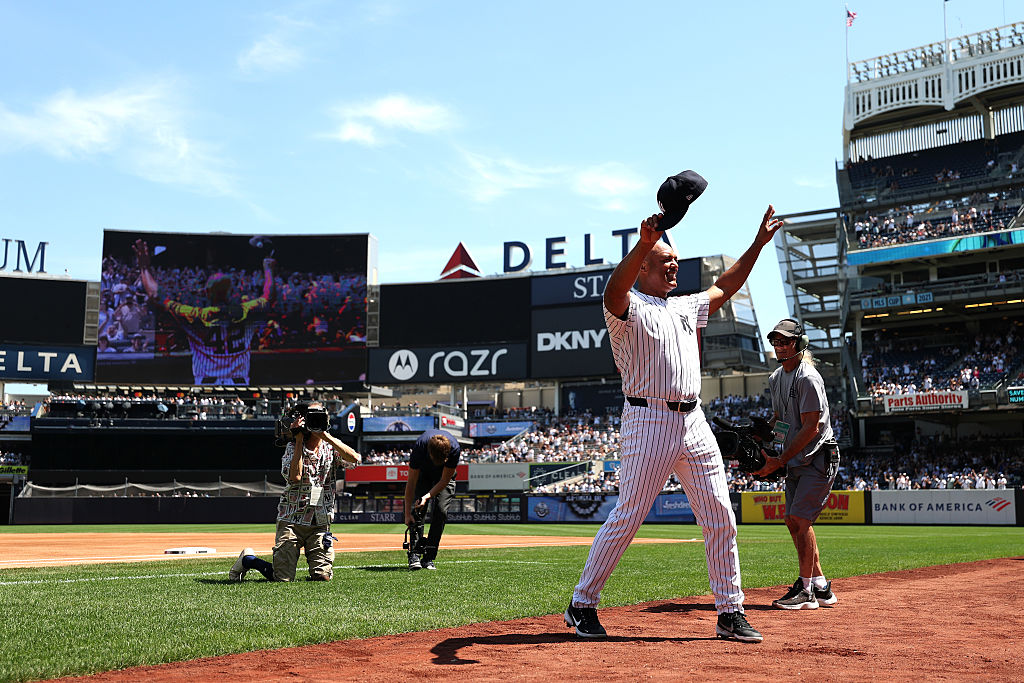
Mariano Rivera (born November 29, 1969) is a Panamanian-American former professional baseball player who was a pitcher for 19 seasons in Major League Baseball (MLB) for the New York Yankees, from 1995 to 2013. Nicknamed "Mo" and "Sandman", he spent most of his career as a relief pitcher and served as the Yankees' closer for 17 seasons. A 13-time All-Star and five-time World Series champion, he is MLB's career leader in saves (652) and games finished (952). Rivera won five American League (AL) Rolaids Relief Man Awards and three Delivery Man of the Year Awards, and he finished in the top three in voting for the AL Cy Young Award four times. In 2019, he was inducted into the Baseball Hall of Fame in his first year of eligibility, and is to date the only player ever to be elected unanimously by the Baseball Writers' Association of America (BBWAA).
Raised in the modest Panamanian fishing village of Puerto Caimito, Rivera was an amateur player until he was signed by the Yankees organization in 1990. He debuted in the major leagues in 1995 as a starting pitcher, before permanently converting to a relief pitcher late that year. After a breakthrough season in 1996 as a setup man, he became the Yankees' closer in 1997. In the following seasons, he established himself as one of baseball's top relievers, leading the major leagues in saves in 1999, 2001, and 2004. Rivera primarily threw a sharp-moving, mid-90s mile-per-hour cut fastball that frequently broke hitters' bats and earned a reputation as one of the league's toughest pitches to hit. With his presence at the end of games, signaled by his foreboding entrance song "Enter Sandman", Rivera was a key contributor to the Yankees' dynasty in the late 1990s and early 2000s that won four championships in five years. He was an accomplished postseason performer, winning the 1999 World Series Most Valuable Player (MVP) Award and the 2003 AL Championship Series MVP Award, while setting postseason records that included lowest earned run average (ERA) (0.70) and most saves (42).
Rivera is considered one of the most dominant relievers in major league history. Pitching with a longevity and consistency uncommon to the closer role, he saved at least 25 games in 15 consecutive seasons and posted an ERA under 2.00 in 11 seasons, both of which are records. When he retired, his career 2.21 ERA and 1.00 WHIP were the lowest in the live-ball era among qualified pitchers. Fellow players credit him with popularizing the cut fastball across the major leagues. Along with his signature pitch, Rivera was known for his precise control, smooth pitching motion, and composure on the field. In 2013, the Yankees retired his uniform number 42; he was the last major league player to wear the number full time, following its league-wide retirement in 1997 in honor of Jackie Robinson. In 2014, MLB named its AL Reliever of the Year Award in Rivera's honor.
A devout Christian, Rivera has been involved in charitable causes and the religious community through the Mariano Rivera Foundation. For his philanthropy, Rivera received the Presidential Medal of Freedom, the highest civilian award in the United States, in September 2019.
Contents
Early life
Mariano Rivera was born on November 29, 1969, in Panama City, Panama, to Mariano Rivera Palacios and Delia Jiron. Rivera has one older sister, Delia, and two younger brothers, Alvaro and Giraldo. Supported by Mariano Sr.'s job as captain of a fishing boat, the family lived in Puerto Caimito, a Panamanian fishing village that Rivera described as "poor". As a young man, Rivera played soccer and baseball with his friends on the beach during low tide. Soccer was his favorite sport, and Pelé his favorite athlete. For baseball games, they substituted cardboard milk cartons for gloves and tree branches for bats, and they fashioned balls by taping wads of shredded fishing nets. Rivera used this makeshift equipment until his father bought him his first leather glove when he was 12 years old. Speaking about his youth, Rivera said that although he stayed out of trouble, he "was hanging with the wrong people".
Rivera attended Escuela Victoriano Chacón for elementary school and La Escuela Secundaria Pedro Pablo Sanchez for his secondary education, but he dropped out in ninth grade. At age 16, he began to learn the fishing trade by working on a commercial boat captained by his father, catching sardines. Rivera, who worked six-day weeks, year round, called the job "extremely hard" and was more interested in becoming a mechanic. He spent three years learning the fishing trade, saving the money he earned in hopes of opening an automobile repair shop. Two incidents on his father's boat validated his doubts about fishing as a career. In 1988, Rivera's uncle Miguel was lashed by an unsecured rope that shot off a hydraulic mechanism, and a month later he died from his injuries. About a year later, at age 19, Rivera was forced to abandon his father's ship after it began capsizing due to a malfunctioning water pump and an overweight load of fish.
Rivera continued to play sports during his teenage years but eventually quit soccer around age 17 after a series of ankle and knee injuries. Consequently, he shifted his attention to baseball, though he considered it a hobby rather than a potential profession. At age 18, Rivera joined the Panamá Oeste Vaqueros, a local amateur baseball team, as a utility player. Herb Raybourn, a scout, watched him play shortstop in a 1988 baseball tournament but did not project him to be a major leaguer. A year later, Panamá Oeste's pitcher performed so poorly in a playoff game that Rivera was asked to replace him, and despite no experience at the position, he pitched well. Teammates Claudino Hernández and Emilio Gáez consequently contacted Chico Heron, a scout for the New York Yankees of Major League Baseball (MLB). Two weeks after his pitching debut, Rivera was invited to a Yankees tryout camp run by Heron in Panama City. Raybourn, who had returned to Panama to scout as the Yankees' director of Latin American operations, received a tip about Rivera. Raybourn was surprised to hear he had switched positions but decided to watch him throw. Although Rivera lacked formal pitching training, weighed just 155 pounds (70 kg), and threw only 85–87 miles per hour (137–140 kilometers per hour), Raybourn was impressed by his athleticism and smooth, effortless pitching motion. Viewing the free agent Rivera as a raw talent, Raybourn signed him to a contract with the Yankees organization on February 17, 1990; the contract included a signing bonus of US$2,500 ($6,161 today), according to MLB records.
Professional baseball career
Minor leagues (1990–1995)
After signing his contract, Rivera—who spoke no English and had never left home before—flew to the United States and reported to the Gulf Coast League (GCL) Yankees, a Rookie level minor-league affiliate of the New York Yankees. Feeling lonely and homesick, he wrote home to his parents often, as they did not have access to telephones in Puerto Caimito. At that point in his career, scouts considered Rivera to be a "fringe prospect" at best, but he made progress with a strong 1990 season for the GCL Yankees. Pitching mostly in relief, he allowed only 24 baserunners and one earned run in 52 innings pitched—a 0.17 earned run average (ERA). The team permitted Rivera to start the season's final game in order for him to accumulate enough innings pitched to qualify for the league's ERA title (which carried a $500 bonus); his subsequent seven-inning no-hitter "put him on the map with the organization", according to manager Glenn Sherlock. In the offseason, Rivera returned to Panama and tipped Raybourn off about a promising local player, Rivera's 16-year-old cousin Rubén, whom the Yankees consequently signed.
In 1991, Rivera was promoted to the Class A level Greensboro Hornets of the South Atlantic League, where he started 15 of the 29 games in which he pitched. Despite a 4–9 win–loss record, he recorded a 2.75 ERA in 114+2⁄3 innings pitched and struck out 123 batters while walking 36 batters. New York Yankees manager Buck Showalter took notice of Rivera's strong strikeout-to-walk ratio, calling it "impressive in any league" and saying, "This guy is going to make it." A minor-league scout for the Cincinnati Reds filed a report that season about Rivera that said: "long arms w/ slender strong body, loose actions...will challenge in velocity...maturity is a question, consistency is a question...consistency will need to be maintained to improve and advance."
In 1992, Rivera was promoted to the Class A-Advanced level Fort Lauderdale Yankees of the Florida State League (FSL), but he missed the first third of the season with elbow stiffness. He started ten games for Fort Lauderdale, compiling a 5–3 win–loss record and a 2.28 ERA, while walking only five batters in 59+1⁄3 innings pitched. Ultimately, Rivera was sidelined again after suffering damage to the ulnar collateral ligament (UCL) in his right elbow. The injury was attributed to him snapping his wrist during his throwing motion in an attempt to improve the movement of his slider.
Rivera underwent elbow surgery on August 27, 1992, leading to concerns that he would be out through the 1993 season. Contrary to popular belief, the operation was not Tommy John surgery; Rivera's surgeon, Frank Jobe, determined that ligament replacement was not necessary and instead repaired the frayed UCL. Rivera was left unprotected by the Yankees in MLB's 1992 expansion draft, which filled the rosters for two expansion teams, the Florida Marlins and Colorado Rockies. At one point in the draft, Marlins general manager Dave Dombrowski was planning to select Rivera with his next pick, but after the Rockies chose Yankee Brad Ausmus, the Yankees were shielded from losing any more players; Rivera went undrafted.
Major leagues (1995–2013)
After being called up to the major leagues on May 16, 1995, Rivera made his debut for the New York Yankees on May 23 against the California Angels. Starting in place of injured pitcher Jimmy Key, Rivera allowed five earned runs in 3+1⁄3 innings pitched in a 10–0 loss. He struggled through his first four major league starts, posting a 10.20 ERA, and as a result, he was demoted to Columbus on June 11. As a 25-year-old rookie just three years removed from major arm surgery, Rivera did not have a guaranteed spot in the Yankee organization. Management considered trading him to the Detroit Tigers for starter David Wells.
While recovering from a sore shoulder in the minor leagues, Rivera pitched a no-hit shutout in a rain-shortened five-inning start on June 26. Reports from the game indicated that his pitches had reached 95–96 mph (153–154 km/h), about 6 mph (9.7 km/h) faster than his previous average velocity; Rivera attributes his inexplicable improvement to God. Yankees general manager Gene Michael was skeptical of the reports until verifying that Columbus' radar gun was not faulty and that another team's scout had taken the same measurements. Afterwards, he ended any trade negotiations involving Rivera. On July 4, in his first start back in the major leagues, Rivera pitched eight scoreless innings against the Chicago White Sox, allowing just two hits while striking out 11 batters. In five subsequent starts, he was unable to match his success from that game. After a brief demotion to Columbus in August, Rivera made one last start in the major leagues in September before he was moved to the Yankees' bullpen. Overall, he finished his first major league season with a 5–3 record and a 5.51 ERA in ten starts and nine relief outings. His performance in the American League Division Series against the Seattle Mariners, in which he pitched 5+1⁄3 scoreless innings of relief, convinced Yankees management to keep him and convert him to a relief pitcher the following season.
Rivera was nearly traded prior to the 1996 season to address the Yankees' depleted depth at the shortstop position. Owner George Steinbrenner considered an offer to send Rivera to the Mariners in exchange for shortstop Félix Fermín, but Yankees management convinced Steinbrenner to instead entrust the position to rookie Derek Jeter. In 1996, Rivera served primarily as a setup pitcher, typically pitching in the seventh and eighth innings of games before closer John Wetteland pitched in the ninth. Their effectiveness as a tandem helped the Yankees win 70 of 73 games that season when leading after six innings. Over a stretch of games between April 19 and May 21, Rivera pitched 26 consecutive scoreless innings, including 15 consecutive hitless innings. During the streak, he recorded his first career save in a May 17 game against the Angels. Rivera finished the regular season with a 2.09 ERA in 107+2⁄3 innings pitched and set a Yankees single-season record for strikeouts by a reliever (130). Baseball Reference calculated his value to the Yankees that year to be 5.0 wins above replacement (WAR), a figure no reliever has surpassed in a single season since. In the postseason, he allowed just one earned run in 14+1⁄3 innings pitched, helping the Yankees advance to and win the 1996 World Series against the Atlanta Braves. It was the franchise's first World Series championship since 1978. In MLB's annual awards voting by the Baseball Writers' Association of America (BBWAA), Rivera finished in twelfth place for the American League (AL) Most Valuable Player (MVP) Award and third for the AL Cy Young Award, which is given to the league's best pitcher. Commentator and former player Tim McCarver said that the Yankees "revolutionized baseball" that year with Rivera, calling him "a middle reliever who should have been on the All-Star team and who was a legitimate MVP candidate".
Player profile
Pitching style
Rivera's signature pitch was a cut fastball or "cutter", which exhibited lateral movement towards left-handed hitters similar to that of a slider but with the velocity of a fastball. The sharp, late movement of Rivera's cutter prevented hitters from making contact with the ball on the sweet spot of their bats, leading to them not only making weak contact on batted balls but also frequently breaking their bats. According to a tally by columnist Buster Olney, Rivera broke 44 bats during the 2001 regular season. Chipper Jones, who once witnessed teammate Ryan Klesko break three bats in a plate appearance against Rivera in the 1999 World Series, called the pitch a "buzz saw". Rivera's long fingers and loose wrist allowed him to impart more spin on the ball, contributing to the pitch's movement. Describing his grip of the cutter, he said, "it's really a four-seam fastball with pressure on the middle finger". By adjusting the pressure that he applied to the ball with his fingertips, he could vary the pitch's movement. One of the keys to his cutter grip was bending his thumb at the knuckle and tucking it under the ball so the nail aligned with his middle finger; this position prevented his thumb pad from impeding the spin of the ball as it left his hand. Rivera threw four-seam and two-seam fastballs as complementary pitches but primarily used his cutter; according to baseball statistics website Fangraphs, Rivera threw at least 82% cutters each season from 2008 to 2013. All three pitches typically reached a velocity in the low-to-mid 90s mph.
Early in his major league career, Rivera was a "power pitcher" who relied on an overpowering four-seam fastball that topped out at 96 mph (154 km/h) to retire hitters. By enticing them to swing and miss at pitches high in the strike zone, he accumulated strikeouts at a high rate. Rivera altered his pitching style after accidentally discovering the cutter. One day in June 1997 during one of his daily warm-up tosses with teammate Ramiro Mendoza, Rivera noticed that his fastballs were moving sharply and unpredictably, a problem that began to occur in games as well. After unsuccessfully spending a month trying to eliminate the movement, Rivera relented and incorporated the cutter into his pitching repertoire, making it one of his primary pitches in 1998. When asked about the pitch's origin, he explained: "It was just from God. I didn't do anything. It was natural." As he came to rely on the cutter, Rivera began to record more outs on batted balls. This change resulted in his strikeouts per 9 innings rate decreasing from 10.87 in 1996 to 5.3 in 1998, but it also decreased his pitches per inning rate from 18.7 in 1995 to 14.9 in 1998. Rivera credited his improved efficiency and consequent longevity in baseball to his long-time pitching coach Mel Stottlemyre.
Personality
Rivera exhibited a reserved demeanor on the field that contrasted with the emotional, demonstrative temperament of many of his peers. Hall of Fame closer Goose Gossage said that Rivera's composure under stress gave him the appearance of having "ice water in his veins". Commenting on his ability to remain focused in pressure situations, Rivera said, "When you start thinking, a lot of things will happen... If you don't control your emotions, your emotions will control your acts, and that's not good." His ability to compartmentalize his successes and failures impressed fellow reliever Joba Chamberlain, who said, "He's won and lost some of the biggest games in the history of baseball, and he's no worse for the wear when he gives up a home run." Rivera explained the need to quickly forget bad performances, saying, "the game that you're going to play tomorrow is not going to be the same game that you just played." Derek Jeter called him the "most mentally tough" teammate with whom he had ever played.
During his playing career, Rivera was regarded as a team leader within the Yankees organization, often mentoring younger pitchers and counseling teammates. He had a team-first mindset and deferred most discussions about individual accolades to team goals and his teammates, praising them for making his presence in games possible. When asked to describe his job, Rivera once put it simply, "I get the ball, I throw the ball, and then I take a shower."
Legacy
Rivera was a dominant reliever throughout his career, pitching with a consistency and longevity uncharacteristic of a role commonly marked by volatility and high turnover. In his 17-year tenure as the Yankees' closer, Rivera compiled considerable career numbers. A 13-time All-Star, he is MLB's all-time regular season leader in saves (652) and games finished (952). He pitched in 1,115 regular season games, which is fourth-most in MLB history, the most in AL history, and the most by a right-handed pitcher. Rivera holds or shares several records for the most seasons of reaching various save milestones, including seasons with at least: 20 saves (sixteen); 25 saves (fifteen consecutive, sixteen total); 30 saves (nine consecutive, fifteen total); 35 saves (twelve); 40 saves (nine); and 50 saves (two). At the time of his retirement, Rivera's career ERA (2.21) and WHIP (1.00) were the lowest of any MLB pitcher in the live-ball era (minimum 1,000 innings pitched), making him one of the top pitchers since 1920 at preventing hitters from reaching base and scoring. He recorded an ERA under 2.00 in 11 seasons, tying him with Walter Johnson for the most such seasons (minimum 60 innings pitched each). Rivera also ranks first in career adjusted ERA+ (205), a statistic that adjusts ERA for league and ballpark to allow comparisons of pitchers on the same baseline. His 1,135 regular season strikeouts rank 13th all time among relievers.
In addition to his strong regular season numbers, Rivera excelled in the postseason, recording an 8–1 win–loss record and a 0.76 WHIP. He holds numerous postseason records, including lowest career ERA among players with a minimum of 30 innings pitched (0.70), most saves (42), most consecutive scoreless innings pitched (33+1⁄3), most consecutive save opportunities converted (23), and most games pitched (96). He saved more than twice as many postseason games as any other pitcher; Kenley Jansen, with 20, has the next-highest total. In an oft-cited statistic, more people have walked on the Moon (12) than have scored an earned run against Rivera in the postseason (11). Joe Torre, who was the Yankees' manager for most of Rivera's career, said: "Let's face it. The regular season for Mo is great, but that's the cupcakes and the ice cream. What separates him from everybody else is what he's done in the postseason." Rivera's dominance in the postseason often led to him being utilized for two-inning appearances, as he saved a record 14 postseason games in this manner—more than all other MLB relievers combined while he was an active player. He ranks first all time in win probability added (WPA) in the postseason with 11.7, nearly three times the total of the next-closest player. He also ranks first all time in championship WPA in the postseason (183, or 1.83), meaning his performance alone added nearly two World Series championships to the Yankees. In a 2009 ESPN.com poll, Rivera was voted one of the top five postseason players in MLB history. Neil Greenberg of The Washington Post ranked him the most "clutch" player in MLB postseason history.
Personal life
Rivera and his wife Clara have known each other since elementary school, and they were married on November 9, 1991. They have three sons, including Mariano III. The family lived in Panama until 2000, when they relocated to Westchester County, New York. In 2006, the Riveras purchased a 13,000-square-foot (1,200 m2) home in Rye, New York, for $5.7 million. They listed it for sale for $3.995 million in 2020, and sold it for $3.783 million in June 2022. The couple also sold a lakefront home in Tampa, Florida, for $3.2 million in December 2019.
Mariano III joined the Quinnipiac Bobcats baseball team as a walk-on, and after transferring, he also pitched for Iona College in New Rochelle, not far from his home. He was drafted by the Yankees with the 872nd pick in the 2014 MLB draft, but decided to return to Iona for his junior year. In the following year's draft, Mariano III was selected by the Washington Nationals in the fourth round with the 134th overall pick. After pitching for the Potomac Nationals minor league team for four seasons, he opened an automobile repair shop in Chester, New York, in 2020.
Over the course of his professional career, Rivera learned English, beginning in 1991 with the Greensboro Hornets, when he realized none of his teammates spoke his native Spanish. He is now a proponent of Latino players learning English and of American press members learning Spanish to bridge the cultural gap. He encouraged immigrants to the United States to make learning English their top priority. Rivera became a naturalized citizen of the United States in October 2015 and was recognized as an Outstanding American by Choice during the ceremony.
In February 2019, a Panamanian woman accused Rivera of failing to financially support her two children, a boy and a girl then aged 11 and 15, that Rivera had allegedly fathered out of wedlock. Five lawsuits were filed in his native country, demanding child support that he allegedly stopped paying two years earlier. He called the demands "unfounded", and the two sides ultimately settled the lawsuits.
Religion and philanthropy
Rivera is a devout Christian. During his childhood, neither he nor his family attended church, but after a born-again experience around the age of 21, Rivera became religious and converted from Catholicism to a Pentecostal faith. His parents followed his lead after seeing the difference it made in him. Rivera believes that God has a reason for everything that happens. For example, he found his failure in Game 7 of the 2001 World Series easier to deal with when he learned of the consequences it had for teammate Enrique Wilson. Had the Yankees won the series, Wilson would have remained in New York for the championship parade and would have departed for his native Dominican Republic on American Airlines Flight 587, which crashed shortly after takeoff and killed all 260 people aboard. Rivera told Wilson, "I am glad we lost the World Series, because it means that I still have a friend." Rivera's pitching glove was inscribed "Phil. 4:13", in reference to the Bible verse Philippians 4:13 ("I can do all things through Christ, who strengthens me").
Rivera is involved with philanthropic efforts in several countries. The Mariano Rivera Foundation, a 501(c)(3) organization established in July 1998, helps provide underprivileged children with an education, distributing more than $500,000 annually in the US and Rivera's native Panama through church-based institutions. His contributions in Panama include building an elementary school, providing Christmas gifts to children, and developing a program that provides computer access and adult mentors to youths. Rivera has funded church start-ups in Panama, Mexico, the Dominican Republic, California, Florida, and New York. In 2011, he acquired a 107-year-old church from the city of New Rochelle for $1, and after his foundation renovated it at a cost of $3 million, it opened in March 2014 as Refugio de Esperanza ("Refuge of Hope"). The church is part of the Assemblies of God organization and hosts a Pentecostal congregation that previously met at Rivera's home, with his wife Clara serving as its pastor.
For years, the Mariano Rivera Foundation was a private institution, but during his final baseball season in 2013, many teams wanted to commemorate the pitcher by donating to his foundation. As a result, he formed a public version of it; Naomi Gandia was appointed its executive director, working from its headquarters in Stanton, Delaware. Since retiring from baseball, Rivera has dedicated himself to philanthropy and his churches. In 2014, he and Clara created a scholarship in their names that they have awarded to students at the local College of New Rochelle. Recently, Rivera has organized an annual charity golf tournament that benefits White Plains Hospital and his foundation. He also holds multiple events annually in Delaware, including giveaways of backpacks with school supplies to children, distribution of turkey dinners during the holiday season, and the "Mariano Rivera Foundation 5K & Kids Run". In 2021, his foundation launched the Mariano Rivera Mentorship Program, a faith-based initiative aimed at serving underprivileged males in Gainesville, Florida; New Rochelle; and Houston.
Business interests and endorsements
Rivera was an investor in two New York area restaurants: "Clubhouse Grill", which opened in New Rochelle in 2006 as "Mo's New York Grill"; and Siro's, which opened in Manhattan in 2012. Both restaurants have since closed. In 2015, he opened a Toyota and Scion car dealership in Mount Kisco, New York, and in 2022, he opened a Honda dealership in Port Jefferson Station, New York. He is a founder and part-owner of Cherri Cafe, a coffee company focused on Central American coffee, especially Panamanian beans. Rivera joined the Washington Speakers Bureau in July 2019 as a paid public speaker. In July 2022, he became co-president of the newly formed United International Baseball League, the first professional baseball league in the Middle East and South Asia; in November of that year, it was announced that the league had been renamed Baseball United and that he had joined its investment and ownership group. In May 2026, Rivera launched a line of three hot sauces under the brand name "Mo's Heat", which was made in partnership with the Panamanian hot sauce company D'Elidas.
In June 2026, it was reported that Rivera had been defrauded of $1 million that he invested in a non-existent development project called Orlando World Live. Florida resident Steven H. Minard was arrested the month prior and was accused of attempting to deceive and defraud Rivera between August 2021 and September 2023. After convincing Rivera to invest in the project, Minard allegedly did not provide him with critical information. Minard later agreed to return the funds to Rivera but allegedly sent him falsified bank statements and wire transfer records instead to convince him repayment was in progress.
Rivera has been a celebrity spokesman for several companies, including: Nike sports apparel; Canali, a premium men's clothing company, as their first athlete spokesperson; the New York Acura Dealers; Skechers footwear; and The Hartford Financial Services Group. Rivera donated all his earnings from endorsement deals to his foundation. In June 2019, a partnership between Rivera and e-commerce website eBay was announced. According to eBay, the company created a collection of Rivera-centric sports memorabilia that included 42 game-used and personal items donated by him for auction to benefit his foundation. In 2024, he modeled for a streetwear collaboration between the New York Yankees and the clothing company New York or Nowhere.
A 2011 list by the marketing firm Nielsen ranked him as the second-most marketable player in baseball behind only Derek Jeter; the list accounted for personal attributes such as sincerity, approachability, experience, and influence. Based on sales figures from Majestic Athletic, Rivera had the 18th-best-selling MLB jersey in 2011, and the top-selling jersey in the second half of 2013. He earned approximately $169.6 million in salary during his baseball career, ten percent of which he donated to his foundation.
Politics
Rivera is a supporter of Israel as a Jewish state. In 2013, the New York Board of Rabbis (NYBR) named him their "Man of the Year". The organization helped facilitate trips to Israel in 2015 and 2018 in which Rivera participated. The latter trip included a visit to Michve Alon, an Israel Defense Forces base, that was arranged by Friends of the Israel Defense Forces. Rivera attended the Christians United for Israel conference in July 2019.
Rivera served on the Opioid and Drug Abuse Commission formed by US president Donald Trump in March 2017. The following May, Rivera was nominated to co-chair the President's Council on Sports, Fitness, and Nutrition. He was appointed to a second two-year term on the council in December 2020. He continued as a co-chair until 2022, when President Joe Biden appointed new co-chairs, but continued to serve as member of the council. Rivera was once again named to the council in 2025 for Trump's second presidency.
In August 2018, he co-hosted a fundraiser dinner for the America First Action PAC with Donald Trump Jr. and Kimberly Guilfoyle. In response to a Daily Beast article in July 2019 that labeled his politics "far-right", Rivera defended himself and affirmed his support for President Trump, saying: "I respect him, I respect what he does. I believe that he's doing the best for the United States of America." Rivera said that their friendship predated Trump's presidency and that he would not "turn [his] back on [Trump]". Rivera continued to support Trump into 2024, endorsing him prior to that year's presidential election.
Lawsuit against Refuge of Hope church
In January 2025, a civil lawsuit was filed in Westchester County against Rivera's church Refuge of Hope, in which he and his wife Clara were accused of failing to protect an underage female member of their congregation from multiple incidents of sexual assault. According to the lawsuit, Clara convinced the girl's mother to allow her daughter to participate in a 2018 summer internship at Ignite Life Center, a fellow Assemblies of God church in Florida that was affiliated with Refuge of Hope. There, the girl was allegedly assaulted by an older minor female on 15 occasions. After the victim's mother became concerned for her daughter's safety and contacted Clara, the Rivera couple allegedly traveled to Florida and urged the victim to remain quiet. The lawsuit also alleges that she was sexually assaulted by the same person later that summer in the Riveras' home in Rye while attending a barbecue, and by a male youth leader at Refuge of Hope in 2021. An attorney for the Riveras said the allegations against them were false and claimed the couple first heard about the sex abuse in 2022 after an attorney sent them a letter requesting a financial settlement. In a revised filing of the lawsuit submitted in April, the Riveras were added as defendants, replacing an LLC at the address of their former home that they were no longer associated with.
Post-baseball honors and life
In March 2014, Rivera was twice recognized for his philanthropic efforts, receiving the ROBIE Humanitarian Award from the Jackie Robinson Foundation, as well as a Jefferson Award for Public Service. Later that month, the "Legends Series", comprising two MLB exhibition games between the Yankees and Miami Marlins, was played in Rivera's native Panama to "honor [his] legacy". He helped promote the games, which were accompanied by charitable events and a gala benefiting his foundation.
On April 9, 2014, MLB announced that a new annual award for relief pitchers, the Reliever of the Year Award, would replace the existing Delivery Man of the Year Award, and that the AL honor would be named after Rivera. The following month, a section of River Avenue bordering Yankee Stadium at 161st Street was renamed "Rivera Avenue" in the pitcher's honor. This coincided with the release of his autobiography, The Closer: My Story, co-authored with Wayne Coffey. New York University bestowed an honorary Doctor of Humane Letters degree upon Rivera during its commencement ceremony at Yankee Stadium on May 21, 2014. During the 2015 Little League World Series, he was inducted into the Little League Hall of Excellence. The Yankees dedicated a plaque to Rivera in Yankee Stadium's Monument Park on August 14, 2016.
Rivera was elected to the National Baseball Hall of Fame on January 22, 2019, in his first year of eligibility. He became the first player in history to be elected unanimously by the BBWAA, appearing on all 425 ballots; the previous record for election percentage was held by Ken Griffey Jr., who received 99.3% of votes in 2016. Rivera was the second Panamanian player to be elected to the Hall of Fame after Rod Carew, and the eighth relief pitcher. He was officially inducted into the Hall of Fame on July 21, 2019, in Cooperstown, New York. The ceremony was attended by 55,000 people, the second-largest crowd for a Hall of Fame induction. Among those in attendance were Panamanian president Laurentino Cortizo and Rivera's former teammates, including Bernie Williams, who performed "The Star-Spangled Banner" and "Take Me Out to the Ballgame" on guitar. Rivera's speech concluded the ceremony and lasted nearly 25 minutes, four of which he spoke in Spanish.
Leading up to and following his induction into the National Baseball Hall of Fame, Rivera was recognized by several institutions. The New York Racing Association hosted him at Saratoga Race Course as their guest of honor on July 12, 2019, and held a fundraising luncheon to benefit his foundation. At John F. Kennedy International Airport in New York City, Gate 42B at Terminal 4 was renamed for Rivera in a ceremony with Delta Air Lines, which also placed a sticker bearing his signature and uniform number on one of their airplanes. On July 27, the City of New Rochelle held a parade in his honor and awarded him a key to the city. The Yankees held a pregame celebration for him at Yankee Stadium on August 17 and made a $250,000 donation to his foundation. On September 16, 2019, President Trump, a long-time Yankees fan, presented Rivera with the Presidential Medal of Freedom, the highest civilian award that can be bestowed upon a person by the United States government. A statement on whitehouse.gov said: "Off the field, through the Mariano Rivera Foundation, he has helped provide children in need with an education, empowering them to achieve a better future. The United States proudly honors Mariano Rivera for being a legend of the game of baseball and for his commitment to strengthening America's communities."
