




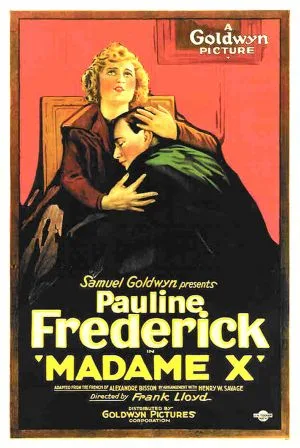
Madame X is a 1920 American silent melodrama film directed by Frank Lloyd and starring Pauline Frederick. The film is based on the 1908 play Madame X, by French playwright Alexandre Bisson, and was adapted for the screen by J.E. Nash and Frank Lloyd. A copy of this film survives in the George Eastman Museum Motion Picture Collection.
The play was previously adapted for the screen in 1916. The play has been subsequently remade several times.
Contents
Plot
As described in a film magazine, jealous husband Louis Floriot, refusing to forgive his wife Jacqueline for fleeing from his wrath and living with the friend who presses his attentions on her, forces her into the life of a derelict. Twenty years later she returns to France from Buenos Aires believing that her son Raymond has died. Laroque, a crook who aids her in her return to France, learns that she is married to a man of wealth, and tries, with the help of his two associates M. Robert Parissard and M. Merival, to get possession of a fortune that rightfully belonged to Jacqueline. To protect her husband from violence, Jacqueline kills Laroque and, accused of murder, is brought to trial. Refusing to confer with her counsel and preferring death to freedom, during the course of the trial she receives the shocking revelation that the defendant attorney is her son Raymond. The tragic story ends with the reunion of the two and the death of the miserable mother.
Cast
Pauline Frederick as Jacqueline Floriot
William Courtleigh as Louis Floriot
Casson Ferguson as Raymond Floriot
Maude Louis as Rose Dubois (as Maud Louis)
Hardee Kirkland as Dr. Chessel
Alan Roscoe as Cesaire Noel
John Hohenvest as M. Valmorin
Correan Kirkham as Helene Valmorin
Sidney Ainsworth as Laroque
Lionel Belmore as M. Robert Parissard
Willard Louis as M. Merival
Cesare Gravina as Victor
Maude George as Marie
Censorship
It was common at that time for American state film censorship boards to require cuts in films for reasons of morality or to promote the common good. One noted cut in this film required by the Pennsylvania film board was in a scene with Jesus and the woman taken in adultery where an intertitle card with a New Testament verse on sin and casting stones was removed.
Critical assessment
Film historian and biographer Higham, Charles reports that “Frank Lloyd’s best silent film was Madame X (1920), [demonstrating] his polished craftsmanship and advanced control of the language of physical gesture.”:
“Lloyd's direction turned Madame X into a masterpiece of commercial cinema. In the first place, he ensures that every minute detail of French life, the diplomat’s mansion, the shoddy apartment where Madame X (Pauline Frederick) resides, the Hall of Justice, is perfection itself. And there is the matchless command of film pacing, the brilliant use of the
iris, the unerring cutting, the pitiless precision of observation. Instead of being a novelette, the film is the equivalent of a Zola novel...In the silent period, only Erich von Stroheim’s Greed (1924) surpassed the physical detail of this creation.”