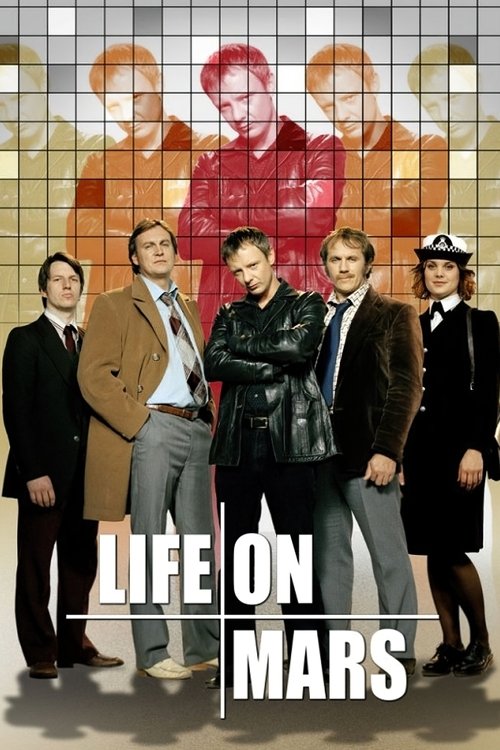
Themes and storyline
After the premiere, each of the remaining fifteen episodes begins with a short teaser before a monologue in which Sam repeats, as part of the moving imagery of the title sequence:
My name is Sam Tyler. I had an accident and I woke up in 1973. Am I mad, in a coma, or back in time? Whatever's happened, it's like I've landed on a different planet. Now, maybe if I can work out the reason, I can get home.
This questioning is a central plot device throughout the series, displaying both the character's and the audience's uncertainty about what has happened.
Throughout the course of Life on Mars, Sam's uncertainty is reinforced by frequent paranormal phenomena, such as hearing voices and seeing images from 2006 on radios, telephones, and televisions. The voices discuss his medical condition, leading him to partially believe that he is in a coma. Other elements suggest to him that he is insane, such as his frequent and unexpected encounters with the Test Card Girl from Test Card F, who speaks directly to him. Annie Cartwright partially persuades Sam that he is truly in 1973, arguing that his mind would be unable to fabricate the amount of detail and tangibility in the world where he finds himself, evidence that he is in fact in 1973.
Sam's uncertain situation is not the focal point of most episodes, remaining a sub-plot. In most episodes, the main plot centres on a particular crime or case relating to the police, such as drug trafficking, a hostage situation, murders and robberies. For this reason, most episodes follow a conventional police drama format. As the series progresses, Sam focuses on how he will get home in almost every episode.
A recurring motif throughout the series is the overlapping of the past and present. For example, during Series 1: Episode 6 Sam hears the voice of his mother in 2006, telling him his life-support will be switched off at 2:00 pm. At the same time he is called into a hostage-taking situation, where the perpetrator states that he will kill his victims at precisely the same hour. Sam also encounters as their younger selves people whom he knows in the future, including suspects, friends, his own parents, and himself as a child.
Sam comes from an era in which suspects' rights and the preservation of forensic evidence are stringently observed. His background leads Sam into conflict, as other characters exhibit openly sexist, homophobic, and racist behaviour, and often indulge all these prejudices while carrying out their police duties.
The series frequently makes use of Gene Hunt's comical rudeness in the form of jokes and dramatic irony about a future which the audience already knows, but which the characters in 1973 do not. For example, in Series 1: Episode 5, Hunt declares, "There will never be a woman prime minister as long as I have a hole in my arse." However, in line with the ambivalence of the Hunt character, the irony is qualified by the fact that, in the real 1973, Margaret Thatcher herself told the BBC's Valerie Singleton in an interview, "I don't think there will be a woman Prime Minister in my lifetime." The clip of this remark had often been replayed on British TV and the audience would be familiar with it.
Another theme in the show is Sam's confusion about police work in 1973, as he often mistakenly mentions techniques and technologies that were not used in 1973, such as two-way mirrors. One such theme is that Sam continually gives criminals the updated version of the right to silence warning, which was changed in 1994. When he does so, someone around him usually points out that he is giving the warning incorrectly.