Anime
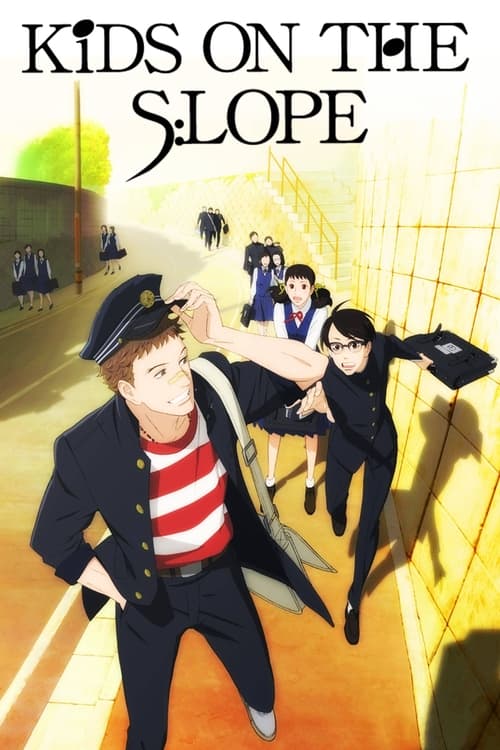
An anime adaptation of Kids on the Slope produced by MAPPA in association with Tezuka Productions was released in 2012. It was the first anime series produced by MAPPA, which was founded by Masao Maruyama in 2011 after his departure from the studio Madhouse. Maruyama co-founded Madhouse in 1972, and approached Shinichirō Watanabe to direct Kids on the Slope on the basis of their previous work at Madhouse together. Watanabe spent the three years prior to the release of Kids on the Slope developing projects for Madhouse that ultimately stalled in planning phases or were cancelled, leading Maruyama to offer Watanabe the series to direct "as something to do." The series was heralded as a "triumphant return to the mainstream" for Watanabe following a seven-year hiatus from directing anime, which spanned from the conclusion of his previous series Samurai Champloo in 2005.
Kids on the Slope was Watanabe's first anime series adapted from an existing work, rather than based on an original concept. Maruyama stated that Watanabe initially resisted the prospect of creating an adaptation and expressed concerns over a lack of creative freedom, but agreed after learning that the series was about jazz (music frequently forms a core element of Watanabe's works), and after Kids on the Slope network Fuji TV agreed to greenlight his subsequent anime series Terror in Resonance. After reading the original Kids on the Slope manga, Watanabe noted that while jazz music forms the basis of the story, he was interested in its approach to plot and characterization, particularly "the kind of way that it portrays emotional distance." Upon learning that Watanabe was developing a new anime series, composer Yoko Kanno asked to be involved in its production. While Kanno has stated that she is not a fan of jazz music, she sought to be involved in Watanabe's next project after their previous collaborations on Macross Plus and Cowboy Bebop.
The primary production staff for Kids on the Slope is composed of Watanabe as director, Kanno as composer, Nobuteru Yūki as character designer, Yoshimitsu Yamashita as chief animation director, and Ayako Katō and Yūko Kakihara as scriptwriters. The series was Watanabe's first single cour series; on adapting the series with a compressed number of episodes, Watanabe noted that a manga series of Kids on the Slope's length would typically have been adapted as 15 or 16 episodes, "so trying to fit it into 12 episodes necessitated a bit of rushing."
Maruyama estimates that "about half" of the production time and budget for the series went towards creating its musical performance scenes. Though Maruyama had experience depicting musical performances in animation through his work on Beck: Mongolian Chop Squad and Forest of Piano at Madhouse, he found that "jazz performance turned out to be a huge challenge." Despite pressure to render the performance scenes as computer-generated imagery to reduce time and costs, Watanabe rendered these scenes using hand-drawn animation by utilizing motion capture: real-life musicians were filmed performing the scene's music from multiple angles, which was then edited into a single "scene" that animators used as photo reference.
Watanabe and Kanno found jazz artists to perform the series' soundtrack and motion capture by searching videos on YouTube. They sought young artists who were "rough and therefore charming," with Watanabe noting that it "would be terrible if we asked veteran studio musicians to perform it in a "young style'." Pianist Takashi Matsunaga and drummer Shun Ishiwaka were cast to record the music and motion capture for Kaoru and Sentarō, respectively.
The series' soundtrack consists of an original score and cover versions of existing jazz songs. Each episode of the series is named after a jazz standard, with the titles, lyrics, and/or music of each song typically having significance with regards to the events of the episode. As majority of the series' music consists of diegetic jazz performance, its score is minimal, with Kanno noting that Kids on the Slope is a "work built on the jazz part alone, and we'd just need music for atmosphere." While Kanno was initially told by Watanabe that she would only have to produce the score for the series, she ultimately produced both its score and jazz performances. In preparation for the series, Kanno visited jazz clubs and researched recording techniques of the 1950s and 1960s; for Kaoru and Sentarō's performance scenes, Kanno elected to record both drums and piano simultaneously (rather than record the instruments separately and later arrange them digitally, as is standard in modern music production) to emulate these recording techniques. Kanno collaborated with disc jockeys DJ Mitsu The Beats and Mabanua on the series' score, stating that she sought their involvement not to bring a contemporary "DJ sound" to the 1960s setting, but to instead capture a sense of "youth" in the music.
The series uses two pieces of theme music: its opening theme "Sakamichi no Melody" is written and performed by Yuki, while its closing theme "Altair" is written and performed by Motohiro Hata. Due to production delays, the opening sequence was animated before its music was produced; delays also forced the opening sequence to be produced by a staff that was entirely separate from the main series animation staff, a move Maruyama noted as "not something you see with anime very often."
The adaptation was announced in the December 2011 issue of Monthly Flowers. Kōji Yamamoto, the producer of Fuji TV's Noitamina programming block, confirmed that same month that the series would air on the network beginning in April. The first trailer for the series was released in January 2012, alongside an announcement of the series' production staff. The twelve-episode series aired on Noitamina from 12 April to 28 June 2012.
In English-language markets, the series is licensed by Sentai Filmworks and aired on the streaming service Crunchyroll, which simulcast the series during its original broadcast run. An English language dubbed version of the series was also produced by Sentai Filmworks; episodes aired on Anime Network and Hulu one month after streaming on Crunchyroll. Sentai Filmworks additionally produced the North American home video release of Kids on the Slope, which was released on Blu-ray and DVD on 7 May 2013. In 2014, the series aired on Viz Media's now-defunct streaming service Neon Alley. The Blu-ray was re-released on 13 April 2021. The series was first released in the United Kingdom and Ireland by MVM Films on 24 June 2013. In Australia, Hanabee released the series on 7 August 2013. Anime Limited re-released the series in the United Kingdom and Ireland with a collector's edition on 18 December 2023 and a standard edition on 17 June 2024.