




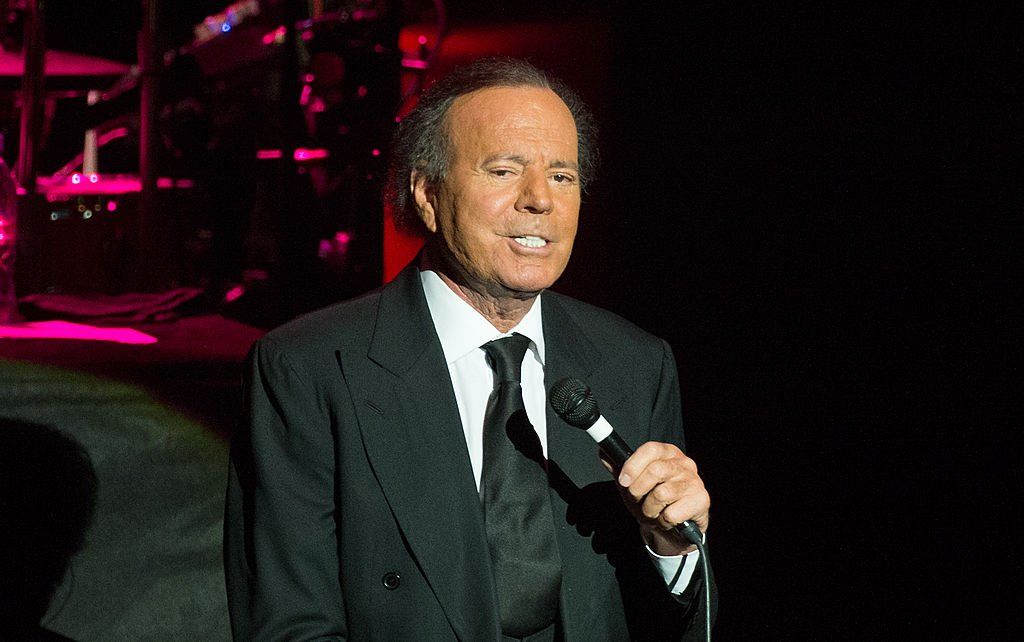
Julio José Iglesias de la Cueva (Spanish: [ˈxuljo jˈɣlesjas]; born 23 September 1943) is a Spanish singer and songwriter. Iglesias is recognized as the most commercially successful Spanish singer in the world and one of the top record sellers in music history, having sold more than 300 million records worldwide in 14 languages. It is estimated that during his career he has performed in more than 5,000 concerts, for over 60 million people in six continents. In April 2013, Iglesias was inducted into the Latin Songwriters Hall of Fame.
In 1983, Iglesias was credited as having recorded songs in the most languages in the world, and in 2013 for being the best-selling male Latin artist of all-time. In April 2013 in Beijing, he was honoured as the most popular international artist in China. In Brazil, France, Italy and elsewhere, Iglesias is the most successful foreign record seller, while in his home country, Spain, he has sold the most records in history, with 23 million records.
During his career, Iglesias has won many awards in the music industry, including a Grammy, Latin Grammy, World Music Award, Billboard Music Award, American Music Award and Lo Nuestro Award. He has been awarded the Gold Medal for Merit in the Fine Arts of Spain and the Legion of Honour of France. UNICEF named him Special Ambassador for the Performing Arts in 1989. He has had a star on the Hollywood Walk of Fame since 1985.
Contents
Early life
Iglesias was born in Madrid to Julio Iglesias Puga, a medical doctor from Ourense who became one of the youngest gynecologists in the country, and María del Rosario de la Cueva y Perignat. His paternal grandparents, Manuela Puga Noguerol and Ulpiano Iglesias Sarria, were of Galician ancestry. His maternal grandparents were José de la Cueva y Orejuela and Dolores de Perignat y Ruiz de Benavides, who was a native of Guayama, Puerto Rico.
The name "Iglesias" translates as "churches". Iglesias says that he is of Jewish ancestry on his maternal side, and that his mother's family name, "de la Cueva", meaning literally "of the cave" and referring to Jewish people in hiding, is a common Jewish name.
He alternated playing professional football with studying law at the CEU San Pablo University in Madrid. In his youth, he was a goalkeeper for Real Madrid Castilla in the Segunda División. His professional football career was ruined when he was involved in a serious automobile accident in 1963 that left him unable to walk for two years. The accident smashed his lower spine and left his legs permanently weakened and requiring therapy for several years. He has said of those years, "I had more courage and attitude than talent". While he was in hospital after the accident, a nurse named Eladio Magdaleno gave him a guitar so that he could recover the dexterity of his hands. In learning to play, he discovered his musical talent. After his rehabilitation, Iglesias studied for three months at Bell Educational Trust's Language School in Cambridge, England. In 2001, he returned to obtain his law degree at Complutense University of Madrid.
Entertainment career
In 1968, he won the Benidorm Song Festival with the song "La vida sigue igual" (meaning "Life Goes on the Same") which was used in the 1969 film La vida sigue igual in which he played a fictionalized version of his own life. He then signed a deal with Discos Columbia, the Spanish branch of the Columbia Records company, and released his first studio album, titled Yo Canto. The album spent 15 weeks in the Spanish charts and peaked at No. 3. He represented Spain in the Eurovision Song Contest 1970 with the song "Gwendolyne", finishing in fourth place. Shortly after, he had a number one hit in many European countries with "Un canto a Galicia", sung in Galician, in honour of his father, who hailed from Galicia. That single sold one million copies in Germany. In 1975, he found success in the Italian market by recording a song exclusively in Italian, called "Se mi lasci non vale". Notable albums from this decade are A flor de piel (1974, with the European hit "Manuela"), El amor (1975), and Soy (1973). He also sang in French: one of his popular songs in this language became "Je n'ai pas changé".
In 1979, he moved to Miami, in the United States, signed a deal with CBS International, and started singing in different languages such as French, Italian, Portuguese, and German. Two years later, he released the album De niña a mujer, which he dedicated to his daughter Chabeli, who appeared on the cover with him. From it came the first English-language hit of his career, a cover of "Begin the Beguine" that became number 1 in the United Kingdom; he also released a collection, Julio (1983).
In 1984, he released 1100 Bel Air Place, the hit album which established him as a star in the English-speaking entertainment industry. It sold over three million albums in the United States alone. The first single, "To All the Girls I've Loved Before", a duet with Willie Nelson, hit No. 1 on the Country charts and went Top Five in the Billboard Hot 100. It also featured "All of You", in vocal duet with Diana Ross, a Top Twenty Pop hit, that climbed to No. 2 on the Adult Contemporary Chart with the help of a popular video. He also covered "The Air That I Breathe", written by Albert Hammond and popularized by The Hollies, on this album; Iglesias's version featured vocals from The Beach Boys.
Iglesias won a Grammy Award for Best Latin Pop Album in the 1988 Grammy Awards for the album Un hombre solo ("A Man Alone"). In that year, he recorded a duet with Stevie Wonder, "My Love", in his Non Stop album, a crossover success in 1988.
Personal life
On 29 January 1971, Iglesias married Isabel Preysler, a Filipina television host. Preysler, a Filipina of Spanish ancestry, was also a member of the wealthy and aristocratic Pérez de Tagle family. The couple had three children: Chábeli (born 3 September 1971), a socialite; Julio Jr. (born 25 February 1973), a singer; and Enrique (born 8 May 1975), an internationally successful singer-songwriter, actor, and record producer. In the 1970s, Iglesias and his family were extensively depicted on the front pages of international newspapers and magazines. The marriage ended in divorce in 1979. The couple also applied for marriage annulment by the Catholic Church which was granted in 1980.
Whenever Iglesias was not on tour, he spent his time at his Miami residence, purchased in 1978 for $650,000. The mansion on the private Indian Creek Island, whose interior design was made by Virginia Sipl, was placed on the market in 2006 for a quoted $28 million, making it one of the "Ten Most Expensive Homes in the South" in 2006 according to Forbes magazine.
After his divorce, Iglesias lived with Dutch model Miranda Rijnsburger, 22 years his junior, whom he married on 26 August 2010 in a small church in Marbella, Spain. They had five children: Miguel Alejandro Iglesias (born 7 September 1997), Rodrigo Iglesias (born 3 April 1999), twins Cristina and Victoria Iglesias (born 1 May 2001), and Guillermo Iglesias (born 5 May 2007). They took up residence in the Dominican Republic, where Iglesias had acquired several hotel complexes, as well as the Punta Cana International Airport, which he acquired jointly with other investors, including fashion designer Oscar de la Renta.
On 19 December 2005, Iglesias's father died of a heart attack at the age of 90. A week before his father's death, it became known that Ronna Keitt, his father's 42-year-old wife, was pregnant with their second child. Their first child, Jaime, had been born on 18 May 2004. The second child, Ruth, was born on 26 July 2006.
In 2008, after his house in Indian Creek did not sell at his asking price, he ordered it razed and said he planned to build another on the lot. In 2012, he purchased the property next door for $15 million and announced that he planned to build a new home on the combined properties. In 2020, he agreed to sell it to Jared Kushner and his wife Ivanka Trump, a daughter of U.S. President Donald Trump.
Honours and awards
Honours
Gold Medal of Merit in the Fine Arts
Gold Medal of the Community of Madrid
France
Knight of the Legion of Honour
Medal of the City of Paris
Collaborations on Other Artists' Albums
Without a Song by Willie Nelson (1983), song: "As Time Goes By"
Voces unidas by various artists (1985), song: "Cantaré, cantarás"
Suspiros de España by Manolo Escobar (1987), song: "Un canto a Galicia"
What a Wonderful World by Willie Nelson (1988), song: "Spanish Eyes"
Soñadores de España by Plácido Domingo (1989), song: "Soñadores de España"
Homenaje by Lola Flores (1990), song: "Somos dos caminantes"
Piel de hombre by José Luis Rodríguez "El Puma" (1992), song: "Torero"
La distancia by Simone Bittencourt de Oliveira (1993), song: "Brigas"
Duets by Frank Sinatra (1993), song: "Summer Wind"
Mar adentro by Donato y Estéfano (1995), song: "Naturaleza"
Voces unidas by various artists (1996), song: "Puedes llegar..."
Amigos by Paul Anka (1996), song: "A mi manera (My Way)"
Desde que tú te has ido by Cecilia (posthumous release, 1996), song: "Un ramito de violetas"
Nana latina by Nana Mouskouri (1996), song: "Sé que volverás"
...Y Amigos by Raúl di Blasio (1998), song: "Uno"
Videography
Julio Iglesias en España (1989, 57 minutes), recorded in Spain (1988)
Julio Iglesias en América (1990, 58 minutes)
Julio Iglesias Tournée 88 (1989, 50 minutes)
Starry Night (1991, 78 minutes)
Julio Iglesias: Mis personajes favoritos (1992, 30 minutes)
Julio Iglesias Rediscovered (2002, 50 minutes)
Julio Iglesias in Jerusalem (2003, 50 minutes)