




John Sidney McCain III (August 29, 1936 – August 25, 2018) was an American politician and naval officer who represented Arizona in the United States Congress for over 35 years, first as a U.S. representative from 1983 to 1987, then as a U.S. senator from 1987 until his death in 2018. A member of the Republican Party, he was the party's nominee in the 2008 presidential election.
Born into the prominent McCain family in the Panama Canal Zone, McCain graduated from the U.S. Naval Academy in 1958 and received a commission in the U.S. Navy. He became a naval aviator and flew ground-attack aircraft from aircraft carriers. During the Vietnam War, he almost died in the 1967 USS Forrestal fire. While on a bombing mission during Operation Rolling Thunder over Hanoi in October 1967, McCain was shot down, seriously injured, and captured by the North Vietnamese. He was a prisoner of war until 1973. McCain experienced episodes of torture and refused an out-of-sequence early release. He sustained wounds that left him with lifelong physical disabilities. McCain retired from the Navy as a captain in 1981 and moved to Arizona.
In 1982, McCain was elected to the House of Representatives, where he served two terms. Four years later, he was elected to the Senate, where he served six terms. While generally adhering to conservative principles, McCain also gained a reputation as a "maverick" for his willingness to break from his party on certain issues, including LGBT rights, gun regulations, and campaign finance reform where his stances were more moderate than those of the party's base. McCain was investigated and largely exonerated in a political influence scandal of the 1980s as one of the Keating Five. He then made regulating the financing of political campaigns one of his signature concerns, which eventually resulted in the passage of the McCain–Feingold Act in 2002. With Russ Feingold, McCain would receive the 1999 John F. Kennedy Profile in Courage Award. He was also known for his work in the 1990s to restore diplomatic relations with Vietnam. McCain chaired the Senate Commerce Committee from 1997 to 2001 and 2003 to 2005, where he opposed pork barrel spending and earmarks. He belonged to the bipartisan "Gang of 14", which played a key role in alleviating a crisis over judicial nominations.
McCain entered the race for the 2000 Republican presidential nomination, but lost a heated primary season contest to George W. Bush. He secured the 2008 Republican presidential nomination, beating fellow candidates Mitt Romney and Mike Huckabee, though he lost the general election to Democratic presidential nominee Barack Obama. McCain subsequently adopted more orthodox conservative stances and attitudes and largely opposed actions of the Obama administration, especially with regard to foreign policy matters. In 2015, he became Chairman of the Senate Armed Services Committee. He refused to support Donald Trump in the 2016 presidential election and later became a vocal critic of the first Trump administration. While McCain opposed the Obama-era Affordable Care Act (ACA), he cast the deciding vote against the American Health Care Act of 2017, which would have partially repealed the ACA. After being diagnosed with glioblastoma in 2017, he reduced his role in the Senate to focus on treatment, dying from the disease in 2018.
Contents
Early life and military career (1936–1981)
Early life and education
John Sidney McCain III was born on August 29, 1936, at Coco Solo Naval Air Station in the Panama Canal Zone, to naval officer John S. McCain Jr. and Roberta Wright McCain. He had an older sister, Sandy, and a younger brother, Joe. At that time, the Panama Canal was under U.S. control.
His father and his paternal grandfather, John S. McCain Sr., were also Naval Academy graduates and both became four-star admirals in the United States Navy. In addition, his grand-uncle William A. McCain and great grand-uncle Henry Pinckney McCain served as general officers in the United States Army. The McCain family moved with their father as he took various naval postings in the United States and in the Pacific. As a result, the younger McCain attended a total of about 20 schools. In 1951, the family settled in Northern Virginia, and McCain attended Episcopal High School, a private preparatory boarding school in Alexandria. He excelled at wrestling and graduated in 1954. He referred to himself as an Episcopalian as recently as June 2007, after which date he said he came to identify as a Baptist.
Following in the footsteps of his father and grandfather, McCain entered the United States Naval Academy, where he was a friend and informal leader for many of his classmates and sometimes stood up for targets of bullying. He also fought as a lightweight boxer. He earned the nickname "John Wayne" "for his attitude and popularity with the opposite sex." McCain did well in academic subjects that interested him, such as literature and history, but studied only enough to pass subjects that gave him difficulty, such as mathematics. He came into conflict with higher-ranking personnel and did not always obey the rules. "He collected demerits the way some people collect stamps." His class rank (894 of 899) was not indicative of his intelligence nor his Intelligence quotient (IQ), which had been tested to be 128 and 133. McCain graduated in 1958.
Naval training, first marriage, and Vietnam War assignment
McCain began his early military career when he was commissioned as an ensign, and started two and a half years of training at Pensacola to become a naval aviator. While there, he earned a reputation as a man who partied. He completed flight school in 1960, and became a naval pilot of ground-attack aircraft; he was assigned to A-1 Skyraider squadrons aboard the aircraft carriers USS Intrepid and USS Enterprise in the Caribbean and Mediterranean Seas. McCain began as a sub-par flier who was at times careless and reckless; during the early to mid-1960s, two of his flight missions crashed, and a third mission collided with power lines, but he received no major injuries. His aviation skills improved over time, and he was seen as a good pilot, albeit one who tended to "push the envelope" in his flying.
On July 3, 1965, McCain was 28 when he married Carol Shepp, who had worked as a runway model and secretary. McCain adopted her two young children, Douglas (1959–2026) and Andrew (born 1962). He and Carol then had a daughter, Sidney (born 1966). The same year, he was a one-day champion on the game show Jeopardy!
McCain requested a combat assignment, and was assigned to the aircraft carrier USS Forrestal flying A-4 Skyhawks. His combat duty began in mid-1967, when Forrestal was assigned to a bombing campaign, Operation Rolling Thunder, during the Vietnam War. Stationed in the Gulf of Tonkin, McCain and his fellow pilots became frustrated by micromanagement from Washington; he later wrote, "In all candor, we thought our civilian commanders were complete idiots who didn't have the least notion of what it took to win the war."
On July 29, 1967, McCain was a lieutenant commander when he was near the center of the USS Forrestal fire. He escaped from his burning jet and was trying to help another pilot escape when a bomb exploded; McCain was struck in the legs and chest by fragments. The ensuing fire killed 134 sailors. With the Forrestal out of commission, McCain volunteered for assignment with the USS Oriskany, another carrier employed in Operation Rolling Thunder. There, he was awarded the Navy Commendation Medal and the Bronze Star Medal for missions flown over North Vietnam.
Prisoner of war
McCain was taken prisoner of war on October 26, 1967. He was flying his 23rd bombing mission over North Vietnam when his A-4E Skyhawk was shot down by a missile over Hanoi. McCain fractured both arms and a leg when he ejected from the aircraft, and nearly drowned after he parachuted into Trúc Bạch Lake. Some North Vietnamese pulled him ashore, then others crushed his shoulder with a rifle butt and bayoneted him. McCain was then transported to Hanoi's main Hỏa Lò Prison, nicknamed the "Hanoi Hilton".
Although McCain was seriously wounded and injured, his captors refused to treat him. They beat and interrogated him and he was given medical care only when the North Vietnamese discovered that his father was an admiral. His status as a prisoner of war (POW) made the front pages of major American newspapers.
McCain spent six weeks in the hospital, where he received marginal care. He had lost 50 pounds (23 kg), he was in a chest cast, and his gray hair had turned white. McCain was sent to a different camp on the outskirts of Hanoi. In December 1967, McCain was placed in a cell with two other Americans, who did not expect him to live more than a week. In March 1968, McCain was placed in solitary confinement, where he remained for two years.
In mid-1968, his father John S. McCain Jr. was named commander of all U.S. forces in the Vietnam theater, and the North Vietnamese offered McCain early release because they wanted to appear merciful for propaganda purposes, and also to show other POWs that elite prisoners were willing to be treated preferentially. Such early release was prohibited by the POWs' interpretation of the military Code of Conduct, which states in Article III: "I will accept neither parole nor special favors from the enemy." McCain refused repatriation unless every man taken in before him was also released. To prevent the enemy from using prisoners for propaganda, officers were to agree to be released in the order in which they were captured.
Beginning in August 1968, McCain was subjected to severe torture. He was bound and beaten every two hours, and he was suffering from heat exhaustion and dysentery. Further injuries brought McCain to "the point of suicide", but his preparations were interrupted by guards. Eventually, McCain made an anti-U.S. propaganda "confession". He had always felt that his statement was dishonorable, but as he later wrote: "I had learned what we all learned over there: every man has his breaking point. I had reached mine." Many U.S. POWs were tortured and maltreated to extract "confessions" and propaganda statements; virtually all eventually yielded something. McCain received two to three beatings weekly because of his continued refusal to sign additional statements.
Commanding officer, liaison to Senate, and second marriage
McCain was reunited with his family when he returned to the United States. His wife Carol had been severely injured by an automobile accident in December 1969. She was then four inches shorter, in a wheelchair or on crutches, and substantially heavier than when he had last seen her. As a returned POW, he became a celebrity of sorts.
McCain underwent treatment for his injuries that included months of physical therapy. He attended the National War College at Fort McNair in Washington, D.C., during 1973–1974. He was rehabilitated by late 1974, and his flight status was reinstated. In 1976, he became Commanding Officer of a training squadron stationed in Florida. He improved the unit's flight readiness and safety records, and won the squadron its first-ever Meritorious Unit Commendation. During this period in Florida, he had extramarital affairs, and his marriage began to falter, about which he later stated: "The blame was entirely mine".
McCain served as the Navy's liaison to the U.S. Senate beginning in 1977. In retrospect, he said that this represented his "real entry into the world of politics, and the beginning of my second career as a public servant." His key behind-the-scenes role gained congressional financing for a new supercarrier against the wishes of the Carter administration.
In April 1979, McCain met Cindy Lou Hensley, a teacher from Phoenix, Arizona, whose father had founded a large beer distributorship. They began dating, and he urged his wife, Carol, to grant him a divorce, which she did in February 1980; the uncontested divorce took effect in April 1980. The settlement included two houses and financial support for her ongoing medical treatments due to her 1969 car accident; they remained on good terms. McCain and Hensley were married on May 17, 1980, with Senators William Cohen and Gary Hart attending as groomsmen. McCain's children did not attend, and several years passed before they reconciled. John and Cindy McCain entered into a prenuptial agreement that kept most of her family's assets under her name; they kept their finances separate and filed separate income tax returns.
McCain decided to leave the Navy. It was doubtful whether he would ever be promoted to the rank of full admiral, as he had poor annual physicals and had not been given a major sea command. His chances of being promoted to rear admiral were better, but he declined that prospect, as he had already made plans to run for Congress and said he could "do more good there."
House and Senate elections and career (1982–2000)
U.S. Representative
McCain set his sights on becoming a representative because he was interested in current events, was ready for a new challenge, and had developed political ambitions. Living in Phoenix, he went to work for his new father-in-law's large Anheuser-Busch beer distributorship. As vice president of public relations at the distributorship, he gained political support among the local business community, meeting powerful figures such as banker Charles Keating Jr., real estate developer Fife Symington III (later Governor of Arizona) and newspaper publisher Darrow "Duke" Tully. In 1982, McCain ran as a Republican for an open seat in Arizona's 1st congressional district, which was being vacated by 30-year incumbent Republican John Jacob Rhodes. A newcomer to the state, McCain was termed a carpetbagger. McCain responded to a voter making that charge with what a Phoenix Gazette columnist later described as "the most devastating response to a potentially troublesome political issue I've ever heard":
Listen, pal. I spent 22 years in the Navy. My father was in the Navy. My grandfather was in the Navy. We in the military service tend to move a lot. We have to live in all parts of the country, all parts of the world. I wish I could have had the luxury, like you, of growing up and living and spending my entire life in a nice place like the First District of Arizona, but I was doing other things. As a matter of fact, when I think about it now, the place I lived longest in my life was Hanoi.
McCain won a highly contested primary election with the assistance of local political endorsements, his Washington connections, and money that his wife lent to his campaign. He then easily won the general election in the heavily Republican district.
In 1983, McCain was elected to lead the incoming group of Republican representatives, and was assigned to the House Committee on Interior Affairs. Also that year, he opposed creation of a federal Martin Luther King Jr. Day, but admitted in 2008: "I was wrong and eventually realized that, in time to give full support [in 1990] for a state holiday in Arizona."
At this point, McCain's politics were mainly in line with those of President Ronald Reagan; this included support for Reaganomics, and he was active on Indian Affairs bills. He supported most aspects of the foreign policy of the Reagan administration, including its hard-line stance against the Soviet Union and policy towards Central American conflicts, such as backing the Contras in Nicaragua. McCain opposed keeping U.S. Marines deployed in Lebanon, citing unattainable objectives, and subsequently criticized President Reagan for pulling out the troops too late; in the interim, the 1983 Beirut barracks bombing killed hundreds. McCain won re-election to the House easily in 1984, and gained a spot on the House Foreign Affairs Committee. In 1985, he made his first return trip to Vietnam, and also traveled to Chile where he met with its military junta ruler, General Augusto Pinochet.
Growing family
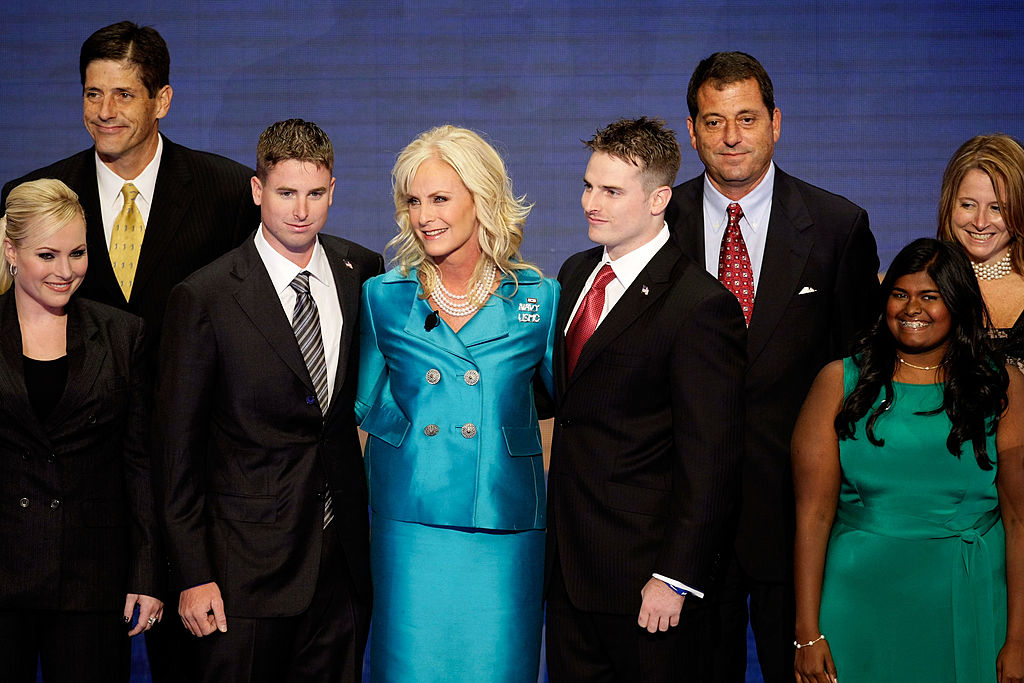
In 1984, McCain and Cindy had their first child, daughter Meghan, followed two years later by son John IV and in 1988 by son James. In 1991, Cindy brought an abandoned three-month-old girl needing medical treatment to the U.S. from a Bangladeshi orphanage run by Mother Teresa. The McCains decided to adopt her and named her Bridget.
First two terms in the U.S. Senate
McCain's Senate career began in January 1987, after he defeated his Democratic opponent, former state legislator Richard Kimball, by 20 percentage points in the 1986 election. McCain succeeded Arizona native, conservative icon, and the 1964 Republican presidential nominee Barry Goldwater upon Goldwater's retirement as U.S. senator from Arizona for 30 years. In January 1988, McCain voted in favor of the Civil Rights Restoration Act of 1987, and voted to override President Reagan's veto of that legislation the following March.
Senator McCain became a member of the Armed Services Committee, with which he had formerly done his Navy liaison work; he also joined the Commerce Committee and the Indian Affairs Committee. He continued to support the Native American agenda. As first a House member and then a senator—and as a lifelong gambler with close ties to the gambling industry—McCain was one of the main authors of the 1988 Indian Gaming Regulatory Act, which codified rules regarding Native American gambling enterprises. McCain was also a strong supporter of the Gramm–Rudman legislation that enforced automatic spending cuts in the case of budget deficits.
McCain soon gained national visibility. He delivered a well-received speech at the 1988 Republican National Convention, was mentioned by the press as a short list vice-presidential running mate for Republican nominee George H. W. Bush, and was named chairman of Veterans for Bush.
McCain became embroiled in a scandal during the 1980s, as one of five United States senators comprising the so-called Keating Five. Between 1982 and 1987, McCain had received $112,000 in lawful political contributions from Charles Keating Jr. and his associates at Lincoln Savings and Loan Association, along with trips on Keating's jets that McCain belatedly repaid, in 1989. In 1987, McCain was one of the five senators whom Keating contacted to prevent the government's seizure of Lincoln, and McCain met twice with federal regulators to discuss the government's investigation of Lincoln. In 1999, McCain said: "The appearance of it was wrong. It's a wrong appearance when a group of senators appear in a meeting with a group of regulators, because it conveys the impression of undue and improper influence. And it was the wrong thing to do." In the end, McCain was cleared by the Senate Ethics Committee of acting improperly or violating any law or Senate rule, but was mildly rebuked for exercising "poor judgment".
Start of third term in the U.S. Senate
In November 1998, McCain won re-election to a third Senate term in a landslide over his Democratic opponent, environmental lawyer Ed Ranger. In the February 1999 Senate trial following the impeachment of Bill Clinton, McCain voted to convict the president on both the perjury and obstruction of justice counts, saying Clinton had violated his sworn oath of office. In March 1999, McCain voted to approve the NATO bombing campaign against the Federal Republic of Yugoslavia, saying that the ongoing genocide of the Kosovo War must be stopped and criticizing past Clinton administration inaction. Later in 1999, McCain shared the Profile in Courage Award with Feingold for their work in trying to enact their campaign finance reform, although the bill was still failing repeated attempts to gain cloture.
In August 1999, McCain's memoir Faith of My Fathers, co-authored with Mark Salter, was published; a reviewer observed that its appearance "seems to have been timed to the unfolding Presidential campaign." The most successful of his writings, it received positive reviews, became a bestseller, and was later made into a TV film. The book traces McCain's family background and childhood, covers his time at Annapolis and his service before and during the Vietnam War, concluding with his release from captivity in 1973. According to one reviewer, it describes "the kind of challenges that most of us can barely imagine. It's a fascinating history of a remarkable military family."
2000 presidential campaign
McCain announced his candidacy for president on September 27, 1999, in Nashua, New Hampshire, saying he was staging "a fight to take our government back from the power brokers and special interests, and return it to the people and the noble cause of freedom it was created to serve". The front-runner for the Republican nomination was Texas Governor George W. Bush, who had the political and financial support of most of the party establishment, whereas McCain was supported by many moderate Republicans and some conservative Republicans.
McCain focused on the New Hampshire primary, where his message appealed to independents. He traveled on a campaign bus called the Straight Talk Express. He held many town hall meetings, answering every question voters asked, in a successful example of "retail politics", and he used free media to compensate for his lack of funds. One reporter later recounted that, "McCain talked all day long with reporters on his Straight Talk Express bus; he talked so much that sometimes he said things that he shouldn't have, and that's why the media loved him." On February 1, 2000, he won New Hampshire's primary with 49 percent of the vote to Bush's 30 percent. The Bush campaign and the Republican establishment feared that a McCain victory in the crucial South Carolina primary might give his campaign unstoppable momentum.
The Arizona Republic wrote that the McCain–Bush primary contest in South Carolina "has entered national political lore as a low-water mark in presidential campaigns", while The New York Times called it "a painful symbol of the brutality of American politics". A variety of interest groups, which McCain had challenged in the past, ran negative ads. Bush borrowed McCain's earlier language of reform, and declined to dissociate himself from a veterans activist who accused McCain (in Bush's presence) of having "abandoned the veterans" on POW/MIA and Agent Orange issues.
Incensed, McCain ran ads accusing Bush of lying and comparing the governor to Bill Clinton, which Bush said was "about as low a blow as you can give in a Republican primary". An anonymous smear campaign began against McCain, delivered by push polls, faxes, e-mails, flyers, and audience plants. The smears claimed that McCain had fathered a black child out of wedlock (the McCains' dark-skinned daughter was adopted from Bangladesh), that his wife Cindy was a drug addict, that he was a homosexual, and that he was a "Manchurian Candidate" who was either a traitor or mentally unstable from his POW days. The Bush campaign strongly denied any involvement with the attacks.
Senate career (2000–2008)
Remainder of third Senate term
McCain began 2001 by breaking with the new administration on a number of matters, including HMO reform, climate change, and gun control legislation; McCain–Feingold was opposed by Bush as well. In May 2001, McCain was one of only two Senate Republicans to vote against the Bush tax cuts. Besides the differences with Bush on ideological grounds, there was considerable antagonism between the two remaining from the previous year's campaign. When a Republican senator, Jim Jeffords, became an Independent, thereby throwing control of the Senate to the Democrats, McCain defended Jeffords against "self-appointed enforcers of party loyalty". Indeed, there was speculation at the time, and in years since, about McCain himself leaving the Republican Party, but McCain had always adamantly denied that he ever considered doing so. Beginning in 2001, McCain used political capital gained from his presidential run, as well as improved legislative skills and relationships with other members, to become one of the Senate's most influential members.
After the September 11 attacks in 2001, McCain supported Bush and the U.S.-led war in Afghanistan. He and Democratic senator Joe Lieberman wrote the legislation that created the 9/11 Commission, while he and Democratic senator Fritz Hollings co-sponsored the Aviation and Transportation Security Act that federalized airport security.
In March 2002, McCain–Feingold, officially known as the Bipartisan Campaign Reform Act of 2002, passed in both Houses of Congress and was signed into law. It was McCain's greatest legislative achievement.
Meanwhile, in discussions over proposed U.S. action against Iraq, McCain was a strong supporter of the Bush administration's position. He stated that Iraq was "a clear and present danger" to the U.S., and voted for the Iraq War Resolution in October 2002. He predicted that U.S. forces would be treated as liberators by many Iraqi people. In May 2003, McCain voted against the second round of Bush tax cuts, saying it was unwise at a time of war. By November 2003, after a trip to Iraq, he was publicly questioning Secretary of Defense Donald Rumsfeld, saying that more U.S. troops were needed; the following year, McCain announced that he had lost confidence in Rumsfeld.
In October 2003, McCain and Lieberman co-sponsored the Climate Stewardship Act that would have introduced a cap and trade system aimed at returning greenhouse gas emissions to 2000 levels; the bill was defeated with 55 votes to 43 in the Senate. They reintroduced modified versions of the Act two additional times, for the final time in January 2007 with the co-sponsorship of Barack Obama, among others.
Start of fourth Senate term
In May 2005, McCain led the so-called Gang of 14 in the Senate, which established a compromise that preserved the ability of senators to filibuster judicial nominees, but only in "extraordinary circumstances". The compromise took the steam out of the filibuster movement, but some Republicans remained disappointed that the compromise did not eliminate filibusters of judicial nominees in all circumstances. McCain subsequently cast Supreme Court confirmation votes in favor of John Roberts and Samuel Alito, calling them "two of the finest justices ever appointed to the United States Supreme Court."
Breaking from his 2001 and 2003 votes, McCain supported the Bush tax cut extension in May 2006, saying not to do so would amount to a tax increase. Working with Democratic Senator Ted Kennedy, McCain was a strong proponent of comprehensive immigration reform, which would involve legalization, guest worker programs, and border enforcement components. The Secure America and Orderly Immigration Act was never voted on in 2005, while the Comprehensive Immigration Reform Act of 2006 passed the Senate in May 2006 but failed in the House. In June 2007, President Bush, McCain, and others made the strongest push yet for such a bill, the Comprehensive Immigration Reform Act of 2007, but it aroused intense grassroots opposition among talk radio listeners and others, some of whom furiously characterized the proposal as an "amnesty" program, and the bill twice failed to gain cloture in the Senate.
By the middle of the 2000s (decade), the increased Indian gaming that McCain had helped bring about was a $23 billion industry. He was twice chairman of the Senate Indian Affairs Committee, in 1995–1997 and 2005–2007, and his Committee helped expose the Jack Abramoff Indian lobbying scandal. By 2005 and 2006, McCain was pushing for amendments to the Indian Gaming Regulatory Act which would have limited creation of off-reservation casinos, and also limited the movement of tribes across state lines to build casinos.
Owing to his time as a POW, McCain was recognized for his sensitivity to the detention and interrogation of detainees in the war on terror. An opponent of the Bush administration's use of torture and detention without trial at Guantánamo Bay, saying: "some of these guys are terrible, terrible killers and the worst kind of scum of humanity. But, one, they deserve to have some adjudication of their cases ... even Adolf Eichmann got a trial". In October 2005, McCain introduced the McCain Detainee Amendment to the Defense Appropriations bill for 2005, and the Senate voted 90–9 to support the amendment. It prohibits inhumane treatment of prisoners, including prisoners at Guantánamo, by confining military interrogations to the techniques in the U.S. Army Field Manual on Interrogation. Although Bush had threatened to veto the bill if McCain's amendment was included, the President announced in December 2005 that he accepted McCain's terms and would "make it clear to the world that this government does not torture and that we adhere to the international convention of torture, whether it be here at home or abroad". This stance, among others, led to McCain being named by Time magazine in 2006 as one of America's 10 Best Senators. McCain voted in February 2008 against a bill containing a ban on waterboarding, which provision was later narrowly passed and vetoed by Bush. However, the bill in question contained other provisions to which McCain objected, and his spokesman stated: "This wasn't a vote on waterboarding. This was a vote on applying the standards of the [Army] field manual to CIA personnel."
2008 presidential campaign
McCain formally announced his intention to run for President of the United States on April 25, 2007, in Portsmouth, New Hampshire. He stated that: "I'm not running for president to be somebody, but to do something; to do the hard but necessary things, not the easy and needless things."
McCain's oft-cited strengths as a presidential candidate for 2008 included national name recognition, sponsorship of major lobbying and campaign finance reform initiatives, his ability to reach across the aisle, his well-known military service and experience as a POW, his experience from the 2000 presidential campaign, and an expectation that he would capture Bush's top fundraisers. During the 2006 election cycle, McCain had attended 346 events and helped raise more than $10.5 million on behalf of Republican candidates. McCain also became more willing to ask business and industry for campaign contributions, while maintaining that such contributions would not affect any official decisions he would make. Despite being considered the front-runner for the nomination by pundits as 2007 began, McCain was in second place behind former Mayor of New York City Rudy Giuliani in national Republican polls as the year progressed.
McCain had fundraising problems in the first half of 2007, due in part to his support for the Comprehensive Immigration Reform Act of 2007, which was unpopular among the Republican base electorate. Large-scale campaign staff downsizing took place in early July, but McCain said that he was not considering dropping out of the race. Later that month, the candidate's campaign manager and campaign chief strategist both departed. McCain slumped badly in national polls, often running third or fourth with 15 percent or less support.
The Arizona senator subsequently resumed his familiar position as a political underdog, riding the Straight Talk Express and taking advantage of free media such as debates and sponsored events. By December 2007, the Republican race was unsettled, with none of the top-tier candidates dominating the race and all of them possessing major vulnerabilities with different elements of the Republican base electorate. McCain was showing a resurgence, in particular with renewed strength in New Hampshire—the scene of his 2000 triumph—and was bolstered further by the endorsements from The Boston Globe, the New Hampshire Union Leader, and almost two dozen other state newspapers, as well as from Senator Lieberman (now an Independent Democrat). McCain decided not to campaign significantly in the January 3, 2008, Iowa caucuses, which saw a win by former Governor of Arkansas Mike Huckabee.
Senate career after 2008
Remainder of fourth Senate term
Following his defeat, McCain returned to the Senate amid varying views about what role he might play there. McCain indicated that he intended to run for re-election to his Senate seat in 2010. As the inauguration neared, Obama consulted with McCain on a variety of matters, to an extent rarely seen between a president-elect and his defeated rival, and President Obama's inauguration speech contained an allusion to McCain's theme of finding a purpose greater than oneself.
Nevertheless, McCain emerged as a leader of the Republican opposition to the Obama economic stimulus package of 2009, saying it incorporated federal policy changes that had nothing to do with near-term job creation and would expand the growing federal budget deficit. McCain also voted against Obama's Supreme Court nomination of Sonia Sotomayor—saying that while undeniably qualified, "I do not believe that she shares my belief in judicial restraint"—and by August 2009 was siding more often with his Republican Party on closely divided votes than ever before in his senatorial career. McCain reasserted that the War in Afghanistan was winnable and criticized Obama for a slow process in deciding whether to send additional troops there.
McCain also harshly criticized Obama for scrapping construction of the U.S. missile defense complex in Poland, declined to enter negotiations over climate change legislation similar to what he had proposed in the past, and strongly opposed the Obama health care plan. McCain led a successful filibuster of a measure that would allow repeal of the military's "Don't ask, don't tell" policy towards gays. Factors involved in McCain's new direction included Senate staffers leaving, a renewed concern over national debt levels and the scope of federal government, a possible Republican primary challenge from conservatives in 2010, and McCain's campaign edge being slow to wear off. As one longtime McCain advisor said, "A lot of people, including me, thought he might be the Republican building bridges to the Obama Administration. But he's been more like the guy blowing up the bridges."
In early 2010, a primary challenge from radio talk show host and former U.S. Congressman J. D. Hayworth materialized in the Senate election in Arizona and drew support from some but not all elements of the Tea Party movement. With Hayworth using the campaign slogan "The Consistent Conservative", McCain said—despite his own past use of the term on a number of occasions—"I never considered myself a maverick. I consider myself a person who serves the people of Arizona to the best of his abilities." The primary challenge coincided with McCain reversing or muting his stance on some issues such as the bank bailouts, closing of the Guantánamo Bay detention camp, campaign finance restrictions, and gays in the military.
Fifth Senate term
While control of the House of Representatives went over to the Republicans in the 112th Congress, the Senate stayed Democratic and McCain continued to be the ranking member of the Senate Armed Services Committee. As the Arab Spring took center stage, McCain urged that the embattled Egyptian president, Hosni Mubarak, step down and thought the U.S. should push for democratic reforms in the region despite the associated risks of religious extremists gaining power. McCain was an especially vocal supporter of the 2011 military intervention in Libya. In April of that year he visited the Anti-Gaddafi forces and National Transitional Council in Benghazi, the highest-ranking American to do so, and said that the rebel forces were "my heroes". In June, he joined with Senator Kerry in offering a resolution that would have authorized the military intervention, and said: "The administration's disregard for the elected representatives of the American people on this matter has been troubling and counterproductive." In August, McCain voted for the Budget Control Act of 2011 that resolved the U.S. debt ceiling crisis. In November, McCain and Senator Carl Levin were leaders in efforts to codify in the National Defense Authorization Act for Fiscal Year 2012 that terrorism suspects, no matter where captured, could be detained by the U.S. military and its tribunal system; following objections by civil libertarians, some Democrats, and the White House, McCain and Levin agreed to language making it clear that the bill would not pertain to U.S. citizens. He continued to oppose the use of torture: It is difficult to overstate the damage that any practice of torture or cruel, inhuman, and degrading treatment by Americans does to our national character and historical reputation—to our standing as an exceptional nation among the countries of the world. It is too grave to justify the use of these interrogation techniques. America has made its progress in the world not only by avidly pursuing our geopolitical interests, but by persuading and inspiring other nations to embrace the political values that distinguish us. As I have already said many times and still maintain, this is not about the terrorists. It is about us.
In the 2012 Republican Party presidential primaries, McCain endorsed former 2008 rival Mitt Romney and campaigned for him, but compared the contest to a Greek tragedy due to its drawn-out nature with massive super PAC-funded attack ads damaging all the contenders. He labeled the Supreme Court's 2010 Citizens United v. Federal Election Commission decision as "uninformed, arrogant, naïve", and, decrying its effects and the future scandals he thought it would bring, said it would become considered the court's "worst decision ... in the 21st century". McCain took the lead in opposing the defense spending sequestrations brought on by the Budget Control Act of 2011 and gained attention for defending State Department aide Huma Abedin against charges brought by a few House Republicans that she had ties to the Muslim Brotherhood.
Sixth and final Senate term
McCain chaired the January 5, 2017, hearing of the Senate Armed Services Committee where Republican and Democratic senators and intelligence officers, including James R. Clapper Jr., the Director of National Intelligence, Michael S. Rogers, the head of the National Security Agency and United States Cyber Command presented a "united front" that "forcefully reaffirmed the conclusion that the Russian government used hacking and leaks to try to influence the presidential election."
McCain visited the American missile destroyer USS John S McCain, which docked in Vietnam on 2 June 2017.
In June 2017, McCain voted to support President Trump's controversial arms deal with Saudi Arabia.
Repeal and replacement of Obamacare was a centerpiece of McCain's 2016 re-election campaign, and in July 2017, he said, "Have no doubt: Congress must replace Obamacare, which has hit Arizonans with some of the highest premium increases in the nation and left 14 of Arizona's 15 counties with only one provider option on the exchanges this year."
In September 2017, as the Rohingya crisis in Myanmar became ethnic cleansing of the Rohingya Muslim minority, McCain announced moves to scrap planned future military cooperation with Myanmar.
In October 2017, McCain praised President Trump's decision to decertify Iran's compliance with the Iran nuclear deal (JCPOA) while not yet withdrawing the U.S. from the agreement, saying that the Obama-era policy failed "to meet the multifaceted threat Iran poses. The goals President Trump presented in his speech today are a welcomed long overdue change."
On July 14, 2017, McCain underwent a minimally invasive craniotomy at Mayo Clinic Hospital in Phoenix, Arizona, to remove a blood clot above his left eye. His absence prompted Senate Majority Leader Mitch McConnell to delay a vote on the Better Care Reconciliation Act. Five days later, Mayo Clinic doctors announced the presence of a glioblastoma, which is a very aggressive cancerous brain tumor. Even with treatment, average survival time is approximately 14 months. McCain was a survivor of previous cancers, including melanoma.
Committee assignments
Committee on Armed Services (Chair)
as chair of the full committee may serve as an ex officio member of any subcommittee
Committee on Homeland Security and Governmental Affairs
Permanent Subcommittee on Investigations
Subcommittee on Financial and Contracting Oversight
Committee on Indian Affairs
Committee on Intelligence (ex officio)
Caucus memberships
International Conservation Caucus
Senate Diabetes Caucus
Senate National Security Caucus (Co-chair)
Sportsmen's Caucus
Senate Wilderness and Public Lands Caucus
Senate Ukraine Caucus
Republican Main Street Partnership
Death and funeral
On August 24, 2018, McCain's family announced that he would no longer receive treatment for his cancer. He died the following day at his home in Cornville, Arizona.
McCain lay in state in the Arizona State Capitol in Phoenix on August 29, which would have been his 82nd birthday. This was followed by a service at North Phoenix Baptist Church on August 30. His remains were then moved to Washington, D.C., to lie in state in the United States Capitol rotunda on August 31, which was followed by a service at the Washington National Cathedral on September 1. He was a "lifelong Episcopalian" who attended, but did not join, a Southern Baptist church for at least 17 years; memorial services were scheduled in both denominations.
Prior to his death, McCain requested that former presidents George W. Bush and Barack Obama deliver eulogies at his funeral and asked that neither President Donald Trump nor his former running mate Sarah Palin attend any of the services. McCain himself planned the funeral arrangements and selected his pallbearers for the service in Washington, including former vice president and former Delaware Senator (and future president) Joe Biden, former Wisconsin Senator Russ Feingold, former Secretary of Defense William Cohen, actor Warren Beatty, and Russian dissident Vladimir Kara-Murza.
Multiple foreign leaders attended McCain's service: Secretary General of NATO Jens Stoltenberg, President of Ukraine Petro Poroshenko, Speaker of Taiwan's Congress Su Jia-chyuan, National Defense Minister of Canada Harjit Sajjan, defense minister Jüri Luik and foreign minister Sven Mikser of Estonia, Foreign Minister of Latvia Edgars Rinkēvičs, Foreign Minister of Lithuania Linas Antanas Linkevičius, and Foreign Affairs Minister of Saudi Arabia Adel al-Jubeir.
Dignitaries who gave eulogies at the Memorial Service in Washington National Cathedral included Barack Obama, George W. Bush, Henry Kissinger, Joe Lieberman, and his daughter Meghan McCain. The New Yorker described the service as the biggest meeting of anti-Trump figures during his presidency.
Those who attended the funeral included former United States presidents Barack Obama, George W. Bush, and Bill Clinton; First Ladies Michelle Obama, Laura Bush, and Hillary Clinton; and former vice presidents Joe Biden, Dick Cheney, Al Gore, and Dan Quayle. Former president Jimmy Carter and former vice president Walter Mondale did not attend; former president George H. W. Bush was too ill to attend the service; and President Trump was not invited. Other attendees included Tom Brokaw, Charlie Rose, Bob Dole, Madeleine Albright, John Kerry, Mitch McConnell, Paul Ryan, Nancy Pelosi, Chuck Schumer, Mitt Romney, Lindsey Graham, Warren Beatty, Elizabeth Warren, Jay Leno, and Kamala Harris. President Trump's daughter and son-in-law Ivanka Trump and Jared Kushner attended to the displeasure of Meghan McCain.
Political positions
Various advocacy groups have given McCain scores or grades as to how well his votes align with the positions of each group. CrowdPac, which rates politicians based on donations made and received, gave Senator McCain a score of 4.3C with 10C being the most conservative and 10L being the most liberal.
The non-partisan National Journal rates a Senator's votes by what percentage of the Senate voted more liberally than them, and what percentage more conservatively, in three policy areas: economic, social, and foreign. For 2005–2006 (as reported in the 2008 Almanac of American Politics), McCain's average ratings were as follows: economic policy: 59 percent conservative and 41 percent liberal; social policy: 54 percent conservative and 38 percent liberal; and foreign policy: 56 percent conservative and 43 percent liberal. In 2012, the National Journal gave McCain a composite score of 73 percent conservative and 27 percent liberal, while in 2013 he received a composite score of 60 percent conservative and 40 percent liberal.
Columnists such as Robert Robb and Matthew Continetti used a formulation devised by William F. Buckley Jr. to describe McCain as "conservative" but not "a conservative", meaning that while McCain usually tended towards conservative positions, he was not "anchored by the philosophical tenets of modern American conservatism". Following his 2008 presidential election loss, McCain began adopting more orthodox conservative views; the magazine National Journal rated McCain along with seven of his colleagues as the "most conservative" Senators for 2010 and he achieved a 100 percent rating from the American Conservative Union for that year. During Barack Obama's presidency, McCain was one of the top five Republicans most likely to vote with Obama's position on significant votes; McCain voted with Obama's position on such votes more than half the time in 2013 and was "censured by the Arizona Republican party for a so-called 'liberal' voting record".
From the late 1990s until 2008, McCain was a board member of Project Vote Smart which was set up by Richard Kimball, his 1986 Senate opponent. The project provides non-partisan information about the political positions of McCain and other candidates for political office. Additionally, McCain used his Senate website to describe his political positions.
In his 2008 speech to the CPAC McCain stated that he believed in "small government; fiscal discipline; low taxes; a strong defense, judges who enforce, and not make, our laws; the social values that are the true source of our strength; and, generally, the steadfast defense of our rights to life, liberty and the pursuit of happiness."
Cultural and political image
McCain's personal character was a dominant feature of his public image. This image includes the military service of both himself and his family, the circumstances and tensions surrounding the end of his first marriage and beginning of his second, his maverick political persona, his temper, his admitted problem of occasional ill-considered remarks, and his close ties to his children from both his marriages. Perhaps the most egregious of McCain's "occasional ill-considered remarks" was his widely condemned 2000 comment that, "I hate the gooks. I will hate them as long as I live." Although McCain claimed he was referring only to his captors and guards, his comments were poorly received by the Asian-American community. His use of a racial slur was also seen as a continuation of a long history of anti-Asian sentiment in America. In his years as a Senator, McCain took more than 20 trips to Vietnam, repeatedly visiting the place of his captivity. After his death, former Vietnamese ambassador to the United States Phạm Quang Vinh described him as "a great friend to Vietnam."
McCain's political appeal was more nonpartisan and less ideological compared to many other national politicians. His stature and reputation stemmed partly from his service in the Vietnam War. He also carried physical vestiges of his war wounds, as well as his melanoma surgery. When campaigning, he quipped: "I am older than dirt and have more scars than Frankenstein."
Writers often extolled McCain for his courage not just in war but in politics, and wrote sympathetically about him. McCain's shift of political stances and attitudes during and especially after the 2008 presidential campaign, including his self-repudiation of the maverick label, left many writers expressing sadness and wondering what had happened to the McCain they thought they had known. By 2013, some aspects of the older McCain had returned, and his image became that of a kaleidoscope of contradictory tendencies, including as a Republican in Name Only or a "traitor" to his party and, as one writer listed, "the maverick, the former maverick, the curmudgeon, the bridge builder, the war hero bent on transcending the call of self-interest to serve a cause greater than himself, the sore loser, old bull, last lion, loose cannon, happy warrior, elder statesman, lion in winter."
In his own estimation, McCain was straightforward and direct, but impatient. His other traits included a penchant for lucky charms, and a sense of humor that sometimes backfired spectacularly, as when he made a joke in 1998 about the Clintons that was widely deemed not fit to print in newspapers: "Do you know why Chelsea Clinton is so ugly? – Because Janet Reno is her father." McCain subsequently apologized profusely, and the Clinton White House accepted his apology. McCain did not shy away from addressing his shortcomings, and he apologized for them. He was known for sometimes being prickly and hot-tempered with Senate colleagues, but his relations with his own Senate staff were more cordial, and inspired loyalty towards him. He formed a strong bond with two senators, Joe Lieberman and Lindsey Graham, over hawkish foreign policy and overseas travel, and they became dubbed the "Three Amigos".
Awards and honors
In addition to his military honors and decorations, McCain was granted a number of civilian awards and honors. During 1997, Time magazine named McCain as one of the "25 Most Influential People in America". In 1999, McCain shared the Profile in Courage Award with Senator Russ Feingold for their work towards campaign finance reform. The following year, the same pair shared the Paul H. Douglas Award for Ethics in Government. In 2005, The Eisenhower Institute awarded McCain the Eisenhower Leadership Prize. The prize recognizes individuals whose lifetime accomplishments reflect Dwight D. Eisenhower's legacy of integrity and leadership. In 2006, the Bruce F. Vento Public Service Award was bestowed upon McCain by the National Park Trust. The same year, McCain was awarded the Henry M. Jackson Distinguished Service Award by the Jewish Institute for National Security Affairs, in honor of Senator Henry M. "Scoop" Jackson. In 2007, the World Leadership Forum presented McCain with the Policymaker of the Year Award; it is given internationally to someone who has "created, inspired or strongly influenced important policy or legislation". In 2010, President Mikheil Saakashvili of Georgia awarded McCain the Order of National Hero, an award never previously given to a non-Georgian. In 2015, the Kyiv Patriarchate awarded McCain its own version of the Order of St. Vladimir. In 2016, Allegheny College awarded McCain, along with Vice President Joe Biden, its Prize for Civility in Public Life. In August 2016, Petro Poroshenko, the President of Ukraine, awarded McCain with the highest award for foreigners, the Order of Liberty. In 2017, Hashim Thaçi, the President of Kosovo, awarded McCain the "Urdhër i Lirisë" (Order of Freedom) medal for his contribution to the freedom and independence of Kosovo, and its partnership with the U.S. McCain also received the Liberty Medal from the National Constitution Center in 2017. In the spring of 2018 McCain was decorated with the Grand Cordon of the Order of the Rising Sun from the Japanese Emperor for 'strengthening bilateral relations and promoting friendship between Japan and the United States'. In 2022, President Biden posthumously awarded McCain the Presidential Medal of Freedom.
McCain received several honorary degrees, including from Colgate University (LL.D; 2000), The Citadel (DPA; 2002), Wake Forest University (LL.D; May 20, 2002), the University of Southern California (DHL; May 2004), Northwestern University (LL.D; June 17, 2005), Liberty University (2006), The New School (2006), and the Royal Military College of Canada (D.MSc June 27, 2013). He was also made an Honorary Patron of the University Philosophical Society at Trinity College Dublin in 2005.
Commemoration
On April 4, 2019, the Kyiv City Council renamed a street that had previously been named after the NKVD agent Ivan Kudria to "John McCain Street".
There is also John McCain Street in the city of Kryvyi Rih. The cities of Vinnytsia and Sumy have Senator McCain Street.
A John McCain memorial was built in Hanoi, now a symbol of McCain's relationship with Vietnam, and the relationship of the U.S. to Vietnam.
Works
Books
Faith of My Fathers by John McCain, Mark Salter (Random House, 1999) ISBN 0-375-50191-6 (later made into the 2005 television film Faith of My Fathers)
Worth the Fighting For by John McCain, Mark Salter (Random House, September 2002) ISBN 0-375-50542-3
Why Courage Matters: The Way to a Braver Life by John McCain, Mark Salter (Random House, 2004) ISBN 1-4000-6030-3
Character Is Destiny: Inspiring Stories Every Young Person Should Know and Every Adult Should Remember by John McCain, Mark Salter (Random House, 2005) ISBN 1-4000-6412-0
Hard Call: Great Decisions and the Extraordinary People Who Made Them by John McCain, Mark Salter (Hachette, 2007) ISBN 0-446-58040-6
Thirteen Soldiers: A Personal History of Americans at War by John McCain, Mark Salter (Simon & Schuster, 2014) ISBN 1-4767-5965-0
The Restless Wave: Good Times, Just Causes, Great Fights, and Other Appreciations by John McCain, Mark Salter (Simon & Schuster, 2018) ISBN 978-1501178009
Articles and forewords
"How the POW's Fought Back", by John S. McCain III, Lieut. Commander, U.S. Navy, U.S. News & World Report, May 14, 1973 (reprinted for web under different title in 2008). Reprinted in Reporting Vietnam, Part Two: American Journalism 1969–1975 (The Library of America, 1998) ISBN 1-883011-59-0
"The Code of Conduct and the Vietnam Prisoners of War", by John S. McCain, Commander USN, National War College, April 8, 1974 (actual paper Archived June 24, 2008, at the Wayback Machine)
Foreword by John McCain to A Code to Keep: The True Story of America's Longest-Held Civilian POW in Vietnam by Ernest C. Brace (St. Martin's Press, 1988) ISBN 0-7090-3560-8
Speeches of John McCain, 1988–2000
Foreword by John McCain to Glory Denied: The Saga of Jim Thompson, America's Longest-held Prisoner by Tom Philpott (W. W. Norton, 2001) ISBN 0-393-02012-6
Foreword by John McCain to The Best and the Brightest by David Halberstam (Random House, 2001 edition) ISBN 1-58836-098-9
Foreword by John S. McCain to Unfinished Business: Afghanistan, the Middle East and Beyond – Defusing the Dangers That Threaten America's Security by Harlan Ullman (Citadel Press, 2002) ISBN 0-8065-2431-6
Foreword by John McCain and Max Cleland to Odysseus in America: Combat Trauma and the Trials of Homecoming by Jonathan Shay (Scribner, 2002) ISBN 0-7432-1156-1
Foreword by John McCain to Debunking 9/11 Myths: Why Conspiracy Theories Can't Stand Up to the Facts by the Editors of Popular Mechanics (Hearst, 2006) ISBN 1-58816-635-X
Introduction by John McCain to Pearl Harbor, the Day of Infamy, an Illustrated History by Dan van der Vat (Black Walnut Books, 2007) ISBN 1-897330-28-6