




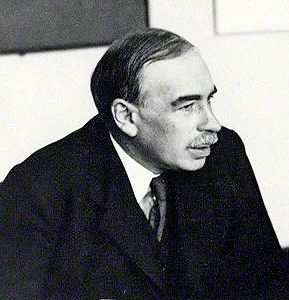
John Maynard Keynes, 1st Baron Keynes ( KAYNZ; 5 June 1883 – 21 April 1946), was an English economist whose writings are considered the basis for the school of thought known as Keynesian economics, as well as its various offshoots. Originally trained in mathematics, he built on and refined earlier work on the causes of business cycles. His ideas, further developed after his death as New Keynesianism, are seen as foundational to mainstream macroeconomics. He has been referred to as the "father of macroeconomics" and is considered one of the most influential economists of the 20th century.
Keynes was educated at King's College at the University of Cambridge, where he graduated in 1904 with a B.A. in mathematics. During the Great Depression of the 1930s, Keynes spearheaded the Keynesian Revolution, challenging the ideas of neoclassical economics that held that free markets would, in the short to medium term, automatically provide full employment, as long as workers were flexible in their wage demands. He argued that aggregate demand (total spending in the economy) determined the overall level of economic activity, and that inadequate aggregate demand could lead to prolonged periods of high unemployment, and since wages and labour costs are rigid downwards, the economy will not automatically rebound to full employment. Keynes advocated the use of fiscal and monetary policies to mitigate the adverse effects of economic recessions and depressions. After the 1929 crisis, Keynes also turned away from free trade, a fundamental pillar of neoclassical economics. He criticised Ricardian comparative advantage theory (the foundation of free trade), considering the theory's initial assumptions unrealistic, and became definitively protectionist. He detailed these ideas in his major work, The General Theory of Employment, Interest and Money, published in early 1936. By the late 1930s, leading Western economies had begun adopting Keynes's policy recommendations. Almost all capitalist governments had done so by the end of the two decades following Keynes's death in 1946. As a leader of the British delegation, Keynes participated in the design of the international economic institutions established after the end of World War II but was overruled by the American delegation on several aspects.
His influence began to wane in the 1970s, partly as a result of the stagflation that plagued the British and American economies during that decade, and partly because of criticism of Keynesian policies by Milton Friedman and other monetarists, who disputed the ability of government to favourably regulate the business cycle with fiscal policy. The 2008 financial crisis sparked the 2008–2009 Keynesian resurgence; Keynesian economics provided the theoretical underpinning for economic policies undertaken in response to the 2008 financial crisis by President Barack Obama of the United States, Prime Minister Gordon Brown of the United Kingdom, and other heads of governments.
When Time magazine included Keynes among its Most Important People of the Century in 1999, it reported that "his radical idea that governments should spend money they don't have may have saved capitalism". The Economist has described Keynes as "Britain's most famous 20th-century economist". In addition to being an economist, Keynes was also a civil servant, a director of the Bank of England, and a part of the Bloomsbury Group of intellectuals.
Contents
Early life and education
John Maynard Keynes was born in Cambridge, England, on 5 June 1883, to an upper-middle-class family. His father, John Neville Keynes, was an economist and a lecturer in moral sciences at the University of Cambridge, while his mother, Florence Ada Keynes, was a local social reformer who went on to become the town's second female mayor. Keynes was the firstborn and was followed by two more children – Margaret Neville Keynes in 1885 and Geoffrey Keynes in 1887. Geoffrey became a surgeon and Margaret married the Nobel Prize-winning physiologist Archibald Hill.
According to Geoffrey, their parents were loving and attentive. They attended a Congregational Church and remained in the same house throughout their lives, where the children were always welcome to return. Keynes received considerable support from his father, including coaching to help him pass his scholarship exams, as well as financial help both as a young man and when his assets were nearly wiped out at the onset of Great Depression in 1929. Keynes's mother made her children's interests her own, and according to Skidelsky, "because she could grow up with her children, they never outgrew home".
In January 1889, at the age of five and a half, Keynes started at the kindergarten of the Perse School for Girls for five mornings a week. He quickly showed a talent for arithmetic, but his health was poor, leading to several long absences. He was tutored at home by a governess, Beatrice Mackintosh, and his mother. In January 1892, at eight and a half, he started as a day pupil at St Faith's preparatory school. By 1894, Keynes was top of his class and excelling at mathematics. In 1896, St Faith's headmaster, Ralph Goodchild, wrote that Keynes was "head and shoulders above all the other boys in the school" and was confident that Keynes could get a scholarship to Eton.
In 1897, Keynes won a King's Scholarship to Eton College, where he displayed talent in a wide range of subjects, particularly mathematics, classics and history; in 1901, he was awarded the Tomline Prize for mathematics. At Eton, Keynes experienced the first "love of his life" in Dan Macmillan, older brother of the future Prime Minister Harold Macmillan. Despite his middle-class background, Keynes mixed easily with upper-class pupils.
In 1902, Keynes left Eton for King's College, Cambridge, after receiving a scholarship for this also, to read mathematics. Alfred Marshall begged Keynes to become an economist, although Keynes's own inclinations drew him towards philosophy, especially the ethical system of G. E. Moore. Keynes was elected to the University Pitt Club and was an active member of the semi-secretive Cambridge Apostles society, a debating club largely reserved for the brightest students. Like many members, Keynes retained a bond to the club after graduating and continued to attend occasional meetings throughout his life. While at the University of Cambridge, Keynes was president of the Cambridge Union Society and Cambridge University Liberal Club. He was said to be an atheist.
Career
In October 1906 Keynes began his Civil Service career as a clerk in the India Office. He enjoyed his work at first, but by 1908 had become bored and resigned his position to return to Cambridge and work on probability theory, through a lectureship in economics at first funded personally by economists Alfred Marshall and Arthur Pigou. He became a fellow of King's College in 1909.
By 1909 Keynes had also published his first professional economics article in The Economic Journal, about the effect of a recent global economic downturn on India. He founded the Political Economy Club, a weekly discussion group. Keynes's earnings rose further as he began to take on pupils for private tuition.
In 1911 Keynes was made the editor of The Economic Journal. By 1913 he had published his first book, Indian Currency and Finance. In that book, Keynes analysed in great detail the monetary arrangements of India, from the late 19th century onwards. The Indian Rupee notes were convertible into silver coin which in turn had growing convertibility into gold coin, pound sterling, at a ratio of 15:1. Keynes recommended policies to speed up the conversion of Rupee into gold – effectively recommending a gold exchange standard.
He was then appointed to the Royal Commission on Indian Currency and Finance – the same topic as his book – where Keynes applied economic theory to practical problems. His written work was published under the name "J M Keynes", though to his family and friends he was known as Maynard. (His father, John Neville Keynes, was also always known by his middle name).
First World War
The British Government called on Keynes's expertise during the First World War. While he did not formally rejoin the civil service in 1914, Keynes travelled to London at the government's request a few days before hostilities started. Bankers had been pushing for the suspension of specie payments – the gold equivalent of banknotes – but with Keynes's help, the Chancellor of the Exchequer (then Lloyd George) was persuaded that this would be a bad idea, as it would hurt the future reputation of the city if payments were suspended before it was necessary.
In January 1915 Keynes took up an official government position at the Treasury. Among his responsibilities were the design of terms of credit between Britain and its continental allies during the war and the acquisition of scarce currencies. According to economist Robert Lekachman, Keynes's "nerve and mastery became legendary" because of his performance of these duties, as in the case where he managed to assemble a supply of Spanish pesetas.
The secretary of the Treasury was delighted to hear Keynes had amassed enough to provide a temporary solution for the British Government. But Keynes did not hand the pesetas over, choosing instead to sell them all to break the market: his boldness paid off, as pesetas then became much less scarce and expensive.
On the introduction of military conscription in 1916, he applied for exemption as a conscientious objector, which was effectively granted conditional upon continuing his government work.
In the 1917 King's Birthday Honours, Keynes was appointed Companion of the Order of the Bath for his wartime work, and his success led to the appointment that had a huge effect on Keynes's life and career; Keynes was appointed financial representative for the Treasury to the 1919 Versailles peace conference. He was also appointed Officer of the Belgian Order of Leopold.
Versailles peace conference
Keynes's experience at Versailles was influential in shaping his future outlook, yet it was not a successful one. Keynes's main interest had been in trying to prevent Germany's compensation payments being set so high it would traumatise innocent German people, damage the nation's ability to pay and sharply limit its ability to buy exports from other countries – thus hurting not just Germany's economy but that of the wider world.
Unfortunately for Keynes, conservative powers in the coalition that emerged from the 1918 coupon election were able to ensure that both Keynes himself and the Treasury were largely excluded from formal high-level talks concerning reparations. Their place was taken by the Heavenly Twins – the judge Lord Sumner and the banker Lord Cunliffe, whose nickname derived from the "astronomically" high war compensation they wanted to demand from Germany. Keynes was forced to try to exert influence mostly from behind the scenes.
The three principal players at the Paris conferences were Britain's Lloyd George, France's Georges Clemenceau and America's President Woodrow Wilson.
It was only Lloyd George to whom Keynes had much direct access; until the 1918 election he had some sympathy with Keynes's view but while campaigning had found his speeches were well received by the public only if he promised to harshly punish Germany, and had therefore committed his delegation to extracting high payments.
Lloyd George did, however, win some loyalty from Keynes with his actions at the Paris conference by intervening against the French to ensure the dispatch of much-needed food supplies to German civilians. Clemenceau also pushed for substantial reparations, though not as high as those proposed by the British, while on security grounds, France argued for an even more severe settlement than Britain.
Wilson initially favoured relatively lenient treatment of Germany – he feared too harsh conditions could foment the rise of extremism and wanted Germany to be left sufficient capital to pay for imports. To Keynes's dismay, Lloyd George and Clemenceau were able to pressure Wilson to agree to include pensions in the reparations bill.
In the 1920s
Keynes had completed his A Treatise on Probability before the war but published it in 1921. The work was a notable contribution to the philosophical and mathematical underpinnings of probability theory, championing the important view that probabilities were no more or less than truth values intermediate between simple truth and falsity. Keynes developed the first upper-lower probabilistic interval approach to probability in chapters 15 and 17 of this book, as well as having developed the first decision weight approach with his conventional coefficient of risk and weight, c, in chapter 26. In addition to his academic work, the 1920s saw Keynes active as a journalist selling his work internationally and working in London as a financial consultant. In 1924, Keynes wrote an obituary for his former tutor Alfred Marshall which Joseph Schumpeter called "the most brilliant life of a man of science I have ever read". Mary Paley Marshall was "entranced" by the memorial, while Lytton Strachey rated it as one of Keynes's "best works".
In 1922 Keynes continued to advocate reduction of German reparations with A Revision of the Treaty. He attacked the post-World War I deflation policies with A Tract on Monetary Reform in 1923 – a trenchant argument that countries should target stability of domestic prices, avoiding deflation even at the cost of allowing their currency to depreciate. Britain suffered from high unemployment through most of the 1920s, leading Keynes to recommend the depreciation of sterling to boost jobs by making British exports more affordable. From 1924 he was also advocating a fiscal response, where the government could create jobs by spending on public works. During the 1920s Keynes's pro-stimulus views had only limited effect on policymakers and mainstream academic opinion – according to Hyman Minsky one reason was that at this time his theoretical justification was "muddled". The Tract had also called for an end to the gold standard. Keynes advised it was no longer a net benefit for countries such as Britain to participate in the gold standard, as it ran counter to the need for domestic policy autonomy. It could force countries to pursue deflationary policies at exactly the time when expansionary measures were called for to address rising unemployment. The Treasury and Bank of England were still in favour of the gold standard and in 1925 they were able to convince the then Chancellor Winston Churchill to re-establish it, which had a depressing effect on British industry. Keynes responded by writing The Economic Consequences of Mr. Churchill and continued to argue against the gold standard until Britain finally abandoned it in 1931.
During the Great Depression
Keynes had begun a theoretical work to examine the relationship between unemployment, money and prices back in the 1920s. The work, Treatise on Money, was published in 1930 in two volumes. A central idea of the work was that if the amount of money being saved exceeds the amount being invested – which can happen if interest rates are too high – then unemployment will rise. This is in part a result of people not wanting to spend too high a proportion of what employers pay out, making it difficult, in aggregate, for employers to make a profit. Another key theme of the book is the unreliability of financial indices for representing an accurate – or indeed meaningful – indication of general shifts in purchasing power of currencies over time. In particular, he criticised the justification of Britain's return to the gold standard in 1925 at pre-war valuation by reference to the wholesale price index. He argued that the index understated the effects of changes in the costs of services and labour.
Keynes was deeply critical of the British government's austerity measures during the Great Depression. He believed that budget deficits during recessions were a good thing and a natural product of an economic slump. He wrote, "For Government borrowing of one kind or another is nature's remedy, so to speak, for preventing business losses from being, in so severe a slump as the present one, so great as to bring production altogether to a standstill."
At the height of the Great Depression, in 1933, Keynes published The Means to Prosperity, which contained specific policy recommendations for tackling unemployment in a global recession, chiefly counter-cyclical public spending. The Means to Prosperity contains one of the first mentions of the multiplier effect. While it was addressed chiefly to the British Government, it also contained advice for other nations affected by the global recession. A copy was sent to the newly elected President Franklin D. Roosevelt and other world leaders. The work was taken seriously by both the American and British governments, and according to Robert Skidelsky, helped pave the way for the later acceptance of Keynesian ideas, though it had little immediate practical influence. At the London Economic Conference in July 1933 opinions remained too diverse for a unified course of action to be agreed upon.
In a lecture in Dublin in March 1933, Keynes had rehearsed two themes critical of what he described as "decadent international but individualistic capitalism", and upon which he was later to elaborate in The General Theory:
Second World War
During the Second World War, Keynes argued in How to Pay for the War, published in 1940, that the war effort should be largely financed by higher taxation and especially by compulsory saving (essentially workers lending money to the government), rather than deficit spending, to avoid inflation. Compulsory saving would act to dampen domestic demand, assist in channelling additional output towards the war efforts, would be fairer than punitive taxation and would have the advantage of helping to avoid a post-war slump by boosting demand once workers were allowed to withdraw their savings. In September 1941 he was proposed to fill a vacancy in the Court of Directors of the Bank of England, and subsequently carried out a full term from the following April. In June 1942, Keynes was rewarded for his service with a hereditary peerage in the King's Birthday Honours. On 7 July his title was gazetted as "Baron Keynes, of Tilton, in the County of Sussex" and he took his seat in the House of Lords on the Liberal Party benches.
As the Allied victory began to look certain, Keynes was heavily involved, as leader of the British delegation and chairman of the World Bank commission, in the mid-1944 negotiations that established the Bretton Woods system. The Keynes plan, concerning an international clearing-union, argued for a radical system for the management of currencies. He proposed the creation of a common world unit of currency, the bancor and new global institutions – a world central bank and the International Clearing Union. Keynes envisaged these institutions as managing an international trade and payments system with strong incentives for countries to avoid substantial trade deficits or surpluses. The US's greater negotiating strength, however, meant that the outcomes accorded more closely to the more conservative plans of Harry Dexter White. According to US economist J. Bradford DeLong, on almost every point where he was overruled by the Americans, Keynes was later proven correct by events.
The two new institutions, later known as the World Bank and the International Monetary Fund (IMF), were founded as a compromise that primarily reflected the American vision. There would be no incentives for states to avoid a large trade surplus; instead, the burden for correcting a trade imbalance would continue to fall only on the deficit countries, which Keynes had argued were least able to address the problem without inflicting economic hardship on their populations. Yet, Keynes was still pleased when accepting the final agreement, saying that if the institutions stayed true to their founding principles, "the brotherhood of man will have become more than a phrase."
Postwar
After the war, Keynes continued to represent the United Kingdom in international negotiations despite his deteriorating health. He succeeded in obtaining preferential terms from the United States for new and outstanding debts to facilitate the rebuilding of the British economy.
Just before his death in 1946, Keynes told Henry Clay, a professor of social economics and advisor to the Bank of England, of his hopes that Adam Smith's "invisible hand" could help Britain out of the economic hole it was in: "I find myself more and more relying for a solution of our problems on the invisible hand which I tried to eject from economic thinking twenty years ago."
Economic viewpoint
Free trade and protectionism
According to Keynesian theory, trade deficits are harmful. The countries that import more than they export weaken their economies. When the trade deficit increases, unemployment rises and gross domestic product (GDP) slows down. Furthermore, surplus countries exert a "negative externality" on their trading partners. They get richer at the expense of others and destroy the output of their trading partners. John Maynard Keynes believed that the products of surplus countries should be taxed to avoid trade imbalances.
At the beginning of his career, Keynes was an economist close to Alfred Marshall, deeply convinced of the benefits of free trade. From the crisis of 1929 onwards, noting the commitment of the British authorities to defend the gold parity of the pound sterling and the rigidity of nominal wages, he gradually adhered to protectionist measures.
On 5 November 1929, when heard by the Macmillan Committee to bring the British economy out of the crisis, Keynes indicated that the introduction of tariffs on imports would help to rebalance the trade balance. The committee's report states in a section entitled "import control and export aid", that in an economy where there is not full employment, the introduction of tariffs can improve production and employment. Thus, the reduction of the trade deficit favours the country's growth.
In January 1930, in the Economic Advisory Council, Keynes proposed the introduction of a system of protection to reduce imports. In the autumn of 1930, he proposed a uniform tariff of 10% on all imports and subsidies of the same rate for all exports. In the Treatise on Money, published in the autumn of 1930, he took up the idea of tariffs or other trade restrictions with the aim of reducing the volume of imports and rebalancing the balance of trade.
On 7 March 1931, in the New Statesman and Nation, he wrote an article entitled Proposal for a Tariff Revenue. He pointed out that the reduction in wages led to a reduction in national demand which constrained markets. Instead, he proposed the idea of an expansionary policy combined with a tariff system to neutralise the effects on the balance of trade. The application of customs tariffs seemed to him "unavoidable, whoever the Chancellor of the Exchequer might be". Thus, for Keynes, an economic recovery policy is only fully effective if the trade deficit is eliminated. He proposed a 15% tax on manufactured and semi-manufactured goods and 5% on certain foodstuffs and raw materials, with others needed for exports exempted (wool, cotton).
Trade imbalances
Keynes was the principal author of a proposal – the so-called Keynes Plan – for an International Clearing Union. The two governing principles of the plan were that the problem of settling outstanding balances should be solved by "creating" additional "international money", and that debtor and creditor should be treated almost alike as disturbers of equilibrium. In the event, though, the plans were rejected, in part because "American opinion was naturally reluctant to accept the principle of equality of treatment so novel in debtor-creditor relationships".
The new system is not founded on free-trade (liberalisation of foreign trade) but rather on the regulation of international trade, to eliminate trade imbalances: the nations with a surplus would have an incentive to reduce it, and in doing so they would automatically clear other nations deficits. He proposed a global bank that would issue its currency – the bancor – which was exchangeable with national currencies at fixed rates of exchange and would become the unit of account between nations, which means it would be used to measure a country's trade deficit or trade surplus. Every country would have an overdraft facility in its bancor account at the International Clearing Union. He pointed out that surpluses lead to weak global aggregate demand – countries running surpluses exert a "negative externality" on trading partners, and pose, far more than those in deficit, a threat to global prosperity.
In his 1933 Yale Review article "National Self-Sufficiency", he already highlighted the problems created by free trade. His view, supported by many economists and commentators at the time, was that creditor nations may be just as responsible as debtor nations for disequilibrium in exchanges and that both should be under an obligation to bring trade back into a state of balance. Failure for them to do so could have serious consequences. In the words of Geoffrey Crowther, then editor of The Economist, "If the economic relationships between nations are not, by one means or another, brought fairly close to balance, then there is no set of financial arrangements that can rescue the world from the impoverishing results of chaos."
These ideas were informed by events prior to the Great Depression when – in the opinion of Keynes and others – international lending, primarily by the US, exceeded the capacity of sound investment and so got diverted into non-productive and speculative uses, which in turn invited default and a sudden stop to the process of lending.
Inflation
Keynes has been characterised as being indifferent or even positive about mild inflation. He had expressed a preference for inflation over deflation, saying that if one has to choose between the two evils, it is "better to disappoint the rentier" than to inflict pain on working-class families. Keynes was also aware of the dangers of inflation. In The Economic Consequences of the Peace, he wrote:
Lenin is said to have declared that the best way to destroy the Capitalist System was to debauch the currency. By a continuing process of inflation, governments can confiscate, secretly and unobserved, an important part of the wealth of their citizens. There is no subtler, no surer means of overturning the existing basis of society than to debauch the currency. The process engages all the hidden forces of economic law on the side of destruction, and does it in a manner which not one man in a million is able to diagnose.
Alienation
Keynes was not deeply concerned with alienation and did not explicitly use the term in his writings. While Keynes was pro-business and viewed capitalism as essential for economic growth, he acknowledged that it created economic insecurity and dissatisfaction, which could alienate workers, yet he believed this was only a temporary problem. In "The Economic Possibilities for Our Grandchildren" (a lecture later published in 1931), he envisioned a future in which society would become so wealthy that the pursuit of money for its own sake would become irrelevant, and he believed that continuous economic growth would eventually reduce the need for excessive labour and alleviate extreme inequality, allowing people to pursue more fulfilling lives. While Keynes's optimistic vision has not fully materialised, global wealth has grown significantly since his time. Yet, alienation remains a pressing issue, especially during periods of rising inequality, suggesting that economic growth alone may not be enough to eliminate the problem.
Influence and legacy
1939–79: Keynesian ascendancy
From the end of the Great Depression to the mid-1970s, Keynes provided the main inspiration for economic policymakers in Europe, America and much of the rest of the world. While economists and policymakers had become increasingly won over to Keynes's way of thinking in the mid and late 1930s, it was only after the outbreak of World War II that governments started to borrow money for spending on a scale sufficient to eliminate unemployment. According to the economist John Kenneth Galbraith (then a US government official charged with controlling inflation), in the rebound of the economy from wartime spending, "one could not have had a better demonstration of the Keynesian ideas".
John Maynard Keynes’s ideas continue to influence economic policy, especially during recessions. Keynes argued that when private demand falls, government spending can help support employment and stabilise the economy. This idea became a central part of Keynesian economics and influenced many policies adopted after World War II. Keynesian ideas have also influenced responses to more recent crises, including the 2008 financial crisis and later economic disruptions. In these cases, governments used policies such as stimulus spending and direct payments to households in attempts to support consumption and reduce economic decline. Some economists argue these policies reflect Keynes’s view that governments can help stabilise downturns, while debate continues over the limits of intervention.
The Keynesian Revolution was associated with the rise of modern liberalism in the West during the post-war period. Keynesian ideas became so popular that some scholars point to Keynes as representing the ideals of modern liberalism, as Adam Smith represented the ideals of classical liberalism. After the war, Winston Churchill attempted to check the rise of Keynesian policy-making in the United Kingdom and used rhetoric critical of the mixed economy in his 1945 election campaign. Despite his popularity as a war hero, Churchill suffered a landslide defeat to Clement Attlee, whose government's economic policy continued to be influenced by Keynes's ideas.
In the late 1930s and 1940s, economists (notably John Hicks, Franco Modigliani and Paul Samuelson) attempted to interpret and formalise Keynes's writings in terms of formal mathematical models. In what had become known as the neoclassical synthesis, they combined Keynesian analysis with neoclassical economics to produce neo-Keynesian economics, which came to dominate mainstream macroeconomic thought for the next 40 years.
1979–2007: Keynesian economics out of favour
Keynesian economics were officially discarded by the British Government in 1979, but forces had begun to gather against Keynes's ideas over 30 years earlier. Friedrich Hayek had formed the Mont Pelerin Society in 1947, with the explicit intention of nurturing intellectual currents to one day displace Keynesianism and other similar influences. Its members included the Austrian School economist Ludwig von Mises along with the then-young Milton Friedman. Initially, the society had little impact on the wider world – according to Hayek it was as if Keynes had been raised to sainthood after his death and that people refused to allow his work to be questioned.
Friedman, however, began to emerge as a formidable critic of Keynesian economics from the mid-1950s, and especially after his 1963 publication of A Monetary History of the United States.
On the practical side of economic life, "big government" had appeared to be firmly entrenched in the 1950s, but the balance began to shift towards the power of private interests in the 1960s. Keynes had written against the folly of allowing "decadent and selfish" speculators and financiers the kind of influence they had enjoyed after World War I. For two decades after World War II public opinion was strongly against private speculators, the disparaging label "Gnomes of Zurich" being typical of how they were described during this period. International speculation was severely restricted by the capital controls in place after Bretton Woods. According to the journalists Larry Elliott and Dan Atkinson, 1968 was the pivotal year when power shifted in favour of private agents such as currency speculators. As the key 1968 event Elliott and Atkinson picked out America's suspension of the conversion of the dollar into gold except on request of foreign governments, which they identified as the beginning of the breakdown of the Bretton Woods system.
Criticisms of Keynes's ideas had begun to gain significant acceptance by the early 1970s, as they were then able to make a credible case that Keynesian models no longer reflected economic reality. Keynes himself included few formulas and no explicit mathematical models in his General Theory. For economists such as Hyman Minsky, Keynes's limited use of mathematics was partly the result of his scepticism about whether phenomena as inherently uncertain as economic activity could ever be adequately captured by mathematical models. Nevertheless, many models were developed by Keynesian economists, with a famous example being the Phillips curve which predicted an inverse relationship between unemployment and inflation. It implied that unemployment could be reduced by government stimulus with a calculable cost to inflation. In 1968, Milton Friedman published a paper arguing that the fixed relationship implied by the Phillips curve did not exist.
2008–09: Keynesian resurgence
The 2008 financial crisis led to public scepticism about the free market consensus even from some on the economic right. In March 2008, Martin Wolf, chief economics commentator at the Financial Times, announced the death of the dream of global free-market capitalism. In the same month macroeconomist James K. Galbraith used the 25th Annual Milton Friedman Distinguished Lecture to launch a sweeping attack against the consensus for monetarist economics and argued that Keynesian economics were far more relevant for tackling the emerging crises.
Economist Robert J. Shiller had begun advocating robust government intervention to tackle the financial crises, specifically citing Keynes. Nobel laureate Paul Krugman also actively argued the case for vigorous Keynesian intervention in the economy in his columns for The New York Times. Other prominent economic commentators who have argued for Keynesian government intervention to mitigate the 2008 financial crisis included George Akerlof, J. Bradford DeLong, Robert Reich and Joseph Stiglitz. Newspapers and other media have also cited work relating to Keynes by Hyman Minsky, Robert Skidelsky, Donald Markwell and Axel Leijonhufvud.
A series of major bailouts were pursued during the 2008 financial crisis, starting on 7 September 2008 with the announcement that the US government was to nationalise the two government-sponsored enterprises which oversaw most of the US subprime mortgage market – Fannie Mae and Freddie Mac. In October, Alistair Darling, the British Chancellor of the Exchequer, referred to Keynes as he announced plans for substantial fiscal stimulus to head off the worst effects of recession, in accordance with Keynesian economic thought. Similar policies have been adopted by other governments worldwide. This was in stark contrast to the action imposed on Indonesia during the 1997 Asian financial crisis, when it was forced by the IMF to close 16 banks at the same time, prompting a bank run.
Much of the post-crisis discussion reflected Keynes's advocacy of international coordination of fiscal or monetary stimulus, and of international economic institutions such as the IMF and the World Bank, which many had argued should be reformed as a "new Bretton Woods", and should have been even before the crises broke out.
The IMF and United Nations economists advocated a coordinated international approach to fiscal stimulus. Donald Markwell argued that in the absence of such an international approach, there would be a risk of worsening international relations and possibly even world war arising from economic factors similar to those present during the depression of the 1930s.
New Keynesian economics
New Keynesian economics developed in the 1990s and early 2000s as a response to the critique that macroeconomics lacked microeconomic foundations. New Keynesianism developed models to provide microfoundations for Keynesian economics. It incorporated parts of new classical macroeconomics to develop the new neoclassical synthesis, which forms the basis for mainstream macroeconomics today.
Two main assumptions define the New Keynesian approach to macroeconomics. Like the New Classical approach, New Keynesian macroeconomic analysis usually assumes that households and firms have rational expectations. However, the two schools differ in that New Keynesian analysis usually assumes a variety of market failures. In particular, New Keynesians assume that there is imperfect competition in price and wage setting to help explain why prices and wages can become "sticky", which means they do not adjust instantaneously to changes in economic conditions.
Wage and price stickiness, and the other market failures present in New Keynesian models, imply that the economy may fail to attain full employment. Therefore, New Keynesians argue that macroeconomic stabilisation by the government (using fiscal policy) and the central bank (using monetary policy) can lead to a more efficient macroeconomic outcome than a laissez-faire policy would.
Reception
Praise
On a personal level, Keynes's charm was such that he was generally well received wherever he went – even those who found themselves on the wrong side of his occasionally sharp tongue rarely bore a grudge. Keynes's speech at the closing of the Bretton Woods negotiations was received with a lasting standing ovation, rare in international relations, as the delegates acknowledged the scale of his achievements made despite poor health.
Austrian School economist Friedrich Hayek was Keynes's most prominent contemporary critic, with sharply opposing views on the economy. Yet after Keynes's death, he wrote: "He was the one really great man I ever knew, and for whom I had unbounded admiration. The world will be a very much poorer place without him." Colleague Nicholas Davenport recalled, "There were deep emotional forces about Maynard ... One could sense his humanity. There was nothing of the cold intellectual about him."
Lionel Robbins, former head of the economics department at the London School of Economics, who engaged in many heated debates with Keynes in the 1930s, had this to say after observing Keynes in early negotiations with the Americans while drawing up plans for Bretton Woods:
This went very well indeed. Keynes was in his most lucid and persuasive mood: and the effect was irresistible. At such moments, I often find myself thinking that Keynes must be one of the most remarkable men that have ever lived – the quick logic, the birdlike swoop of intuition, the vivid fancy, the wide vision, above all the incomparable sense of the fitness of words, all combine to make something several degrees beyond the limit of ordinary human achievement.
Douglas LePan, an official from the Canadian High Commission, wrote:
I am spellbound. This is the most beautiful creature I have ever listened to. Does he belong to our species? Or is he from some other order? There is something mythic and fabulous about him. I sense in him something massive and sphinx like, and yet also a hint of wings.
Bertrand Russell named Keynes one of the most intelligent people he had ever known, commenting:
Critiques
As a man described by some as having the greatest impact of any 20th-century economist, Keynes attracted considerable criticism from both sides of the political spectrum. In the 1920s, Keynes was seen as anti-establishment and was mainly attacked from the right. In the "red 1930s", many young economists favoured Marxist views, even in Cambridge, and while Keynes was engaging principally with the right to try to persuade them of the merits of more progressive policy, the most vociferous criticism against him came from the left, who saw him as a supporter of capitalism.
In 1931, Friedrich Hayek extensively critiqued Keynes's 1930 Treatise on Money. After reading Hayek's The Road to Serfdom, Keynes wrote to Hayek: "Morally and philosophically I find myself in agreement with virtually the whole of it." He concluded the letter with the recommendation:
What we need therefore, in my opinion, is not a change in our economic programmes, which would only lead in practice to disillusion with the results of your philosophy; but perhaps even the contrary, namely, an enlargement of them. Your greatest danger is the probable practical failure of the application of your philosophy in the United States.
On the pressing issue of the time, whether deficit spending could lift a country from depression, Keynes replied to Hayek's criticism in the following way:
I should ... conclude rather differently. I should say that what we want is not no planning, or even less planning, indeed I should say we almost certainly want more. But the planning should take place in a community in which as many people as possible, both leaders and followers wholly share your moral position. Moderate planning will be safe enough if those carrying it out are rightly oriented in their minds and hearts to the moral issue.
Asked why Keynes expressed "moral and philosophical" agreement with Hayek's Road to Serfdom, Hayek said that Keynes believed he was still a classical English liberal with the values of individual freedom. Hayek argued that Keynes did not see how far he had moved away from classical liberalism, nor did think systematically enough to notice the conflicts between Keynesianism and liberalism. Hayek called Keynes "corrupted by political necessity".
Personal life
Relationships
Keynes's early romantic and sexual relationships were exclusively with men. Keynes had been in relationships while at Eton and Cambridge; significant among these early partners were Dilly Knox and Daniel De Mendi Macmillan. Keynes was open about his affairs, and from 1901 to 1915 kept separate diaries in which he tabulated his many sexual encounters. Keynes's relationship and later close friendship with Macmillan was to be fortunate, as Macmillan would go on to be chairman of the Macmillan Publishers founded by his grandfather, which first published Keynes's Economic Consequences of the Peace.
Attitudes in the Bloomsbury Group, in which Keynes was avidly involved, were relaxed about homosexuality. Keynes, together with writer Lytton Strachey, had reshaped the Victorian attitudes of the Cambridge Apostles: "since [their] time, homosexual relations among the members were for a time common", wrote Bertrand Russell. The artist Duncan Grant has been described as "the supreme male love of Keynes's life", and their sexual relationship lasted from 1908 to 1915. Keynes was having sex on a number of occasions with Lytton Strachey, though they were, for the most part, love rivals rather than lovers. Keynes had won the affections of Arthur Hobhouse and, as with Grant, fell out with a jealous Strachey over it. Strachey had previously found himself put off by Keynes, not least because of his manner of "treat[ing] his love affairs statistically". Other notable lovers included writer Francis Birrell, Grant's partner Bunny Garnett, classicist John Tresidder Sheppard, brother of Lytton and psychoanalyst James Strachey, and Indian academic Benoy Kumar Sarkar.
One letter sent to Strachey stated that he intended to visit Tunis "where bed and boy were not expensive", as well as advising Strachey to visit Tunis and Sicily "if you want to go to where the naked boys dance."
Political opponents have used Keynes's sexuality to attack his academic work. One line of attack held that he was uninterested in the long-term ramifications of his theories because he had no children. Donald Kagan, in On the Origins of War, quotes Sally Marks and Stephen A. Schuker to suggest that "[Keynes's] passion for Carl Melchior" distorted his position in favour of Germany.
Keynes's friends in the Bloomsbury Group were initially surprised when, in his later years, he began pursuing affairs with women, demonstrating himself to be bisexual. Ray Costelloe (who later married Oliver Strachey) was an early heterosexual interest of Keynes. In 1906, Keynes had written of this infatuation that, "I seem to have fallen in love with Ray a little bit, but as she isn't male I haven't [been] able to think of any suitable steps to take."
Marriage
In 1921, Keynes wrote that he had fallen "very much in love" with Lydia Lopokova, a well-known Russian ballerina and one of the stars of Sergei Diaghilev's Ballets Russes. In the early years of his courtship, he maintained an affair with a younger man, Sebastian Sprott, in tandem with Lopokova, but eventually chose Lopokova exclusively. They were married in 1925, with Keynes's former lover Duncan Grant as best man. "What a marriage of beauty and brains, the fair Lopokova and John Maynard Keynes" was said at the time. Keynes later commented to Strachey that beauty and intelligence were rarely found in the same person, and that only in Duncan Grant had he found the combination. The union was happy, with biographer Peter Clarke writing that the marriage gave Keynes "a new focus, a new emotional stability and a sheer delight of which he never wearied". The couple hoped to have children but this did not happen.
Among Keynes's Bloomsbury friends, Lopokova was, at least initially, subjected to criticism for her manners, mode of conversation and supposedly humble social origins – the last of the ostensible causes being particularly noted in the letters of Vanessa and Clive Bell, and Virginia Woolf. In her novel Mrs Dalloway (1925), Woolf bases the character of Rezia Warren Smith on Lopokova. E. M. Forster later wrote in contrition about "Lydia Keynes, whose every word should be recorded"; "How we all used to underestimate her".
Keynes had no children, and his wife outlived him by 35 years, dying in 1981.
Support for the arts
Keynes thought that the pursuit of money for its own sake was a pathological condition, and that the proper aim of work is to provide leisure. He wanted shorter working hours and longer holidays for all.
Keynes was interested in literature in general and drama in particular and supported the Cambridge Arts Theatre financially, which allowed the institution to become one of the major British stages outside London.
Keynes's interest in classical opera and dance led him to support the Royal Opera House at Covent Garden and the Ballet Company at Sadler's Wells. During the war, as a member of CEMA (Council for the Encouragement of Music and the Arts), Keynes helped secure government funds to maintain both companies while their venues were shut. Following the war, Keynes was instrumental in establishing the Arts Council of Great Britain and was its founding chairman in 1946. From the start, the two organisations that received the largest grants from the new body were the Royal Opera House and Sadler's Wells.
Keynes built up a substantial collection of fine art, including works by Paul Cézanne, Edgar Degas, Amedeo Modigliani, Georges Braque, Pablo Picasso and Georges Seurat (some of which can now be seen at the Fitzwilliam Museum). He enjoyed collecting books; he collected and protected many of Isaac Newton's papers. In part on the basis of these papers, Keynes wrote of Newton as "the last of the magicians."
Philosophical and spiritual views
Keynes, like other members of the Bloomsbury Group, was greatly influenced by the philosophy of G. E. Moore, which in 1938 he described as "still my religion under the surface". According to Moore, states of mind were the only valuable things in themselves, the most important being "the pleasures of human intercourse and the enjoyment of beautiful objects". Virginia Woolf's biographer tells an anecdote of how Virginia Woolf, Keynes and T. S. Eliot discussed religion at a dinner party, in the context of their struggle against Victorian era morality.
Keynes may have been religiously confirmed, but according to Cambridge University he was clearly an agnostic for all his life. According to one biographer, "he was never able to take religion seriously, regarding it as a strange aberration of the human mind" but also added that he came to "value it for social and moral reasons" later in life. Another biographer writes that he "broke the family faith and became a 'ferocious agnostic'" during his time at Eton. One Cambridge acquaintance remembered him as "an atheist with a devotion to King's chapel". At Cambridge, he was strongly associated with the Cambridge Heretics Society, an avowed atheist group which promoted secularism and humanism.
Investments
Keynes was ultimately a successful investor, building up a private fortune. His assets were nearly wiped out following the Wall Street crash of 1929, which he did not foresee, but he soon recouped. At Keynes's death, in 1946, his net worth stood just short of £500,000 – equivalent to £24,000,000 in 2024. The sum had been amassed despite lavish support for various charities and philanthropies and despite his ethical reluctance to sell on a falling market in cases where he saw such behaviour as likely to deepen a slump.
Keynes managed the endowment of King's College, Cambridge starting in the 1920s, initially with an unsuccessful strategy based on market timing but later shifting to focus in the publicly traded stock of small and medium-sized companies that paid large dividends. This was a controversial decision at the time, as stocks were considered high-risk and the centuries-old endowment had traditionally been invested in agricultural land and fixed income assets like bonds. Keynes was granted permission to invest a small minority of assets in stocks, and his adroit management resulted this portion of the endowment growing to become the majority of the endowment's assets. The active component of his portfolio outperformed a British equity index by an average of 6% to 8% a year over a quarter century, earning him a favourable mention by later investors such as Warren Buffett and George Soros.
Joel Tillinghast of Fidelity Investments describes Keynes as an early practitioner of value investing, a school of thought formalised in the US by Benjamin Graham and David Dodd at Columbia Business School during the 1920s and 1930s. However, Keynes is believed to have developed his ideas independently. Keynes is also regarded as a pioneer of financial diversification as he recognised the importance of holding assets with "opposed risks" as he wrote "since they are likely to move in opposite directions when there are general fluctuations"; and also as an early international investor who avoided home country bias by investing substantially in stocks outside the United Kingdom. Ken Fisher characterised Keynes as an exception to the rule that economists usually make horrible investors.
Keynes joined the Board of the National Mutual Life Assurance Society in 1919 and served as chairman from 1921 to 1938. Keynes introduced a policy of active trading of fixed interest stocks, coupled with investment in equities. "Keynes was the first to give [investment trading] the seal of respectability and to apply it to a life assurance fund".
Political life
Keynes was a lifelong member of the Liberal Party, which until the 1920s had been one of the two main political parties in the United Kingdom, and as late as 1916 had often been the dominant power in government. Keynes had helped campaign for the Liberals at elections from about 1906, yet he always refused to run for office himself, despite being asked to do so on three separate occasions in 1920. From 1926, when Lloyd George became leader of the Liberals, Keynes took a major role in defining the party's economic policy, but by then the Liberals had been displaced into third-party status by the growing workers-oriented Labour Party.
In 1939 Keynes had the option to enter Parliament as an independent MP with the University of Cambridge seat. A by-election for the seat was to be held due to the illness of an elderly Tory, and the master of Magdalene College had obtained agreement that none of the major parties would field a candidate if Keynes chose to stand. Keynes declined the invitation as he felt he would wield greater influence on events if he remained a free agent.
Keynes was a lifelong proponent of eugenics, though he consistently opposed any form of compulsory sterilisation or involuntary euthanasia. His involvement in advocating for eugenics spanned his entire professional career, from service as treasurer of the new Cambridge University Eugenics Society in 1911 to serving as director of the British Eugenics Society from 1937 to 1944. As late as 1946, shortly before his death, Keynes declared eugenics to be "the most important, significant and, I would add, genuine branch of sociology which exists."
Historians have emphasised that Keynes's interest in eugenics was not merely incidental or reflective of broader elite opinion in early twentieth-century Britain, but was integrated into his economic, ethical, and philosophical thought. His early engagement with questions of genetic heredity, including collaboration with geneticist William Bateson, informed his views on probability, social science, heredity, population 'quality' and size, and public policy.
In the interwar period, Keynes linked eugenic ideas to his wider concerns about economic management and the future of industrial society. He argued that effective social and economic planning would depend not only on controlling population size but also on improving its "quality," and at times attributed Britain’s difficulties to deficiencies in leadership that he regarded as hereditary. In his essay 'The End of Laissez-Faire' (1926), Keynes argued that the "time may arrive a little later when the community as a whole must pay attention to the innate quality as well as to the mere numbers of its future members."
Death
Throughout his life, Keynes worked energetically for the benefit both of the public and his friends; even when his health was poor, he laboured to sort out the finances of his old college. Helping to set up the Bretton Woods system, he worked to institute an international monetary system that would be beneficial for the world economy. In 1946, Keynes suffered a series of heart attacks, which ultimately proved fatal. They began during negotiations for the Anglo-American loan in Savannah, Georgia, where he was trying to secure favourable terms for the United Kingdom from the United States, a process he described as "absolute hell". A few weeks after returning from the United States, Keynes died of a heart attack at Tilton, his farmhouse home near Firle, East Sussex, England, on 21 April 1946, at the age of 62. Against his wishes (he wanted his ashes to be deposited in the crypt at King's), his ashes were scattered on the Downs above Tilton.
Both of Keynes's parents outlived him: his father John Neville Keynes (1852–1949) by three years, and his mother Florence Ada Keynes (1861–1958) by twelve. Keynes's brother Sir Geoffrey Keynes (1887–1982) was a distinguished surgeon, scholar and bibliophile. Keynes's sister, Margaret Hill (1885–1970) was a prominent social reformer. His nephews include Richard Keynes (1919–2010), a physiologist, and Quentin Keynes (1921–2003), an adventurer and bibliophile. His niece, Polly Hill (1914–2005), was an economic anthropologist and emeritus fellow of Clare Hall, Cambridge.