



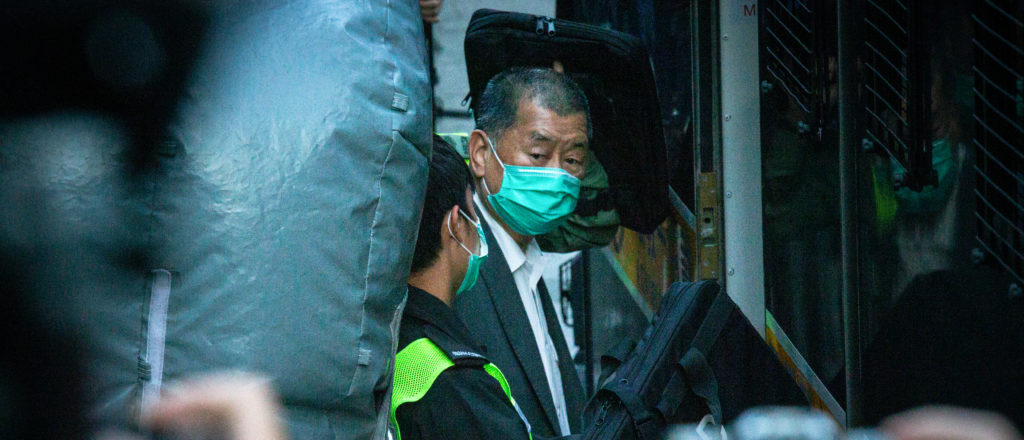
Lai Chee-ying (Chinese: 黎智英; born 8 December 1947), also known as Jimmy Lai, is a Hong Kong businessman, politician, and political prisoner. He founded the clothing retailer Giordano, the media company Next Digital (formerly Next Media), and the newspaper Apple Daily. He is one of the main contributors to Hong Kong's pro-democracy camp, especially to the Democratic Party. A British citizen since 1994, he was imprisoned in 2020 and his business operations shuttered under pressure from the Chinese government.
A prominent critic of the Chinese Communist Party (CCP) who met with U.S. Vice President Mike Pence, Secretary of State Mike Pompeo, and National Security Advisor John Bolton during the Hong Kong protests of 2019–2020, Lai was arrested on 10 August 2020 by the Hong Kong Police Force on charges of violating the new national security law, an action which prompted widespread criticism. He was ultimately sentenced to 20 years in prison, a penalty Human Rights Watch called "both cruel and profoundly unjust" and Reporters Without Borders called bogus. As of September 2025, Lai remained imprisoned in solitary confinement at Hong Kong's Stanley Prison although this was at his own request to be segregated from other inmates, for reasons of his own. Lai regarded his imprisonment as "the summit of his own life".
In 2020, Lai was awarded the "Freedom of Press Award" by Reporters Without Borders for his role in founding Apple Daily, a news outlet under Lai's pro-democracy leadership that "still dares to openly criticise the Chinese regime and which widely covered last year's pro-democracy protests." That same month, Lai resigned from his roles with Next Digital as director and chairman of the board.
Contents
Early life
Lai was born in Canton (Guangzhou), then part of the Republic of China, to a once-wealthy business family whose fortunes collapsed after the Communist takeover. When he was seven, his family was torn apart during the political turmoil of the early People's Republic. His father had left for Hong Kong, his mother was sent to labour reform, and his older siblings were dispersed, leaving Lai to fend largely for himself with his twin sister and a mentally disabled sister. Sustained at first by the charity of neighbours, he soon began bartering and selling household items to survive, later turning to petty trading and black-market hawking near cinemas and train stations to keep his siblings fed, all while dodging police raids and street violence. He continued working even after his mother's release, as the family still depended on his income.
Based on his own words, while earning money carrying luggage at a train station, he was once tipped with a piece of chocolate by a man from Hong Kong; starving, he was struck by its sweetness, began to see Hong Kong as a kind of paradise. Determined to reach that promised place, he stowed away alone at age 12 to Hong Kong, where he found work as a child labourer in a garment factory earning the equivalent of US$8 a month and taught himself English.
Business career
Giordano
Lai's factory work saw him rise to the position of factory manager. In 1975, Lai used his year-end bonus on Hong Kong stocks to raise cash and bought a bankrupt garment factory, Comitex, where he began producing and exporting sweaters. Customers included J.C. Penney, Montgomery Ward, and other U.S. retailers.
In 1981, Lai founded Asian clothing retailer Giordano. By rewarding sellers with financial incentives in Hong Kong, he built the chain into an Asia-wide retailer. Giordano was said to have more than 8,000 employees in 2,400 shops in 30 countries.
In 1996, Lai sold his stake in Giordano, leaving the garment industry for media and politics, keeping Comitex active as a shell company. After his arrest under National Security Law in August 2020, Lai tried to sell his asset in Hong Kong, including the entire floor of Tai Ping Industrial Centre. Comitex, along with other private companies controlled by Lai, was reported to be the financial tools for his political activities and donations.
Other ventures
In 1997, Lai put up the capital for his twin sister, Lai Si-wai, to acquire numerous properties in the Southern Ontario wine and vacation region of Niagara-on-the-Lake. The Lais Group of Companies now owns additional properties in Caledon and Jordan, both in Ontario. Lai remains the owner despite his arrest.
During the dot-com boom of the late 1990s, Lai started an Internet-based grocery retailer that offered home delivery services, adMart. The business expanded its product scope beyond groceries to include electronics and office supplies, but was shut down after losing between $100 and $150 million. Lai attributed this business failure to overconfidence and a lack of viable business strategy.
In 2011, Lai's private company Sum Tat Ventures, based in British Virgin Islands, acquired the entirety of Next Media's subsidiary Colored World Holdings for US$120 million, shortly after which CWH ceased operations. Near the end of 2013, Lai spent approximately US$73 million (or NT$2.3 billion) to purchase a 2 per cent stake in Taiwanese electronics manufacturer HTC.
Activities in Myanmar
In 2014, leaked documents showed Lai paid former US deputy defence secretary and former World Bank president Paul Wolfowitz US$75,000 for his help with projects in Myanmar. Lai also reportedly remitted approximately US$213,000 to an NGO run by businessman Phone Win, with whom Lai's Hong Kong-registered Best Combo company reportedly collaborated on Yangon real estate projects.
Media career
Lai emerged as one of the most influential and controversial media entrepreneurs in Hong Kong and Taiwan, pioneering a reader-centric, mass-market approach that blended tabloid energy with political reporting. Inspired by publications such as USA Today and The Sun, Lai introduced paparazzi journalism, bold graphics, and accessible language to his audience through Next Magazine and Apple Daily.
Lai has faced sustained pressure and attempts to silence him throughout his career, encompassing political, commercial, and physical intimidation. His publications were banned in mainland China since their inception, reportedly after he told then-premier Li Peng, often seen as the person behind the 1989 Tiananmen Square crackdown, to "drop dead" and called the Chinese Communist Party "a monopoly that charges a premium for lousy service" in a 1994 column. Beijing also exerted commercial pressure on his retail business, prompting him to sell his stake in Giordano. In addition, he was subjected to repeated acts of intimidation aimed at silencing him, including assault, vehicle ramming, weapons left at his residence, and multiple petrol bombings targeting his home and media headquarters.
Over the years, pro-Beijing tycoons and major corporations in Hong Kong were said to have avoided advertising in his outlets, a practice former Chief Executive Leung Chun-ying has publicly admitted that while in office he met major advertisers and helped drive Apple Daily’s ad revenue down, despite official denials at the time. Furthermore, Lai faced supplier boycotts and obstacles listing his company on the Hong Kong Stock Exchange, which he ultimately achieved in 1999 through a reverse takeover of Paramount Publishing Group.
Hong Kong publications
Following the 1989 Tiananmen Square crackdown, Lai became an outspoken advocate of democracy and critic of the Beijing government. In 1990, he founded Next Magazine, which fused tabloid sensationalism with hard-hitting political and business reporting. He later launched a string of other magazines, including Sudden Weekly (忽然一週), Eat & Travel Weekly (飲食男女), Trading Express/Auto Express (交易通/搵車快線) and the youth-oriented Easy Finder (壹本便利).
In 1995, as the city prepared for the 1997 handover, Lai invested US$100 million of his own funds to establish Apple Daily. By 1997, its circulation had reached 400,000 copies, making it the territory's second-largest newspaper. Lai positioned the paper as a defender of press freedom and democratic values, and it frequently exposed the personal dealings and political ties of Hong Kong tycoons, earning both public support and elite hostility. In 2003, ahead of the 1 July march, Next Magazine and Apple Daily featured a photo-montage of the territory's embattled chief executive Tung Chee-Hwa taking a pie in the face. The magazine openly urged citizens to take to the streets while distributing stickers calling for Tung to resign. By 2006, Next Magazine and Sudden Weekly ranked first and second in Hong Kong's magazine circulation, while Apple Daily became the city's No. 2 newspaper.
In 2020, amid escalating political tensions, Lai launched an English-language edition of Apple Daily. Same year, the English edition published a 64-page report by Typhoon Investigations alleging that Hunter Biden, son of Joe Biden, had problematic ties to the Chinese Communist Party; the claims were widely circulated by far-right figures including Steve Bannon. A subsequent investigation by NBC News questioned the report's credibility, linking it to a purportedly fake intelligence firm and a fabricated author identity, while Christopher Balding later acknowledged writing parts of it and said it had been commissioned by Apple Daily. Lai denied personal involvement, though senior executive Mark Simon resigned over the matter. The report was among many incidents that was said to be instrumental to the January 6, 2021 Capitol attack.
Taiwan publications
Lai expanded into Taiwan with a Taiwanese edition of Next Magazine in 2001 and Apple Daily in 2003, entering a competitive and politically charged market. Established rivals reportedly pressured advertisers and distributors to boycott his publications, and his offices were vandalized on several occasions. Despite early resistance, his outlets eventually became market leaders in their categories, significantly influencing Taiwan's previously more restrained media culture. In 2006, he launched Sharp Daily, a free commuter newspaper, along with Me! Magazine.
Political activities
Lai is a longtime champion of the Hong Kong pro-democracy movement. According to Lai, The Road to Serfdom by Friedrich Hayek inspired him to fight for freedom. His advocacy had been expressed through his business ventures, such as distributing Giordano t-shirts with portraits of student leaders. His high-profile support for the pro-democracy movements came under strong condemnation from the Chinese government. As the proprietor of one of few that journals that has remained staunchly supportive of the pro-democracy cause, challenging Chinese Communist Party rule, Lai is considered an "anti-China troublemaker". In May 2020, Lai told CNN that US president Donald Trump was "the only one who can save us" from China, with Apple Daily publishing a similar plea addressed to Trump the same month. In the 2020 United States elections, Lai backed Trump, praising the latter for his "hardline approach" to Beijing.
On 13 December 2014, Lai was one of the pro-democracy leaders arrested during the clearance of the Admiralty protest site of the Umbrella Movement. On the following day, Lai announced he would step down as head of Next Media "to spend more time with his family and further pursue his personal interests."
Lai had been the target of hostile attacks and disturbances, including the leaving of machetes, axes and threatening messages in his driveway. He had been rammed by a car, and his home was firebombed several times, most recently in 2019. Lai's aide and Next Media spokesman Mark Simon condemned these attacks and stated, "This is a continual effort to intimidate the press in Hong Kong. This is raw and pure intimidation." Some activists felt that the Hong Kong Police Force and the Hong Kong government, which have been Chinese-controlled since the handover in 1997, did not always follow up on these misconducts against Lai, and that culprits are rarely found.
During the early hours of 12 January 2015, two masked men hurled petrol bombs at Lai's home on Kadoorie Avenue in Kowloon Tong. At the same time, a petrol bomb was thrown at the Next Media headquarters in Tseung Kwan O Industrial Estate. The fires were extinguished by security guards. The perpetrators fled and two cars used in the attacks were found torched in Shek Kip Mei and Cheung Sha Wan. The crimes were denounced as an "attack on press freedom".
Between July and November 2019 Lai was able to meet with US Vice President Mike Pence and later with US House Speaker Nancy Pelosi to discuss the Hong Kong protests. Lai said, 'We in Hong Kong are fighting for the shared values of the US against China. We are fighting their war in the enemy camp.' Pelosi published a photograph of herself, Lai, along with Martin Lee and Janet Pang and supporting words to the Hong Kong protesters. Lai also later met with then US National Security Adviser John Bolton. Bloomberg reporter, Nicholas Wadham tweeted that the meeting was meant to send a signal to Beijing, as it was very "unusual for non governmental visitors to get this kind of access".
National security law and prosecution
On 30 June 2020, the Hong Kong national security law was enacted by China's parliament, by-passing the Legislative Council of Hong Kong. Before the law was enacted, Lai called it "a death knell for Hong Kong" and alleged that it would destroy the territory's rule of law.
On 10 August 2020, Lai was arrested at his home for alleged collusion with foreign forces (a crime under the new national security law) and fraud. Other Next Digital staff were also arrested, and police searched the home of both Lai and his son. Later in the morning, approximately 200 Hong Kong police officers raided the offices of Apple Daily in Tseung Kwan O Industrial Estate, seizing around 25 boxes of materials. HSBC took the step to freeze his bank account.
After Lai was arrested, the stock price of Next Digital rose as high as 331 per cent on 11 August. Bail was set at HK$300,000 (approx. US$38,705), with a surety of HK$200,000 (approx. US$25,803). Apple Daily said that more than 500,000 copies of its subsequent day's paper were printed, five times the usual number. The front page of Apple Daily showed an image of Lai in handcuffs with the headline: "Apple Daily must fight on."
The Hong Kong and Macao Affairs Office, an agency of mainland China, welcomed the arrest and called for Lai to be severely punished. The Hong Kong Journalists Association described the raid as "horrendous" and unprecedented in Hong Kong. The Democratic Party accused the government of trying to create a chilling effect in the Hong Kong media industry. Former governor Chris Patten called the events "the most outrageous assault yet" on Hong Kong's press. The head of the University of Hong Kong journalism department called the raid an "outrageous, shameful attack on press freedom".
On 2 December 2020, Lai reported to the police station as part of his bail condition for his August arrest related to ongoing national security law violation but was immediately arrested by police for alleged fraud, in that he and two Next Digital executives allegedly violated lease terms for Next Digital office space. Police referred to a further investigation into possible national security law violation against one of the three, apparently referring to Lai. The case was adjourned until April 2021, with Lai being denied bail.
Films
The Hong Konger: Jimmy Lai's Extraordinary Struggle for Freedom
The Hong Konger: Jimmy Lai's Extraordinary Struggle for Freedom is a documentary film produced by American think tank Acton Institute. In the film, Lai's various businesses are highlighted, and Lai is shown to prioritise freedom of speech and pro-democracy stances over pure entrepreneurial or profit motives. Jack Wolfsohn of National Review said that the film "...sends a vital message about the importance of preserving liberty and fighting tyranny."
The Call of the Entrepreneur
The Call of the Entrepreneur is a documentary produced by Cold Water Media in which Jimmy Lai is one of the main subjects. The film premiered in Grand Rapids, Michigan, US on 17 May 2007.
Personal life
Lai and his first wife, Judy, had three children. She left him for another man. In 1989 he met his current wife Teresa, then a 24-year-old college student; they married two years later, and have children together.
Lai is a practising Catholic.
Awards
In June 2021, Lai received the 2021 Gwen Ifill Press Freedom Award from the Committee to Protect Journalists, and in December that year, together with the staff of shuttered Apple Daily, the Golden Pen of Freedom Award from the World Association of Newspapers and News Publishers. Sebastien Lai received the latter award on behalf of his incarcerated father.
In April 2022, Lai was amongst five Hong Kong citizens to be nominated for the Nobel Peace Prize for "putting his freedom on the line".
In May 2022, Lai was awarded an honorary degree from the Catholic University of America for his faith and decision to remain in Hong Kong to fight for democracy. Due to his current imprisonment, the award was accepted by Lai's son, Sebastien.
Lai is a recipient of the Washington D.C.-based Transatlantic Leadership Network "Freedom of the Media" award in 2024.