








Jesus (c. 6 to 4 BC – AD 30 or 33), also known as Jesus Christ, Jesus of Nazareth, and by various other names and titles, was a 1st-century Jewish preacher and religious leader in the Roman province of Judaea. He is the central figure of Christianity, the world's largest religion. Most branches of Christianity consider Jesus the incarnation of God the Son and the awaited Messiah or Christ. Accounts of Jesus's life are contained in the Gospels, especially the four canonical Gospels of the New Testament. Since the Enlightenment, academic research has produced various views on the historical reliability of the Gospels and the extent to which they reflect the historical Jesus, but virtually all modern scholars of antiquity agree that Jesus existed historically.
According to Christian tradition, as represented in the Gospels and the Acts of the Apostles, Jesus was circumcised at eight days old, presented at the Temple in Jerusalem at 40 days old, baptized by John the Baptist as a young adult, and, after 40 days and nights of fasting in the wilderness, began his public ministry. He was an itinerant teacher whom his followers believed to possess divine authority in interpreting Jewish law. Jesus often debated with other Jews, most commonly the Pharisees and Sadducees, about how best to follow God, engaged in healings, taught in parables, and gathered followers, 12 of whom he appointed as his apostles. According to the New Testament accounts, he was arrested in Jerusalem and tried by the Sanhedrin, handed over to the Roman authorities, and crucified on the order of Pontius Pilate, the Roman prefect of Judaea. In Christian theology, the Resurrection is the event in which Jesus rose from the dead, on the third day after his death, and this belief became the foundation of the early Christian Church, which expanded into a worldwide movement.
Christian theology includes the beliefs that Jesus was conceived by the Holy Spirit, was born of a virgin named Mary, performed miracles, founded the Christian Church, died by crucifixion as a sacrifice for atonement for sin, was resurrected by God the Father, and ascended into Heaven, from where he will return. Christians commonly believe that Jesus enables people to be reconciled to God. The Nicene Creed asserts that Jesus will judge the living and the dead, either before or after their bodily resurrection, an event associated with the Second Coming of Jesus in Christian eschatology. Many branches of Christianity consider Jesus as the incarnation of God the Son, the second of the three persons of the Trinity. The birth of Jesus in Bethlehem is celebrated annually, generally on 25 December, as Christmas. His crucifixion is commemorated on Good Friday and his resurrection on Easter Sunday. The world's most widely used calendar era—in which the current year is AD 2026 (or 2026 CE)—is traditionally based on the approximate date of the birth of Jesus.
Mainstream Judaism rejects the belief that Jesus was the awaited messiah, holding that he did not fulfil messianic prophecies, was not lawfully anointed, and was neither divine nor resurrected. In contrast, Jesus in Islam is considered the messiah and a prophet of God, who was sent to the Israelites and will return to Earth before the Day of Judgement. Muslims believe that Jesus was born of the virgin Mary but was neither God nor the son of God. Most Muslims do not believe that he was killed or crucified, but that God raised him into Heaven while he was still alive. Jesus is also revered in the Baháʼí and Druze faiths, as well as in Rastafari.
Contents
Name
A Jewish person in Jesus's time usually had only one name, sometimes followed by a patronymic phrase of the form "son of [father's name]", or by the person's home town. Thus, in the New Testament, Jesus is commonly referred to as "Jesus of Nazareth". Jesus's neighbours in Nazareth referred to him as "the carpenter, the son of Mary and brother of James and Joses and Judas and Simon", "the carpenter's son", or "Joseph's son"; in the Gospel of John, the disciple Philip refers to him as "Jesus son of Joseph from Nazareth".
The name Jesus is the English transliteration, through Latin Iesus, of Ancient Greek: Ἰησοῦς, which is the Greek rendering of the Hebrew name Joshua (יְהוֹשֻׁעַ Yehoshua). The Hebrew/Aramaic name was common among Judean Jews at the time of Jesus's birth, although by that period it had been shortened to יֵשׁוּעַ (Yeshua) from יְהוֹשֻׁעַ (Yehoshua); the contraction had already occurred in later biblical books such as Nehemiah, where Joshua is referred to as Yeshua.
The name means "God saves" in Hebrew, literally "Yahweh saves", from the root ישׁע (y-š-ʿ, 'to save') and the noun יְשׁוּעָה (yeshuah, 'salvation'). The Gospel of Matthew asserts the etymological significance of Jesus's name explicitly in the prophecy of the angel to Joseph about his birth: "you will call his name Jesus (Ἰησοῦς), for he will save (σώσει) his people from their sins".
The fact that Moses' successor Joshua bears the same name as Jesus in the original Greek, Hebrew, and Aramaic has been given theological significance by commentators, as a parallel is often drawn between the two leaders and the etymology of their shared name ('to save'): Joshua leads the Jews into the Promised Land, while in Christianity Jesus is understood to save both Jews and Gentiles from their sins.
Jesus Christ
Since the 1st century, Christians have commonly referred to Jesus as "Jesus Christ". The word Christ is not a given name but was originally a title or office ("the Christ"), meaning "The Messiah". The term derives from the Greek Χριστός (Christos), a calque of the Hebrew word משיח (mashiakh), transliterated into English as messiah. The Hebrew term means "anointed", from the verb מָשַׁח (mashaḥ), "to rub with oil, to anoint". In the Septuagint, the Hebrew word was rendered into Greek as χριστός (christos), meaning "anointed", from the verb χρίω (chrio), "to rub with oil, to anoint". In biblical Judaism, sacred oil was used to anoint certain exceptionally holy people and objects as part of their religious investiture.
Early Christians designated Jesus as "the Christ" because they believed him to be the Messiah whose arrival is prophesied in the Hebrew Bible (Old Testament). In post-biblical usage, Christ came to be viewed as a name—one part of "Jesus Christ". The term Christian, meaning a follower of Christ, has been in use since the 1st century.
Life and teachings in the New Testament
Canonical gospels
The four canonical gospels (Matthew, Mark, Luke, and John) are the foremost sources for the life and message of Jesus. Other parts of the New Testament also include references to key episodes in his life, such as the Last Supper in 1 Corinthians 11:23–26. Acts of the Apostles refers to Jesus's early ministry and its anticipation by John the Baptist. Acts 1:1–11 provides more detail about the Ascension of Jesus than the canonical gospels do. In the undisputed Pauline letters, which were written earlier than the gospels, Jesus's words or instructions are cited several times.
Some early Christian groups had separate descriptions of Jesus's life and teachings that are not included in the New Testament. These include the Gospel of Thomas, Gospel of Peter, Gospel of Judas, the Apocryphon of James, and many other apocryphal writings. Most scholars conclude that these texts were written later and are less historically reliable than the canonical gospels.
The canonical gospels are four accounts, each attributed to a different author. The authors of the gospels are generally regarded as pseudonymous and are attributed by tradition to the four evangelists, each associated with Jesus or his close followers: Mark by John Mark, an associate of Peter; Matthew to one of Jesus's disciples; Luke to a companion of Paul mentioned in a few epistles; and John to another of Jesus's disciples, the "beloved disciple".
According to Marcan priority, the first to be written was the Gospel of Mark (AD 60–75), followed by the Gospel of Matthew (AD 65–85), the Gospel of Luke (AD 65–95), and the Gospel of John (AD 75–100). Most scholars agree that the authors of Matthew and Luke used Mark as a source for their gospels. Since Matthew and Luke also share some content not found in Mark, many scholars infer that they used a hypothetical Q source in addition to Mark, while a growing number support the Farrer hypothesis or Matthean Posteriority, in which Matthew and Luke used each other directly. Luke and Matthew treat their sources more conservatively than other ancient historians like Diodorus Siculus, though the parallels and variations of the Synoptic gospels are typical of ancient historical biographies.
One important aspect of the study of the gospels is the literary genre under which they fall. Whether the gospel authors set out to write novels, myths, histories, or biographies has a significant impact on how their works ought to be interpreted. Although not without critics, the view that the gospels are a type of ancient biography represents the consensus among scholars today.
Genealogy and nativity
Jesus was Jewish, born to Mary, the wife of Joseph. The Gospels of Matthew and Luke offer two different accounts of his genealogy. Matthew traces Jesus's ancestry to Abraham through David, while Luke traces Jesus's ancestry through Adam to God. The lists are identical between Abraham and David but differ markedly from that point onward; Matthew has 27 generations from David to Joseph, whereas Luke has 42, with almost no overlap between the names on the two lists. Various theories have been put forward to explain why the two genealogies are so different.
Both Matthew and Luke describe Jesus's birth, particularly that he was born to a virgin named Mary in Bethlehem in fulfilment of prophecy. Luke's account emphasizes events before the birth of Jesus and centres on Mary, while Matthew's mostly covers events after the birth and centres on Joseph. Both accounts state that Mary was engaged to a man named Joseph, who was descended from King David and was not Jesus's biological father, and both support the doctrine of the virgin birth of Jesus, according to which Jesus was miraculously conceived by the Holy Spirit in Mary's womb when she was still a virgin. At the same time, there is evidence, at least in the Lukan Acts of the Apostles, that Jesus was thought to have had, like many figures in antiquity, a dual paternity, since there it is stated that he descended from the seed or loins of David. By taking Jesus as his own son, Joseph is understood to confer on him the necessary Davidic descent. Some scholars suggest that Jesus had Levite heritage from Mary, based on her blood relationship with Elizabeth.
In Matthew, Joseph is troubled because Mary, his betrothed, is pregnant, but in the first of Joseph's four dreams an angel assures him not to be afraid to take Mary as his wife because her child was conceived by the Holy Spirit. In Matthew 2:1–12, wise men or Magi from the East bring gifts to the young Jesus as the King of the Jews. They find him in a house in Bethlehem. Herod the Great hears of Jesus's birth and, wanting him killed, orders the killings of male infants in Bethlehem and its surroundings. However, an angel warns Joseph in his second dream, and the family flees to Egypt, later returning and settling in Nazareth.
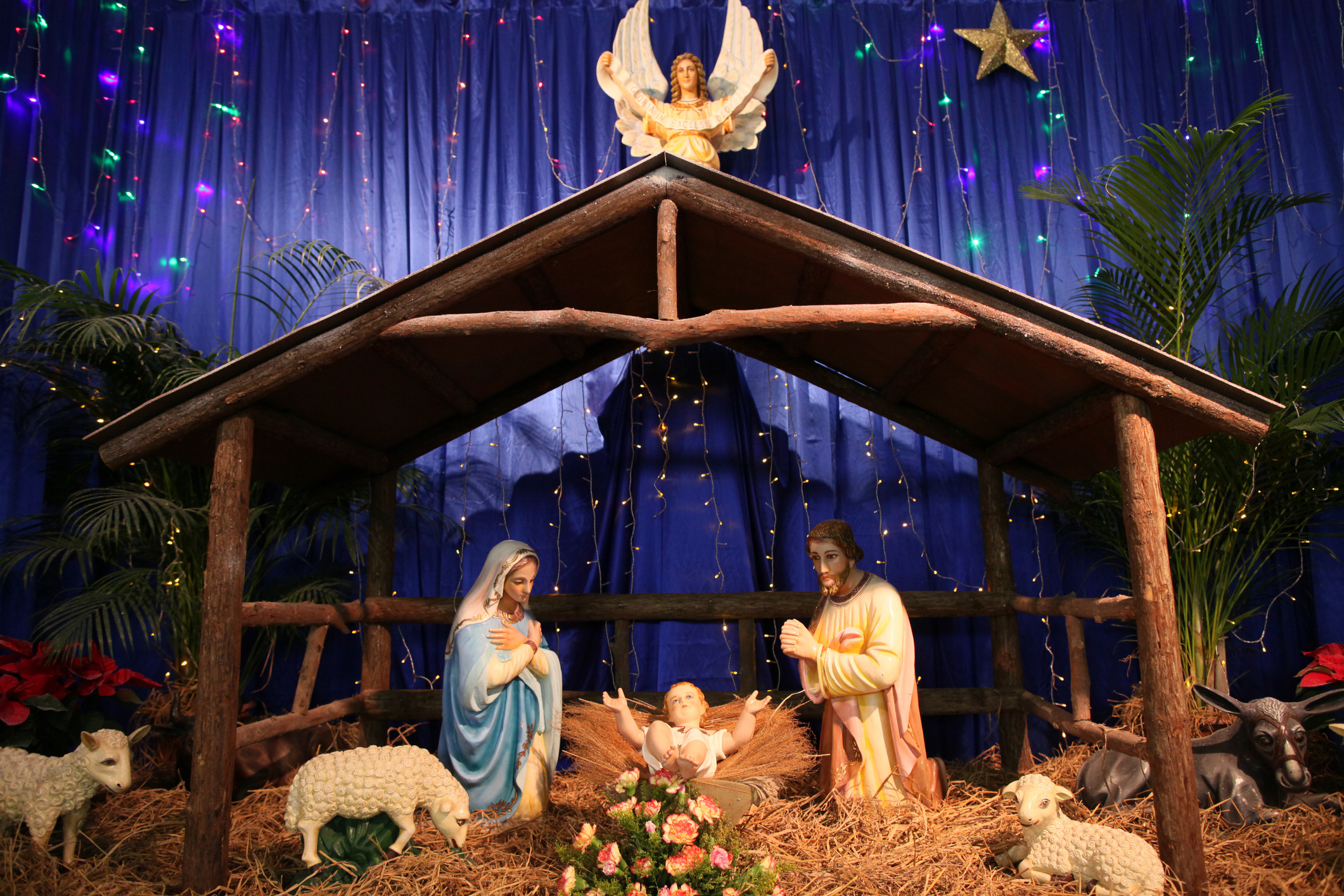
In Luke 1:31–38, Mary learns from the angel Gabriel that she will conceive and bear a child called Jesus through the action of the Holy Spirit. When Mary is due to give birth, she and Joseph travel from Nazareth to Joseph's ancestral home in Bethlehem to register in the census ordered by Caesar Augustus. While there, Mary gives birth to Jesus, and, as they have found no room in the inn, she places the newborn in a manger. An angel announces the birth to a group of shepherds, who go to Bethlehem to see Jesus and subsequently spread the news abroad. Luke 2:21 recounts how Joseph and Mary have their baby circumcised on the eighth day after birth and name him Jesus, as Gabriel had commanded Mary. After the presentation of Jesus at the Temple, Joseph, Mary, and Jesus return to Nazareth.
Early life, family, and profession
Jesus's childhood home is identified in the Gospels of Luke and Matthew as Nazareth, a town in Galilee in present-day Israel, where he lived with his family. Although Joseph appears in descriptions of Jesus's childhood, no mention is made of him thereafter. His other family members, including his mother Mary; his four brothers, James, Joses (or Joseph), Judas, and Simon; and his unnamed sisters, are mentioned in the Gospels and other sources. Jesus's maternal grandparents are named Joachim and Anne in the Gospel of James. The Gospel of Luke records that Mary was a relative of Elizabeth, the mother of John the Baptist. Some extra-biblical contemporary sources consider Jesus and John the Baptist to be second cousins, based on the belief that Elizabeth was the daughter of Sobe, the sister of Anne.
The Gospel of Mark reports that at the beginning of his ministry, Jesus comes into conflict with his neighbours and family. Jesus's mother and brothers come to get him because people are saying that he is out of his mind. Jesus responds that his followers are his true family. In the Gospel of John, Jesus and his mother attend a wedding at Cana, where he performs his first miracle at her request. Later, she is present at his crucifixion, and he expresses concern for her well-being.
Jesus is called a τέκτων (tektōn) in Mark 6:3, a term traditionally understood as "carpenter" but which can also refer to makers of objects in various materials, including builders. Given the term's broad semantic range and "the socio-historical reality of a common Nazarene τέκτων", Matthew K. Robinson, a minister and academic, prefers to translate τέκτων as 'builder-craftsman'. The Gospels indicate that Jesus could read, paraphrase, and debate scripture, but this does not necessarily mean that he received formal scribal training.
The Gospel of Luke reports two journeys of Jesus and his parents in Jerusalem during his childhood. They come to the Temple in Jerusalem for the presentation of Jesus as a baby in accordance with Jewish Law, where a man named Simeon prophesies about Jesus and Mary. When Jesus, at the age of twelve, goes missing on a pilgrimage to Jerusalem for Passover, his parents find him in the Temple sitting among the teachers, listening to them and asking questions, and the people are amazed at his understanding and answers. Mary scolds Jesus for going missing, to which Jesus replies that he must "be in his Father's house".
Baptism and temptation
The synoptic gospels describe Jesus's baptism in the Jordan River and the temptations he faced while spending forty days in the Judaean Desert as a preparation for his public ministry. In each of these accounts, the accounts of Jesus's baptism is preceded by information about John the Baptist. They portray John preaching repentance for the forgiveness of sins, encouraging the giving of alms to the poor, baptizing people in the region of the Jordan River around Perea, and foretelling the arrival of someone "more powerful" than he.
In the Gospel of Mark, John the Baptist baptizes Jesus, and as Jesus comes up out of the water he sees the Holy Spirit descending on him like a dove, and a voice comes from heaven and declares him to be God's Son. This is one of two events described in the Gospels where a voice from Heaven refers to Jesus as "Son", the other being the Transfiguration. The Spirit then drives him into the wilderness, where he is tempted by Satan. After John's arrest, Jesus begins his ministry in Galilee.
In the Gospel of Matthew, when Jesus comes to John to be baptized, John protests, saying, "I need to be baptized by you." Jesus instructs him to proceed with the baptism "to fulfil all righteousness". Matthew then narrates three specific temptations that Satan offers Jesus in the wilderness. In the Gospel of Luke, the Holy Spirit descends in bodily form like a dove after all the people have been baptized and while Jesus is praying. Later, John implicitly acknowledges Jesus by sending his followers to inquire about him. Luke also describes three temptations experienced by Jesus in the wilderness before he begins his ministry in Galilee.
The Gospel of John does not narrate Jesus's baptism and temptation. Instead, John the Baptist testifies that he saw the Spirit descend and remain on Jesus. John publicly proclaims Jesus as the Lamb of God, and some of John's followers become disciples of Jesus. Before John is imprisoned, Jesus leads his followers to baptize, and they baptize more people than John.
Public ministry
The Synoptics depict two main geographical settings in Jesus's ministry. The first takes place in Galilee, north of Judea, where Jesus conducts a largely successful ministry; the second occurs in Jerusalem, where he is rejected and killed. Often referred to as "rabbi", Jesus delivers his message orally. In these accounts, he forbids those who recognize him as the messiah—including people he heals and demons he is said to exorcise—to speak about it (see Messianic Secret). By contrast, the Gospel of John portrays Jesus's ministry as taking place primarily in and around Jerusalem rather than in Galilee, and his divine nature is more openly proclaimed and recognized.
Scholars commonly divide the ministry of Jesus into several stages. The Galilean ministry begins when Jesus returns to Galilee from the Judaean Desert after resisting the temptations of Satan. He then preaches throughout Galilee, and in Matthew 4:18–20, his first disciples—who will later form the core of the early Church—encounter him and begin to follow him. This period includes the Sermon on the Mount, one of Jesus's major discourses, as well as the calming of the storm, the feeding of the 5,000, walking on water, and various other miracles and parables. It concludes with the Confession of Peter and the Transfiguration.
As Jesus travels towards Jerusalem, during what is often called the Perean ministry, he returns to the region where he was baptized, roughly a third of the way down from the Sea of Galilee along the Jordan River. The final phase of his ministry, In Jerusalem, begins with his triumphal entry into the city on Palm Sunday. In the Synoptic Gospels, during that week Jesus drives the money changers from the Second Temple, and Judas bargains to betray him. This period culminates in the Last Supper and, in the Johannine account, the Farewell Discourse.
Near the beginning of his ministry, Jesus appoints twelve apostles. In Matthew and Mark, Jesus calls his first four apostles, who are fishermen, and they are described as immediately leaving their nets to follow him. In John, Jesus's first two apostles are initially disciples of John the Baptist; the Baptist sees Jesus and calls him the Lamb of God, and the two, hearing this, begin to follow Jesus. In addition to the Twelve Apostles, the introduction of the Sermon on the Plain in Luke identifies a much larger group of people as disciples. In Luke 10:1–16, Jesus sends 70 or 72 of his followers out in pairs to prepare towns for his prospective visits; they are instructed to accept hospitality, heal the sick, and proclaim the Kingdom of God.
Resurrection and ascension
The Gospels do not describe the moment of the resurrection of Jesus. They describe the discovery of his empty tomb and several appearances of Jesus, with distinct differences in each narrative.
In the four Gospels, Mary Magdalene goes to the tomb on Sunday morning, alone or with one or several other women. The tomb is empty, with the stone rolled away, and there are one or two angels, depending on the accounts. In the Synoptics, the women are told that Jesus is not here and that he is risen. In Mark and Matthew, the angel also instructs them to tell the disciples to meet Jesus in Galilee. In Luke, Peter visits the tomb after he is told it is empty. In John, he goes there with the beloved disciple. Matthew mentions Roman guards at the tomb, who report to the priests of Jerusalem what happened. The priests bribe them to say that the disciples stole Jesus's body during the night.
The four Gospels then describe various appearances of Jesus in his resurrected body. Jesus first reveals himself to Mary Magdalene in Mark 16:9 and John 20:14–17, along with "the other Mary" in Matthew 28:9, while in Luke the first reported appearance is to two disciples heading to Emmaus. Jesus then reveals himself to the eleven disciples, in Jerusalem or in Galilee. In Luke 24:36–43, he eats and shows them his tangible wounds to prove that he is not a spirit. He also shows them to Thomas to end his doubts, in John 20:24–29. In the Synoptics, Jesus commissions the disciples to spread the gospel message to all nations, while in John 21, he tells Peter to take care of his sheep.
Jesus's ascension into Heaven is described in Luke 24:50–53, Acts 1:1–11, and mentioned in 1 Timothy 3:16. In the Acts of the Apostles, forty days after the Resurrection, as the disciples look on, "he was lifted up, and a cloud took him out of their sight". 1 Peter 3:22 states that Jesus has "gone into heaven and is at the right hand of God".
The Acts of the Apostles describes several appearances of Jesus after his Ascension. In Acts 7:55, Stephen gazes into heaven and sees "Jesus standing at the right hand of God" just before his death. On the road to Damascus, the Apostle Paul is converted to Christianity after seeing a blinding light and hearing a voice saying, "I am Jesus, whom you are persecuting." In Acts 9:10–18, Jesus instructs Ananias of Damascus in a vision to heal Paul. The Book of Revelation includes a revelation from Jesus concerning the last days of Earth.
Early Christianity
After Jesus's life, his followers, as described in the first chapters of the Acts of the Apostles, were all Jews either by birth or conversion, for which the biblical term "proselyte" is used, and referred to by historians as Jewish Christians. The early Gospel message was spread orally, probably in Aramaic, but almost immediately also in Greek. The New Testament's Acts of the Apostles and Epistle to the Galatians record that the first Christian community was centred in Jerusalem and its leaders included Peter, James, the brother of Jesus, and John the Apostle.
After his conversion, Paul the Apostle spread the teachings of Jesus to various non-Jewish communities throughout the eastern Mediterranean region. Paul's influence on Christian thinking is said to be more significant than that of any other New Testament author. By the end of the 1st century, Christianity began to be recognized internally and externally as a separate religion from Judaism which itself was refined and developed further in the centuries after the destruction of the Second Temple.
Numerous quotations in the New Testament and other Christian writings of the first centuries indicate that early Christians generally used and revered the Hebrew Bible (the Tanakh) as religious text, mostly in the Greek (Septuagint) or Aramaic (Targum) translations. Early Christians wrote many religious works, including the ones included in the canon of the New Testament. The canonical texts, which have become the main sources used by historians to try to understand the historical Jesus and sacred texts within Christianity, were probably written between AD 50 and 120.
Historical views
Prior to the Enlightenment, the Gospels were usually regarded as accurate historical accounts, but since then scholars have emerged who question the reliability of the Gospels and draw a distinction between the Jesus described in the Gospels and the Jesus of history. Since the 18th century, three separate scholarly quests for the historical Jesus have taken place, each with distinct characteristics and based on different research criteria, which were often developed during the quest that applied them. While there is widespread scholarly agreement on the existence of Jesus, and a basic consensus on the general outline of his life, the portraits of Jesus constructed by various scholars often differ from each other, and from the image portrayed in the gospel accounts.
Approaches to the historical reconstruction of the life of Jesus have varied from the "maximalist" approaches of the 19th century, in which the gospel accounts were accepted as reliable evidence wherever it is possible, to the "minimalist" approaches of the early 20th century, where hardly anything about Jesus was accepted as historical. In the 1950s, as the second quest for the historical Jesus gathered pace, the minimalist approaches faded away, and in the 21st century, minimalists such as Price are a small minority. Although a belief in the inerrancy of the Gospels cannot be supported historically, many scholars since the 1980s have held that, beyond the few facts considered to be historically certain, certain other elements of Jesus's life are "historically probable". Modern scholarly research on the historical Jesus thus focuses on identifying the most probable elements.
Judea and Galilee in the 1st century
In AD 6, Judea, Idumea, and Samaria were transformed from a client state of the Roman Empire into an imperial province, also called Judea. A Roman prefect, rather than a client ruler, governed the land. The prefect governed from Caesarea Maritima, leaving Jerusalem to be run by the High Priest of Israel. As an exception, the prefect came to Jerusalem during religious festivals, when religious and patriotic enthusiasm sometimes inspired unrest or uprisings. Galilee with Perea was a Herodian client state under the rule of Herod Antipas since 4 BC. Galilee was evidently prosperous, and poverty was limited enough that it did not threaten the social order.
Philip (d. AD 34), half-brother of Herod Antipas, ruled as Tetrarch yet another Herodian client state to the north and east of the sea of Galilee that included Gaulanitis, Batanea, and Iturea; it was mostly non-Jewish. South of this on the east bank of the Jordan was the Decapolis; a collection of Hellenistic city-states that were clients of the Roman Empire. North of Galilee were the cities of Tyre and Sidon which were in the Roman province of Syria. Though non-Jewish lands surrounded the mostly Jewish territories of Judea and Galilee, Roman law and practice allowed Jews to remain separate legally and culturally.
This was the era of Hellenistic Judaism, which combined Jewish religious tradition with elements of Hellenistic culture. Until the fall of the Western Roman Empire and the Muslim conquests of the Eastern Mediterranean, the main centres of Hellenistic Judaism were Alexandria (Egypt) and Antioch (now Southern Turkey), the two main Greek colonies of the Middle East and North Africa area, both founded at the end of the 4th century BC in the wake of the conquests of Alexander the Great. Hellenistic Judaism also existed in Jerusalem during the Second Temple Period, where there was conflict between Hellenizers and traditionalists (sometimes called Judaizers). The Hebrew Bible was translated from Biblical Hebrew and Biblical Aramaic into Jewish Koine Greek; the Targum translations into Aramaic were also generated during this era, both due to the decline of knowledge of Hebrew.
Jews based their faith and religious practice on the Torah, five books said to have been given by God to Moses. The three prominent religious parties were the Pharisees, the Essenes, and the Sadducees. Together these parties represented only a small fraction of the population. Most Jews looked forward to a time when God would deliver them from their pagan rulers, possibly through war against the Romans.
Sources
New Testament scholars face a formidable challenge when they analyse the canonical Gospels. The Gospels are not biographies in the modern sense, and the authors explain Jesus's theological significance and recount his public ministry while omitting many details of his life. James Dunn has argued that the accounts of his teachings and life were initially conserved by oral transmission, which was the source of the written Gospels. The Gospels are commonly seen as literature that is based on oral traditions, Christian preaching, and Old Testament exegesis with the consensus being that they are a variation of Greco-Roman biography; similar to other ancient works such as Xenophon's Memoirs of Socrates.
The reports of supernatural events associated with Jesus's death and resurrection make the challenge even more difficult. Scholars regard the Gospels as compromised sources of information because the writers were trying to glorify Jesus. Ed Sanders argues that surviving textual sources provide more reliable details for Jesus's thoughts than they do for the thoughts of Alexander the Great, owing to the texts discussing Jesus being authored closer in time to the events they relate to. Biographies written about Alexander the Great during his own lifetime (who lived 330 years earlier) have all been lost, but are known of through references in biographies written by later authors. Although the texts about Jesus contain ideas from both Jesus and his later followers, it is possible to distinguish which parts originate from Jesus's own view, and which were ideas from his later followers.
Scholars use several criteria, such as the criterion of independent attestation, the criterion of coherence, and the criterion of discontinuity to judge the historicity of events. The historicity of an event also depends on the reliability of the source; indeed, the Gospels are not independent nor consistent records of Jesus's life. The Synoptics, especially Mark, the earliest written gospel, have been considered the most reliable sources of information about Jesus for many decades. John, the latest written gospel, differs considerably from the Synoptic Gospels, and has been considered less reliable, although John's gospel is seen as having more reliability than previously thought or sometimes even more reliable than the synoptics since the third quest.
Some scholars (such as the Jesus Seminar) believe that the non-canonical Gospel of Thomas might be an independent witness to many of Jesus's parables and aphorisms. For example, Thomas confirms that Jesus blessed the poor and that this saying circulated independently before being combined with similar sayings in the Q source. The majority of scholars are sceptical about this text and believe it should be dated to the 2nd century AD. Other select non-canonical Christian texts may also have value for historical Jesus research.
Chronology
Jesus was a Galilean Jew, born around the beginning of the 1st century, who died in AD 30 or 33 in Judea. The general scholarly consensus is that Jesus was a contemporary of John the Baptist and was crucified as ordered by the Roman governor Pontius Pilate, who held office from AD 26 to 36.
The Gospels offer several indications concerning the year of Jesus's birth. Matthew 2:1 associates the birth of Jesus with the reign of Herod the Great, who died around 4 BC, and Luke 1:5 mentions that Herod was on the throne shortly before the birth of Jesus, although this gospel also associates the birth with the Census of Quirinius which took place ten years later. Luke 3:23 states that Jesus was "about thirty years old" at the start of his ministry, which according to Acts 10:37–38 was preceded by John the Baptist's ministry, which was recorded in Luke 3:1–2 to have begun in the 15th year of Tiberius's reign (AD 28 or 29). By collating the gospel accounts with historical data and using various other methods, most scholars arrive at a date of birth for Jesus between 6 and 4 BC, but some propose estimates that include a wider range.
The date range for Jesus's ministry has been estimated using several different approaches. One of these applies the reference in Luke 3:1–2, Acts 10:37–38, and the dates of Tiberius's reign, which are well known, to give a date of around AD 28–29 for the start of Jesus's ministry. Another approach estimates a date around AD 27–29 by using the statement about the temple in John 2:13–20, which asserts that the temple in Jerusalem was in its 46th year of construction at the start of Jesus's ministry, together with Josephus's statement that the temple's reconstruction was started by Herod the Great in the 18th year of his reign. A further method uses the date of the death of John the Baptist and the marriage of Herod Antipas to Herodias, based on the writings of Josephus, and correlates it with Matthew 14:4 and Mark 6:18. Given that most scholars date the marriage of Herod and Herodias as AD 28–35, this yields a date about AD 28–29.
Various approaches have been used to estimate the year of the crucifixion of Jesus. Most scholars agree that he died in AD 30 or 33. The Gospels state that the event occurred during the prefecture of Pilate. The date for the conversion of Paul (estimated to be AD 33–36) acts as an upper bound for the date of Crucifixion. The dates for Paul's conversion and ministry can be determined by analysing the Pauline epistles and the Acts of the Apostles. Astronomers have tried to estimate the precise date of the Crucifixion by analysing lunar motion and calculating historic dates of Passover, a festival based on the lunisolar Hebrew calendar. The most widely accepted dates derived from this method are 7 April AD 30, and 3 April AD 33 (both Julian).
Historicity of events
Nearly all historians (both modern and historical) agree that Jesus was a real person who historically existed. Scholars have reached a limited consensus on the basics of Jesus's life.
Many scholars including biblical ones agree that Joseph, Jesus's father, died before Jesus began his ministry. Joseph is not mentioned in the Gospels during Jesus's ministry. Joseph's death would explain why in Mark 6:3, Jesus's neighbours refer to Jesus as the "son of Mary" (sons were usually identified by their fathers).
According to Theissen and Merz, it is common for extraordinary charismatic leaders, such as Jesus, to come into conflict with their ordinary families. In Mark, Jesus's family comes to get him, fearing that he is mad (Mark 3:20–34), and this account is thought to be historical because early Christians would probably not have invented it. After Jesus's death, many members of his family joined the Christian movement. Jesus's brother James became a leader of the Jerusalem Church.
Géza Vermes says that the doctrine of the virgin birth of Jesus arose from theological development rather than from historical events.
Other scholars take it as significant that the virgin birth is attested by two separate gospels, Matthew and Luke.
E. P. Sanders and Marcus Borg note that the birth narratives in Matthew and Luke are ahistorical and the clearest cases of invention in the Gospel narratives of Jesus's life. Dale Allison and W. D. Davies argue that Matthew presents a unified and preexisting infancy narrative based on haggadic legends about Moses, though they maintain that elements in the story such as the names of Mary and Joseph and Jesus being in Nazareth during Herod's reign are historical. Both accounts have Jesus born in Bethlehem, in accordance with Jewish salvation history, and both have him growing up in Nazareth, but Sanders points out that the two report different explanations for how that happened. Luke's account of a worldwide census is not plausible, while Matthew's account is more plausible, but the story reads as though it was invented to identify Jesus as a new Moses, and the historian Josephus reports Herod the Great's brutality without ever mentioning that he massacred little boys. Scholars including Gerd Theissen and Annette Merz conclude that Jesus was born in Nazareth, and the Bethlehem birth narrative was developed to align Jesus's story with scripture foretelling that the messiah would be born in Bethlehem. The differences found in the gospel accounts are typical of ancient historical biographies. The contradictions were apparent to early Christians, with harmonizations present in the infancy gospels of Thomas and the Gospel of James, which are dated to the 2nd century AD.
Portraits of Jesus
Modern research on the historical Jesus has not led to a unified picture of the historical figure, partly because of the variety of academic traditions represented by the scholars. Given the scarcity of historical sources, it is generally difficult for any scholar to construct a portrait of Jesus that can be considered historically valid beyond the basic elements of his life. The portraits of Jesus constructed in these quests often differ from each other, and from the image portrayed in the Gospels.
Jesus is seen as the founder of, in the words of Sanders, a "renewal movement within Judaism". One of the criteria used to discern historical details in the "third quest" is the criterion of plausibility, relative to Jesus's Jewish context and to his influence on Christianity. A disagreement in contemporary research is whether Jesus was apocalyptic. Most scholars conclude that he was an apocalyptic preacher, like John the Baptist and Paul the Apostle. Certain prominent North American scholars, such as Burton Mack and John Dominic Crossan, advocate for a non-eschatological Jesus, one who is more of a Cynic sage than an apocalyptic preacher. In addition to portraying Jesus as an apocalyptic prophet, a charismatic healer or a cynic philosopher, some scholars portray him as the true messiah or an egalitarian prophet of social change. The attributes described in the portraits sometimes overlap, and scholars who differ on some attributes sometimes agree on others.
Since the 18th century, scholars have occasionally put forth that Jesus was a political national messiah, but the evidence for this portrait is negligible. Likewise, the proposal that Jesus was a Zealot does not fit with the earliest strata of the Synoptic tradition.
Language, ethnicity, and appearance
Jesus grew up in Galilee and much of his ministry took place there. The languages spoken in Galilee and Judea during the 1st century AD included Jewish Palestinian Aramaic, Hebrew, and Greek, with Aramaic being predominant. There is substantial consensus that Jesus gave most of his teachings in Aramaic in the Galilean dialect. Other than Aramaic and Hebrew, it is likely that he was also able to speak Greek.
Modern scholars agree that Jesus was a Jew of 1st-century Judea. Ioudaios in New Testament Greek is a term which in the contemporary context may refer to religion (Second Temple Judaism), ethnicity (of Judea), or both. In a review of the state of modern scholarship, Amy-Jill Levine writes that the entire question of ethnicity is "fraught with difficulty", and that "beyond recognizing that 'Jesus was Jewish', rarely does the scholarship address what being 'Jewish' means".
The New Testament gives no description of the physical appearance of Jesus before his death—it is generally indifferent to racial appearances and does not refer to the features of the people it mentions. Jesus probably looked like a typical Jewish man of his time and place; standing around 166 cm (5 ft 5 in) tall with a thin but fit build, olive-brown skin, brown eyes and short, dark hair. He also probably had a beard that was not particularly long or heavy.
Christ myth theory
The Christ myth theory is the hypothesis that Jesus of Nazareth never existed; or that if he did, he had virtually nothing to do with the founding of Christianity and the accounts in the gospels. Stories of Jesus's birth, along with other key events, have so many mythic elements that some scholars have suggested that Jesus himself was a myth.
Bruno Bauer (1809–1882) taught that the first Gospel was a work of literature that produced history rather than described it. According to Albert Kalthoff (1850–1906), a social movement produced Jesus when it encountered Jewish messianic expectations. Arthur Drews (1865–1935) saw Jesus as the concrete form of a myth that predated Christianity. Despite arguments put forward by authors who have questioned the existence of a historical Jesus, virtually all scholars of antiquity accept that Jesus was a historical figure and consider the myth theory to be fringe.
Religious perspectives
Jesus's teachings and the retelling of his life story have significantly influenced the course of human history, and have directly or indirectly affected the lives of billions of people, even non-Christians, worldwide. He is considered by many people to be the most influential figure to have ever lived, finding a significant place in numerous cultural contexts.
Apart from his own disciples and followers, the Jews of Jesus's day generally rejected him as the messiah, as does Judaism today. Christian theologians, ecumenical councils, reformers and others have written extensively about Jesus over the centuries. Christian denominations have often been defined or characterized by their descriptions of Jesus. Meanwhile, Manichaeans, Gnostics, Muslims, Druzes, the Baháʼís, and others have found prominent places for Jesus in their religions.
Christianity
Jesus is the central figure of Christianity. Although Christian views of Jesus vary, it is possible to summarize the key beliefs shared by the major denominations, as stated in their catechetical or confessional texts. Christian views of Jesus are derived from the texts of the New Testament, including the canonical gospels and letters such as the Pauline epistles and the Johannine writings. These documents outline the key Christian beliefs about Jesus, including his divinity, humanity, and earthly life, and that he is the Christ and the Son of God. Despite their many shared beliefs, not all Christian denominations agree on all doctrines, and both major and minor differences on teachings and beliefs have persisted throughout Christianity for centuries.
The New Testament states that the resurrection of Jesus is the foundation of the Christian faith. Christian doctrine holds that through his sacrificial death and resurrection, humans can be reconciled with God and are thereby offered salvation and the promise of eternal life. Recalling the words of John the Baptist in the gospel of John, these doctrines sometimes refer to Jesus as the Lamb of God, who was crucified to fulfil his role as the servant of God. Jesus is thus seen as the new and last Adam, whose obedience contrasts with Adam's disobedience. Christians view Jesus as a role model, whose God-focused life believers are encouraged to imitate.
Most branches of Christianity believe that Jesus is both human and the Son of God. While there has been theological debate over his nature, Trinitarian Christians generally believe that Jesus is the Logos, God's incarnation and God the Son, both fully divine and fully human. The doctrine of the Trinity is not universally accepted among Christians. With the Reformation, Christians such as Michael Servetus and the Socinians started questioning the ancient creeds that had established Jesus's two natures. Nontrinitarian Christian groups include the Church of Jesus Christ of Latter-day Saints, Unitarians and Jehovah's Witnesses.
Christians revere not only Jesus but also his name. Devotions to the Holy Name of Jesus go back to the earliest days of Christianity. These devotions and feasts exist in both Eastern and Western Christianity.
Judaism
Judaism rejects the idea of Jesus (or any future Jewish messiah) being God, or a mediator to God, or part of a Trinity. It holds that Jesus is not the messiah, arguing that he neither fulfilled the messianic prophecies in the Tanakh nor embodied the personal qualifications of the Messiah. Jews argue that Jesus did not fulfil prophecies to build the Third Temple, gather Jews back to Israel, bring world peace, and unite humanity under the God of Israel. Furthermore, according to Jewish tradition, there were no prophets after Malachi, who delivered his prophecies in the 5th century BC.
Judaic criticism of Jesus is long-standing and includes a range of stories found in the Talmud, written and compiled between the 3rd and 5th centuries. In one such story, Yeshu HaNozri ('Jesus the Nazarene'), a lewd apostate, is executed by the Jewish high court for spreading idolatry and practising magic. According to some, the form Yeshu is an acronym which in Hebrew reads "may his name and memory be blotted out". The majority of contemporary scholars consider that this material provides no information on the historical Jesus. The Mishneh Torah, a late 12th-century work of Jewish law written by Moses Maimonides, states that Jesus is a "stumbling block" who makes "the majority of the world to err and serve a god other than the Lord".
Mediaeval Hebrew literature contains the anecdotal "Episode of Jesus" (known also as Toledot Yeshu), in which Jesus is described as being the son of Joseph, the son of Pandera (see: Episode of Jesus). The account portrays Jesus as an imposter.
Manichaeism
Manichaeism, an ancient religious movement, became one of the earliest organized religions outside of Christianity to honour Jesus as a significant figure. Within the Manichaean belief system, Jesus is revered alongside other prominent prophets such as Zoroaster, Gautama Buddha, and Mani himself.
Islam
A major figure in Islam, Jesus (often referred to by his Quranic name ʿĪsā) is considered to be a messenger of God and the messiah (al-Masīḥ) who was sent to guide the Children of Israel (Banī Isrāʾīl) with a new scripture, the Gospel (referred to in Islam as Injīl). The form ʿĪsē is a pre-Islamic phonosemantic correspondence with the Safaitic name ʿsy, attested in Arabian inscriptions. Muslims regard the gospels' accounts in the New Testament as partially authentic, and believe that Jesus's original message was altered (taḥrīf) and that Muhammad came later to revive it. Belief in Jesus (and all other messengers of God) is a requirement for being a Muslim. The Quran mentions Jesus by name 25 times—more often than Muhammad—and emphasizes that Jesus was a mortal human who, like all other prophets, had been divinely chosen to spread God's message. While the Quran affirms the Virgin birth of Jesus, he is considered to be neither an incarnation nor the son of God. Islamic texts emphasize a strict notion of monotheism (tawḥīd) and forbid the association of partners with God, which would be idolatry.
The Quran describes the annunciation to Mary (Maryam) by the Holy Spirit that she is to give birth to Jesus while remaining a virgin. It calls the virgin birth a miracle that occurred by the will of God. The Quran (21:91 and 66:12) states that God breathed his spirit into Mary while she was chaste. Jesus is called a "spirit from God" because he was born through the action of the Spirit, but that belief does not imply his pre-existence.
To aid in his ministry to the Jewish people, Jesus was given the ability to perform miracles, by permission of God rather than by his own power. Through his ministry, Jesus is seen as a precursor to Muhammad. In the Quran (4:155–160) it is said that the Jews claim to have killed Jesus in a similar manner to previous prophets sent to them, but that this was only made to appear that way, and that they neither killed nor crucified him and that he was raised into the heavens by God and that he will testify against the Jews during the Day of Resurrection.
According to most classic Sunni and Twelver Shi'ite interpretations of these verses, the likeness of Jesus was cast upon a substitute (most often one of his disciples), who was crucified in Jesus's stead. Some mediaeval Muslims, including the ghulāt writing under the name of al-Mufaddal ibn Umar al-Ju'fi, the Brethren of Purity, various Isma'ili philosophers, and the Sunni mystic al-Ghazali, affirmed the historicity of Jesus's crucifixion. These thinkers held the docetic view that, although Jesus's human body had died on the cross, his spirit had survived and ascended into heaven, so that his death was only an appearance. Nevertheless, to Muslims it is the ascension rather than the crucifixion that constitutes a major event in the life of Jesus. There is no mention of his resurrection on the third day, and his death plays no special role in Islamic theories of salvation. Jesus is a central figure in Islamic eschatology: Muslims believe that he will return to Earth at the end of time and defeat the Antichrist (ad-Dajjal) by killing him.
Druze
In the Druze faith, Jesus is considered and revered as one of the seven spokesmen or prophets (natiq), defined as messengers or intermediaries between God and mankind, along with figures including Moses, Muhammad and Muhammad ibn Isma'il, each of them sent at a different period of history to preach the message of God. In Druze tradition, Jesus is known under three titles: the True Messiah (al-Masih al-Haq), the Messiah of all Nations (Masih al-Umam), and the Messiah of Sinners. This is due, respectively, to the belief that Jesus delivered the true Gospel message, the belief that he was the Saviour of all nations, and the belief that he offers forgiveness.
Baháʼí Faith
In the Baháʼí Faith, Jesus is considered one of the Manifestations of God, defined as divine messengers or prophets sent by God to guide humanity, along with other religious figures such as Moses, Krishna, Zoroaster, Buddha, Muhammad, and Baháʼu'lláh. Baháʼís believe that these religious founders or leaders have contributed to the progressive revelation by bringing spiritual and moral values to humanity in their own time and place. As a Manifestation of God, Jesus is believed to reflect God's qualities and attributes, but is not considered the only saviour of humanity nor the incarnation of God. Baháʼís believe in the virgin birth, but see the resurrection and the miracles of Jesus as symbolic.
Other
In Christian Gnosticism (now a largely extinct religious movement), Jesus was sent from the divine realm and provided the secret knowledge (gnosis) necessary for salvation. It is important to note that Gnosticism is not a homogeneous religion, but an umbrella term used by modern scholars to describe diverse religious and philosophical ideas and systems that emerged in the late first century among early Christian sects and other religious movements. Most Gnostics believed that Jesus was a human who became possessed by the spirit of "the Christ" at his baptism. This spirit left Jesus's body during the crucifixion but was rejoined to him when he was raised from the dead. Some Gnostics were docetics, believing that Jesus did not have a physical body, but only appeared to possess one. The Gnostic Jesus can both differ greatly from the Christian Jesus, but also build on him. For instance, the Testimony of Truth, a Gnostic Christian text found in the Nag Hammadi library buried around 400 AD, explains that the serpent in Genesis 3 who instructs Adam and Eve is Jesus.
Hinduism has no established set of beliefs and no universal or common view of Jesus. However, a lot of Hindus, including religious and political leaders, tend to variously consider Jesus as either a Āchārya, Sadhu or Avatar. Some Hare Krishnas also claim that Jesus Christ is an exemplary Hare Krishna devotee, and was predicted and prophesied in the Bhavishya Purana.
Paramahansa Yogananda, an Indian guru, taught that Jesus was the reincarnation of Elisha and a student of John the Baptist, the reincarnation of Elijah. Some Buddhists, including Tenzin Gyatso, the 14th Dalai Lama, regard Jesus as a bodhisattva who dedicated his life to the welfare of people. The New Age movement entertains a wide variety of views on Jesus.
Theosophists, from whom many New Age teachings originated, refer to Jesus as the Master Jesus, a spiritual reformer, and they believe that Christ, after various incarnations, occupied the body of Jesus.
In the Anthroposophy founded by Rudolf Steiner, Jesus Christ is a central balancing force mediating between the two opposing polarities of evil, namely the fanatical exalted mysticism of Lucifer, and the cold materialism of Ahriman.
Atheists reject Jesus's divinity, but have different views about him—from challenging his mental health to emphasizing his "moral superiority" (Richard Dawkins).
Artistic depictions
As in other Early Christian art, the earliest depictions date to the late 2nd or early 3rd century, and surviving images are found in the Catacombs of Rome. Some of the earliest depictions of Jesus at the Dura-Europos church date to before 256. A wide range of depictions of Jesus appeared during the next two millennia, influenced by cultural settings, political circumstances and theological contexts.
The depiction of Christ in pictorial form was highly controversial in the early Church. From the 5th century, flat painted icons became popular in the Eastern Church. The Byzantine Iconoclasm acted as a barrier to developments in the East, but by the 9th century, art was permitted again. The Protestant Reformation brought renewed resistance to imagery, but total prohibition was atypical, and Protestant objections to images have tended to reduce since the 16th century. Although large images are generally avoided, few Protestants now object to book illustrations depicting Jesus. The use of depictions of Jesus is advocated by the leaders of denominations such as Anglicans and Catholics and is a key element of the Eastern Orthodox tradition.
In Eastern Christian art, the Transfiguration was a major theme, with every Eastern Orthodox monk trained in icon painting having to prove his craft by painting an icon depicting it. Icons receive the external marks of veneration, such as kisses and prostration, and they are thought to be powerful channels of divine grace.
In Western Europe, the Renaissance brought forth artists who focused on depictions of Jesus; Fra Angelico and others followed Giotto in the systematic development of uncluttered images. Before the Protestant Reformation, the crucifix was common in Western Christianity. It is a model of the cross with Jesus crucified on it. The crucifix became the central ornament of the altar in the 13th century, a use that has been nearly universal in Roman Catholic churches since then.
Associated relics
The total destruction that ensued with the siege of Jerusalem by the Romans in AD 70 made the survival of items from 1st-century Judea very rare, and almost no direct records survive about the history of Judaism from the last part of the 1st century to the 2nd century. Biblical scholar Margaret M. Mitchell writes that, although Eusebius (4th century) reports (Ecclesiastical History III 5.3) that the early Christians left Jerusalem for Pella just before Jerusalem was subjected to the final lockdown, we must accept that no items from the early Jerusalem Church have survived. Paranormal investigator Joe Nickell writes, "as investigation after investigation has shown, not a single, reliably authenticated relic of Jesus exists."
Throughout the history of Christianity, relics attributed to Jesus have been claimed, but doubt has been cast on them. The 16th-century Catholic theologian Erasmus wrote sarcastically about the proliferation of relics and the number of buildings that could have been constructed from the wood claimed to be from the cross used in the Crucifixion. Similarly, while experts debate whether Jesus was crucified with three nails or four, at least thirty holy nails are venerated as relics across Europe.
Some relics, such as purported remnants of the crown of thorns placed on the head of Jesus, receive only a modest number of pilgrims, while the Shroud of Turin (which is associated with an approved Catholic devotion to the Holy Face of Jesus), has received millions, including the popes John Paul II and Benedict XVI.