




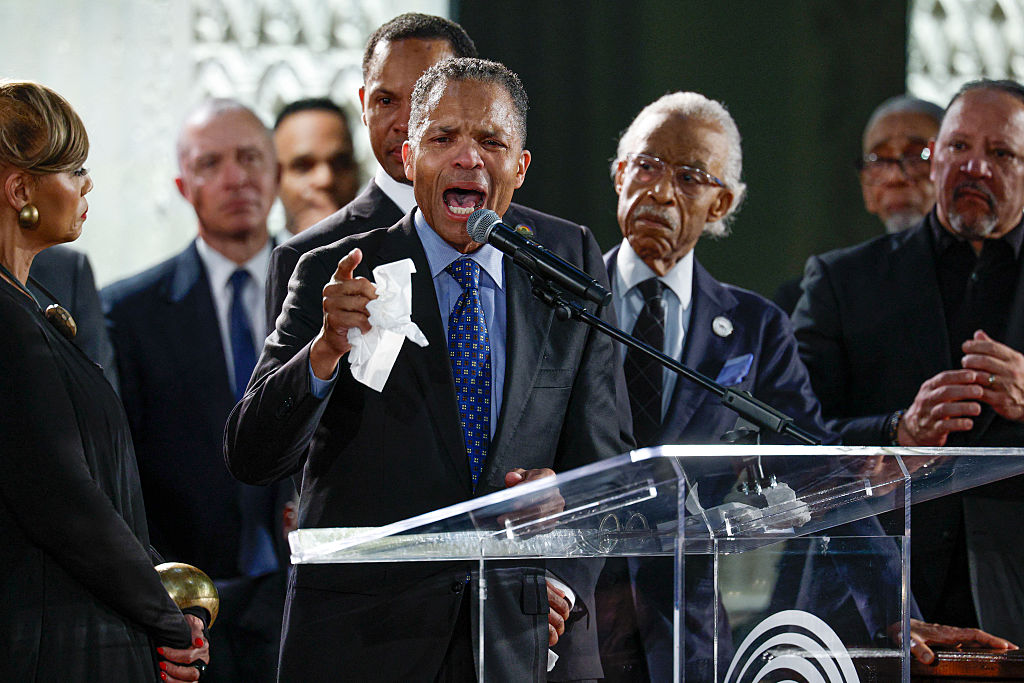
Jesse Louis Jackson (né Burns; October 8, 1941 – February 17, 2026) was an American civil rights activist, LGBTQ rights activist, politician, and ordained Baptist minister. A protégé of Martin Luther King Jr. and James Bevel during the civil rights movement, he became one of the most prominent civil rights leaders of the late 20th and early 21st centuries, and an ardent advocate and early supporter of LGBTQ rights in the United States. From 1991 to 1997, he served as a shadow United States senator for the District of Columbia.
Born in Greenville, South Carolina, Jackson began his activism in the 1960s and founded the organizations that later merged to form the Rainbow/PUSH Coalition. Expanding his work into international affairs in the 1980s, he became a vocal critic of the Reagan administration and launched a presidential campaign in 1984. Initially viewed as a fringe candidate, he finished third for the Democratic nomination behind former vice president Walter Mondale and Senator Gary Hart. He continued his activism and mounted a second presidential bid in 1988, finishing as the runner‑up for the Democratic nomination to Massachusetts governor Michael Dukakis.
Jackson did not seek the presidency again, but in 1990, he was elected as the District of Columbia's shadow senator, serving one term during the H. W. Bush and Clinton administrations. Although initially critical of President Bill Clinton, he later became a supporter and friend. Jackson hosted Both Sides with Jesse Jackson on CNN from 1992 to 2000. A critic of police brutality, the Republican Party, and conservative policies, he was widely regarded as one of the most influential African‑American activists of his era.
Contents
Early life and education
Jackson was born Jesse Louis Burns on October 8, 1941, in Greenville, South Carolina, to Helen Burns, an 18-year-old high school student, and her 33-year-old married neighbor Noah Louis Robinson. His ancestry included Cherokee, enslaved African-Americans, Irish plantation owners, and a Confederate sheriff. A former professional boxer, Robinson worked for a textile brokerage and was well known in the black community. A year after Jesse's birth, his mother married Charles Henry Jackson, a post-office maintenance worker who later adopted him. Jesse took his stepfather's surname, though he also maintained a close relationship with Robinson as he grew up. He said he considered both men his fathers.
As a child, Jesse Jackson was taunted by other children about his out‑of‑wedlock birth, and he said those experiences helped motivate him to succeed. Living under Jim Crow segregation laws, he was taught to go to the back of the bus and to use separate water fountains—practices he accepted until the Montgomery bus boycott of 1955. He attended a racially segregated school, Sterling High School in Greenville, where he was elected student class president, finished 10th in his class, and earned letters in baseball, football, and basketball.
After graduating from high school in 1959, Jackson rejected a contract from a minor-league professional baseball team so that he could attend the University of Illinois on a football scholarship. After his second semester at the predominantly white college, he transferred to North Carolina A&T, a historically black university in Greensboro, North Carolina. Accounts of the reasons for the transfer differed, though Jackson said he changed schools because racial prejudice prevented him from playing quarterback and limited his participation on a competitive public‑speaking team.
Writing an article on ESPN.com in 2002, sociologist Harry Edwards noted that the University of Illinois had previously had a black quarterback, but also observed that black athletes attending predominantly white colleges during the 1950s and 1960s encountered a "combination of culture shock and discrimination". Edwards suggested that Jackson left the University of Illinois in 1960 because he had been placed on academic probation, but the university's president reported in 1987 that Jackson's 1960 freshman transcript was clean and that he would have been eligible to re-enroll at any time.
Civil rights activism
SCLC and Operation Breadbasket
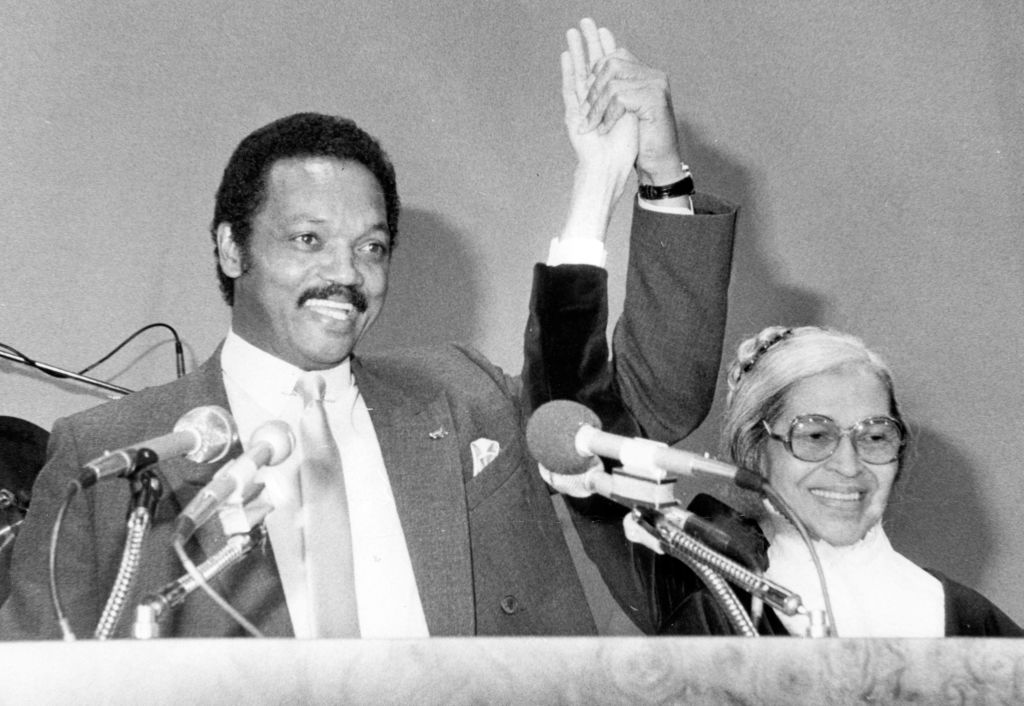
Jackson was known for commanding public attention since he first started working for Martin Luther King Jr. In 1965 he participated in the Selma to Montgomery marches organized by James Bevel, King, and other civil rights leaders in Alabama. Impressed by Jackson's drive and organizational abilities, King soon began giving Jackson a role in the Southern Christian Leadership Conference (SCLC), though he was concerned about Jackson's apparent ambition and attention-seeking. When Jackson returned from Selma, he was charged with establishing a frontline office for the SCLC in Chicago.
In 1966, King and Bevel selected Jackson to head the Chicago branch of the SCLC's economic arm, Operation Breadbasket, and he was promoted to national director in 1967. Operation Breadbasket had been started by the Atlanta leadership of the SCLC as a job placement agency for blacks. Under Jackson's leadership, a key goal was to encourage massive boycotts by black consumers as a means to pressure white-owned businesses to hire blacks and to purchase goods and services from black-owned firms.
T. R. M. Howard, a 1950s proponent of the consumer boycott tactic, soon became a major supporter of Jackson's efforts—donating and raising funds, and introducing Jackson to prominent members of the black business community in Chicago. Under Jackson's direction, Operation Breadbasket held popular weekly workshops on Chicago's South Side featuring white and black political and economic leaders, and religious services complete with a jazz band and choir.
Jackson became involved in SCLC leadership disputes after King's assassination on April 4, 1968. When King was shot, Jackson was in the parking lot one floor below. He told reporters he was the last person to speak to King, and that King died in his arms, an account that several King aides who were present disputed. In the wake of King's death, Jackson worked on SCLC's Poor People's Campaign in Washington, D.C., and was credited with managing its 15-acre tent city, but he began to clash with Ralph Abernathy, King's successor as SCLC chairman. In 1969, The New York Times reported that several black leaders viewed Jackson as King's successor and that Jackson was one of the few black activists who was preaching racial reconciliation. Jackson believed a conspiracy was involved in King's murder. In 1978, he met for four hours with King's convicted assassin, James Earl Ray. He said that Ray was involved in King's assassination but did not kill him, and that others who were involved were "still walking the streets".
Operation PUSH and the Rainbow Coalition
People United to Save Humanity (Operation PUSH) officially began operations on December 25, 1971; Jackson later changed the name to People United to Serve Humanity. T. R. M. Howard was installed as a member of the board of directors and chair of the finance committee. At its inception, Jackson planned to orient Operation PUSH toward politics and to pressure politicians to work to improve economic opportunities for blacks and poor people of all races. SCLC officials reportedly felt the new organization would help black businesses more than it would help the poor.
In 1978, Jackson called for a closer relationship between blacks and the Republican Party, telling the Party's National Committee that "Black people need the Republican Party to compete for us so we can have real alternatives... The Republican Party needs black people if it is ever to compete for national office." In 1983, Jackson and Operation PUSH led a boycott of beer giant Anheuser-Busch, criticizing the level of minority employment in its distribution network. In 1996, Jackson family friend Ron Burkle introduced Anheuser-Busch CEO August Busch IV to Yusef Jackson, Jesse's son. In 1998, Anheuser-Busch chose Yusef and his brother Jonathan to head River North Sales, a Chicago beer distribution company. The Chicago Tribune noted these moves in a 2001 front-page story. "There is no causal connection between the boycott in 1983 and me meeting in the middle '90s and me buying this company in 1998", Yusef said in a 2005 interview with Crain's Chicago Business.
In 1984, Jackson organized the Rainbow Coalition and resigned as president of Operation PUSH to run for president of the United States, though he remained involved as chairman of the board. PUSH's activities were described in 1987 as conducting boycotts of businesses to induce them to provide more jobs and business to blacks and as running programs for housing, social services, and voter registration. The organization was funded by contributions from businesses and individuals. In early 1987, the continued existence of Operation PUSH was imperiled by debt, a fact that Jackson's political opponents used during his race for the 1988 Democratic Party nomination. In the mid-1990s, the Operation PUSH and Rainbow Coalition organizations merged.
Other civil rights activism
On July 16, 1960, while he was home from college, Jackson joined seven other African Americans in a sit-in at the Greenville Public Library in Greenville, South Carolina, which only allowed white people. The group was arrested for "disorderly conduct". Jackson's pastor paid their bond, the Greenville News said. DeeDee Wright, another member of the group, later said they wanted to be arrested "so it could be a test case." The Greenville City Council closed both the main library and the branch that black people used. The possibility of a lawsuit led to the reopening of both libraries September 19, also the day after the News printed a letter written by Wright.
In 1984, Jackson and Coretta Scott King sent letters to Florida governor Bob Graham asking him to halt the scheduled execution of James Dupree Henry, a black man convicted of killing Z. L. Riley, an Orlando based civil rights leader. Jackson met with Graham, but was unable to persuade him, and Henry was executed on September 20.
LGBT rights activism
Jackson was an ardent advocate and early supporter of LGBT rights in the United States. While seeking the 1984 Democratic presidential nomination, he became the first person to mention gays and lesbians in a major-party convention speech when he included gays and lesbians as part of the fabric of American society in his speech to the 1984 Democratic National Convention, saying, "the lesbian, the gay [...] make up the American quilt" and "The rainbow includes lesbians and gays. No American citizen ought to be denied equal protection from the law". In 1987, while seeking the 1988 Democratic presidential nomination, Jackson was one of the leaders of the Second National March on Washington for Lesbian and Gay Rights.
In both of his presidential campaigns, Jackson placed LGBT rights front and center in a way no presidential candidate had done before, advocating for ending employment discrimination against gay employees and for ending the ban on openly gay service members in the military. In 1993, he spoke at the March on Washington for Lesbian, Gay, and Bi Equal Rights and Liberation, saying: "No more homophobia. Let's respect people, protect people. Everyone is somebody".
In 2004, Jackson spoke out in support of same-sex marriage in a speech in Massachusetts, which had become the first state to recognize same-sex marriage, saying, "Gays deserve the right of choice to choose their own partners". In 2010, he gave a speech to a gay rights rally in San Francisco at the United States Court of Appeals for the Ninth Circuit, which was then considering a case challenging 2008 California Proposition 8, and said:
We stand with you today to support marriage equality and to declare that Proposition 8 must be struck down as unconstitutional. People's right to self-expression, self-determination, must be respected and affirmed. It's time to challenge ignorance, a time to break the silence and the chains of hatred, of divisive and discriminatory bigotry. Marriage is based on love and commitment—not on sexual orientation. I support the right for any person to marry the person of their choosing.
If Dr. King and our civil rights movement has taught us anything, it's the fundamental principle of that all people deserve equal protection under the law. LGBT people deserve equal rights—including marriage equality—and equal protection under the law. Discrimination against one group of people is discrimination against all of us. The state—and the courts—should not sanction discrimination.
International activism
Jackson's influence extended to international matters in the 1980s and 1990s. In 1983, he traveled to Syria to secure the release of the captured American pilot Robert Goodman, who was being held by the Syrian government. Goodman had been shot down over Lebanon while on a mission to bomb Syrian positions there. After Jackson made a dramatic personal appeal to President Hafez al-Assad, Goodman was released. The Reagan administration was initially skeptical about Jackson's trip, but after Jackson secured Goodman's release, Reagan welcomed Jackson and Goodman to the White House on January 4, 1984. This helped boost Jackson's popularity as a patriot and served as a springboard for his 1984 presidential run. In June 1984 Jackson negotiated the release of 22 Americans being held in Cuba after an invitation by Cuban president Fidel Castro. On the eve of the 1991 Persian Gulf War, Jackson went to Iraq to plead with Saddam Hussein for the release of foreign nationals held there as "human shields", securing the release of several Britons and 20 Americans.
Jackson was an outspoken advocate for the end of South Africa's racial apartheid regime, lobbying Pope John Paul II and Soviet leader Mikhail Gorbachev against the South African government; he accompanied anti-apartheid leader (and future president) Nelson Mandela upon Mandela's release from prison. In 1997, Jackson traveled to Kenya to meet with Kenyan President Daniel arap Moi as U.S. President Bill Clinton's special envoy for democracy to promote free and fair elections. In April 1999, during the Kosovo War and the NATO bombing of Yugoslavia, he traveled to Belgrade to negotiate the release of three U.S. POWs captured on the Macedonian border while patrolling with a UN peacekeeping unit. Jackson, Serbian American congressman Rod Blagojevich, and rabbi Steven Jacobs met with then-Yugoslav president Slobodan Milošević, who later agreed to release the three men. Jackson's negotiation was not officially sanctioned by the Clinton administration and was deemed a private humanitarian mission. Despite this, Jacobs was received by the Clinton White House for his prominent role on Jackson's negotiating team.
On February 15, 2003, Jackson spoke to over an estimated one million people in Hyde Park, London, at the culmination of the demonstration against the imminent invasion of Iraq by the U.S. and the United Kingdom. In November 2004, he visited senior politicians and community activists in Northern Ireland in an effort to encourage better cross-community relations, rebuild the peace process, and restore the governmental institutions of the Belfast Agreement.
Political activism
During the 1980s, Jackson achieved wide fame as a politician and a spokesman for civil rights issues.
1984 presidential campaign
In May 1983, Jackson became the first African-American man since Reconstruction to address a joint session of the Alabama Legislature, where he said it was "about time we forgot about black and white and started talking about employed and unemployed". Art Harris saw Jackson as "testing the waters for a black presidential candidacy down South". In June, Jackson delivered a speech to 4,000 black Baptist ministers in Memphis bemoaning the fact that only one percent of American public officials were African-American despite blacks making up 12 percent of the population; the crowd responded with chants for him to "Run". Jackson's address to the National Congress of American Indians and touring of southern Texas to test his appeal among Hispanics fueled speculation that he would run for president.
On November 3, 1983, Jackson announced his campaign for president of the United States in the 1984 election, becoming the second African American (after Shirley Chisholm) to mount a nationwide campaign for president as a Democrat. Jackson's candidacy divided support among black politicians, and even prominent African Americans such as Coretta Scott King, who supported his right to run, refrained from endorsing him due to their belief he would not win the nomination. Among black office-holders, Jackson received the support of former Mayor of Atlanta Maynard Jackson, and Mayor of Newark Kenneth A. Gibson. Jackson entered the race after most prominent Democrats including Senator Gary Hart, and former Vice President Walter Mondale. In December, he was endorsed by National Baptist Convention, USA, Inc. chairman T. J. Jemison, and lost the endorsement of the Alabama Democratic Conference, the largest black political organization in Alabama, to Mondale.
In January, Jackson participated in the first Democratic debate in Hanover, New Hampshire. Although Jackson campaign issues coordinator Frank Watkins said the campaign did not "have to spend but a moment's time on how to utilize TV, because he understands that better than any of the other candidates and most of their media advisers", his performance was criticized for being "either wrong or uninformed". Neither Jackson or Senator Fritz Hollings campaigned prolifically in Iowa ahead of the Iowa caucuses, which Mondale won. Jackson took part in the February 24 League of Women Voters-sponsored debate, and The New York Times wrote that Jackson "provided the most dramatic exchange of the 90-minute program when Barbara Walters, the ABC News interviewer who was the moderator, asked him if he had made anti-Semitic statements, including referring to Jews as 'Hymies.'" Hart defended Jackson as having "no derogatory feelings in his soul"; Hart won the New Hampshire primary.
Activity between presidential campaigns
In January 1985, concurrent with the second inauguration of Ronald Reagan, Jackson led several hundred supporters in a procession through downtown Washington to the grounds of the Washington Monument. He stressed that they needed to "keep alive the hopes of those who have fallen through the safety net" and challenge America "to protect the poor". In April, Jackson led a rally to protest the sale of an elderly farmer's form to Kearney Trust Co. outside the Clinton County Courthouse, where he called the gathering of farmers, union labor members, ministers, and urban blacks from Kansas City "a rainbow coalition for economic justice". In June, Mayor of the District of Columbia Marion Barry introduced Jackson at the Winston Elementary School, where Jackson said that the "number one threat to the development of this generation is drugs".
In June 1986, Jackson delivered a commencement speech at Medgar Evers College in which he bemoaned that many young people were "experiencing an ethical collapse, a spiritual withdrawal, and escaping this reality through drugs, alcohol, sex without love, making unwanted babies and turning on each other with violence". Later that month, after basketball player Len Bias died from cardiac arrest stemming from "cocaine intoxication", Jackson and Representative Charles Rangel called for Reagan to announce a nationwide war on drugs and seek increased funding of federal anti-drug education programs in public schools.
During the 1987 Chicago mayoral election, Jackson led an effort to get Chairman Paul G. Kirk to meet with the Cook County party leaders in Chicago to prevent the campaign's deterioration and avoid "dissension and splintering of the Democratic vote". Jackson and his supporters charged that Chicago Democrats would do anything to prevent Harold Washington from being reelected, including campaigning for his Republican challenger.
1988 presidential campaign
By early 1986, there was speculation that Jackson would run for president again in 1988. In March 1987, he formed an exploratory committee, making him the second potential candidate to do so, after Gary Hart. By April 1987, after previously having spent "all of half a day" in Iowa, Jackson had spent six days there throughout the year and moved his office to the rural part of the state instead of Des Moines. He stressed that farmers and businessmen were akin to unemployed blacks in being negatively affected by the Reagan administration's economic policies. In July, Jackson met with former Governor of Alabama George Wallace for half an hour, calling the former segregationist "one of the most forward of any governor across the South in terms of the sharing of appointments with blacks and whites and women, and the tone of the administration had changed". The meeting was seen as Jackson testing support for a presidential bid. In September, Jackson attended a presidential candidates forum; he embraced the Congressional Black Caucus's positions on education, employment, and defense, and was greeted with chants of "Run Jesse Run" and "Win Jesse Win".
On October 11, 1987, Jackson announced his candidacy in the 1988 presidential election. At the time of his announcement, polling showed that he led in nine of the 12 Southern states that would hold primaries or caucuses in March and led the Democratic field at 27 percent. In November, Jackson announced that Speaker of the California State Assembly Willie Brown would serve as his campaign chairman while political strategist Gerald Austin became his campaign manager. Later that month, Jackson announced he would stop his tour of the Persian Gulf to attend the funeral of his friend, Mayor of Chicago Harold Washington, before changing his mind.
Jackson's campaign platform included a call for a single-payer system of universal health care; higher taxes on the wealthy and defense spending cuts intended to reduce federal budget deficits and increase education, housing, welfare, and childcare spending; ratifying the Equal Rights Amendment; an executive order to ban discrimination against gays and lesbians in federal agencies, the army, and to recognize gay couples for spousal benefits; reducing the supply and flow of drugs into communities; the creation of a domestic version of the World Bank called the "American Investment Bank" that would have the authority to sell government bonds to rebuild American infrastructure; suspending the development of new nuclear weapons in order to eventually ban them altogether; and "a very different relationship with the Soviet Union" involving a constructive partnership. In 1987, The New York Times called Jackson "a classic liberal in the tradition of the New Deal and the Great Society".
Stance on abortion
Although Jackson was one of the most liberal members of the Democratic Party, his position on abortion was originally more in line with pro-life views. Less than a month after the 1973 U.S Supreme Court decision Roe v. Wade legalized abortion, Jackson began a PUSH campaign against the decision, calling abortion murder and declaring that Jesus and Moses might not have been born if abortion had been available in ancient times. Jackson's strong rhetoric on abortion temporarily alienated one of his major supporters, T. R. M. Howard, a Black physician who performed the procedure.
In 1975, Jackson endorsed a plan for a constitutional amendment banning abortion. He also endorsed the Hyde Amendment, which bars the funding of abortions through the federal Medicaid program. In a 1977 National Right to Life Committee News report, Jackson argued that the basis for Roe v. Wade—the right to privacy—had also been used to justify slavery and the treatment of slaves on the plantations. Jackson decried what he believed was the casual taking of life and the decline in society's values. He later changed his views, saying that women have the right to an abortion and that the government should not interfere. In 1988, a pro-life opinion writer in the Washington Post wrote: "He [Jackson] supports federal funding of abortion and says moral positions shouldn't be imposed on public policy. Freedom of choice must prevail. He echoes the arguments that make Democrats the party of abortion."
After the leak of the draft decision to overturn Roe v. Wade, Jackson compared the draft to Dred Scott v. Sandford, as both were "preceded by a disingenuous campaign to urge citizens to respect the decisions of the court as grounded in law, not politics". He predicted overturning Roe v. Wade would "spark fierce political battles over basic rights in the states, the Congress, the courts and on the streets". In June 2022, the Supreme Court overruled Roe in Dobbs v. Jackson.
Later political activities
After District of Columbia Mayor Marion Barry was arrested, Jackson was under pressure to enter the mayoral race to replace Barry. While Jackson said he was not running for the position, he also said, "that public servants should never say never, and they should never say forever." Jackson talked about running with his 1988 presidential campaign chairman, Joel Ferguson, and Ferguson formally announced Jackson's decision not to enter the race the next day. Jackson instead ran for office as "shadow senator" for the District of Columbia when the position was created in 1991, serving until 1997, when he did not run for reelection. This unpaid position was primarily a lobbying post for statehood for the District of Columbia.
In 1990, Jackson attended a dinner honoring the 20th anniversary of The Joint Center for Political and Economic Studies, where George H. W. Bush spoke of the day an African-American would one day be president and teased Jackson by invoking him when mentioning his visit with children in ghettos: "Jesse. I'm talking about little kids. I'm not talking about 49-year-old guys. Let's not rush it."
In November 1991, Democratic National Committee chair Ron Brown reported that Jackson had told him that he would not enter the 1992 Democratic Party presidential primaries. A short time later, Jackson formally declared he would not mount a third presidential bid and called for the creation of a "new democratic majority". His decision not to run caused concerns for the future of the Rainbow Coalition, which The New York Times wrote "has only carried political clout in the years when Mr. Jackson has run for President." Governor of Arkansas Bill Clinton insulted Jackson on an open television microphone and called Jackson to apologize. Jackson said focusing on the comments was unhelpful and noted that Clinton was the only one of the then-five Democratic presidential candidates who had not agreed to join Jackson on campaign trips highlighting housing, health, and education issues. On April 26, 1992, Jackson and Clinton had a 40-minute meeting in Clinton's hotel suite and emerged to announce that they were both committed to defeating Bush in the general election. Asked if he was ready to endorse Clinton, Jackson said: "Well, if he wins the nomination of our party, he would be well on his way. We need a new President and we need a new direction. We cannot afford any more of what George Bush represents." After Clinton became the likely nominee, Jackson appealed to the Democratic Party's platform committee to neither "go with the flow on capital punishment" nor "walk soft on right-to-work laws". Although Jackson promised to endorse the party's nominee, his comments were seen as directed toward Clinton. David S. Broder noted Jackson's lessened influence at the 1992 Democratic National Convention and contrasted him with Chairman Brown: "At almost the same moment that Jackson learned he could no longer hold the Democratic Party and its nominee hostage to his demands, Brown was showing he could carry the party and its convention in his hands." In January 1992, Jackson began hosting a CNN talk show, Both Sides with Jesse Jackson. The program featured guests representing opposite sides of a single issue and was among the few programs on CNN hosted by a liberal.
Posthumous political impact
In March 2026, during the Illinois US Senate Democratic primary, Lieutenant Governor Juliana Stratton said that Jackson had included her in a list of endorsements before his death. On the day before the primary, Yusef Jackson issued a statement walking back the alleged endorsement, saying the process had not been finalized.
Personal life
Marriage and family
Jackson married Jacqueline Lavinia Brown (born 1944) on December 31, 1962, and together they had five children, including political commentator Santita (1963), former U.S. representative Jesse Jr. (1965), attorney Yusef (1970), and U.S. representative Jonathan Luther (1966).
Jackson's younger brother, Charles "Chuck", was a singer with the vocal group The Independents and released two albums as a solo artist in the late 1970s. Along with his songwriting partner and fellow producer, Marvin Yancy, he was largely responsible for launching Natalie Cole's career.
On May 25, 1987, Jackson was made a Master Mason on Sight by Grand Master Senter of the Most Worshipful Prince Hall Grand Lodge of Illinois, thereby becoming a Prince Hall Freemason. Jackson had friendships with Ted Kennedy, Bernie Sanders, Aretha Franklin, Bobby Bland, Elijah Cummings, John Lewis, Maxine Waters, and Michael Jackson.
In January 2001, it was revealed that Jackson had had an affair with a staffer, Karin Stanford, which resulted in the birth of a daughter, Ashley Jackson, in May 1999. According to CNN, in August 1999 the Rainbow Push Coalition paid Stanford $15,000 (equivalent to $28,990 in 2025) in moving expenses and $21,000 (equivalent to $40,590 in 2025) for contracting work. A promised advance of an additional $40,000 against future contracting work was rescinded once the affair became public. This incident prompted Jackson to withdraw from activism for a short period. He was paying $4,000 a month in child support as of 2001. CNN suspended, and later canceled, Both Sides with Jesse Jackson.
Health issues
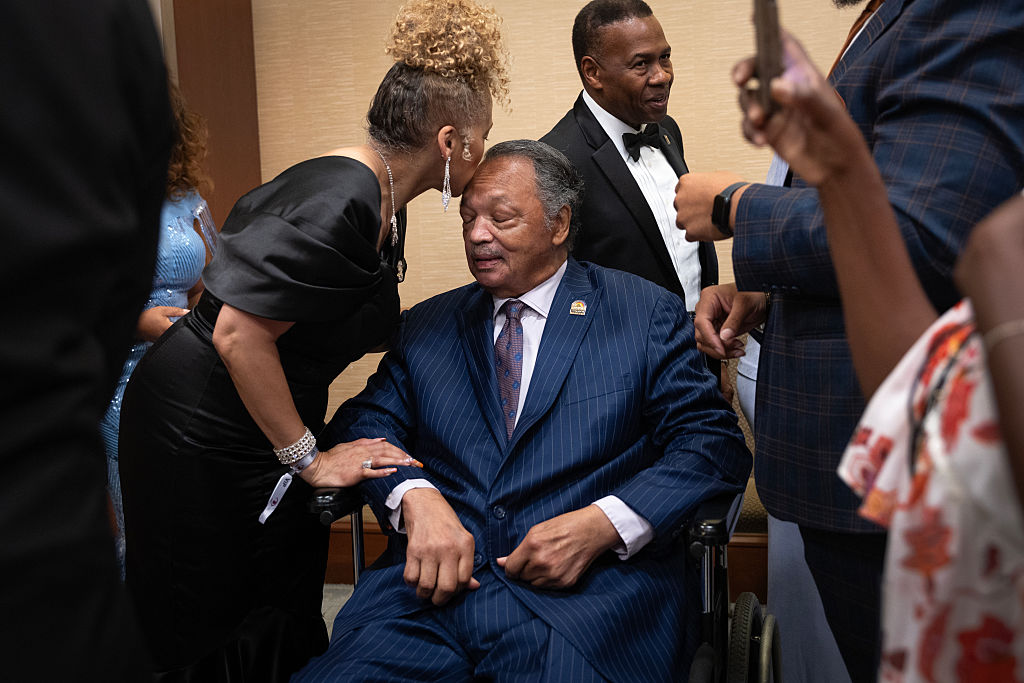
In September 2008, Jackson was admitted to Northwestern Memorial Hospital after experiencing dehydration and stomach pains. Doctors diagnosed him with viral gastroenteritis. In November 2017, he was diagnosed with Parkinson's disease. In August 2021, he and his wife were hospitalized with COVID-19 at Northwestern Memorial Hospital in Chicago. On August 27, it was reported that he had been transferred to a rehabilitation facility, while his wife had been moved to the intensive care unit. She was released from the hospital on September 4, while Jackson continued to receive care for Parkinson's.
In 2025, Jackson was hospitalized in Chicago from November 14 to 24. Rainbow PUSH said his diagnosis had been changed in April 2025 to progressive supranuclear palsy (PSP), a neurodegenerative condition that has symptoms that can resemble those of Parkinson's. Among those who visited him during his stay were Bill and Hillary Clinton, Al Sharpton, and Greg Mathis. In December, his family announced that he was in an acute nursing facility in stable condition and was expected to return home soon. He was discharged from the facility on December 22.
Death and funeral
Jackson died at his home in Chicago on February 17, 2026, at the age of 84. His family announced his death on social media.
Tributes
Tributes were published from U.S. President Donald Trump, Al Sharpton, William Barber II, former U.S. Presidents Bill Clinton (in a joint statement with his wife, Hillary), Barack Obama (in a joint statement with his wife, Michelle), and Joe Biden, attorney Benjamin Crump, Chuck Schumer, Martin Luther King III, former U.S. Vice President Kamala Harris, former Ambassador Andrew Young, South Carolina Governor Henry McMaster, South Carolina U.S. Senators Lindsey Graham and Tim Scott, Alveda King, Hakeem Jeffries, Rahm Emanuel, Brandon Johnson, Raphael Warnock, Bernice King, Frank Scott Jr., South Carolina Congressman Jim Clyburn, South Carolina State Representative Wendell Gilliard, Benedict College, and King Charles III. On February 28, 2026, NAACP CEO Derrick Johnson and Samuel L. Jackson paid tribute to Jesse Jackson at the 2026 NAACP Image Awards, televised on CBS and BET. Samuel L. Jackson dressed in African attire and invoked Jesse Jackson's "keep hope alive" and "I am somebody" messages. Jackson's family was in attendance.
North Carolina Governor Josh Stein ordered all U.S. and North Carolina flags at state facilities lowered to half-staff from sunrise on February 19 to sunset on February 28. Illinois Governor JB Pritzker also ordered the lowering of state flags during this period. Kentucky Governor Andy Beshear ordered flags lowered on March 7, the day of Jackson's funeral. Colorado Governor Jared Polis ordered flags lowered on March 5 and 6. Michigan Governor Gretchen Whitmer ordered flags lowered on February 26 and 27. Iowa Governor Kim Reynolds ordered flags lowered from sunrise to sunset on February 27. Flags were ordered lowered in Connecticut, New York, Delaware, New Jersey, Minnesota, Pennsylvania and the District of Columbia. South Carolina Governor Henry McMaster's office announced that flags would be lowered on March 2.
On February 18, Jackson's family revealed that as part of his celebration of life services, Jackson would lie in state at the Rainbow/PUSH headquarters in Chicago on February 26 and 27. Plans were later expanded to include celebrations in South Carolina and Washington, D.C., with the church service and final celebration in Chicago moved to March 6 and 7. A request for Jackson to lie in state in the U.S. Capitol was denied by Speaker of the U.S. House of Representatives Mike Johnson. On March 1, Jackson's wife Jacqueline became ill in Nashville, and plans were made for her to return to Chicago after being released from care. The Jackson family stated their intention to "honor its commitment to the State of South Carolina" and afterward "return home to Chicago". The Washington D.C. service was postponed.
Illinois lying in state and service
On February 26, Jackson's casket arrived at Rainbow/PUSH headquarters, and Jackson lay in state there in an open casket starting at 10 a.m. At the February 26 service, Al Sharpton made remarks, with Chicago Mayor Brandon Johnson, former Congressman Bobby Rush, Illinois Comptroller Susana Mendoza, and Cook County Sheriff Tom Dart among those in attendance. Public viewing took place for a second and final time at the Rainbow/PUSH headquarters on February 27. On February 28, the Jackson cortege departed Chicago.
South Carolina lying in state and service
On March 1, the Jackson cortege arrived in Columbia, South Carolina. While in South Carolina, Jackson's body was kept at Leevy's Funeral Home in Columbia.
On March 2, Jackson's casket, draped with an American flag, departed Leevy's Funeral Home and arrived at the South Carolina State House on a horse-drawn carriage. After it entered the State House rotunda, a private ceremony was held for the Jackson family. Among those in attendance were former Ambassador Andrew Young, former State Representative I. S. Leevy Johnson, South Carolina Legislative Black Caucus Chair Representative Annie McDaniel, television judge Greg Mathis, University of South Carolina coach Dawn Staley, and State Representative Wendell Gilliard.
After this ceremony, Jackson lay in state at the South Carolina State House, the second African American to be so honored after Clementa Pinckney. Flags on top of the State House were lowered from sunrise to sunset, as directed by Governor McMaster. Afterward, a public memorial service was held at Brookland Baptist Church in West Columbia, South Carolina, with eldest child Santita Jackson, Congressman Jim Clyburn, Columbia, South Carolina mayor and Biden Appointee Stephen K. Benjamin, Benedict College president Roslyn Artis, CNN Commentor Bakari Sellers and civil rights activist Cleveland Sellers and former State Representative James Felder, among the speakers. Priscilla Williams-Till, a cousin of Emmett Till, attended the service and gave remarks to the press about links between Jackson, Emmett, and his mother Mamie Till.
The Jackson family left South Carolina on March 5.
Illinois public and private funeral
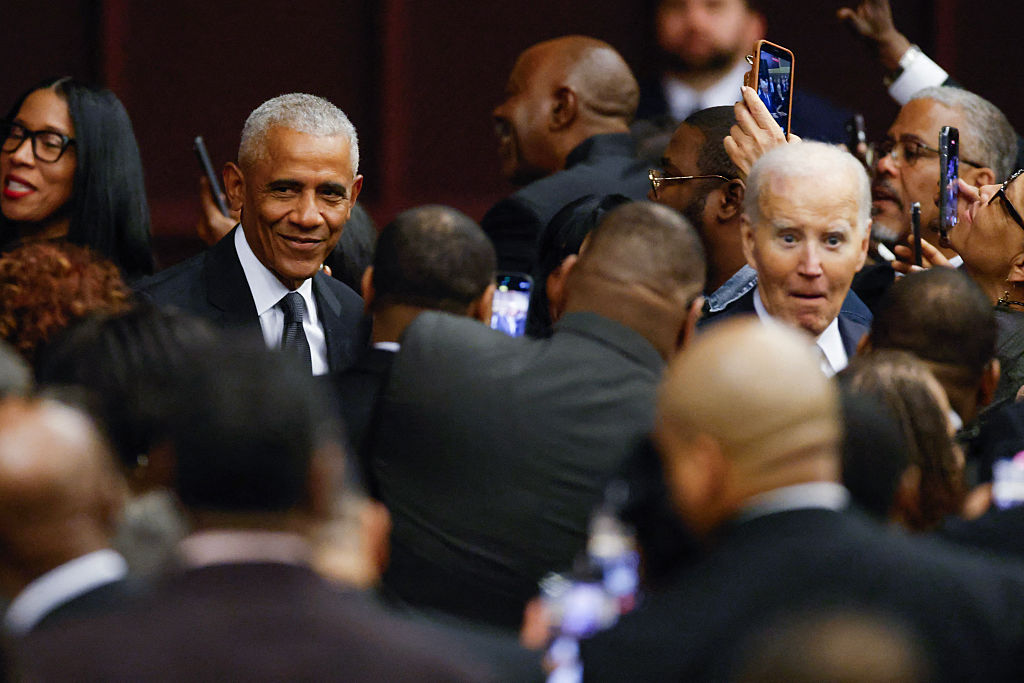
On March 6, former U.S. Presidents Bill Clinton, Barack Obama, and Joe Biden and former First Ladies Hillary Clinton and Jill Biden attended Jackson's House of Hope memorial service. James Meeks and Charles Jenkins co-officiated. Jackson family members, President Clinton, President Obama, former Vice President Kamala Harris, Illinois Governor JB Pritzker, Chicago Mayor Brandon Johnson, and Colombia president Gustavo Petro spoke at the public service. Jackson's final memorial service, which involved members of his family and African leaders such as South African president Cyril Ramaphosa and Democratic Republic of Congo president Felix Tshisekedi, was held at Rainbow/PUSH headquarters on March 7. Jackson was buried at a private service at Oak Woods Cemetery.
Legacy
Awards and honors
In 1969, Jackson was named Omega Psi Phi Outstanding Citizen of the Year.
Ebony Magazine named Jackson to its "100 most influential black Americans" list in 1971.
In 1979, Jackson received the Jefferson Award for Greatest Public Service Benefiting the Disadvantaged.
In 1988, the NAACP awarded Jackson its President's Award, and the next year, the organization awarded him the Spingarn Medal.
In 1991, Jackson received the American Whig–Cliosophic Society's James Madison Award for Distinguished Public Service.
In 1999, Jackson received the Golden Doves for Peace journalistic prize awarded by the Italian Research Institute Archive Disarmo.
In 1999, Jackson received the Order of the Palmetto, South Carolina's highest civilian honor, from Governor Jim Hodges.
In 2000, Bill Clinton awarded Jackson the Presidential Medal of Freedom, the nation's highest honor bestowed on civilians.
In 2002, scholar Molefi Kete Asante included Jackson on his list of 100 Greatest African Americans.
In 2008, Jackson was presented with an Honorary Fellowship from Edge Hill University. In an AP-AOL "Black Voices" poll in February 2006, Jackson was voted "the most important black leader".
In 2009, Jackson inherited the title of the High Prince of the Agni people of Côte d'Ivoire from Michael Jackson. The same year, he was crowned Prince Côte Nana by Amon N'Douffou V, King of Krindjabo, who rules more than a million Agni tribespeople. Jackson and his wife were also titleholders in the Nigerian chieftaincy system.
Public image
In 1987, Donald Rheem called Jackson "one of the most successful black leaders in American history, with 25 years of public service as a self-styled country preacher pushing voter registration, inner-city economic development, and a moral message telling blacks to get off drugs and get on with a fulfilling life." For The Harvard Crimson, David J. Barron wrote that Jackson had "become the undisputed leader of Blacks partly on the strength of his call for young Blacks to recognize that despite their disadvantages they are 'somebody.'" Jackson was often called a civil rights icon and praised as a gifted orator. His 1980s presidential campaigns are seen as historic and credited with increasing black voter turnout, exceeding expectations, and paving the way for Barack Obama's 2008 campaign. Former Democratic National Committee Chairwoman Donna Brazile commended Jackson for helping "to enable a new generation of African Americans to serve" through his presidential campaign.
Herb Benham claimed Jackson last had "credibility" when he was involved with the Southern Christian Leadership Conference, Operation PUSH, and marching with King, which he added was "so many decades ago that it makes the corporate-blackmailing, publicity-sniffing, knee-jerking Jackson seem as if he has had two lives—one respectable and one not." Jackson was also charged with exploiting racial divides for his gain, Larry Elder writes that Jackson, Sharpton, Farrakhan, and Bill Clinton have had careers predicated "on exaggerating the extent and the impact of anti-black white racism" and had each "earned a nice living promoting the bogus anti-black-white-racism-remains-a-serious-problem narrative." A proponent of marriage, Jackson was accused of hypocrisy for fathering a child out of wedlock.
In October 2021, renowned television judge Greg Mathis described Jackson as "my most impactful mentor," with the two first meeting when Jackson visited the jail Mathis was being held in. According to Mathis, it was Jackson who "suggested I get my GED, go to college and become an activist."
Relations with the Jewish community
Jackson was criticized for calling Jews "Hymies" and New York City "Hymietown" in 1984 remarks to a black reporter for The Washington Post; "Hymie" is a pejorative term for Jews. He had mistakenly assumed the references would not be printed. Louis Farrakhan made the situation worse by publicly warning, in Jackson's presence, that "If you harm this brother [Jackson], it will be the last one you harm." During a speech before national Jewish leaders in a Manchester, New Hampshire, synagogue, Jackson publicly apologized to Jews for his remarks but did not denounce Farrakhan's warning. A rift between Jackson and many in the Jewish community endured until at least the 1990s.
According to a 1987 article in The New York Times, Jackson began attempting to improve his relationship with the Jewish community after 1984. In 2000, he was invited to speak in support of Jewish U.S. senator and vice-presidential nominee Joe Lieberman at the Democratic National Convention. After the Pittsburgh synagogue shooting, the deadliest attack on the Jewish community in the U.S., Jackson joined other clergy at Congregation Sukkat Shalom in Wilmette to honor the 11 victims, saying: "When nine black lives were lost at Charleston, rabbis were there for us. Now we are here for this community." On March 8, 2020, Jackson endorsed Bernie Sanders, who is Jewish, for president.
During his House of Hope memorial service on March 6, 2026, Rabbi Steven Jacobs, who acknowledged his decades-long friendship with Jackson, addressed the controversy, vehemently denying that Jackson was an antisemite.
In 2026, Jackson's daughter Ashley announced that she had converted to Judaism and that her father had supported her decision to do so.