




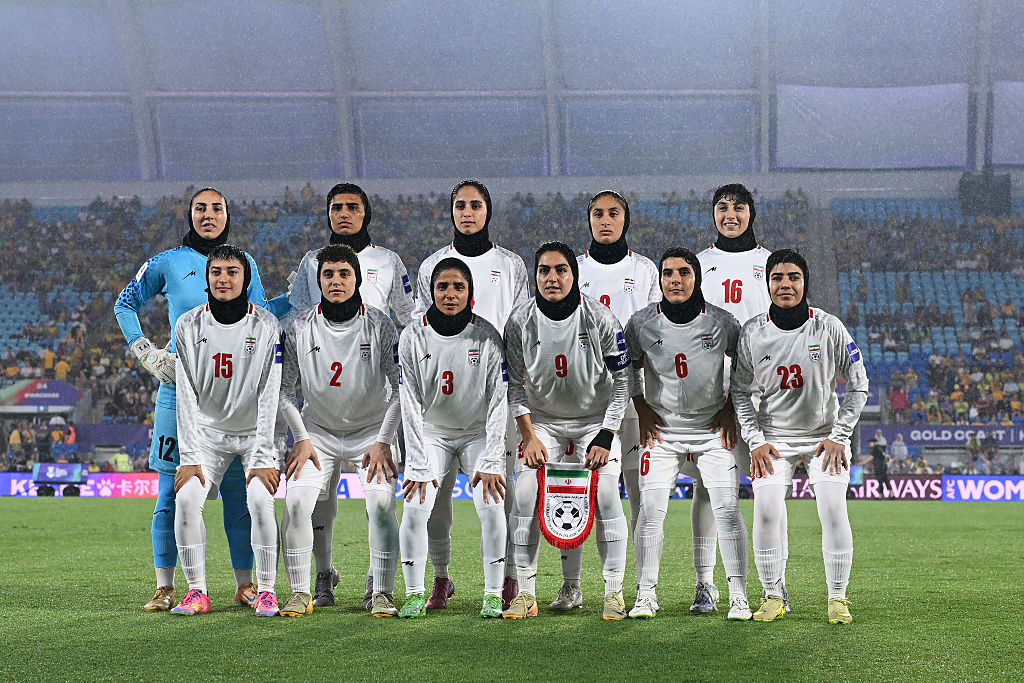
The Iran women's national football team, nicknamed the Lionesses, represents Iran in international women's football and is governed by the Football Federation Islamic Republic of Iran (FFIRI). The team played its first international match in May 1971 against Italy and its first FIFA-recognised international in September 2005 against Syria.
Contents
History
Early years: 1969–1979
In 1969, a group of Iranian women attended FIFA coaching classes for women's football in South Korea, Singapore, and India. During their time in those countries they also watched women's football matches. Upon their return home, Iran Football Federation after many meetings decided to kick start women's football in Iran. Soon after, clubs such as Taj, Persepolis, Deyhim, Oghab, and PAS formed women's football teams and a women's football league was established in Tehran. Persepolis women football team was coached by Alan Rogers, assisted by Ali Parvin.
On 7 May 1971, visitors to Tehran, Italy, took to the field and won against Iranian club side Taj S.C 2-0. The goals were scored by Medri and Bertolo. The Italians also missed a penalty kick by Nonni. It was the first time an Iranian women's team faced a foreign opponent. Two days later there was the second match which was between Iran women's national football team and Italy, with the Azzurre scoring five goals. Nonni, Gerwien, who scored a brace, Pesenti and Gualdi scored.
Both matches were organisedby Pari Abasalti, editor-in-chief of Ettelaat-e Banuvan magazine, who was also the president of Iran's Damsels and Ladies Association. The venue was Amjadieh stadium in Tehran. Iran women's national team comprised players selected from Taj, Persepolis, Deyhim, Oghab, and PAS. Some of the players who played were Hengameh Afshar, Goli Rahani, and Effat Mohammadi. The team's head coach was Aziz Asli.
Women's football was abandoned after the 1979 Iranian Revolution.
Re-establishment in 2004
Refounded in 2004, the team reached second place at the 2005 West Asian Football Federation Women's Championship in Amman, Jordan held in September and October 2005.
In May 2006, the women's team hosted their first foreign visitors when a club from Berlin, Germany called BSV Al-Dersimspor played out a 2–2 draw in Ararat Stadium in Tehran.
The team won second place again at the 2007 and 2011 West Asian Football Federation Women's Championship.
2010s
Iran were briefly banned by FIFA from international competition in 2011 for wearing hijabs. This caused Iran to forfeit its bid to qualify for the 2012 Summer Olympics. The ban was lifted in 2012.
In 2015 an official claimed that eight players on the team were males awaiting sex change operations. The claims arose from random gender checks introduced in 2014 after it had been revealed that four of the players were either men who had not completed sex change operations, or were women suffering from sexual development disorders. The FIFA-appointed doctor in Iran denied the claim, saying that all of the women had been checked.
On 27 December 2019, Zahra Khajavi broke the clean sheet record of Iranian football by not conceding any goal for 953 minutes. Also, she, along with Alireza Biranvand, are known as the record holders of the longest hand throws in Iranian football. As one of the best goalkeepers in the history of Iranian football, Khajavi was able to once again draw the attention of the domestic media to the Iranian women's national football team. Her achievements played a key role in the progress of the women's national football team in these years.
2020s
In the 2020s, women's football became more popular among young Iranians, both boys and girls.
Iran qualified for their first ever AFC Women's Asian Cup when they won against Jordan on penalties in the qualifiers for the 2022 edition to be hosted in India. In Iran's debut, the team held India goalless, but following India's withdrawal due to the COVID-19 pandemic, Iran's only point was lost, and thus Iran was left vulnerable to China and Chinese Taipei, losing 0–7 and 0–5 in process, and was eliminated as the worst third-placed team.
In 2023, a report on BBC Persian reported the lack of facilities and friendly matches for the team. This report suggested that the Iranian Football Federation was unwilling to have a women's team. In the 2024 AFC Women's Olympic Qualifying Tournament, Maryam Azmoon's team had one draw and two defeats (in the second round of the tournament). Their loss against powerful Australia was predictable for the fans.
Following the 2025–2026 Iranian protests and the large-scale crackdown in which thousands of protesters were killed, a number of players resigned from the national team in solidarity with the protesters. The Football Federation Islamic Republic of Iran reportedly threatened resigning players with multi-year bans from professional football, judicial action, and prison sentences.
During the 2026 AFC Women's Asian Cup in Australia, members of the squad refused to sing the national anthem before their opening match against South Korea on 2 March 2026, in an act widely interpreted as solidarity with the ongoing protests and victims of the crackdown in Iran. Iranian state television subsequently labelled the players "wartime traitors", with one broadcaster stating the designation was punishable by death. In their subsequent matches, the players were seen singing the anthem, after reports emerged of threats from security officials accompanying the delegation.
Following the team's elimination from the tournament, five players — Fatemeh Pasandideh, Zahra Ghanbari, Zahra Sarbali, Atefeh Ramezanizadeh and Mona Hamoudi — accepted humanitarian visas from the Australian Government on 9 March 2026 and were taken to a safe location. Player Mohaddeseh Zolifi and staff member Zahra Soltan Meshkeh Kar also initially chose to remain, though one of the two subsequently returned to Iran with the rest of the squad. As the team's bus departed the hotel, it was briefly blocked by protesters chanting "Save our girls!".
Team image
Nicknames
The Iran women's national football team have been known or nicknamed as the "Iranian Lionesses" (in Persian: Shirzanan). The team has been widely nicknamed the Persian stars since 2010. "Persian ladies" are the other nickname of the team in Asian football.
Media coverage and promotion
In the decades after 1979, the media coverage of women's football in Iran had problems, but the matches of the women's national team are usually followed by Iranian men and women in the national and foreign media.
Persian-language documentaries and sports programs are made about the team's winning potential and history.
Kits and crest
The table below lists the kit supplier for the Iranian national football team.
Home stadium
Iran plays their home matches at the Ararat Stadium.
Attendance of women in football matches
On 9 November 2018 Fatma Samoura, Secretary General of International Federation of Football Association FIFA said she would ask Iranian government to end ban on women’s entry to sport stadiums.
In September 2019, it was reported that Iranian female football fan Sahar Khodayari, dubbed the "blue girl", died after self-immolating in front of a court in Tehran when she found out she could face a two year sentence for attempting to enter a football stadium to watch her favourite team play.
Results and fixtures
The following is a list of matches in the last 12 months, as well as any future matches that have been scheduled.
Legend
Win
Draw
Lose
Fixture
2026
Fixtures and Results (Iran)– Soccerway.com
Head-to-head record
As of 2 March 2026, after the match against South Korea.
Coaching staff
Current coaching staff
As of 21 July 2025
Manager history
Aziz Asli (1971)
Shahrzad Mozafar (2005)
Zhu Fang Shin (2008)
Maryam Irandoost (2010–2012)
Helena Costa (2012–2014)
Mahnaz Amirshaghaghi (2014–2016)
Maryam Azmoon (2016–2020)
Maryam Irandoost (2021–2022)
Maryam Azmoon (2022–2025)
Marziyeh Jafari (2025–)
Players
2025 squad
The following players were called up for two friendly matches to be held in Tashkent, Uzbekistan in November 2025.**
**On 9 March 2026, Zahra Sarbali, Fatemeh Pasandideh, Atefeh Ramezanizadeh, and Mona Hamoudi, and captain and top-goalscorer Zahra Ghanbari, as members of the team at the 2026 AFC Women's Asian Cup tournament in Australia, left the team's training camp in Australia and sought refuge due to fears of retaliation from Iranian authorities. The team had refused to sing the national anthem at the first game of the tournament, shortly after the beginning of the 2026 Iran war. They were granted asylum on humanitarian visas in Australia.
Recent call-ups
The following players have been called up to the squad in the past year.
Players of Iranian heritage in other national teams
Unfortunately, due to strict FIFA rules, Iran women's team is unable to acquire experienced footballers who have many caps for other national teams. Two players of Iranian heritage in other national teams are Sara Doorsoun ( Germany), and Natasha Shirazi ( Uganda).
Players from Iranian diaspora
The following players from Iranian diaspora (dual citizens) capped for Iran national team, the flag next to them shows their citizenship:
Katayoun Khosrowyar
Melika Mohammadi
Several others such as the following never capped for the national team despite having capped for Iran's youth national team:
Sofia Askari
Kimya Raietparvar Taloukie
Vida Raietparvar Taloukie
Honours
Regional
WAFF Women's Championship
Runners-up: 2005, 2007, 2011
CAFA Women's Championship
Runners-up: 2018, 2022
Competitive record
Olympic Games
Notes:
*Draws include knockout matches decided on penalty kicks.
AFC Women's Asian Cup
*Draws include knockout matches decided on penalty kicks.
Asian Games
*Draws include knockout matches decided on penalty kicks.
WAFF Women's Championship
*Draws include knockout matches decided on penalty kicks.
Malavan F.C. participated at the 2010.
CAFA Women's Championship
*Draws include knockout matches decided on penalty kicks.
Iran U-23 team participated at the 2018 edition.
FIFA World Ranking
As of 26 January 2022, after the match against Chinese Taipei.
Best Ranking Best Mover Worst Ranking Worst Mover