Gone with the Wind
The competition to win the part of Mammy in Gone with the Wind was almost as fierce as that for Scarlett O'Hara. First Lady Eleanor Roosevelt wrote to film producer David O. Selznick to ask that her own maid, Elizabeth McDuffie, be given the part. McDaniel did not think she would be chosen, because she had earned her reputation as a comic actress. One source claimed that Clark Gable recommended that the role be given to McDaniel; in any case, she went to her audition dressed in an authentic maid's uniform and won the part.
McDaniel said that the role was an "opportunity to glorify Negro womanhood … The brave efficient type of womanhood which … has built our race, paid for our elaborate houses of worship, and sustained our business, charitable and improvement organisations."
Loew's Grand Theater on Peachtree Street in Atlanta was selected by the studio as the site for the Friday, December 15, 1939, premiere of Gone with the Wind. Studio head David O. Selznick asked that McDaniel be permitted to attend, but MGM advised him not to, because of Georgia's segregation laws. Clark Gable threatened to boycott the Atlanta premiere unless McDaniel was allowed to attend, but McDaniel convinced him to attend anyway.
Most of Atlanta's 300,000 citizens crowded the route of the seven-mile (11 km) motorcade that carried the film's other stars and executives from the airport to the Georgian Terrace Hotel, where they stayed. While Jim Crow laws kept McDaniel from the Atlanta premiere, she did attend the film's Hollywood debut on December 28, 1939. Upon Selznick's insistence, her picture was also featured prominently in the program. The 2010 documentary film Change in the Wind revealed a friendship between Gone with the Wind (1936) author Margaret Mitchell and McDaniel. “The Mayor of Atlanta called for a hand for our Hattie McDaniel and I wish you could have heard the cheers,” Mitchell telegrammed her after the first screening.
For her performance as the enslaved house servant who repeatedly scolds her owner's daughter, Scarlett O'Hara (Vivien Leigh), and scoffs at Rhett Butler (Clark Gable), McDaniel won the 1939 Academy Award for Best Supporting Actress, the first Black actor to have been nominated for and to win an Oscar. "I loved Mammy", McDaniel said when speaking to the white press about the character. "I think I understood her because my own grandmother worked on a plantation not unlike Tara". She similarly wrote to Mitchell, praising the author's "authenticity" in her portrayal of the Old South, echoing stories McDaniel had heard from her own grandmother. Her role in Gone with the Wind had alarmed some whites in the South; there were complaints that in the film she had been too "familiar" with her white owners.
At least one writer pointed out that McDaniel's character did not significantly depart from Mammy's persona in Margaret Mitchell's novel, and that in both the film and the book, the much younger Scarlett speaks to Mammy in ways that would be deemed inappropriate for a Southern teenager of that era to speak to a much older white person, and that neither the book nor the film hints of the existence of Mammy's own children (dead or alive), her own family (dead or alive), a real name, or her desires to have anything other than a life at Tara, serving on a slave plantation. Moreover, while Mammy scolds the younger Scarlett, she never crosses Mrs. O'Hara, the more senior white woman in the household. Some critics felt that McDaniel not only accepted the roles but also in her statements to the press acquiesced to Hollywood's stereotypes, providing fuel for critics of those who were fighting for Black civil rights. Later, when McDaniel tried to take her "Mammy" character on a road show, Black audiences did not prove receptive.
While many Black people were happy over McDaniel's personal victory, they also viewed it as bittersweet. They believed Gone With the Wind celebrated the slave system and condemned the forces that destroyed it. For them, the unique accolade McDaniel had won suggested that only those who did not protest Hollywood's systemic use of racial stereotypes could find work and success there.
A review in The Times noted that McDaniel "almost acts everybody else off the screen when she is allowed to appear in the foreground."
The 12th Academy Awards took place at Coconut Grove Restaurant of the Ambassador Hotel in Los Angeles. It was preceded by a banquet in the same room. Louella Parsons, an American gossip columnist, reported about Oscar night, writing on February 29, 1940:
Hattie McDaniel earned that gold Oscar by her fine performance of 'Mammy' in Gone with the Wind. If you had seen her face when she walked up to the platform and took the gold trophy, you would have had the choke in your voice that all of us had when Hattie, hair trimmed with gardenias, face alight, and dress up to the queen's taste, accepted the honor in one of the finest speeches ever given on the Academy floor.
Academy of Motion Picture Arts and Sciences, fellow members of the motion picture industry and honored guests: This is one of the happiest moments of my life, and I want to thank each one of you who had a part in selecting me for one of their awards, for your kindness. It has made me feel very, very humble; and I shall always hold it as a beacon for anything that I may be able to do in the future. I sincerely hope I shall always be a credit to my race and to the motion picture industry. My heart is too full to tell you just how I feel, and may I say thank you and God bless you.
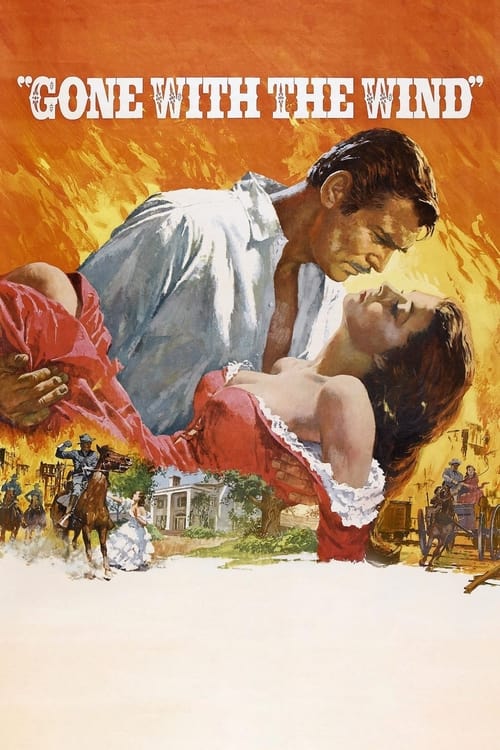
McDaniel received a plaque-style Oscar, approximately 5.5 in (14 cm) by 6 in (15 cm), the type awarded to all Best Supporting Actors and Actresses at that time. She and her escort were required to sit at a segregated table for two at the far wall of the room; her white agent, William Meiklejohn, sat at the same table. The hotel had a strict no-Blacks policy, but allowed McDaniel in as a favor. The discrimination continued after the award ceremony as well; her white co-stars went to a "no-Blacks" club, where McDaniel was also denied entry. No other Black woman won an Oscar again for 50 years until Whoopi Goldberg won Best Supporting Actress for her role in Ghost. Weeks prior to McDaniel winning her Oscar, there was even more controversy. David Selznick, the producer of Gone With the Wind, omitted the faces of all the Black actors on the posters advertising the movie in the South. None of the Black cast members were allowed to attend the premiere for the film.
Gone with the Wind won eight Academy Awards. It was later named by the American Film Institute (AFI) as number four among the top 100 American films of all time in the 1998 ranking and number six in the 2007 ranking.