Homosexuality and escapism
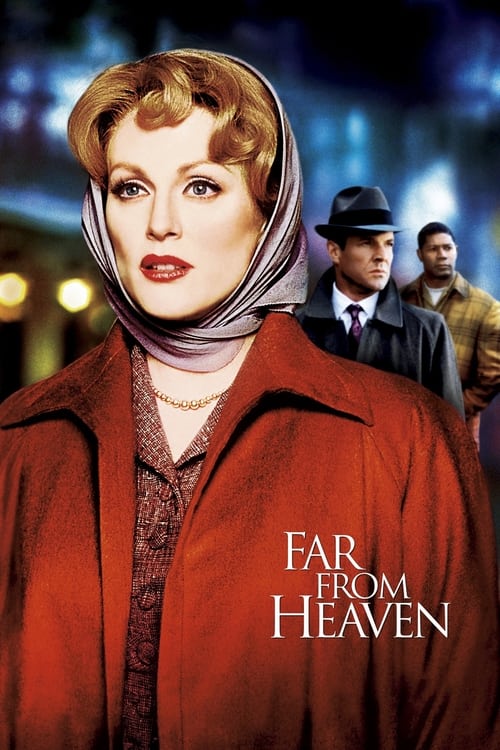
Frank Whitaker's burgeoning homosexuality sets in motion a series of events that ultimately culminate in both the estrangement of his wife and the failure of his marriage. Characterized as the reliable husband, the successful hardworking businessman, the charming spouse, and the devoted father, he is idealized in a way that assigns him so many demanding roles, it is almost as if he is driven to pursue his homosexual tendencies as a means to escape his taxing everyday life and release his burden and frustration. We witness this early on in the film in his office at Magnatech when lunch meetings and dinner meetings pile up in his schedule, as portfolio season is well underway and his New York office continues to push up deadlines. Much like Cathy, Frank falls short of his exalted reputation, and as he is exploring Hartford one evening, avoiding returning home by taking in a movie, he soon finds himself walking the streets, delving further into the seedy underbelly of Hartford nightlife, where he hopes to find what he is looking for. It is when he notices what appear to be two gay men walking into a basement bar that he finally acts on his impulses and begins the slippery slope of self gratification that ultimately comes to dominate his lifestyle. It is through these humble beginnings that we come to explore with Frank the subversive and hushed nature cast upon the gay community during this time period.
Mitra Moin writes in her essay, "Far from Heaven and Carol: Channeling 1950s Melodrama":
The 1950s is a time of constraining expectations; everyone is expected to lead perfect suburban lives, and those that deviate are socially condemned. Haynes sets this up in Far from Heaven, where Cathy appears to have a model life: two children, a successful husband, and a suburban home. She is a typical housewife, admired by others: "Women just like yourself, with families and homes to keep up." This is dismantled in the premise, when Cathy receives a call from the police station regarding her husband. Beauty and perfection, here, are forms of oppression. The props are also important to observe as symbols of the 1950s: The television manifests the suburban prosperity that characterizes the time period. Cathy must adhere to the narrow and confining gender roles of the 1950s, just as Frank must suppress his homosexual desires. These characters, disillusioned in their seemingly flawless worlds, ultimately find these symbols as oppressive.
Likewise, Cathy, who finds an escape through her relationship with Raymond, begins to act on her impulses as well, taking us further into the bigoted, prejudiced nature of upper class Hartford society. When Cathy, in the aftermath of Eleanor observing the physical abuse Frank has inflicted upon her, is discovered crying in her yard by Raymond, their relationship becomes even closer, and he extends to her an invitation for a day in the country in an effort to take her mind off her worries, which she ultimately accepts. This invitation, however, sets in motion a series of events that culminates in a romantic evening between the two, which is inadvertently observed by Mona Lauder, a woman whose gossip is notorious for spreading like wildfire. It is through Mona's prejudiced tittle-tattle that Cathy soon finds herself with her reputation besmirched, as even her friends and loved ones are disgusted with her behavior. Frank's revelation of his affair to Cathy, which effectively ends their marriage, is mirrored when Cathy reveals her attraction for Raymond to Eleanor and is summarily rejected, exposing the subtle dichotomy between their respective vices. As Rebecca Sherr notes in her essay:
The "mirroring" technique occurs several times and is a visual clue as to the parallels the film draws between interracial romance and homosexuality. [...] The two instances of "coming out" in Far from Heaven produce different narrative trajectories, and the mediating factor of racial difference accounts for these divergent outcomes. This difference in outcome is based in the notion of visibility—racial difference cannot usually be hidden. The film communicates that heterosexual, interracial desire could, in a sense, be seen as even more "queer" than homosexuality, at least in the context of queerness as visible deviance.
Although Cathy finds herself isolated at the end of the film, a divorcée fallen from grace who now devotes her life to her children and her volunteer work for organizations such as the NAACP, she still possesses feelings for Raymond that, though now held back, dominate the subtext of the ending of the film, without either character having to utter a single word in their silent, tear-wrenching farewell. Todd McGowan observes of both Cathy and Frank in "Relocating Our Enjoyment of the 1950s: The Politics of Fantasy in Far from Heaven": "The point here is not that they enjoy in spite of the widespread disapproval; it is instead that this disapproval enables and fuels their enjoyment. Their time together has the significance it does precisely because the social prohibition does not permit it."