




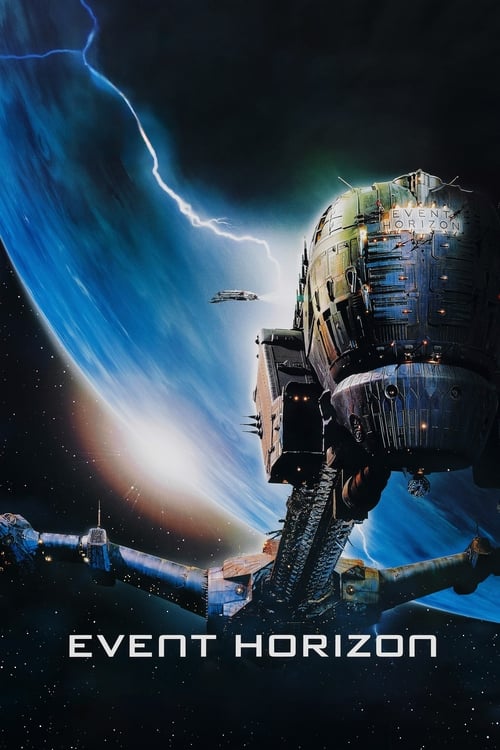


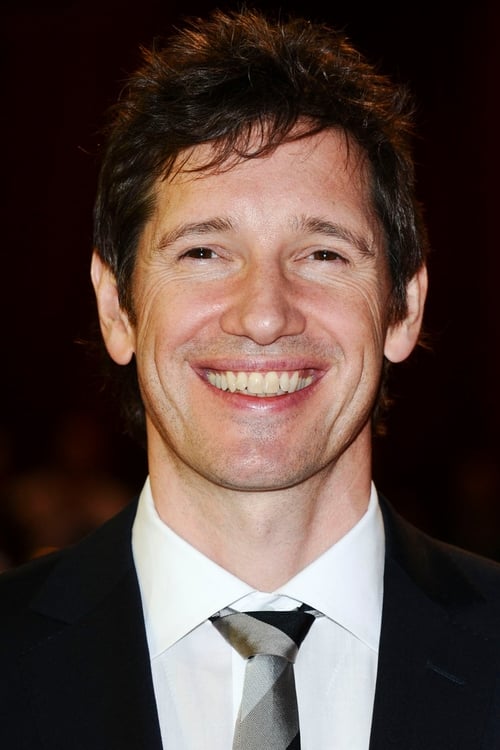





Event Horizon is a 1997 science fiction horror film directed by Paul Anderson and written by Philip Eisner. The film stars Laurence Fishburne, Sam Neill, Kathleen Quinlan, and Joely Richardson. Set in 2047, it follows the crew of the rescue vessel Lewis and Clark, led by Captain Miller (Fishburne), who are sent to investigate the Event Horizon, a spaceship that mysteriously vanished seven years prior during its maiden voyage to Proxima Centauri and has reappeared in orbit around Neptune. Accompanied by the ship's designer, Dr. Weir (Neill), they board the derelict ship to search for survivors and determine what happened after its experimental gravity drive, meant for faster-than-light travel by folding space-time, was activated.
Eisner conceived the story in the early 1990s as a "haunted house in space" and completed a first draft in 1992. Following the commercial success of Mortal Kombat (1995), Anderson sought a darker and more visceral project and accepted Paramount Pictures' offer of Eisner's script. Finding the original script too similar to Alien (1979), Anderson worked with Eisner to reorient the story, introducing influences from Solaris (1972) and Hellraiser (1987). Principal photography took place entirely at Pinewood Studios in England from 18 November 1996 to 14 March 1997 as an American–British co-production, on a budget estimated at $50–70 million. Paramount compressed the schedule after Titanic was delayed, leaving little time for post-production. Anderson's original 130-minute cut was reduced to 96 minutes at the studio's insistence after test audiences reacted poorly to its graphic content.
Event Horizon premiered in Beverly Hills on 12 August 1997, and was released in the United States on 15 August and in the United Kingdom one week later. Critical reception was generally unfavourable, with reviewers calling it derivative, shallow, and overly gory, though the performances received some praise. The film was a box-office bomb, grossing $47.1 million worldwide; early in its theatrical run, Paramount's parent company, Viacom, wrote it off as a major loss. Commentators have attributed its failure in part to its late-summer release against lighter science-fiction hits such as Men in Black and to marketing targeting hardcore science-fiction fans rather than horror enthusiasts.
The film later found a cult following on home video. The success of its initial DVD release prompted Paramount to discuss a director's cut with Anderson, but most of the deleted footage had been lost or destroyed. It has since been reappraised, appearing on lists of the best horror films of all time, and influencing many subsequent science-fiction and horror films and video games. In 2025, IDW Publishing began publishing the comic-book prequel series Event Horizon: Dark Descent; a sequel series, Event Horizon: Inferno, followed in 2026.
Contents
Plot
In 2047, a distress signal is received from the Event Horizon, a spaceship that disappeared during its maiden voyage to Proxima Centauri seven years earlier. The ship has mysteriously reappeared in orbit around Neptune, prompting the US Aerospace Command to dispatch the Lewis and Clark rescue vessel to investigate. Its crew members—Captain Miller, second-in-command Lieutenant Starck, pilot Smith, medical technician Peters, engineer Justin, doctor D.J., and rescue technician Cooper—are joined by Dr. William Weir, who designed the Event Horizon. Shortly before arrival at the Event Horizon, Weir briefs them on the ship's experimental gravity drive with a simple visualization of how it folds spacetime to instantly transport the ship across vast distances. He then plays them the distress signal, which consists of screams, howls, and what sounds like a voice. D.J. recognizes it as the Latin phrase "līberāte mē", which he translates as "save me".
Upon boarding the Event Horizon, the crew finds signs of a massacre. As they search for survivors, the ship's gravity drive activates and briefly pulls Justin into a portal before unleashing a shock wave that breaches the hull of the Lewis and Clark. The crew is forced to move to the Event Horizon while Cooper rescues Justin from the portal, finding that he has been reduced to a catatonic state. Smith and Cooper are sent on a spacewalk to repair the hull of the Lewis and Clark while the rest of the crew begin to experience hallucinations of their biggest fears and regrets. Miller sees Eddie Corrick, a subordinate from a previous journey whom he left to die in order to save the other crew members. Peters sees her son with his legs covered in bloody lesions, while Weir sees a vision of his late wife, now eyeless, urging him to join her.
Justin suddenly wakes from his coma while the entire ship seems to be shaking and attempts to vent himself from the airlock; he is saved at the last second by Miller, who places a severely injured Justin in stasis. Shaken, Miller confides in D.J. about his hallucinations, prompting D.J. to reveal that he found a longer phrase in the distress signal. It really says "libera te tutemet ex inferis", which he translates as "save yourself from Hell". D.J. concludes that the ship's drive must have opened a gateway to somewhere beyond the known universe and brought something horrible back with it. His conclusion gains more credibility when a video log is discovered on the Event Horizon, showing the ship's crew members horrifically brutalizing each other after engaging the gravity drive, with their captain chanting in Latin as he holds his own eyeballs in his hands.
Cast
Laurence Fishburne as Captain S. J. Miller: The highly experienced commanding officer of the Lewis and Clark and a former crewmember of the Goliath who survived its failed rescue mission
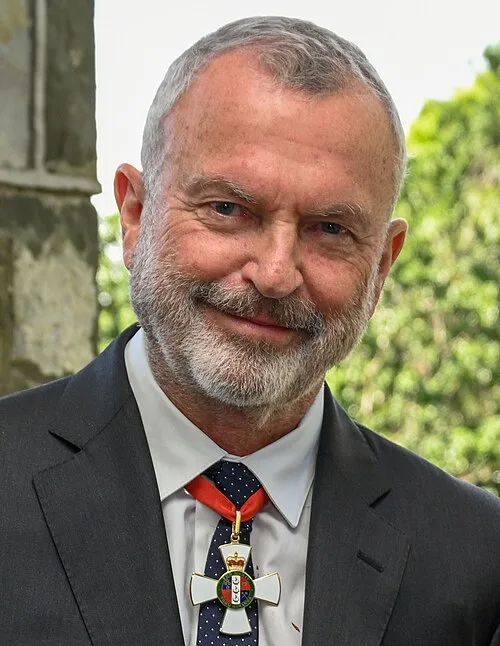
Sam Neill as Dr. William G. "Billy" Weir: The disgraced designer of the Event Horizon who was exiled to an Earth-orbiting station after the ship vanished
Kathleen Quinlan as Peters: The maternal and caring medical technician of the Lewis and Clark
Joely Richardson as Lieutenant M. L. Starck: The sharp-minded and sharp-tongued communications officer of the Lewis and Clark
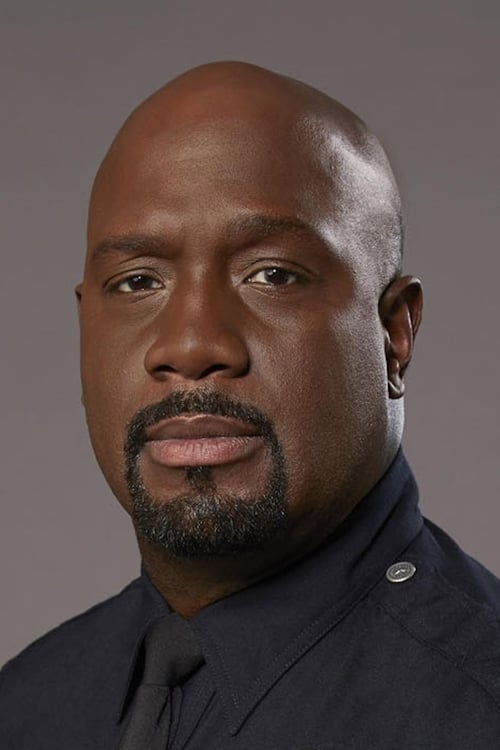
Richard T. Jones as T. F. Cooper: The cocky rescue technician of the Lewis and Clark
Jack Noseworthy as F. M. Justin: The hot-shot chief engineer of the Lewis and Clark
Jason Isaacs as D.J.: The stoic medical doctor of the Lewis and Clark
Sean Pertwee as W. F. "Smitty" Smith: The high-strung pilot of the Lewis and Clark
Appearing in hallucinations are Holley Chant as Claire Weir, Dr. Weir's deceased wife; Barclay Wright as Denny Peters, Peters' son; and Noah Huntley as Edmund "Eddie" Corrick, Miller's former Goliath shipmate, whom he continues to regret having left behind to burn to death. Robert Jezek appears as a rescue technician who rescues the survivors of the Lewis and Clark crew. In the recovered Event Horizon ship's log video, Peter Marinker portrays Captain John Kilpack, the ship's commanding officer.
Other members of the original crew were played by British film directors Bharat Nalluri and Gary Sinyor, actress Emily Booth, several pornographic actors in the orgiastic massacre footage, as well as the film's screenwriter Philip Eisner as a man consuming another's entrails. Director Paul Anderson makes a cameo on the cover of a fictional autobiography seen floating aboard the Event Horizon during Weir's opening dream sequence.
Production
Conception and writing
Event Horizon was conceived in the early 1990s by aspiring screenwriter Philip Eisner. Inspired by a rewatching of Stanley Kubrick's The Shining (1980), he sought to transpose the haunted-house premise into a science-fiction setting. Eisner also drew from his interest in physics; he reasoned that exposure to warped spacetime at scales beyond normal human perception would psychologically shatter people. His other influences included the works of H. P. Lovecraft, Robert Wise's The Haunting (1963), Kubrick's 2001: A Space Odyssey (1968), Ridley Scott's Alien (1979), the tabletop game Warhammer 40,000 (starting 1987), and Stephen Hawking's book A Brief History of Time (1988).
Eisner first pitched the concept verbally to his contract employers, producers Lawrence Gordon and Lloyd Levin, describing it as "a haunted house story in space". Gordon responded favourably and encouraged him to develop a full screenplay. Eisner began writing in spring 1992, spending eight months on the first draft and delivering the initial version of the script by October. Gordon and Levin commissioned the project and advanced it in partnership with Paramount Pictures.
The opening thirty pages remained largely intact through production, aside from the removal of a sequence for budgetary reasons involving the mining vessel Lucky Strike, which would have established the Lewis and Clark crew working as a team in action, with some elements from it moved to later on in the film when the crew is on Event Horizon. Progress on the remainder of the script was slower, coinciding with personal difficulties for Eisner following the death of his father in a skiing accident; a studio executive provided support to maintain his momentum. As the project originated as a pitch, Gordon retained ownership of the material; upon departing Largo Entertainment, he took the Event Horizon script with him. The film was subsequently produced by Gordon's new company Golar, whose name is a respelling of Largo.
Development and reworking
After Mortal Kombat (1995) was a commercial success in the United States, English director Paul Anderson was inundated with screenplay offers, as well as the opportunity to direct the Mortal Kombat sequel Mortal Kombat Annihilation (1997) and the upcoming X-Men (2000), which he was interested in but withdrew because of its extremely tight production schedule or turned it down because he did not want to another PG-13 movie as he had done previously with Mortal Kombat. He instead sought a darker and more visceral project. He became particularly interested in two science-fiction scripts, Soldier (1998) for Warner Bros. and Event Horizon for Paramount, and found the choice between them difficult. Anderson initially signed on to direct Soldier, but the project was postponed after its star, Kurt Russell, decided he required a full year of physical training to prepare for the role. Rather than wait, Anderson pivoted back and attached himself to Event Horizon, which at the time still lacked a director.
Anderson's initial reaction to the script, which involved the Event Horizon experiencing a series of hauntings by "tentacular" aliens, having crossed the threshold of their planet or dimension, was that it bore a striking resemblance to Alien. Producer and longtime collaborator Jeremy Bolt felt it was a "terrific concept" but was "very dense" in terms of length and the storyline got "a bit lost". Seeking to avoid direct imitation, Anderson revised the material, reorienting it toward the traditions of classic haunted-house cinema, particularly The Haunting and The Shining for their emphasis on unseen evil and ambiguous endings. He also introduced the notion that the vessel itself had become possessed, drawing on the concept of Hell. Andrew Kevin Walker, the screenwriter of Seven (1995), was brought in as a script doctor to perform a major rewrite of the screenplay, developing its hell and damnation concept. Among his other contributions was a floating tooth (which was filmed but later cut) discovered by the crew upon boarding the Event Horizon. Walker received no on-screen credit for his work.
Anderson has stated that the screenplay was also inspired by Andrei Tarkovsky's Solaris (1972), a film of which he is fond of. Bolt believed that the sequence in which rain falls inside the spaceship drew from Solaris. Both Anderson and Bolt recalled that Eisner denied having seen either Solaris or Disney's The Black Hole (1979), a denial they regarded as untrue. Anderson, however, earlier indicated in the film's audio commentary that he himself had introduced the rain sequence, remarking: "the reason for this coolant... This is something I added to the movie purely ... for the end result which was when they switched the gravity back on the idea that it was raining in the spaceship." Anderson also introduced the influence of Hellraiser (1987) to the film.
Pre-production
Pre-production began in May 1996. The decision was made to shoot in England, where Anderson and Bolt were based and where Pinewood Studios offered the necessary facilities, including the large stages associated with the James Bond films. Key early hires included editor Martin Hunter (who had collaborated with Anderson on Mortal Kombat), cinematographer Adrian Biddle (as they loved his work on Aliens, Thelma & Louise, and 1492: Conquest of Paradise), and production designer Joseph Bennett, a relatively young designer whose work on Jude (1996) impressed the team. Anderson valued Bennett's enthusiasm and visual flair, believing it would compensate for limited prior experience on large-scale films.
Visual effects supervisor Richard Yuricich, a veteran of science fiction films whose credits included 2001: A Space Odyssey, Close Encounters of the Third Kind, and Blade Runner, was secured early on the strong recommendation of the Mission: Impossible team. Construction manager Harry Metcalfe oversaw the ambitious set-building program. The overall aesthetic was conceived as dark, Gothic, and nightmarish, blending high technology with medieval and visceral human elements. Anderson insisted on a distinctive design that avoided feeling like a lesser Alien or Blade Runner.
The filmmakers sought a strong ensemble of skilled actors capable of handling the script's perceived three-dimensional characters rather than relying on a single major star. Captain Miller was originally envisioned as a white Texan in concept art. After Gordon suggested Laurence Fishburne for the role and the crew strongly agreed, he was cast. Fishburne was hooked by the screenplay's suspense and its focus on character over typical science-fiction spectacle; he was particularly drawn to the dynamic between the experienced astronaut and the ship's designer. He turned down the role of the judge in Francis Ford Coppola's The Rainmaker (1997) to take the part. After Gary Sinise and Jeremy Irons declined offers to play Dr. William Weir, Neill took on the role instead, intrigued by the story's "air of mystery" and the chance to portray a grieving, troubled scientist whose greatest creation reappears after years of loss.
Quinlan, whom the crew sought after admiring her work in Apollo 13 (1995), joined as emergency technician Peters, attracted by the ensemble nature of the piece and the opportunity to play an active, professional single mother rather than reacting primarily to special effects. Richardson was cast as navigator Starck, drawn to familiarity with the other cast members as well as the character's sharp edge. Richard T. Jones played Cooper, connecting with the crew's energetic, protective "joker." Jack Noseworthy took the role of engineer Justin, drawn to the script's psychological-thriller quality and its internal, character-driven horror. Jason Isaacs portrayed the taciturn doctor D.J., interested in the roller-coaster intensity of the story and a role that initially appears potentially suspicious. Isaacs was previously in Anderson's debut feature Shopping (1994). Sean Pertwee was cast as pilot Smith, inspired by the character's superstitious attachment to the ship (echoing the "never get off the boat" philosophy of Apocalypse Now; Pertwee cited Chef, the character who said that in that film, as an inspiration for his performance in Event Horizon).
Filming and effects
Principal photography began on 18 November 1996 and wrapped on 14 March 1997, spanning roughly 16 weeks. The film was shot entirely at Pinewood Studios in Iver Heath, England, using seven sound stages, two silent stages, and the studio's garden for the only exterior shot set on Earth. This sequence, the first filmed for the production, showed a video of Peter's son's birthday party. Under Metcalfe's supervision, approximately 20 different sets were constructed, filmed, and struck. The interiors of the Event Horizon filled much of the available space, including the vast 007 Stage. It was Anderson's largest production yet, with a budget of US$50 million, according to him and Eisner.
Visual effects provided by Cinesite and Computer Film Company. Using an architectural cam program, Anderson modeled the Event Horizon ship after Notre Dame Cathedral. Effects supervisors Yuricich and Neil Corbould kept most visuals in-camera, and moving sets were constructed for the gravity drive gyroscope and the revolving tunnel. Because the majority of scenes were filmed in a studio on gothic-inspired sets, Anderson felt the cast experienced a kind of "cabin fever" that better served their performances. Joely Richardson called the experience of working on the film "cursed".
The gravity drive set was filmed on the 007 Stage at Pinewood Studios in London during the Christmas period. The cast and crew faced challenging conditions due to the lack of insulation and the stage's thin metal walls, which made the environment extremely cold; rainfall also produced deafening noise from reverberations off the roof. Neill found the later stages of filming particularly demanding, as he was required to work largely unclothed.
The effects team minimized the use of computer-generated imagery (CGI), preferring practical effects and in-camera techniques whenever feasible, in line with Yuricich's insistence on shooting as much as possible practically. CGI was employed mainly as an enhancement rather than for fully synthetic shots. As Anderson noted, the production avoided visual effects where unnecessary, favored traditional methods with greater reliance on models over CGI, and, after discussion, opted to build the gravity drive gyroscope as a practical effect rather than create it digitally.
For zero-gravity sequences, the actors were suspended upside down in harnesses and spun. At the start of filming, the script featured far more such scenes throughout the Event Horizon, but time constraints, the cast's discomfort with wire work, and budget limitations led the introducion of "magnetic boots" instead. Anderson noted that competing with the practical zero-gravity effects of Apollo 13 (1995), which were done in confined spaces, would have been difficult given the film's larger sets, so the production relied on traditional methods. Most of these scenes were shot on VistaVision to provide a larger negative for post-production; Anderson used unusual angles and continuous camera movement and rotation to heighten disorientation.
Design
Anderson and concept artist Rick Buden developed the film's visual style through previsualization in Los Angeles before work relocated to London. Bennett and the art department established a "techno-medieval" aesthetic for the Event Horizon: when powered and lit, it resembled a modern vessel in the vein of 2001: A Space Odyssey (1968); when darkened, its forms evoked a dungeon or Gothic cathedral. Inspiration came from particle-accelerator interiors (for their technological yet almost armored, medieval quality), as well as Tibetan, medieval, and Renaissance design elements. The ship's overall form was cruciform; designers scanned elements of Notre-Dame Cathedral into computers and incorporated towers and other features into the thruster pods and structure, so that from a distance the vessel appeared as a crucifix hanging above Neptune. Areas such as the second and third containments surrounding the gravity drive (literally a contained black hole) received particular attention as the source of the malevolent force.
By contrast, the Lewis and Clark was designed as a more familiar, functional vessel—described as a submarine crossed with an ambulance—serving as the crew's relatively safe, lived-in environment. Models supervisor David Sharpe oversaw an extensive miniatures program: roughly 28 models in total (approximately 14 of the Event Horizon, 12 of the Lewis and Clark, and two of the Daylight Space Station), built in multiple scales to allow both wide establishing shots of the enormous vessels (the Event Horizon nearly 7,000 feet long) and detailed action close-ups. Many models were constructed as "explodables" for destruction sequences.
Anderson conceived the film's spinning meat-grinder-like containment, inspired by a Universal Studios Tour ride from his youth (the Six Million Dollar Man attraction, which he believed later became the Earthquake or Dante's Peak ride). The ride spun a tube around passengers to disorient them in a haunted-house style, an effect he recreated on a large scale.
Scenes set aboard the Event Horizon contain religious and Gothic architectural imagery. Anderson has explained that the ship's overall form is deliberately cruciform, resembling a crucifix when viewed from above, and its medical bay also features Gothic-style pillars of distinctly medieval design. The gravity drive gyroscope has been compared to the ophanim; it was inspired by the Lament Configuration from the 1987 film Hellraiser, particularly in the way it realigns and reshapes itself.
Editing
As Anderson explained, directors usually have a standard 10-week editing period to produce a film's first cut, as guaranteed by the Directors Guild of America. However, due to the short production schedule, the rapidly approaching release date, and the fact that principal photography had not finished, Anderson agreed to a six-week editing period, and promised to deliver the film by August 1997, as Paramount wanted a hit film before Titanic's planned September release date. When the main unit wrapped, Anderson was supposed to start editing the film, but he had two weeks of shooting left with the second unit, shortening post-production to just four weeks, during which only a rough cut could be assembled. He noted that at two hours and 10 minutes, it was overly long, with weak direction and acting that could have used another editing pass; unfinished special effects; and a poor sound mix.
Martin Hunter edited nearly the entire film. Terry Rawlings assisted for a few weeks, offering guidance and a few edits, most notably the transition from Neil shaving to the space-station window blinds opening, the film's first jump scare. Anderson regarded this cut as one of his favorites, noting that it heightened audience anticipation and fear thereon.
Test screening audiences reacted poorly to the first cut. A second assembly, nicknamed "The Old Testament Cut" by the crew for its more explicit references to hell and damnation, received a similar response. Viewers objected to the extreme gore; Anderson and Bolt later claimed that some audience members fainted. Paramount executives, who had stopped reviewing dailies before the graphic sequences were filmed, saw the completed film for the first time with the test audience and were shocked by its intensity. They insisted on a shorter running time and reduced gore, and some felt the film was "besmirching" their Star Trek franchise. Anderson agreed that while his first cut was too long, Paramount forced him to make one that was instead too short, and that the film would benefit by the restoration of around 10 minutes of footage, including some of the deleted gore.
The film's ending was a combination of two unused alternate endings. One did not have a jump scare at the end when another rescue crew finds the last two survivors, and Starck hallucinates that she sees Weir, although there was a similar version of the scene included in this ending where she hears screams of the Event Horizon crew and screams before Cooper wakes her. This was the film's original ending in the shooting script. The second ending had Miller fight the burned man from his visions at the core instead of Weir, but this was changed due to the negative test screening.
Music
Michael Kamen was hired to compose the film's score. Anderson, a fan of hybrid genre music, invited the electronic dance music duo Orbital to collaborate with Kamen and to provide synthesized sounds for the film's unsettling atmosphere. This was also Anderson's first movie to have a classical score. The Prodigy's "Funky Shit" from their 1997 album The Fat of the Land plays over the closing credits; the band visited the set during production and later offered the track shortly before the album topped several charts and brought them fame.
A soundtrack album was released which combined various cues from the score into four tracks of approximately ten minutes.
Release
Event Horizon was originally intended for a fall 1997 release. Paramount, however, accelerated the schedule after Titanic missed its planned summer slot and was changed to winter.
Anderson has repeatedly criticized the rushed marketing campaign that accompanied the accelerated schedule for its August 1997 release. Limited time was available to develop trailers, posters, and promotional materials. He has described the final theatrical poster as particularly unsatisfactory, remarking that "you could throw a plate at the screen and randomly select a better image." Bolt lobbied hard for a poster of Jack in his spacesuit in the meat-grinder-like containment to the gravity drive. Anderson agreed it would have been better than the final poster design. The campaign, in his view, failed to convey the film's horror intensity and instead positioned it somewhat generically as a space adventure from the studio behind Star Trek. Anderson later stated that Paramount "almost sold it as a slightly darker version of Star Trek or something." The film opened against stronger summer competition, including Air Force One, and was characterized by Anderson as a "feel-bad" movie placed in a "feel-good" season.
A novelization of the film, written by Steven Edward McDonald, was published on 1 August 1997.
The film premiered in Beverly Hills, California on August 12, 1997, with Fishburne, Neill, Quinlan, and Isaacs among those in attendance. Three days later, it was released in American theaters.
Reception
Box office
Event Horizon grossed $9.5 million during its opening weekend in the United States and Canada, showing in over 2,311 theaters and ranking fourth at the box office behind the debuting Cop Land ($13.5 million) and the holdovers Air Force One ($12.4 million) and Conspiracy Theory ($12.3 million). In the United Kingdom, it earned US$1.7 million in its first four days on 207 screens and ranked third behind Men in Black and Bean; Variety described the opening as "solid but not spectacular". It ultimately ended its run in UK theaters with £3.6 million.
In its second weekend the film fell 54 percent to $4.4 million from 2,328 theaters, dropping to seventh place behind the debuts of G.I. Jane and Money Talks, as well as Air Force One, the new release Mimic, Conspiracy Theory and Cop Land. In its third weekend (the Labor Day frame) it declined a further 29 percent to $3.1 million, falling to eleventh place. The following weekend it dropped to thirteenth with $1.3 million as the theater count was reduced to 1,630. By its fifth weekend it had fallen to fifteenth place with under $1 million, and it left the top 20 by its sixth weekend in mid-September, ultimately finishing its American run with $26.7 million.
Paramount began a wider international rollout in mid-September. The film opened to $721,809 from 120 screens in Australia and later took $319,777 from 24 screens in Singapore, $302,370 from 64 prints in Italy, and $354,000 in five days on 128 screens in France. The film's foreign cume was roughly $20.4 million by May 1998. A delayed 13 July 1998 release in Spain sold 366,515 tickets and grossed nearly €1.3 million; it was distributed there by Universal Pictures International.
The film was a major box office failure. In late September 1997, while it was still in release, Viacom (Paramount's parent) stock fell 5 percent after Wall Street analysts cut third-quarter cash-flow forecasts, partly citing a write-off on Event Horizon; no amount for which was disclosed. According to the industry magazine BoxOffice, its worldwide theatrical total was $47.1 million.
Critical response
Upon release, Event Horizon received mostly negative reviews from critics, who often dismissed it as shallow, derivative, and overly gory. On the review aggregator website Rotten Tomatoes, 36% of 96 critics' reviews are positive, with an average rating of 5.4/10. The website's consensus reads: "Despite a strong opening that promises sci-fi thrills, Event Horizon quickly devolves into an exercise of style over substance whose flashy effects and gratuitous gore fail to mask its overreliance on horror clichés." Metacritic, which uses a weighted average, assigned the film a score of 35 out of 100, based on 20 critics, indicating "generally unfavorable" reviews. Audiences polled by CinemaScore gave the film an average grade of "D+" on an A+ to F scale.
Roger Ebert gave the film two out of four stars, commending its atmosphere and noting the opening portion as particularly well crafted; however, he felt it never managed to become the intense, thought-provoking experience it wanted to be. The Washington Post critic Stephen Hunter called the film "pointlessly loud", with more devotion to style than scares and a satisfying explanation of its supernatural experiences. In a lukewarm review, Empire magazine wrote: "That the film never fulfils its promise is down to its over reliance on horror vagaries in a precision-built sci-fi milieu, ultimately leaving too many unanswered queries. A sharper script and a more credible solution could have turned this impressive hokum into a force to be reckoned with". Critics frequently noted the film's evident influences, often describing it as "The Shining in space" or an Alien knockoff. Ebert and Jonathan Rosenbaum particularly highlighted the debt to Solaris, with Ebert arguing that the earlier film handled similar themes more effectively.
Several critics praised the ensemble cast even as they faulted the film as a whole. Reviewers in The Washington Post, Variety, and the Los Angeles Times highlighted the strong work of Fishburne, Neill, and Quinlan in particular, with Fishburne regarded as the strongest and Quinlan noted as a "close second" by The Washington Post reviewer. James Berardinelli remarked that Neill was able to create more of a distinct character than most of the supporting players because he had the most material to work with, while deeming Jones's comic-relief turn as the most memorable performance. Variety, however, also countered the cast worked "far beyond the call of duty, but to little avail" and were sometimes forced to deliver "inadvertently hilarious" lines. Anderson later noted that critics at the time failed to appreciate the film or its sense of humor; certain lines reviewers saw as unintentionally funny had in fact been deliberately included by the filmmakers.
Post-release
Performance analysis and aftermath
Retrospective accounts have tied Event Horizon's weak theatrical run to its release date and marketing. As noted by IndieWire, it arrived a month after the lighthearted science-fiction box-office hits Men in Black and Contact, and was jarringly darker by comparison. Anderson later said the film was not a summer picture and should have opened nearer Halloween. He called rushing post-production—at Paramount's request, to fill the slot left by the delayed Titanic—his biggest mistake, and disliked the marketing campaign that sold the film to science-fiction and Star Trek fans rather than as horror. He recalled an executive telling him, "We're the studio that makes Star Trek!", as if the film were "besmirching" the franchise. Eisner likewise said Paramount "[didn't know] what they had".
The failure left Anderson despondent. While preparing Soldier (1998), he screened the film for Kurt Russell, who predicted that in twenty years it would be one he was glad he had made. Anderson has often repeated the remark and has stayed proud of the work, later describing it as having "the best looking stuff [he has] ever shot". On the audio commentary, he recalled that Fishburne later contacted him during the production of The Matrix (1999) to thank him, stating that the wire-work on Event Horizon had prepared him for the physical demands of that film and that he "would've died" on The Matrix without it. Anderson also said Richard T. Jones' wife told him it was Jones' favourite film.
Isaacs remembered producer Gordon suggesting they leave an opening-night screening of the film for dinner, and later described "a funny bond" among the cast after the film found an audience. Neill has called the theatrical version "half an hour too short" and "cut like it was on speed", saying he "always felt cheated" by it and would welcome a director's cut. He has also noted the film's later fame: "people seem to have seen it and it just sort of sears itself into their imagination." Quinlan recalled that she defended the film during a conversation with Titanic director James Cameron, who had argued that its failure was because audiences had wanted to see a "manifestation of a creature".
Bolt, who continued to work with Anderson, later called the production a "baptism of fire" and "a great training ground for Resident Evil", adding that he had always thought the film was "damn good" and found its rediscovery "extremely gratifying".
Home media
Although Event Horizon underperformed theatrically, it became a major success on home video and developed a cult following from it. This began when Paramount first released it on DVD in December 1998, as a basic release that included the theatrical trailer as the only special feature. By 2004, strong DVD sales prompted the studio to offer Anderson funding for a director's cut that would reintegrate deleted scenes; Anderson noted that locating the materials after many years would be difficult; alternatives under discussion at the time included separate deleted scenes with commentary or a branching edition. The excised footage had not been carefully stored, and much of it was missing. The director's cut was therefore abandoned. In its place, Paramount released a special-edition two-DVD set featuring one deleted scene, two extended scenes, and a few shots of deleted material within the making-of featurette; the recovered footage was of videotape quality.
A two-disc Collector's Edition DVD was released in 2006, featuring an audio commentary by Anderson and Bolt, several making-of featurettes, deleted scenes and other supplements. Paramount had originally scheduled that DVD release for 2005; the commentary track was recorded in 2004 after an unsuccessful initial attempt by Anderson. On 23 March 2021, Shout! Factory issued a new Collector's Edition Blu-ray that included a 4K transfer from the original camera negative, the special features from the 2006 edition, and newly recorded interviews with the cast and crew.
In an Event Horizon Q&A in 2011, Anderson stated that extra footage would never be made available, explaining that much of it was gone forever. The following year, he announced that producer Levin had located a VHS tape containing the original rough cut; Anderson planned to view the recovered footage for the first time since assembling the film after completing Resident Evil: Retribution. In a January 2017 interview he reiterated that a director's cut would never be released because the footage no longer existed. Regarding the VHS tape, he said neither he nor Levin had yet watched it, as Levin had moved to Spain, though he remained eager to do so at some point.
Plagiarism accusations
In later years, filmmaker William Malone accused Event Horizon of plagiarising from his unproduced script Dead Star, which had circulated among major Hollywood studios for roughly a decade. Dead Star's script was set in the distant future and centered on a rescue crew investigating a long-missing spaceship; the crew discovers an alien machine capable of opening a portal to Hell, portrayed as a literal parallel dimension. The device unleashes nightmarish manifestations and ultimately allows Satan to appear and wreak havoc. Malone stated that it "got knocked off by five or six different movies—most notably Event Horizon", adding that "[he has] to imagine that—because Event Horizon is so similar—major portions of it were lifted from [his] script." He did not pursue legal action, later explaining that "for [him], life is too short to sue people."
Dead Star later served as the basis for Supernova (2000), though by then Malone was no longer involved and the finished film differed substantially from his original concept. Because Event Horizon had already been released, Supernova underwent significant reworking to avoid appearing to imitate it and other recent science-fiction films. Film Stories remarked that H. R. Giger's designs for Dead Star appeared to influence Event Horizon more strongly than Supernova. In its review of Event Horizon, The Digital Bits noted similarities suggesting the production had borrowed heavily from Dead Star, though no one associated with the film has acknowledged this; the review observed that Event Horizon altered the nature of the portal and made the ship itself the primary source of evil. Dead Star was pitched in the late 1980s as "Hellraiser in space"; a description Screen Slate also gave Event Horizon.
Financing litigation
Event Horizon was partly financed by Paramount Pictures through a 1996 insurance-backed slate deal with ICE Insured Finance LLC. and JPMorgan. The arrangement was one of several slate financing structures Paramount used in the mid-1990s to share production risk. The ICE-insured slate specifically covered the Paramount releases Event Horizon, The Saint, Face/Off, and Twilight (1998). Under the structure, JPMorgan arranged loans to special-purpose entities that purchased profit-participation rights in the films. Insurance policies were intended to make the loans largely risk-free by covering any shortfalls between loan obligations and film revenues.
Insurers later claimed that the loans connected to the slate, including those related to Event Horizon, had been fraudulently obtained. This left JPMorgan and related banks responsible for the outstanding amounts. Related insurance litigation arising from the structure was settled around 2004. Following that settlement, JPMorgan obtained control of the participation interests previously held by the special-purpose entities.
In 2010, Content Partners LLC, an asset-management firm that had acquired participation interests in the late-1990s Paramount slate of approximately 25 films (including Event Horizon), sued the studio. Content Partners alleged that Paramount had underpaid tens of millions of dollars through improper cost allocations, inflated expenses, and inaccurate revenue reporting on the group of titles. Paramount filed a cross-complaint accusing Content Partners and JPMorgan of engaging in a civil conspiracy to transfer rights in the films without the studio's required consent. After several years of proceedings in the Los Angeles Superior Court, the parties reached a settlement in December 2013. Both sides denied any wrongdoing, the terms of the agreement were not publicly disclosed, and the case was dismissed with prejudice.
Other media
In 2025, Event Horizon: Dark Descent, a comic book prequel series, was published by IDW Publishing. The series implied that the demonic entity behind the incident of Event Horizon is named Paimon. After the success of this prequel series, a sequel comic book titled Event Horizon: Inferno was announced, set 200 years after the film.
In February 2026, it was announced that Titan Books was set to publish Event Horizon: The Making of the Classic Film as written by Janine Pipe. The book includes previously unseen archival material, and interviews with the cast and crew as well as an introduction written by Paul W. S. Anderson himself. The book was set for release on 1 September 2026, but was later delayed to an August 24, 2027 release.
Legacy
In the years since its release, Event Horizon has developed a cult following and has been referenced in other works of popular culture. In 2022 retrospectives for the 25th anniversary of its release, IGN noted its impact on other media such as the Dead Space video game series, and Rotten Tomatoes wrote that "its unforgettable imagery, standout cast, and escalating thrills have made it a celebrated cult classic for horror aficionados". Total Film said "the film has been cemented in pop culture history as both a cult classic and vital addition to the sci-fi/horror subgenre". Collider called it "a grand, ambitious vision that tries to marry elements from the Alien films (the first half-hour or so hews very closely to Aliens) with spiritual depth. It doesn't quite pull all of it together, but where the pieces do fit work better than expected, a film aiming for A+ that is content with its B grade. So yes, Event Horizon is indeed worthy of its reevaluation." Forbes described it as "Anderson's nightmarish epic", while Fangoria's Scott Wampler said that this was Anderson's best film. Of the film's re-evaluation, Anderson said, "It's finally got the reaction now that I was hoping it would get 25 years ago." In 2024, Variety named Event Horizon as the 94th best horror film of all time.
The scene in the film where Weir illustrates how wormholes work with a pen and paper was replicated in Christopher Nolan's Interstellar (2014) and Taika Waititi's Thor: Love and Thunder (2022). A separate sequence, depicting the rotating tunnel lined with sharp blades leading to the ship's engine room, inspired the "Chompers" sequence leading to the "Omega 13" in Galaxy Quest (1999). Other films influenced by Event Horizon include Sunshine (2007), Pandorum (2009), Lockout (2012), As Above, So Below (2014), Infini (2015), The Cloverfield Paradox (2018), and Ad Astra (2019).
In video games, Event Horizon has been cited as an influence on several titles. Dead Space (2008) creator Glen Schofield noted: "The idea of a spaceship going to hell… that's something just crazy and I wanted to create something like that." He also praised its background storytelling and sense of isolation. The film also inspired games such as Destiny 2 (2017), Hellpoint (2020), The Callisto Protocol (2022), Starfield (2023), and Directive 8020 (2026).
In 2020, online commotion arose regarding Neill's influence on the design of his character's uniform, which featured an Australian flag patch with the Australian Aboriginal flag instead of the Union Jack as its canton. Neill had suggested the design; he had thought that by the film's 2047 setting, Australia would be a republic and would acknowledge Indigenous history on its flag. He responded and reaffirmed the choice. Following Neill's death in 2026, The Hollywood Reporter noted that "a large part of [the film's] cult status is owed to [Neill]".
Future
Potential films
In December 2011, Anderson and Bolt stated that there have been ongoing discussions to explore additional movies that would expand the Event Horizon story, in the form of a prequel and a sequel. Potential stories to be developed include following the first crew aboard the Event Horizon and their mission that led to their disappearance for seven years, as well as a continuation film detailing the events that followed the rescue of Starck, Cooper, and Justin. By October 2020 however, after years of no development, Anderson stated that he had not returned to the property in any continuation because he did not want to take away from the experience of the original film.
Television series
In August 2019, reports surfaced that a television series based on the film was being developed by Paramount Television and Amazon Studios. Adam Wingard will direct the series, in addition to serving as executive producer alongside Larry Gordon, Lloyd Levin, both of whom previously had held producer roles on the film, and Jeremy Platt. In March 2024, Wingard provided a brief update stating, "It's definitely in the works. I've just been in Godzilla land for so long. I wouldn't say that there's definitive traction in terms of it moving forward, but we have a fucking amazing script. Once this movie's over, it's just about refocusing my attention towards getting that set up." As of May 2025, the series was still believed to be actively in development.