




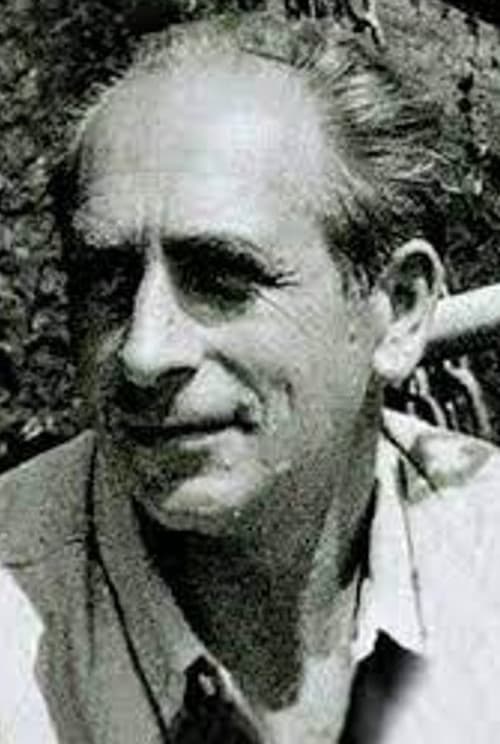
Eugène Lourié (Russian: Евгений Лурье, romanized: Yevgeniy Lur'ye; né Yevgeny Lure; 8 April 1903 – 26 May 1991) was a Russian-French filmmaker active in interwar France and postwar Hollywood. Lourié worked primarily as an art director as well as a production designer, costume designer, director, special effects director, screenwriter and actor. In 2011, Lourié was posthumously entered into the Art Directors Guild Hall of Fame.
Contents
Early years
Yevgeny Lure was born on 8 April 1903 in Kharkov, Kharkovsky Uyezd (present-day Kharkiv, Ukraine) to Russian Jewish parents. His first experience with cinema was in 1911 when a movie theater opened in Kharkov. In 1919, during the Russian Civil War, he worked on an anti-communist film titled Black Crowes.
After he fled from the Soviet Union, he made his way to Istanbul. While there he made money for a fare to Paris, by painting and drawing movie posters. He even slept in the theater on top of a piano to save money.
Career
Art director and production designer
In the 1930s, he worked as a production designer for such directors as Jean Renoir, Max Ophüls, and René Clair. As an assistant and production designer to Renoir, he worked on such French films as La Grande illusion and La Règle du Jeu. After Renoir had moved to Hollywood in the early 1940s, Lourié moved as well, and worked with other directors including Sam Fuller, Charlie Chaplin, and Robert Siodmak.
Science-fiction and special effects
In 1952, he made his directorial debut with The Beast from 20,000 Fathoms, the first of three dinosaur films that Lourié would direct. The film was profitable, but Lourié has said that he regrets that the film typecast him as a science fiction director. He decided that after his 1961 film, Gorgo, which he directed in 1959, he would stop directing movies because he did not want to direct "the same comic-strip monsters."
Eight years later, he received an Academy Award nomination for his visual effects on Krakatoa, East of Java. Lourié makes a silent cameo appearance in the film, portraying a lighthouse keeper on the coast of Java in 1883 who observes Krakatoa's final, cataclysmic explosion and enters the lighthouse to send news of it by telegraph.
He also contributed special and visual effects to Flight from Ashiya (1964) and Crack in the World (1965).
Return to art department
Throughout the 1970s, Lourié worked on TV shows like Kung Fu, The Delphi Bureau, and The Brian Keith Show. His last directorial credit was as a second unit director for the pilot episode of the notoriously-troubled Supertrain.
In 1980, Lourié designed Clint Eastwood's Bronco Billy, his last feature film credit as an art director.
Lourié had a small acting part in Richard Gere's 1983 picture Breathless, a remake of the French New Wave classic of the same name. He also appeared on an episode of Tales of the Unexpected.
Personal life
On 28 December 1940, Lourié married Laure Lourié, a French costume designer, in Bormes-les-Mimosas. Lourié was the son-in-law of the Chilean painter Manuel Ortíz de Zárate and the Polish painter Jadwiga Piechowska.
Death
Lourié died on 26 May 1991 of a stroke while in the Motion Picture and Television Hospital in Woodland Hills, Los Angeles.
