




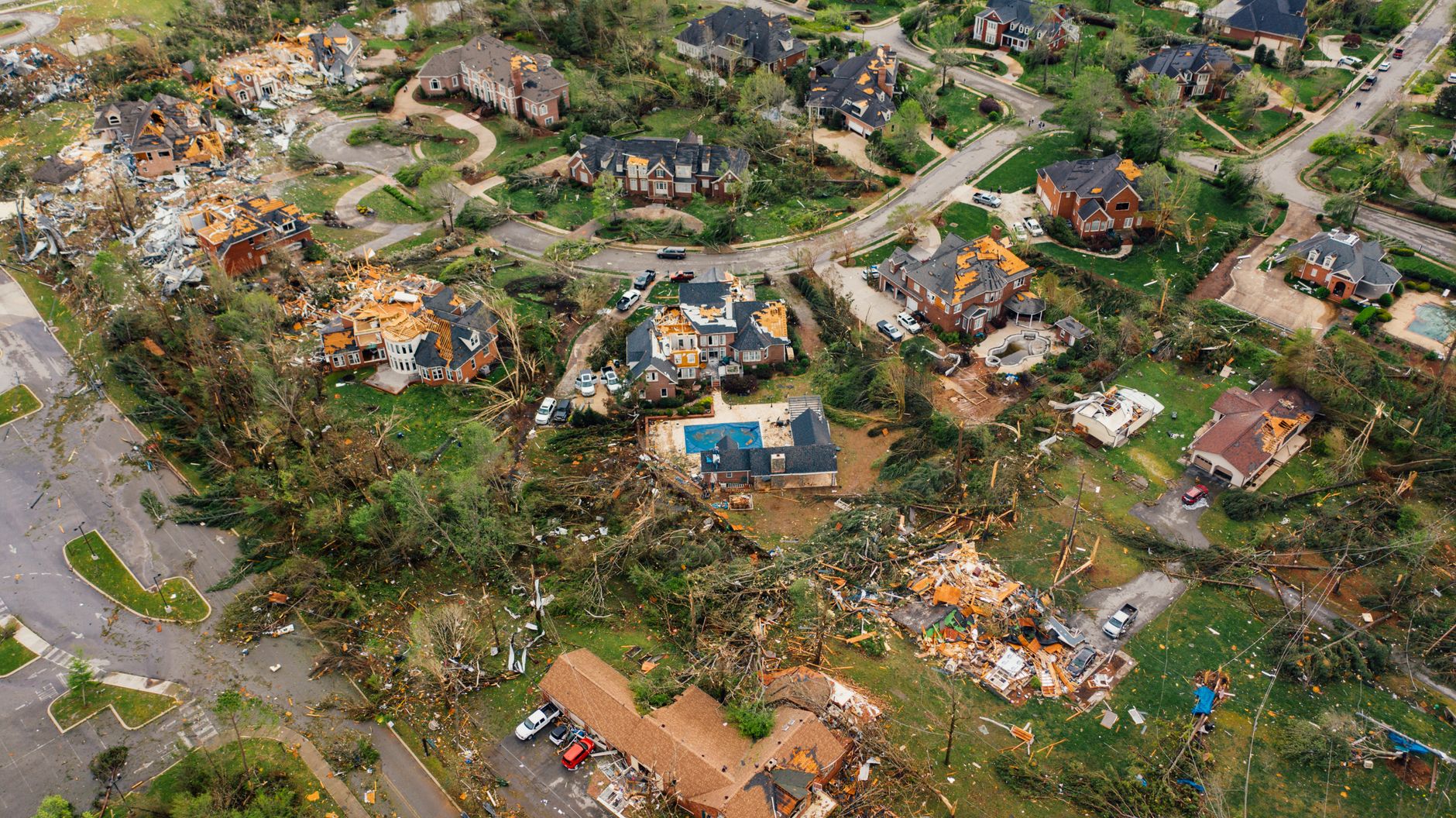
The Enhanced Fujita scale (abbreviated EF-Scale) is a scale that rates tornado intensity based on the severity of the damage a tornado causes. It is used in the United States, Brazil and France, among other countries. The EF scale is also unofficially used in other countries, including China. The rating of a tornado is determined by conducting a tornado damage survey.
The scale has the same basic design as the original Fujita scale—six intensity categories from zero to five, representing increasing degrees of damage. It was revised to reflect better examinations of tornado damage surveys, in order to align wind speeds more closely with associated storm damage. Better standardizing and elucidating what was previously subjective and ambiguous, it also adds more types of structures and vegetation, expands degrees of damage, and better accounts for variables such as differences in construction quality. An "EF-Unknown" (EFU) category was later added for tornadoes that cannot be rated due to a lack of damage evidence.
As with the Fujita scale, the Enhanced Fujita scale is a damage scale and only an estimate for actual wind speeds. While the wind speeds associated with the damage listed did not and have not undergone empirical analysis (such as detailed physical or any numerical modeling) due to expensive costs, the wind speeds were obtained through a process called expert elicitation, which was based on various engineering studies since the 1970s as well as from the field experience of meteorologists and engineers. Unlike the original Fujita scale and International Fujita scale, ratings on the Enhanced Fujita scale are based solely off the effects of 3-second gusts on any given damage indicator.
Contents
History
The Enhanced Fujita scale replaced the decommissioned Fujita scale that was introduced in 1971 by Ted Fujita. Operational use began in the United States on February 1, 2007, followed by Canada on April 1, 2013, who uses a modified version known as the CEF-scale. It has also been in use in France since 2008, albeit modified slightly by using damage indicators that take into account French construction standards, native vegetation, and the use of metric units. In Brazil, the EF Scale is used by the Reporting Platform and Voluntary Network of Severe Storm Observers (PREVOTS) since June 2018, and by other agencies since 2025. Similarly, the Japanese implementation of the scale is also modified along similar lines; the Japanese variant is referred to locally in Japan as the JEF or Japanese Enhanced Fujita Scale. The scale is also used unofficially in other countries, such as China.
The newer scale was publicly unveiled on October 4, 2004, at the American Meteorological Society's 22nd Conference on Severe Local Storms in Hyannis, Massachusetts. It was developed from 2000 to 2004 by the Fujita Scale Enhancement Project of the Wind Science and Engineering Research Center at Texas Tech University, which brought together dozens of expert meteorologists and civil engineers in addition to its own resources.
The scale was used for the first time in the United States a year after its public announcement when parts of central Florida were struck by multiple tornadoes, the strongest of which were rated at EF3 on the new scale.
In November 2022, a research paper was published that revealed a more standardized EF-scale was in the works. This newer scale is expected to combine and create damage indicators, and introduce new methods of estimating wind speeds in tornadoes. Some of these newer methods include mobile doppler radar and forensic engineering.
In 2024, Anthony W. Lyza, Matthew D. Flournoy, and A. Addison Alford, researchers with the National Severe Storms Laboratory, Storm Prediction Center, CIWRO, and the University of Oklahoma's School of Meteorology, published a paper stating, ">20% of supercell tornadoes may be capable of producing EF4–EF5 damage".
Parameters
The seven categories for the EF scale are listed below, in order of increasing intensity. Although the wind speed estimates and photographic damage examples have been updated, the damage descriptions are broadly derived from those used with the Fujita scale. In operational practice, however, damage indicators and degrees of damage are predominantly used in determining tornado intensity.
Damage indicators and degrees of damage
The EF scale currently has 28 damage indicators (DI), or types of structures and vegetation, each with a varying number of degrees of damage (DoD). Each structure has a maximum DoD value, which is given by total destruction. Lesser damage to a structure will yield lower DoD values. Wind speed estimates are divided into three categories; Lower Bound (LB), Expected (EXP), and Upper Bound (UB). EXP is the average wind speed estimate needed to cause the DoD for the "typical construction" of the DI. If the construction of the DI was better/worse than typical, the LB/UB values would be used.
Differences from the Fujita scale
The Enhanced Fujita Scale takes into account the quality of construction and standardizes different kinds of structures. The wind speeds on the original scale were deemed by meteorologists and engineers as being too high, and engineering studies indicated that slower winds than initially estimated cause the respective degrees of damage. The old scale lists an F5 tornado as wind speeds of 261–318 mph (420–512 km/h), while the new scale lists an EF5 as a tornado with winds above 200 mph (322 km/h), found to be sufficient to cause the damage previously ascribed to the F5 range of wind speeds. Tornadoes in the United States that occurred before February 1, 2007, retained their original Fujita ratings after the EF Scale was adopted.
The EF Scale retained the same 0–5 category structure as the original Fujita scale, but it changed the operational rating methodology by formalizing 28 Damage Indicators (DI) and 8 Degrees of Damage (DoD), revising the associated wind-speed estimates, and explicitly considering construction quality when evaluating damage. A linear conversion was derived to relate F-scale and EF-scale wind estimates and preserve continuity in the historical database, but tornadoes are not rated operationally by applying that formula. Different structures, depending on their building materials and ability to survive high winds, have their own DIs and DoDs. Some differences do exist between the two scales in the ratings assigned to damage. On the original Fujita scale, a tornado would generally earn an F5 rating by completely destroying and sweeping away frame homes built to typical American construction standards. On the Enhanced Fujita scale that level of damage would generally be rated as high-end EF4, requiring a house of above-standard construction to be rated EF5. A 2025 study indicated that these more rigorous standards resulted in a decrease in the percentage of tornadoes receiving F5/EF5 ratings after the implementation of the new scale. This difference in frequency disappears when high-end EF4 tornadoes, with peak estimated winds of 190–200 miles per hour (310–320 km/h), are included as "EF5 candidates."
Since the EF Scale still uses actual tornado damage and similar degrees of damage for each category to estimate the storm's wind speed, the National Weather Service states that the scale will likely not lead to an increase in the number of tornadoes classified as EF5. Additionally, the upper bound of the wind speed range for EF5 is open—in other words, there is no maximum wind speed designated.
Rating classifications
For purposes such as tornado climatology studies, Enhanced Fujita scale ratings may be grouped into classes. The National Weather Service classifies EF0 and EF1 as weak, EF2 and EF3 as strong, as EF4 and EF5 as violent. The National Weather Service also uses the EF scale to classify tornadoes with a rating of EF2 and greater as significant. The National Weather Service Quad Cities, Iowa/Illinois uses a modified EF scale wording, which gives a new term for each rating on the scale, going from weak to catastrophic.