Production
The film was shot in numerous locations in Ciudad Acuña, Coahuila, located in Northeastern Mexico adjacent to Del Rio, Texas. The film used 16 mm film and was shot in 14 days. Rodriguez had a $7,000 budget (equivalent to $16,547 in 2025), almost half of which he raised by participating in experimental clinical drug testing while living in Austin, Texas. The opening scenes, featuring a shootout in a jail, were filmed at the local Acuña jail situated on the outskirts of the town. The female warden and the male guard were the real-life warden and guard; Rodriguez thought it was convenient because it saved him the cost of hiring actors and renting clothing. The intro bar scene was shot inside the Corona Club and exterior street scenes were shot on Hidalgo Street. The shootout was filmed outside at "Boy's Town", the local red-light district.
Not everyone in Acuña was pleased with the filming. Local journalists Ramiro Gómez and Jesús López Viejo were especially critical of the filming, and to win them over, Rodriguez gave them small parts in the film. Due to the high body count of the film, Rodriguez increasingly had difficulties finding adult men to play thugs, as dead characters obviously could not return; for that reason, when the Mariachi meets Moco's gang at the end of the film, the gang consists mainly of teenagers.
On the El Mariachi DVD, Rodriguez devotes both a DVD commentary and an "Extras" section to explaining the tricks of filming a feature-length film with just $7,000. Rodriguez heavily stresses the need for cost cutting, "because if you start to spend, you cannot stop anymore." This is why he cut costs at every possible opportunity. He did not use a slate; the actors, instead, signaled the number of scene and number of take with their fingers. He did not use a dolly, and instead held the camera while being pushed around in a wheelchair. He did not use synchronised sound; rather, he shot the film silent, then recorded on-set audio so it could be synced in post-production. Professional lighting was replaced by two 200-watt clip-on desk lamps. No film crew was hired; actors not in the scenes helped out instead. Rodriguez believed in filming scenes sequentially in one long take with a single camera; every few seconds, he froze the action, so he could change the camera angle and make it appear that he used multiple cameras simultaneously. Bloopers were kept in to save film: Rodriguez is visible on a bus with the Mariachi; the Mariachi bumps his weapon into a street pole; he fails to throw his guitar case on a balcony; and Dominó twitches her face when she is already dead. Rodriguez spared expense by shooting on 16 mm film as opposed to 35 mm, and transferred the film to 3⁄4-inch video for offline editing, avoiding the costs of cutting on film. In the end, he used only 24 rolls of film and only spent $7,225 of the $9,000 he had planned.
Rodriguez gave insight into his low budget approach to simulate machine gun fire. The problem was that when using real guns, as opposed to the specially designed blank firing firearms used in most films, the blanks would jam the weapon after being fired once. To solve this, Rodriguez filmed the firing of one blank from different angles, dubbed canned machine gun sounds over it, and had the actors drop bullet shells to the ground to make it look like as if multiple rounds had been shot. In addition, he occasionally used water guns instead of real guns to save money. The squibs used in shootout scenes were simply condoms filled with fake blood and fixed over weightlifting belts.
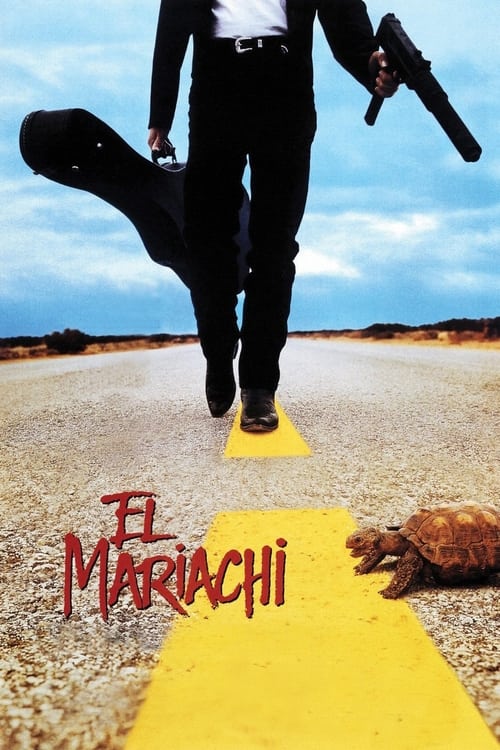
Several aspects of the film were improvised. The tortoise that crawls in front of the Mariachi was not planned, but was kept in anyway. Similarly, there is a scene in which the Mariachi buys a coconut, but Rodriguez forgot to show him paying for the fruit; instead of driving back to the place to shoot additional scenes, Rodriguez decided to build in a voice-over in which the Mariachi asserts that the coconuts were for free. Improvisation was also useful to cover up continuity mistakes: at the end of the movie, the Mariachi has his left hand shot, but Rodriguez forgot to bring the metal glove to cover up the actor's hand; he solved it by packing his hand with black duct tape.
In the DVD commentary, Rodriguez describes the acting of Peter Marquardt who portrayed gangster boss Moco. As the language of the film was Spanish, which Marquardt did not master, he had to learn his lines without understanding what he was saying. Rodriguez describes the running gag in which Moco strikes a match using the stubble of his henchman Bigotón as a means to start and end the film: after Moco is killed, Bigotón does the same to him. When Moco was hit in the chest in the final shooting, Marquardt's blood squib exploded with such force that he actually crumpled to the ground in pain.
Originally, the film was meant to be sold on the Latino video market as funding for another bigger and better project that Rodriguez was contemplating. However, after being rejected from various Latino straight-to-video distributors, Rodriguez decided to send his film (it was in the format of a trailer at the time) to bigger distribution companies where it started to get attention.
When the sequel Desperado was produced, Antonio Banderas replaced Gallardo as the actor for the main character of the series. The filmmakers re-shot the final showdown from El Mariachi as a flashback sequence for Banderas' character in Desperado.