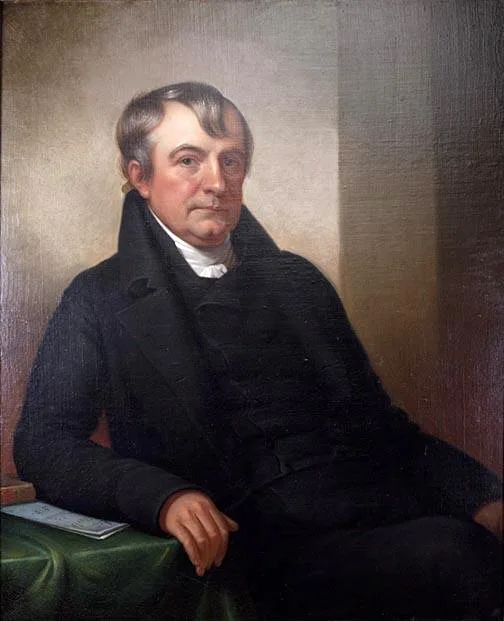
Overview
Edward Johnson (1767 – 1829) was an American politician and businessman. He was a native of Baltimore, Maryland and served as that city's mayor for six terms between 1808 and 1824. A staunch member of Jefferson's Democratic-Republican Party, he led Baltimore during the War of 1812 and was instrumental in organizing the civilian defense of the city. For several years he was the owner of one of Baltimore's largest breweries and also served as a director of the Bank of Baltimore.
Biography
Johnson was born in Baltimore in 1767, the son of a prominent physician in that city. Little is known about his early life, and many 19th and early 20th century biographies have mistakenly referred to him as a doctor, confusing him with his father who was also named Edward Johnson. In 1797, he was elected to the City Council, a requirement for which was ownership of property assessed at a minimum of $2000, a very large sum in those days. His occupation in 1798 was listed as "brewer". Johnson's sister Rebecca had married brewery owner Thomas Peters in 1783. Johnson's father later became a partner in his son-in-law's business. When Dr. Johnson died in 1797, Edward Johnson took over his father's share in the company, eventually becoming its sole owner by 1807.<ref>The exact dates for the various changes of ownership are unclear. A contemporary account of a fatal accident involving one of the brewery's draymen in 1803 gives "Peters and Johnson" as the name of the brewery. See Griffith, Thomas Waters (1833) Annals of Baltimore"], p. 177. According to Flowers (June 16, 1983) by 1807 the brewery was advertised as "Edward Johnson and Company".</ref>
Fiercely anti-British and a member of Thomas Jefferson's Democratic-Republican party, Johnson was elected Baltimore's third mayor in 1808. A triumphal victory parade took place to celebrate his election with Johnson on board a horse-drawn boat on wheels. A bonfire was lit on Gallows Hill, and "to give its flame a brighter glow", six large casks of imported gin from Holland (on which England had exacted tax) were thrown onto it. He was subsequently re-elected in 1810, 1812, and 1814. (At the time, the mayor's term of office was only two years.) He remained in the brewery business during his first two terms as mayor. However, the brewery burnt down in 1812 and after he had it rebuilt in 1813 he sold it to George Brown.
From Wikipedia (CC BY-SA 4.0).