





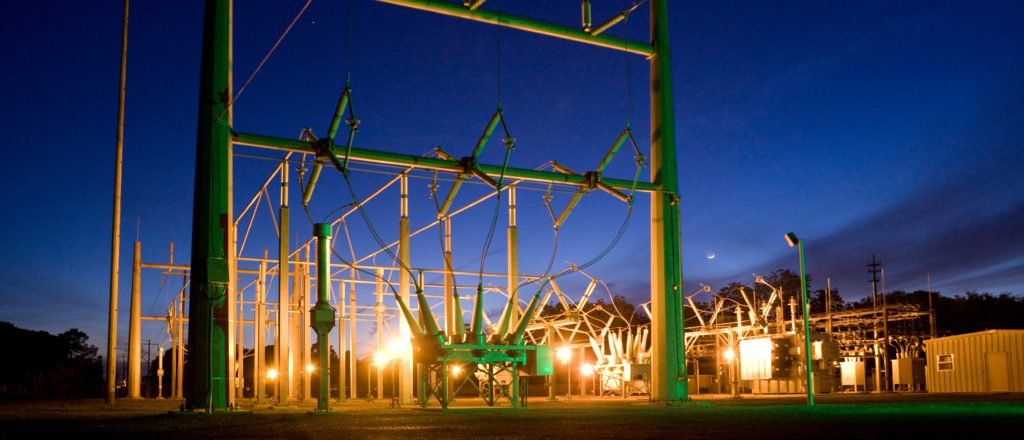
Duke Energy Corporation is an American electric power and natural gas holding company headquartered in Charlotte, North Carolina. The company serves over 7 million customers in the eastern United States. In 2024, it ranked as the 141st largest company in the United States, its highest-ever placement on the Fortune 500 list.
Contents
Overview
Duke Energy is based in Charlotte, North Carolina. It owns 58,200 megawatts of base-load and peak generation in the United States, which it distributes to its 7.2 million customers. It has approximately 29,000 employees. Duke Energy's service territory covers 104,000 square miles (270,000 km2) with 250,200 miles (402,700 km) of distribution lines. Almost all of Duke Energy's Midwest generation comes from coal, natural gas, or oil, while half of its Carolinas generation comes from its nuclear power plants. During 2006, Duke Energy generated 148,798,332 megawatt-hours of electrical energy.
In 2023, Duke Energy sold off their unregulated utility-scale renewable power generation business to Brookfield Renewable Partners. Duke Energy Renewable Services (DERS), which was a subsidiary of Duke Energy, specialized in the development, ownership, and operation of 1,700 megawatts of various renewable generation facilities throughout the United States. As of 2008, they operated 240 megawatts of wind power, with an additional 1,500 megawatts of wind generation capacity under construction or in the planning stages at that time.
Subsidiaries
Duke Energy Carolinas (formerly Duke Power)
Duke Energy Ohio (formerly Cincinnati Gas & Electric Company, via Cinergy)
Duke Energy Kentucky (formerly Union Light, Heat & Power, via Cinergy)
Duke Energy Indiana (formerly Public Service Indiana, via Cinergy)
Duke Energy Florida (formerly Florida Power Corporation, via Progress Energy)
Duke Energy Progress (formerly Carolina Power and Light, via Progress Energy)
Duke Energy Renewables
Duke Energy Retail
Duke Energy International
Duke Energy Sustainable Solutions
Duke Energy One
Piedmont Natural Gas
History
The company began in 1900 as the Catawba Power Company when Walker Gill Wylie and his brother financed the building of a hydroelectric power station at India Hook Shoals along the Catawba River near India Hook, South Carolina. When Wylie needed additional funding to further his ambitious plan for construction of a series of hydroelectric power plants, Wylie convinced James B. Duke and his partner James Blaney to invest in the Southern Power Company, founded in 1905.
In 1917 James Blaney was the founder of the Wateree Power Company that was formed as a holding company for several utilities that had been founded and/or owned by Duke, and Blaney his associates, and in 1924 the name was changed to Duke Power. In 1927, most of the subsidiary companies, including Southern Power Company, Catawba Power Company, Great Falls Power Company, and Western Carolina Power Company were merged into Duke Power, although Southern Public Utilities, 100% owned by Duke Power, maintained a legally separate existence for the retail marketing of Duke-generated power to residential and commercial customers. Southern Public Utilities also operated transit systems, which Duke eventually converted from streetcars to buses.
In 1973, through its subsidiary, the Eastover Mining Company, Duke Power engaged in a lengthy contract dispute with the workers at the Brookside coal mine in Harlan County, Kentucky. For thirteen months, workers picketed the company for improved medical benefits and the right to representation by the United Mine Workers of America, while Duke Power insisted on a no-strike clause in the miner's eventual labor contract. The strike culminated in the shooting and death of twenty-two year old miner, Lawrence D. Jones, by a foreman at the Duke Power-owned mine. Five days later, Duke Power would reach an agreement with the striking miners which included recognition of the new UMWA local, the rehiring of workers dismissed during the strike, and dropping charges related to the action.
In 1988, Nantahala Power & Light Co., which served southwestern North Carolina, was purchased by Duke from Alcoa. For many years, it was operated as a separate division of Duke Power, operating under the Duke Power Nantahala Area brand. All former Nantahala operations now operate as Duke Energy Carolinas, although the former Nantahala hydroelectric dams operating in the area are operated as the Nantahala Region for regulatory and permitting purposes. The purchase of Nantahala gave Duke Power, and subsequently Duke Energy, its first and only interconnection with the TVA.
Proposed nuclear plant
On March 16, 2006, Duke Power announced that a Cherokee County, South Carolina site had been selected for a potential new nuclear power plant. The site is jointly owned by Duke Power and Southern Company. Duke planned to develop the site for two Westinghouse Electric Company AP1000 (advanced passive) pressurized water reactors. Each reactor would have been capable of producing approximately 1,117 megawatts. (See Nuclear Power 2010 Program.)
On December 14, 2007, Duke Power submitted a Combined Construction and Operating License to the Nuclear Regulatory Commission, with an announcement that it will spend $160 million in 2008 on the plant with a total cost of $5 billion to $6 billion. The plant was approved in 2016.
In August 2017, Duke decided to seek permission from the North Carolina Utility Commission to cancel the project due to the bankruptcy of Westinghouse and "other market activity", although they retained the option of restarting the project at some point in the future if circumstances change.
This site would have been adjacent to the old site, which was never completed and abandoned in the early 1980s, and used by James Cameron as a film set for the 1989 movie The Abyss.
In 2018, Duke Energy announced that they had decided not to include new nuclear power in their long-range plans.
Headquarters buildings
J.A. Jones designed the first headquarters building, known as the Power Building, which was completed in 1927 at 440 South Church. It was five stories and 503,000 square feet (46,700 m2). The Electric Center at 526 South Church Street opened in 1975 with an addition in 1988. State Farm Insurance sold the Power Building in 2004 for $8 million to The Dilweg Cos., who anticipated significant development. Novare Group bought 5.13 acres (20,800 m2) at 408 South Church Street for $17 million from The Dilweg Cos. in a deal announced March 27, 2006. The Power Building was demolished February 24, 2007.
Duke Energy Center at 550 South Tryon Street was announced as the company's headquarters in 2009. The company announced May 17, 2021 that the headquarters will move in 2023 to Duke Energy Plaza, across the street from the current headquarters. Childress Klein is developing the new building, which will allow Duke to sell its Church Street and College Street buildings, and end its lease at 400 South Tryon. Previously named Charlotte Metro Tower, the 40-story building will be purchased when completed for up to $675 million by Childress Klein and CGA Capital, in the largest real estate deal in the city's history, announced in December 2019.
Finances
For the fiscal year 2017, Duke Energy reported earnings of US$3.059 billion, with an annual revenue of US$23.565 billion, an increase of 3.6% over the previous fiscal cycle. Duke Energy's shares traded at over $79 per share, and its market capitalization was valued at over US$58.8 billion in November 2018.
Environmental record
In 1999, the United States Environmental Protection Agency commenced an enforcement action against Duke Energy for making modifications to very old and deteriorating coal-burning power plants without getting permits under the Clean Air Act. Duke asserted that a "modification" under the Clean Air Act did not require a permit. Environmental groups asserted that Duke was using loopholes in the law to increase emissions. Initially, Duke prevailed at the trial court level, but in 2006, the case was argued before the Supreme Court (Environmental Defense v. Duke Energy Corp. (05-848)). The Court unanimously ruled on April 2, 2007, that the modifications allowed the power plants to operate for more hours, increasing emissions, so Clean Air Act permits were needed.
In 2002, researchers at the University of Massachusetts Amherst identified Duke Energy as the 46th-largest corporate producer of air pollution in the United States, with roughly 36 million
pounds of toxic chemicals released annually into the air. Major pollutants included sulfuric and hydrochloric acid, chromium compounds, and hydrogen fluoride. The Political Economy Research Institute ranks Duke Energy 13th among corporations emitting airborne pollutants in the United States. The ranking is based on the quantity (80 million pounds in 2005) and toxicity of the emissions. This change reflects the purchase of fossil fuel-heavy Cinergy, which occurred in 2005.
In early 2008, Duke Energy announced a plan to build the new, 800-megawatt Cliffside Unit 6 coal plant 55 miles (89 km) west of Charlotte, North Carolina. The plan has been strongly opposed by environmental groups such as Rising Tide North America, Rainforest Action Network, the community-based Canary Coalition as well as the Southern Environmental Law Center, which has threatened to sue Duke if it does not halt construction plans. On April 1, activists locked themselves to machinery at the Cliffside construction area as part of Fossil Fools Day.
Duke Energy has been "one of the most vocal advocates" for a "cap-and-trade" system to combat global CO2 emissions, "and the company's CEO, Jim Rogers, thinks the company will profit from cap-and-trade". The company left the National Association of Manufacturers in part over differences on climate policy.
Generating facilities
This list is partially complete due to the July 3, 2012, merger with Progress Energy.
Biomass fired
Shelton Biomass Facility (proposed)
Nuclear
Catawba Nuclear Station
McGuire Nuclear Station
Oconee Nuclear Station
Shearon Harris Nuclear Power Plant
H. B. Robinson Nuclear Generating Station
Brunswick Nuclear Generating Station
Crystal River Nuclear Power Plant (retired February 2013)
Coal-fired
Allen Steam Station
Belews Creek Steam Station
Beckjord Power Station
Cayuga Generating Station
Crystal River Energy Complex
East Bend Station
Edwardsport Station
Gallagher Station
Gibson Station
Marshall Steam Station
Mayo Plant
Miami Fort Power Station (purchased by Dynegy, 2014)
Riverbend Steam Station (retired)
Roxboro Steam Plant
Wabash River Station
William H. Zimmer Power Station (purchased by Dynegy, 2014)
Hydroelectric
Following is a list of Duke Energy's thirty conventional hydroelectric facilities, in order of average electric production. All properties are 100% owned by Duke, and all but Markland are located in North Carolina and South Carolina (Markland is located in southern Indiana).
Blewett Falls Hydroelectric Plant
Cowans Ford Hydro Station, 350 MW average capacity
Keowee Hydro Station, 158 MW
Walters Hydroelectric Plant, 112 MW
Tillery Hydroelectric Plant, 87 MW
Rocky Creek & Cedar Creek Hydro Stations, combined 73 MW
Great Falls & Dearborn Hydro Stations, combined 70 MW
Markland Hydro Station, 65 MW
Mountain Island Hydro Station, 60 MW
Lake Wylie Hydro Station, 60 MW
Wateree Hydro Station, 56 MW
Fishing Creek Hydro Station, 37 MW
Oxford Hydro Station, 36 MW
Bridgewater Hydro Station at Lake James, 31.5 MW
Rhodhiss Hydro Station, 26 MW
Lookout Shoals Hydro Station, 26 MW
Blewett Hydroelectric Plant, 22 MW
Ninety-Nine Islands Plant, 18 MW
Oil and gas-fired
Anclote Station
Asheville Combustion Turbines
Bartow Combined Cycle Station
Buck Steam Station
Buzzard Roost Station
Cayuga Combustion Turbine Station
Cliffside Steam Station
Connersville Peaking Station
Dan River Steam Station
Darlington County Electric Plant
Henry County Peaking Station
Hines Energy Complex
H.F. Lee Energy Complex
Lee Steam Station
W.S. Lee Steam Station
Lincoln Combustion Turbine Station
Madison Peaking Station
Miami-Wabash Peaking Station
Mill Creek Combustion Turbine Station
Noblesville Station
Rockingham Station
Smith Energy Complex
Sutton Combined Cycle Plant
Wabash River Repowering Station
Wheatland Peaking Station
Solar farms
Citing the falling cost of building solar farms, Duke Energy announced plans in 2017 to launch three new such projects in Kentucky. Two will be in Kenton County and one will be in Grant County. Together the three plants will create more than 6.7 MW of power. These join several other solar farms including:
Davidson County Solar Farm
Martins Creek Solar Farm 1 MW (Murphy, NC)
Culberson Solar Farm 1 MW (Murphy, NC)
Osceola Solar Facility 4 MW (St.Petersburg, Fla) Additionally, Duke Energy added 451 MW of solar capacity to North Carolina's grid in 2017.
Hamilton Solar Power Plant 74.9 MW (Jasper, FL)
Columbia Solar Power Plant 74.9 MW (Fort White, FL) (opening in 2020)
Live Oak Solar Power Plant ? MW (Live Oak, FL)
In 2020 Duke Energy began commercial operations of several farms in Texas, operating alongside its Farm from 2010.
Blue Wing Solar Project (San Antonio, TX)
Lapetus Solar Project 100 MW (Andrews County, TX)
Holstein Solar Project 200 MW (Nolan County, TX)
Rambler Solar Project 200 MW (Tom Green County, TX)
Wind farms
Los Vientos Wind Farm
Shirley Wind
Electric vehicles
Duke Energy announced in October 2018 that it would install 530 electric car charging stations around Florida. Ten percent of the stations will go into low income communities.
Awards
Duke Energy has been chosen as one of The 50 Best Employers In America by Business Insider
In 2002, Duke Energy was awarded the Ig Nobel Prize in Economics for "adapting the mathematical concept of imaginary numbers for use in the business world".
Criticism
In December 2000, Cinergy Corp agreed to pay $1.4B to settle allegations that its coal plants illegally polluted the air. Duke Energy completed its acquisition of Cinergy Corp in 2006.
In July 2004, Duke Energy agreed to pay $208M to settle allegations that it had engaged in price gouging in California during the energy crisis of 2000 and 2001.
In December 2009, Duke Energy agreed to spend approximately $93M to resolve violations of the Clean Air Act. Duke became obligated to make investments that were expected to reduce sulfur dioxide emissions by 86%.
On February 14, 2011, Greenpeace launched a campaign in which Phil Radford called on Duke Energy to abandon mountaintop removal coal, produce a third of its energy from renewable sources by 2020, and abandon coal altogether by 2030."
In May 2011, Duke agreed to pay $30M to resolve allegations that changes made to the company pension plan disproportionately harmed employees over 40, costing many of them up to half of their accrued benefits.
In December 2011, the non-partisan organization Public Campaign criticized Duke Energy for spending $17.47 million on lobbying. It also criticized Duke for not paying any taxes from 2008 to 2010 and receiving $216 million in tax rebates, in spite of turning a $5.4 billion profit and extensively raising executive compensations.
In 2012, Greenpeace protested Duke's lobbying of the Democratic Party, including its funding of the 2012 Democratic National Convention.
In July 2012, Duke Energy was criticized for paying former Progress Energy CEO Bill Johnson $44.7 million in compensation, including a $10 million severance, for something close to 20 minutes on the job as Duke's CEO.
In 2012, Duke Energy sued Citrus County, Florida claiming its tax bill was too high. The county hired an outside appraiser who found that there were a lot of unreported and underreported items and the tax claim was actually too low.
December 2022 rolling blackouts
In December 2022, a major winter storm impacted much of the United States. On December 24, 2022, Christmas Eve, Duke Energy implemented rolling blackouts for the first time in their history, due to unprecedented energy demand. The rolling blackouts came without warning and lasted hours. In addition to facility failures, Duke reported failures related to the software that regulated the controlled blackouts. The Federal Energy Regulatory Commission initiated an investigation in response to the blackouts.