1968–1979: The Godfather films and stardom with Annie Hall
In 1968, Keaton became an understudy for the part of Sheila in the original Broadway production of Hair. She gained some notoriety for her refusal to disrobe at the end of Act I when the cast performs nude, even though nudity in the production was optional for actors (those who performed nude received a $50 bonus). After acting in Hair for nine months, she auditioned for a part in Woody Allen's production of Play It Again, Sam. After nearly being passed over for being too tall (at 5 ft 8 in (173 cm) she was 2 inches (5 cm) taller than Allen) she won the part. She went on to receive a Tony Award nomination for Best Featured Actress in a Play for her performance.
In 1970, Keaton appeared in a deodorant commercial for Hour After Hour. That same year, she made her film debut in Lovers and Other Strangers. She followed with guest roles on the television series Love, American Style; Night Gallery; and Mannix.
Keaton's breakthrough role came two years later when she was cast as Kay Adams, the girlfriend and eventual wife of Michael Corleone (played by Al Pacino) in Francis Ford Coppola's 1972 film The Godfather. Coppola noted that he first noticed Keaton in Lovers and Other Strangers, and cast her because of her reputation for eccentricity that he wanted her to bring to the role (Keaton claimed that at the time she was commonly referred to as "the kooky actress" of the film industry). Her performance in the film was loosely based on her real-life experience of making the film, both of which she described as being "the woman in a world of men." The Godfather was an unparalleled critical and financial success, becoming the highest-grossing film of the year and winning the 1972 Academy Award for Best Picture. She reprised her role as Kay Adams in The Godfather Part II (1974). She was initially reluctant, saying, "At first, I was skeptical about playing Kay again in the Godfather sequel. But when I read the script, the character seemed much more substantial than in the first film." In Part II, her character changed dramatically, becoming more embittered about her husband's criminal empire. Even though Keaton received widespread exposure from the films, some critics felt that her character's importance was minimal. Time wrote that she was "invisible in The Godfather and pallid in The Godfather Part II, but according to Empire magazine, Keaton "proves the quiet lynchpin which is no mean feat in [the] necessarily male dominated films."
Keaton's other notable films of the 1970s included many collaborations with Woody Allen. She played many eccentric characters in several of his comic and dramatic films, including Sleeper; Love and Death; Interiors; Manhattan; Manhattan Murder Mystery and the film version of Play It Again, Sam, directed by Herbert Ross. Allen credited Keaton as his muse during his early film career. In 1976, Keaton starred Off-Broadway in the world premier of the Israel Horovitz play Primary English Class at Circle in the Square Theatre. The New York Times review noted, "Keaton gives a delightful portrait of a woman sinking slowly out of control."
In 1977, Keaton won the Academy Award for Best Actress for Allen's romantic comedy-drama Annie Hall, one of her most famous roles. Annie Hall, written by Allen and Marshall Brickman and directed by Allen, was believed by many to be an autobiographical exploration of his relationship with Keaton. Allen based the character of Annie Hall loosely on Keaton ("Annie" was a nickname of hers, and "Hall" was her original surname). Many of Keaton's mannerisms and self-deprecating sense of humor were added into the role by Allen. (Director Nancy Meyers has claimed: "Diane's the most self-deprecating person alive.") Keaton also said that Allen wrote the character as an "idealized version" of herself. The two starred as a frequently on-again, off-again couple living in New York City. Her acting was later summed up by CNN as "awkward, self-deprecating, speaking in endearing little whirlwinds of semi-logic", and by Allen as a "nervous breakdown in slow motion." Annie Hall emerged as a major critical and commercial success and won the Academy Award for Best Picture. Of Keaton's performance, feminist film critic Molly Haskell wrote, "Keaton took me by surprise in Annie Hall. Here she blossomed into something more than just another kooky dame—she put the finishing touches on a type, the anti-goddess, the golden shiksa from the provinces who looks cool and together, who looks as if she must have a date on Saturday night, but has only to open her mouth or gulp or dart spastically sideways to reveal herself as the insecure bungler she is, as complete a social disaster in her own way as Allen's horny West Side intellectual is in his." In 2006, Premiere magazine ranked Keaton in Annie Hall 60th on its list of the "100 Greatest Performances of All Time", and noted:
It's hard to play ditzy... The genius of Annie is that despite her loopy backhand, awful driving, and nervous tics, she's also a complicated, intelligent woman. Keaton brilliantly displays this dichotomy of her character, especially when she yammers away on a first date with Alvy (Woody Allen), while the subtitle reads, 'He probably thinks I'm a yoyo.' Yo-yo? Hardly.
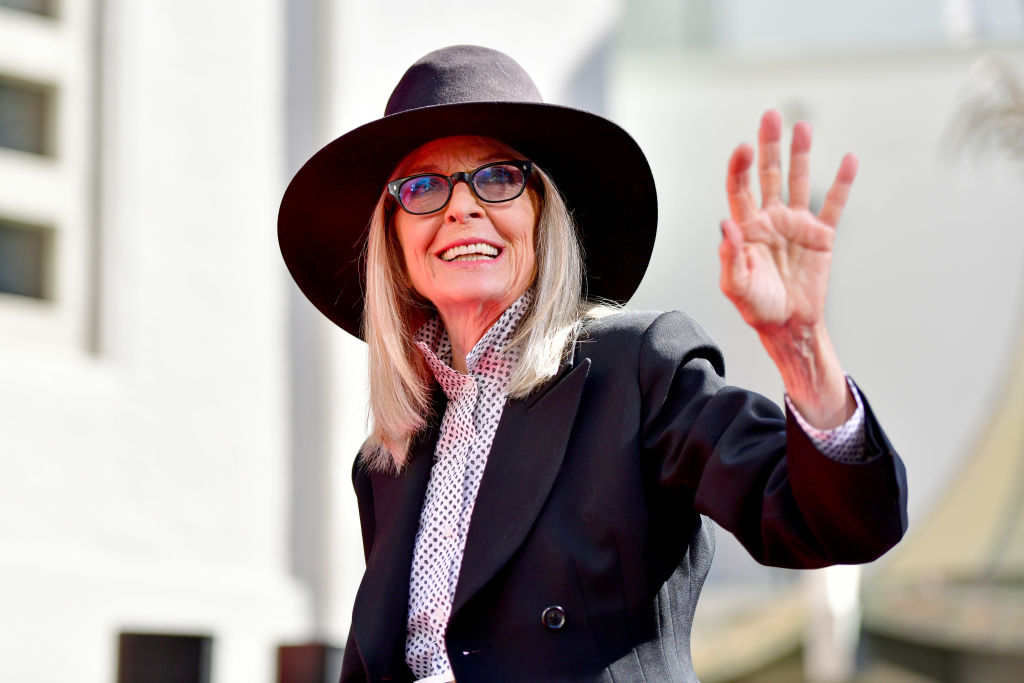
Keaton's eccentric wardrobe in Annie Hall, which consisted mainly of vintage men's clothing, including neckties, vests, baggy pants, and fedora hats, made her an unlikely fashion icon of the late 1970s. A small amount of the clothing seen in the film came from Keaton herself, who was already known for her tomboyish clothing style years before Annie Hall, and Ruth Morley designed the film's costumes. Soon after the film's release, men's clothing and pantsuits became popular attire for women. She was known to favor men's vintage clothing, and usually appeared in public wearing gloves and conservative attire. (A 2005 profile in the San Francisco Chronicle described her as "easy to find. Look for the only woman in sight dressed in a turtleneck. On a 90-degree afternoon in Pasadena.")
Her photo by Douglas Kirkland appeared on the cover of the September 26, 1977, issue of Time magazine, with the story dubbing her "the funniest woman now working in films." Later that year she departed from her usual lighthearted comic roles when she won the highly coveted lead role in the drama Looking for Mr. Goodbar, based on the novel by Judith Rossner. In the film, written and directed by Richard Brooks, she played a Catholic schoolteacher for deaf children who lives a double life, spending nights frequenting singles bars and engaging in promiscuous sex. Keaton became interested in the role after seeing it as a "psychological case history." The same issue of Time commended her role choice and criticized the restricted roles available for female actors in American films:
A male actor can fly a plane, fight a war, shoot a badman, pull off a sting, impersonate a big cheese in business or politics. Men are presumed to be interesting. A female can play a wife, play a whore, get pregnant, lose her baby, and, um, let's see ... Women are presumed to be dull. ... Now a determined trend spotter can point to a handful of new films whose makers think that women can bear the dramatic weight of a production alone, or virtually so. Then there is Diane Keaton in Looking for Mr. Goodbar. As Theresa Dunn, Keaton dominates this raunchy, risky, violent dramatization of Judith Rossner's 1975 novel about a schoolteacher who cruises singles bars.
In addition to acting, Keaton said she "had a lifelong ambition to be a singer." She had a brief, unrealized career as a recording artist in the 1970s. Her first record was an original cast recording of Hair, in 1971. In 1977 she began recording tracks for a solo album, but the finished record never materialized.
Keaton met with more success in the medium of still photography. Like her character in Annie Hall, Keaton had long relished photography as a favorite hobby, an interest she picked up as a teenager from her mother. While traveling in the late 1970s, she began exploring her avocation more seriously. "Rolling Stone had asked me to take photographs for them, and I thought, 'Wait a minute, what I'm really interested in is these lobbies, and these strange ballrooms in these old hotels.' So I began shooting them", she recalled in 2003. "These places were deserted, and I could just sneak in anytime and nobody cared. It was so easy and I could do it myself. It was an adventure for me." Reservations, her collection of photos of hotel interiors, was published in book form in 1980.