Principal photography
Production began in the late summer of 1976. Although the film was set in Texas, the Rocky Mountains are incongruously seen in the exteriors shot in southwestern Alberta in and around the ghost town of Whiskey Gap, located 4 kilometres (2.5 mi) from the Montana border, while the denouement was shot on the grounds of Heritage Park Historical Village in Calgary.
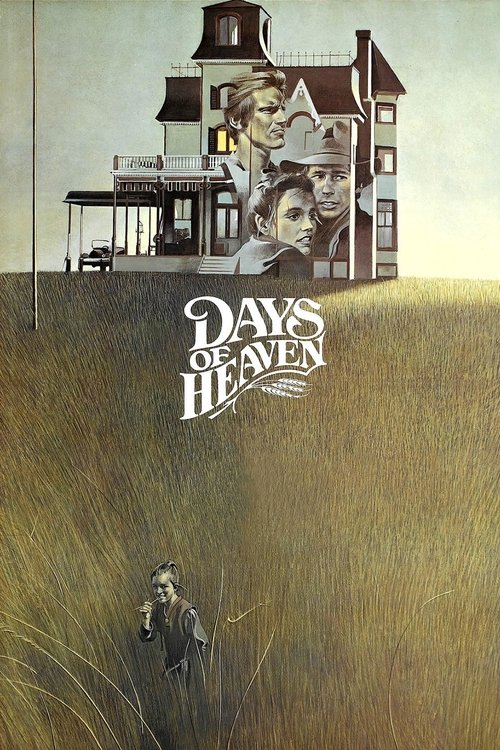
Jack Fisk designed and built the mansion from plywood in the wheat fields and the smaller houses where the workers lived. The mansion was not a facade, as was usually the custom, but authentically recreated inside and out with period colors: brown, mahogany, and dark wood for the interiors. Patricia Norris designed and made the period costumes from used fabrics and old clothes to avoid the artificial look of studio-made costumes.
According to Almendros, the production was not "rigidly prepared", allowing for improvisation. Daily call sheets could have been more detailed, and the schedule changed to suit the weather. This upset some Hollywood crew members not used to working this way. Most crew members were used to a "glossy style of photography" and felt frustrated because Almendros did not give them much work. Daily, he asked them to turn off the lights they had prepared for him. Some crew members said that Almendros and Malick did not know what they were doing. The tension led to some of the crew quitting the production. Malick supported what Almendros was doing and pushed the film's look further, removing more lighting aids and leaving the image bare.
Due to union regulations, Almendros was not allowed to operate the camera. With Malick, he would plan out and rehearse the camera's and the actors' movements. Almendros would stand near the main camera and give instructions to the camera operators. Almendros was gradually losing sight by the time shooting began. To evaluate his set-ups, "he had one of his assistants take Polaroids of the scene, then examined them through powerful glasses". According to Almendros, Malick wanted "a very visual movie. The story would be told through visuals. Very few people really want to give that priority to image. Usually the director gives priority to the actors and the story, but here the story was told through images".
Much of the film was shot during magic hour, which Almendros called "a euphemism, because it's not an hour but around 25 minutes at the most. It is the moment when the sun sets, and after the sun sets and before it is night. The sky has light, but there is no actual sun. The light is very soft, and there is something magic about it. It limited us to around twenty minutes a day, but it did pay on the screen. It gave some kind of magic look, a beauty and romanticism." Lighting was integral to filming, and helped evoke the painterly quality of the landscapes in the film. A vast majority of the scenes were filmed late in the afternoon or after sunset, with the sky silhouetting the actor's faces, which would otherwise be difficult to see. Interior scenes that feature light coming in from the outside were shot using artificial light to maintain the consistency of that intruding light. However, the "magic look" also extended to interior scenes, which occasionally used natural light.
For the "locusts" sequence, the filmmakers dropped peanut shells from helicopters to simulate a swarm of insects. To cause the swarm to seem to rise from a field, the director told actors to walk backward as the shells fell to the ground. The finished footage was run in reverse, creating an image of people walking forward as a locust swarm rose from the field. For close-ups and insert shots, thousands of live locusts were used which had been captured and supplied by Canada's Department of Agriculture.
While the photography yielded the director satisfactory results, the rest of the production was difficult. The actors and crew reportedly viewed Malick as cold and distant. After two weeks of shooting, Malick was so disappointed with the dailies, he "decided to toss the script, go Leo Tolstoy instead of Fyodor Dostoyevsky, wide instead of deep [and] shoot miles of film with the hope of solving the problems in the editing room."
The harvesting machines constantly broke down, which resulted in shooting beginning late in the afternoon, allowing for only a few hours of light before it was too dark to go on. One day, two helicopters were scheduled to drop peanut shells to simulate locusts on film; however, Malick decided to shoot period cars instead. He kept the helicopters on hold at great cost. Production needed to catch up, with costs exceeding the $3,000,000 budget by about $800,000, and Schneider had already mortgaged his home to cover the overages.
The production ran so late that both Almendros and camera operator John Bailey had to leave due to a prior commitment on François Truffaut's The Man Who Loved Women (1977). Almendros approached cinematographer Haskell Wexler to complete the film. They worked together for a week so that Wexler could get familiar with the film's visual style.
Wexler was careful to match Almendros' work, but he did make some exceptions. "I did some hand held shots on a Panaflex", he said, "[for] the opening of the film in the steel mill. I used some diffusion. Nestor didn't use any diffusion. I felt very guilty using the diffusion and having the feeling of violating a fellow cameraman." Although half the finished picture was footage shot by Wexler, he received only credit for "additional photography", much to his chagrin. The credit denied him any chance of an Academy Award for his work on Days of Heaven. Wexler sent film critic Roger Ebert a letter "in which he described sitting in a theater with a stop-watch to prove that more than half of the footage" was his. Later in life, however, he had accepted Almendros receiving credit as cinematographer:
I thought, "Well, God damn it. I should get credit with Nestor on it." And then I had talks with the producer, Bert Schneider, and he said, "Look, you've won Oscars already. What the hell, Nestor should have it." So then I said to myself, "Well, Haskell, you're being a little selfish." And the real thing that convinced me not to say anything ... was that Nestor set the tone of the film. It was actually me maintaining his style to a certain extent, so if there was to be an award, which we didn't know there would be, he should get it. And I'm so happy now—particularly since he is no longer with us—that that happened.